Film Production Courses: What They Teach, What They Miss (2026)
Feb 21, 2026


Film production courses teach you how to make films. Most of them do not teach you how to run a production. There is a difference, and it matters more than most aspiring producers realize before they take on their first real project.
Cinematography, directing, screenwriting, editing, these are craft skills, and there are excellent courses for all of them. But the skills that determine whether a production finishes on time and on budget, budgeting, cost reporting, expense management, crew contracts, insurance, and cash flow, get far less attention in formal film education, and almost none in most online courses.
This guide covers the film production course landscape: what types of courses exist, which platforms and programs are worth your time, and what practical production management skills you should seek out or teach yourself alongside any course you take.
Types of Film Production Courses
Film production education falls into several distinct categories, each serving a different stage of career and learning style:
Formal Degree Programs
Four-year BFA or BA programs at universities and film schools (USC, NYU Tisch, UCLA, AFI, NYFA) provide the most comprehensive education in filmmaking craft. They typically include production practica where students crew each other's films, building real set experience alongside classroom instruction.
The main limitations: cost (tuition at major film programs runs $40,000-$75,000+ per year), time (four years), and a curriculum weighted toward narrative filmmaking craft rather than production management and finance.
Graduate and Certificate Programs
MFA programs and certificate programs (UCLA Extension, AFI Conservatory, American Film Institute) offer more focused, shorter-duration options. UCLA Extension's Entertainment Studies department, for example, offers individual courses in producing, line producing, and production management that working professionals take alongside day jobs.
Certificate programs typically run 6-18 months and focus on specific disciplines. For producers, the line producing and production management certificates at schools like UCLA Extension and New York Film Academy are more relevant than general filmmaking certificates.
Online Course Platforms
The fastest-growing segment. Platforms including Coursera, MasterClass, Skillshare, Filmmakers Academy, and FilmSkills offer self-paced courses taught by working professionals and recognized filmmakers. Cost ranges from free to a few hundred dollars per course, making them accessible to filmmakers at any budget level.
Quality varies significantly. The best online courses (Filmmakers Academy's cinematography courses, Sundance Collab's producing courses) are taught by working industry professionals with real production credits. The weakest are general "how to make a film" overviews with little practical depth.
Workshops and Intensives
Short-format immersive programs (one week to three months) run by film schools, festivals, and industry organizations. Sundance Collab, IFP (Independent Filmmaker Project), Film Independent, and regional film commissions all offer workshops in producing, directing, and screenwriting.
Workshops are valuable for networking as much as instruction, you work alongside other filmmakers at a similar stage, build professional relationships, and often get access to mentors who work in the industry.
Best Film Production Courses for Producers (2026)
If your goal is to produce, to oversee a production from development through delivery, these are the course types and platforms most worth your time:
Line Producing and Production Management
Line producing is one of the most in-demand skills in independent film and one of the least taught. A line producer builds the budget, hires the crew, manages the schedule, and is responsible for getting the film made for what it costs.
UCLA Extension offers producing and line producing courses through its Entertainment Studies program that are taught by working line producers with real credits. These cover scheduling, budgeting, deal memos, and the day-to-day financial management of a production. For producers serious about running productions rather than just developing them, this practical coursework is more valuable than general film school curricula.
Sundance Collab's online producing course covers development through post-production from a producing perspective, including how to attract financing and manage production budgets. It's designed for independent producers working on short and feature projects.
Screenwriting
Understanding script structure is essential for producers because the script is the foundation of the budget. Scene count, location count, cast size, period elements, VFX, and stunts all flow from the script. A producer who can't read a script critically cannot build a reliable budget.
Coursera offers screenwriting specializations from major universities. MasterClass features courses from working screenwriters including Aaron Sorkin and Shonda Rhimes. For producers, the goal isn't to write scripts but to understand how script choices drive production costs.
Film Budgeting
Dedicated film budgeting courses are surprisingly rare outside of formal degree programs. Most online courses treat budgeting as a single module in a broader producing course rather than a standalone discipline.
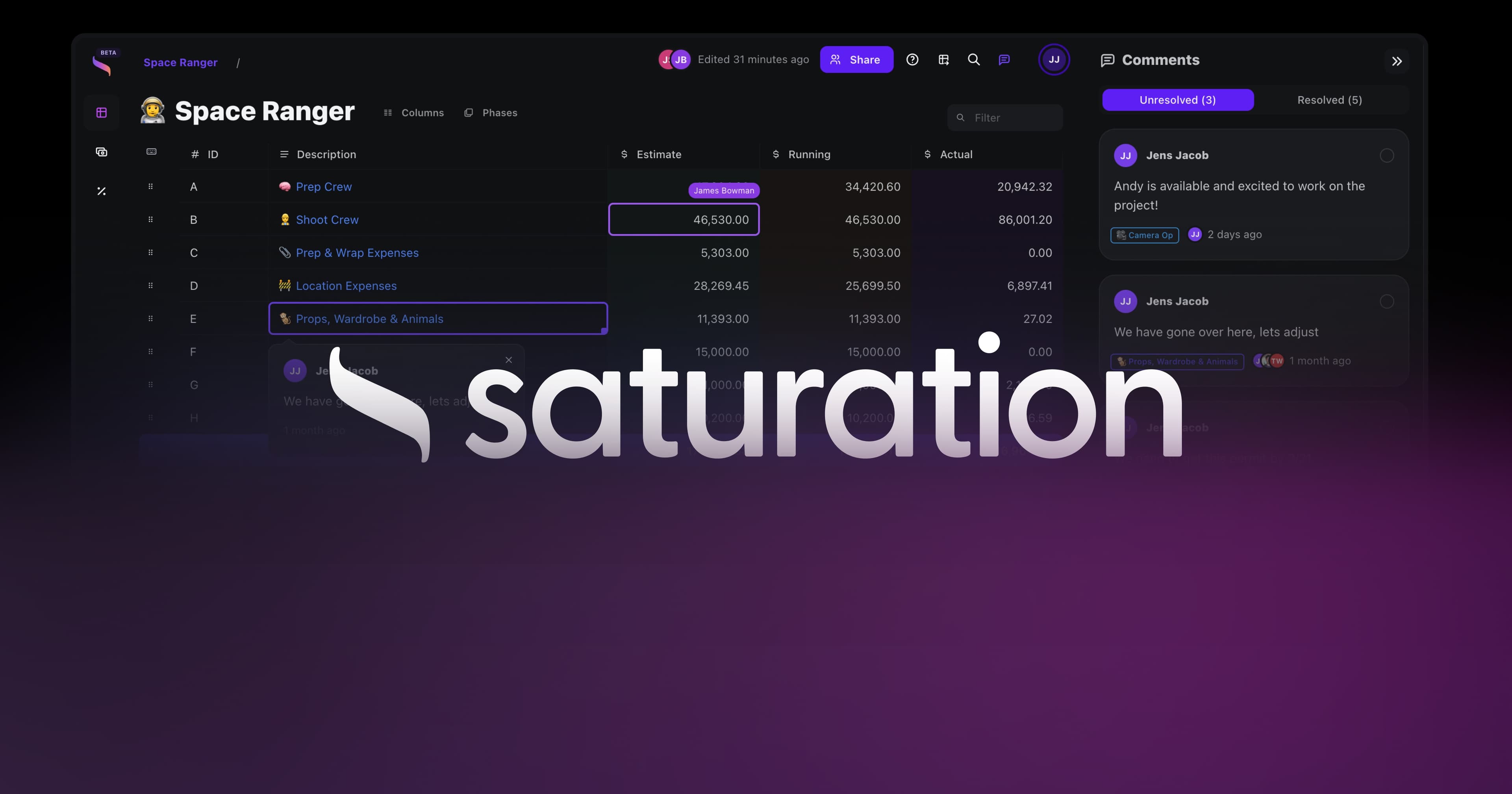
The best self-directed approach: combine a producing course (for context) with hands-on practice in an actual budgeting tool. Building a real budget for a real or hypothetical project in software like Saturation teaches you more than any lecture about budget categories. Saturation's free account lets you build a full production budget with ATL/BTL structure, fringe calculations, and expense tracking from your first project.
For a full explanation of how production budgets are structured, see our guide to how to create a film budget.
Post-Production
Producers need a working knowledge of post-production to manage the post budget and communicate effectively with editors, VFX supervisors, colorists, and sound mixers. Filmmakers Academy offers strong courses in editing, color grading, and visual effects workflows. Understanding what post actually involves prevents the chronic independent film problem of running out of money before the film is finished.
Cinematography and Directing
Producers who understand what the camera department and director are trying to achieve can facilitate those goals rather than creating conflict. FilmSkills offers comprehensive cinematography courses that cover lighting, camera operation, and visual storytelling. Filmmakers Academy's directing courses teach narrative and visual decision-making from the director's perspective.
What Film Production Courses Don't Teach
Most film production courses, from university programs to online platforms, share a common gap: the practical business of running a production. Specifically:
Production Finance and Cash Flow
How do you draw down investor money? How do you manage cash flow when vendor invoices and payroll don't align with your financing disbursements? What is a completion bond and when do you need one? These questions are rarely addressed in coursework but are critical for any producer working with outside financing.
Crew Contracts and Deal Memos
Most courses teach you to hire a crew but don't teach you what needs to be in a deal memo. Daily or weekly rate, overtime structure, credit, deferral terms, kit fees, turnaround, all of these are negotiated per crew member and documented before the first day of production. Getting this wrong creates legal and financial exposure.
Production Expense Tracking
Building a budget is covered in producing courses. Tracking actuals against that budget during production, through purchase orders, petty cash reconciliation, daily hot costs, and weekly cost reports, is almost never taught. This is the work that determines whether you actually finish on budget.
For a complete breakdown of the expense management workflow, see our guide to managing film production expenses.
Insurance and Legal
Production insurance, errors and omissions insurance, location agreements, music licensing, life rights, these are the legal and financial infrastructure of a legitimate production. Most film school graduates encounter them for the first time on their first real production, without preparation.
Tax Incentives
State and country film tax incentives can reduce production costs by 15-35%. Understanding how to structure a production to qualify for incentives, how to work with a tax credit broker, and how to model incentives into your budget is a real skill that can make or break whether an independent film is financeable. Almost no coursework covers this.
Online vs. In-Person: Which Is Better?
The honest answer depends on what you're trying to learn.
For technical craft skills, cinematography, editing, sound design, color grading, online courses are highly effective. The skills are visual and demonstrable, and platforms like Filmmakers Academy and FilmSkills deliver professional-level instruction through video that is as good as or better than classroom instruction.
For producing and line producing skills, in-person programs have advantages that online courses can't fully replicate: real crew dynamics, problem-solving under pressure, and the collaborative experience of actually making something with a team. The producing courses at UCLA Extension, AFI, and similar programs involve actual production work alongside instruction.
For networking, which remains essential for building a career in film, workshops and in-person programs with working professionals are far more valuable than solo online learning. The relationships built in a Sundance Collab intensive or an IFP producing program have real career implications that a Coursera certificate does not.
Do You Need Film School to Be a Producer?
No. Some of the most successful independent producers working today did not attend formal film school. What they did have was a combination of on-set experience, practical production management knowledge, and enough business understanding to manage money responsibly.
The path that reliably produces working producers: start as a production assistant, work your way up through the production office (coordinator to production manager to line producer), take targeted courses to fill specific knowledge gaps, and keep making projects. The credits and relationships built through actual productions matter more than educational credentials in most independent film hiring.
What courses accelerate this path: targeted instruction in areas where on-set experience doesn't teach you enough on its own. Deal memos, tax incentives, production finance, and software tools are all better learned through coursework than trial and error on a real production.
For a full overview of the producer role and the skills required, see our guide to what does a film producer do.
Recommended Course Platforms for Film Producers
Platform | Best For | Cost Range |
|---|---|---|
Sundance Collab | Producing, development, independent film perspective | $200-$600 per course |
UCLA Extension | Line producing, production management, industry-specific certificates | $800-$1,500 per course |
Filmmakers Academy | Cinematography, directing, post-production craft | $250-$500 per course or subscription |
FilmSkills | Comprehensive cinematography, from basics through advanced | Subscription-based |
Coursera | Introduction to filmmaking, screenwriting from university programs | Free audit to $50/month |
MasterClass | Creative inspiration from established directors and writers | $120/year subscription |
Skillshare | Short practical courses, video production, editing basics | $168/year subscription |
What to Learn Alongside Any Film Production Course
Regardless of which course or program you choose, these practical skills are worth building in parallel:
Budgeting software: Build an actual production budget in a tool like Saturation before your first producing credit. Understanding how the software works makes you faster and more reliable on real productions.
Scheduling software: Movie Magic Scheduling or similar tools are standard on professional productions. Learn to read a production board and build a basic schedule.
Deal memo structure: Find templates for standard crew deal memos and understand every line. Know what turnaround means, what a kit fee is, and how overtime is structured.
Tax incentive basics: Research the incentive programs in your state or target production location. The National Conference of State Legislatures publishes summaries, and film commissions are usually happy to explain their programs.
Insurance basics: Know what a production insurance package covers, what E&O insurance is and when you need it, and what a certificate of insurance is for location agreements.
You can start with a free Saturation account to build and practice your first real production budget alongside any course you're taking. The hands-on experience of actually tracking a budget against actuals is something no course fully replicates.
Frequently Asked Questions
What are the best film production courses online?
For producers and line producers: Sundance Collab's producing courses and UCLA Extension's Entertainment Studies program. For cinematography and directing craft: Filmmakers Academy and FilmSkills. For screenwriting: Coursera's university-based screenwriting specializations. For creative inspiration from established filmmakers: MasterClass. The best course depends on which specific skill you need to build.
Do film production courses require any experience?
Most online courses are designed for beginners with no prior film experience. University extension programs and intensive workshops often specify a minimum experience level (at least one short film produced, for example). Graduate programs like AFI and NYU Tisch require both a portfolio and prior experience for admission.
Are free film production courses worth it?
Free courses vary widely in quality. Coursera's free audit options for university-based courses are genuinely valuable for foundational knowledge. YouTube channels from working cinematographers and editors offer real professional knowledge for free. Generic "filmmaking for beginners" free courses on smaller platforms tend to be surface-level. Free courses are worth using to identify what you want to study before committing to paid programs.
What is the difference between film school and a film production certificate?
Film school is a formal degree program (BFA, BA, or MFA) requiring four years for undergraduate or two to three years for graduate study. A film production certificate is a shorter credential, typically 6-18 months, focused on specific skills or disciplines. Certificates don't carry the same academic weight as degrees, but they often provide more practical, industry-focused instruction. For working professionals, certificates are frequently more practical than returning to school for a full degree.
Is a film production degree worth it?
It depends on your goals and resources. The networks built in top MFA programs (USC, NYU Tisch, AFI) have real career value. The craft training is rigorous. But the cost is high and the skills taught in formal programs can increasingly be learned through targeted online courses, workshops, and on-set experience at a fraction of the price. Many successful working producers and directors did not attend formal film school. What you do with your time and who you work with matters more than the credential.
What do film production courses cover?
Most film production courses cover some combination of: screenwriting and story development, directing and visual storytelling, cinematography and camera operation, editing and post-production, sound production and design, and producing and project management. The depth of coverage varies by program. Producing-specific courses add budgeting, scheduling, crew management, and distribution. Very few courses cover production finance, expense management, or tax incentives in depth.
How long do film production courses take?
Range varies widely: individual online courses run 4-20 hours of video content. Workshops and intensives run 1-5 days. Certificate programs typically run 6-18 months of part-time study. Degree programs require 2-4 years. Most working producers combine short-format courses and workshops over time rather than committing to a single extended program.
What software should I learn for film production?
For producing and production management: a film budgeting tool (Saturation for indie productions, Movie Magic Budgeting for larger productions) and a scheduling tool (Movie Magic Scheduling or Gorilla Scheduling). For editing: Adobe Premiere Pro or DaVinci Resolve. For screenwriting: Final Draft or Fade In. For visual effects: Adobe After Effects. Saturation is free to start and covers budgeting, expense management, and contractor payments in one platform.
Film production courses teach you how to make films. Most of them do not teach you how to run a production. There is a difference, and it matters more than most aspiring producers realize before they take on their first real project.
Cinematography, directing, screenwriting, editing, these are craft skills, and there are excellent courses for all of them. But the skills that determine whether a production finishes on time and on budget, budgeting, cost reporting, expense management, crew contracts, insurance, and cash flow, get far less attention in formal film education, and almost none in most online courses.
This guide covers the film production course landscape: what types of courses exist, which platforms and programs are worth your time, and what practical production management skills you should seek out or teach yourself alongside any course you take.
Types of Film Production Courses
Film production education falls into several distinct categories, each serving a different stage of career and learning style:
Formal Degree Programs
Four-year BFA or BA programs at universities and film schools (USC, NYU Tisch, UCLA, AFI, NYFA) provide the most comprehensive education in filmmaking craft. They typically include production practica where students crew each other's films, building real set experience alongside classroom instruction.
The main limitations: cost (tuition at major film programs runs $40,000-$75,000+ per year), time (four years), and a curriculum weighted toward narrative filmmaking craft rather than production management and finance.
Graduate and Certificate Programs
MFA programs and certificate programs (UCLA Extension, AFI Conservatory, American Film Institute) offer more focused, shorter-duration options. UCLA Extension's Entertainment Studies department, for example, offers individual courses in producing, line producing, and production management that working professionals take alongside day jobs.
Certificate programs typically run 6-18 months and focus on specific disciplines. For producers, the line producing and production management certificates at schools like UCLA Extension and New York Film Academy are more relevant than general filmmaking certificates.
Online Course Platforms
The fastest-growing segment. Platforms including Coursera, MasterClass, Skillshare, Filmmakers Academy, and FilmSkills offer self-paced courses taught by working professionals and recognized filmmakers. Cost ranges from free to a few hundred dollars per course, making them accessible to filmmakers at any budget level.
Quality varies significantly. The best online courses (Filmmakers Academy's cinematography courses, Sundance Collab's producing courses) are taught by working industry professionals with real production credits. The weakest are general "how to make a film" overviews with little practical depth.
Workshops and Intensives
Short-format immersive programs (one week to three months) run by film schools, festivals, and industry organizations. Sundance Collab, IFP (Independent Filmmaker Project), Film Independent, and regional film commissions all offer workshops in producing, directing, and screenwriting.
Workshops are valuable for networking as much as instruction, you work alongside other filmmakers at a similar stage, build professional relationships, and often get access to mentors who work in the industry.
Best Film Production Courses for Producers (2026)
If your goal is to produce, to oversee a production from development through delivery, these are the course types and platforms most worth your time:
Line Producing and Production Management
Line producing is one of the most in-demand skills in independent film and one of the least taught. A line producer builds the budget, hires the crew, manages the schedule, and is responsible for getting the film made for what it costs.
UCLA Extension offers producing and line producing courses through its Entertainment Studies program that are taught by working line producers with real credits. These cover scheduling, budgeting, deal memos, and the day-to-day financial management of a production. For producers serious about running productions rather than just developing them, this practical coursework is more valuable than general film school curricula.
Sundance Collab's online producing course covers development through post-production from a producing perspective, including how to attract financing and manage production budgets. It's designed for independent producers working on short and feature projects.
Screenwriting
Understanding script structure is essential for producers because the script is the foundation of the budget. Scene count, location count, cast size, period elements, VFX, and stunts all flow from the script. A producer who can't read a script critically cannot build a reliable budget.
Coursera offers screenwriting specializations from major universities. MasterClass features courses from working screenwriters including Aaron Sorkin and Shonda Rhimes. For producers, the goal isn't to write scripts but to understand how script choices drive production costs.
Film Budgeting
Dedicated film budgeting courses are surprisingly rare outside of formal degree programs. Most online courses treat budgeting as a single module in a broader producing course rather than a standalone discipline.
The best self-directed approach: combine a producing course (for context) with hands-on practice in an actual budgeting tool. Building a real budget for a real or hypothetical project in software like Saturation teaches you more than any lecture about budget categories. Saturation's free account lets you build a full production budget with ATL/BTL structure, fringe calculations, and expense tracking from your first project.
For a full explanation of how production budgets are structured, see our guide to how to create a film budget.
Post-Production
Producers need a working knowledge of post-production to manage the post budget and communicate effectively with editors, VFX supervisors, colorists, and sound mixers. Filmmakers Academy offers strong courses in editing, color grading, and visual effects workflows. Understanding what post actually involves prevents the chronic independent film problem of running out of money before the film is finished.
Cinematography and Directing
Producers who understand what the camera department and director are trying to achieve can facilitate those goals rather than creating conflict. FilmSkills offers comprehensive cinematography courses that cover lighting, camera operation, and visual storytelling. Filmmakers Academy's directing courses teach narrative and visual decision-making from the director's perspective.
What Film Production Courses Don't Teach
Most film production courses, from university programs to online platforms, share a common gap: the practical business of running a production. Specifically:
Production Finance and Cash Flow
How do you draw down investor money? How do you manage cash flow when vendor invoices and payroll don't align with your financing disbursements? What is a completion bond and when do you need one? These questions are rarely addressed in coursework but are critical for any producer working with outside financing.
Crew Contracts and Deal Memos
Most courses teach you to hire a crew but don't teach you what needs to be in a deal memo. Daily or weekly rate, overtime structure, credit, deferral terms, kit fees, turnaround, all of these are negotiated per crew member and documented before the first day of production. Getting this wrong creates legal and financial exposure.
Production Expense Tracking
Building a budget is covered in producing courses. Tracking actuals against that budget during production, through purchase orders, petty cash reconciliation, daily hot costs, and weekly cost reports, is almost never taught. This is the work that determines whether you actually finish on budget.
For a complete breakdown of the expense management workflow, see our guide to managing film production expenses.
Insurance and Legal
Production insurance, errors and omissions insurance, location agreements, music licensing, life rights, these are the legal and financial infrastructure of a legitimate production. Most film school graduates encounter them for the first time on their first real production, without preparation.
Tax Incentives
State and country film tax incentives can reduce production costs by 15-35%. Understanding how to structure a production to qualify for incentives, how to work with a tax credit broker, and how to model incentives into your budget is a real skill that can make or break whether an independent film is financeable. Almost no coursework covers this.
Online vs. In-Person: Which Is Better?
The honest answer depends on what you're trying to learn.
For technical craft skills, cinematography, editing, sound design, color grading, online courses are highly effective. The skills are visual and demonstrable, and platforms like Filmmakers Academy and FilmSkills deliver professional-level instruction through video that is as good as or better than classroom instruction.
For producing and line producing skills, in-person programs have advantages that online courses can't fully replicate: real crew dynamics, problem-solving under pressure, and the collaborative experience of actually making something with a team. The producing courses at UCLA Extension, AFI, and similar programs involve actual production work alongside instruction.
For networking, which remains essential for building a career in film, workshops and in-person programs with working professionals are far more valuable than solo online learning. The relationships built in a Sundance Collab intensive or an IFP producing program have real career implications that a Coursera certificate does not.
Do You Need Film School to Be a Producer?
No. Some of the most successful independent producers working today did not attend formal film school. What they did have was a combination of on-set experience, practical production management knowledge, and enough business understanding to manage money responsibly.
The path that reliably produces working producers: start as a production assistant, work your way up through the production office (coordinator to production manager to line producer), take targeted courses to fill specific knowledge gaps, and keep making projects. The credits and relationships built through actual productions matter more than educational credentials in most independent film hiring.
What courses accelerate this path: targeted instruction in areas where on-set experience doesn't teach you enough on its own. Deal memos, tax incentives, production finance, and software tools are all better learned through coursework than trial and error on a real production.
For a full overview of the producer role and the skills required, see our guide to what does a film producer do.
Recommended Course Platforms for Film Producers
Platform | Best For | Cost Range |
|---|---|---|
Sundance Collab | Producing, development, independent film perspective | $200-$600 per course |
UCLA Extension | Line producing, production management, industry-specific certificates | $800-$1,500 per course |
Filmmakers Academy | Cinematography, directing, post-production craft | $250-$500 per course or subscription |
FilmSkills | Comprehensive cinematography, from basics through advanced | Subscription-based |
Coursera | Introduction to filmmaking, screenwriting from university programs | Free audit to $50/month |
MasterClass | Creative inspiration from established directors and writers | $120/year subscription |
Skillshare | Short practical courses, video production, editing basics | $168/year subscription |
What to Learn Alongside Any Film Production Course
Regardless of which course or program you choose, these practical skills are worth building in parallel:
Budgeting software: Build an actual production budget in a tool like Saturation before your first producing credit. Understanding how the software works makes you faster and more reliable on real productions.
Scheduling software: Movie Magic Scheduling or similar tools are standard on professional productions. Learn to read a production board and build a basic schedule.
Deal memo structure: Find templates for standard crew deal memos and understand every line. Know what turnaround means, what a kit fee is, and how overtime is structured.
Tax incentive basics: Research the incentive programs in your state or target production location. The National Conference of State Legislatures publishes summaries, and film commissions are usually happy to explain their programs.
Insurance basics: Know what a production insurance package covers, what E&O insurance is and when you need it, and what a certificate of insurance is for location agreements.
You can start with a free Saturation account to build and practice your first real production budget alongside any course you're taking. The hands-on experience of actually tracking a budget against actuals is something no course fully replicates.
Frequently Asked Questions
What are the best film production courses online?
For producers and line producers: Sundance Collab's producing courses and UCLA Extension's Entertainment Studies program. For cinematography and directing craft: Filmmakers Academy and FilmSkills. For screenwriting: Coursera's university-based screenwriting specializations. For creative inspiration from established filmmakers: MasterClass. The best course depends on which specific skill you need to build.
Do film production courses require any experience?
Most online courses are designed for beginners with no prior film experience. University extension programs and intensive workshops often specify a minimum experience level (at least one short film produced, for example). Graduate programs like AFI and NYU Tisch require both a portfolio and prior experience for admission.
Are free film production courses worth it?
Free courses vary widely in quality. Coursera's free audit options for university-based courses are genuinely valuable for foundational knowledge. YouTube channels from working cinematographers and editors offer real professional knowledge for free. Generic "filmmaking for beginners" free courses on smaller platforms tend to be surface-level. Free courses are worth using to identify what you want to study before committing to paid programs.
What is the difference between film school and a film production certificate?
Film school is a formal degree program (BFA, BA, or MFA) requiring four years for undergraduate or two to three years for graduate study. A film production certificate is a shorter credential, typically 6-18 months, focused on specific skills or disciplines. Certificates don't carry the same academic weight as degrees, but they often provide more practical, industry-focused instruction. For working professionals, certificates are frequently more practical than returning to school for a full degree.
Is a film production degree worth it?
It depends on your goals and resources. The networks built in top MFA programs (USC, NYU Tisch, AFI) have real career value. The craft training is rigorous. But the cost is high and the skills taught in formal programs can increasingly be learned through targeted online courses, workshops, and on-set experience at a fraction of the price. Many successful working producers and directors did not attend formal film school. What you do with your time and who you work with matters more than the credential.
What do film production courses cover?
Most film production courses cover some combination of: screenwriting and story development, directing and visual storytelling, cinematography and camera operation, editing and post-production, sound production and design, and producing and project management. The depth of coverage varies by program. Producing-specific courses add budgeting, scheduling, crew management, and distribution. Very few courses cover production finance, expense management, or tax incentives in depth.
How long do film production courses take?
Range varies widely: individual online courses run 4-20 hours of video content. Workshops and intensives run 1-5 days. Certificate programs typically run 6-18 months of part-time study. Degree programs require 2-4 years. Most working producers combine short-format courses and workshops over time rather than committing to a single extended program.
What software should I learn for film production?
For producing and production management: a film budgeting tool (Saturation for indie productions, Movie Magic Budgeting for larger productions) and a scheduling tool (Movie Magic Scheduling or Gorilla Scheduling). For editing: Adobe Premiere Pro or DaVinci Resolve. For screenwriting: Final Draft or Fade In. For visual effects: Adobe After Effects. Saturation is free to start and covers budgeting, expense management, and contractor payments in one platform.
Film production courses teach you how to make films. Most of them do not teach you how to run a production. There is a difference, and it matters more than most aspiring producers realize before they take on their first real project.
Cinematography, directing, screenwriting, editing, these are craft skills, and there are excellent courses for all of them. But the skills that determine whether a production finishes on time and on budget, budgeting, cost reporting, expense management, crew contracts, insurance, and cash flow, get far less attention in formal film education, and almost none in most online courses.
This guide covers the film production course landscape: what types of courses exist, which platforms and programs are worth your time, and what practical production management skills you should seek out or teach yourself alongside any course you take.
Types of Film Production Courses
Film production education falls into several distinct categories, each serving a different stage of career and learning style:
Formal Degree Programs
Four-year BFA or BA programs at universities and film schools (USC, NYU Tisch, UCLA, AFI, NYFA) provide the most comprehensive education in filmmaking craft. They typically include production practica where students crew each other's films, building real set experience alongside classroom instruction.
The main limitations: cost (tuition at major film programs runs $40,000-$75,000+ per year), time (four years), and a curriculum weighted toward narrative filmmaking craft rather than production management and finance.
Graduate and Certificate Programs
MFA programs and certificate programs (UCLA Extension, AFI Conservatory, American Film Institute) offer more focused, shorter-duration options. UCLA Extension's Entertainment Studies department, for example, offers individual courses in producing, line producing, and production management that working professionals take alongside day jobs.
Certificate programs typically run 6-18 months and focus on specific disciplines. For producers, the line producing and production management certificates at schools like UCLA Extension and New York Film Academy are more relevant than general filmmaking certificates.
Online Course Platforms
The fastest-growing segment. Platforms including Coursera, MasterClass, Skillshare, Filmmakers Academy, and FilmSkills offer self-paced courses taught by working professionals and recognized filmmakers. Cost ranges from free to a few hundred dollars per course, making them accessible to filmmakers at any budget level.
Quality varies significantly. The best online courses (Filmmakers Academy's cinematography courses, Sundance Collab's producing courses) are taught by working industry professionals with real production credits. The weakest are general "how to make a film" overviews with little practical depth.
Workshops and Intensives
Short-format immersive programs (one week to three months) run by film schools, festivals, and industry organizations. Sundance Collab, IFP (Independent Filmmaker Project), Film Independent, and regional film commissions all offer workshops in producing, directing, and screenwriting.
Workshops are valuable for networking as much as instruction, you work alongside other filmmakers at a similar stage, build professional relationships, and often get access to mentors who work in the industry.
Best Film Production Courses for Producers (2026)
If your goal is to produce, to oversee a production from development through delivery, these are the course types and platforms most worth your time:
Line Producing and Production Management
Line producing is one of the most in-demand skills in independent film and one of the least taught. A line producer builds the budget, hires the crew, manages the schedule, and is responsible for getting the film made for what it costs.
UCLA Extension offers producing and line producing courses through its Entertainment Studies program that are taught by working line producers with real credits. These cover scheduling, budgeting, deal memos, and the day-to-day financial management of a production. For producers serious about running productions rather than just developing them, this practical coursework is more valuable than general film school curricula.
Sundance Collab's online producing course covers development through post-production from a producing perspective, including how to attract financing and manage production budgets. It's designed for independent producers working on short and feature projects.
Screenwriting
Understanding script structure is essential for producers because the script is the foundation of the budget. Scene count, location count, cast size, period elements, VFX, and stunts all flow from the script. A producer who can't read a script critically cannot build a reliable budget.
Coursera offers screenwriting specializations from major universities. MasterClass features courses from working screenwriters including Aaron Sorkin and Shonda Rhimes. For producers, the goal isn't to write scripts but to understand how script choices drive production costs.
Film Budgeting
Dedicated film budgeting courses are surprisingly rare outside of formal degree programs. Most online courses treat budgeting as a single module in a broader producing course rather than a standalone discipline.
The best self-directed approach: combine a producing course (for context) with hands-on practice in an actual budgeting tool. Building a real budget for a real or hypothetical project in software like Saturation teaches you more than any lecture about budget categories. Saturation's free account lets you build a full production budget with ATL/BTL structure, fringe calculations, and expense tracking from your first project.
For a full explanation of how production budgets are structured, see our guide to how to create a film budget.
Post-Production
Producers need a working knowledge of post-production to manage the post budget and communicate effectively with editors, VFX supervisors, colorists, and sound mixers. Filmmakers Academy offers strong courses in editing, color grading, and visual effects workflows. Understanding what post actually involves prevents the chronic independent film problem of running out of money before the film is finished.
Cinematography and Directing
Producers who understand what the camera department and director are trying to achieve can facilitate those goals rather than creating conflict. FilmSkills offers comprehensive cinematography courses that cover lighting, camera operation, and visual storytelling. Filmmakers Academy's directing courses teach narrative and visual decision-making from the director's perspective.
What Film Production Courses Don't Teach
Most film production courses, from university programs to online platforms, share a common gap: the practical business of running a production. Specifically:
Production Finance and Cash Flow
How do you draw down investor money? How do you manage cash flow when vendor invoices and payroll don't align with your financing disbursements? What is a completion bond and when do you need one? These questions are rarely addressed in coursework but are critical for any producer working with outside financing.
Crew Contracts and Deal Memos
Most courses teach you to hire a crew but don't teach you what needs to be in a deal memo. Daily or weekly rate, overtime structure, credit, deferral terms, kit fees, turnaround, all of these are negotiated per crew member and documented before the first day of production. Getting this wrong creates legal and financial exposure.
Production Expense Tracking
Building a budget is covered in producing courses. Tracking actuals against that budget during production, through purchase orders, petty cash reconciliation, daily hot costs, and weekly cost reports, is almost never taught. This is the work that determines whether you actually finish on budget.
For a complete breakdown of the expense management workflow, see our guide to managing film production expenses.
Insurance and Legal
Production insurance, errors and omissions insurance, location agreements, music licensing, life rights, these are the legal and financial infrastructure of a legitimate production. Most film school graduates encounter them for the first time on their first real production, without preparation.
Tax Incentives
State and country film tax incentives can reduce production costs by 15-35%. Understanding how to structure a production to qualify for incentives, how to work with a tax credit broker, and how to model incentives into your budget is a real skill that can make or break whether an independent film is financeable. Almost no coursework covers this.
Online vs. In-Person: Which Is Better?
The honest answer depends on what you're trying to learn.
For technical craft skills, cinematography, editing, sound design, color grading, online courses are highly effective. The skills are visual and demonstrable, and platforms like Filmmakers Academy and FilmSkills deliver professional-level instruction through video that is as good as or better than classroom instruction.
For producing and line producing skills, in-person programs have advantages that online courses can't fully replicate: real crew dynamics, problem-solving under pressure, and the collaborative experience of actually making something with a team. The producing courses at UCLA Extension, AFI, and similar programs involve actual production work alongside instruction.
For networking, which remains essential for building a career in film, workshops and in-person programs with working professionals are far more valuable than solo online learning. The relationships built in a Sundance Collab intensive or an IFP producing program have real career implications that a Coursera certificate does not.
Do You Need Film School to Be a Producer?
No. Some of the most successful independent producers working today did not attend formal film school. What they did have was a combination of on-set experience, practical production management knowledge, and enough business understanding to manage money responsibly.
The path that reliably produces working producers: start as a production assistant, work your way up through the production office (coordinator to production manager to line producer), take targeted courses to fill specific knowledge gaps, and keep making projects. The credits and relationships built through actual productions matter more than educational credentials in most independent film hiring.
What courses accelerate this path: targeted instruction in areas where on-set experience doesn't teach you enough on its own. Deal memos, tax incentives, production finance, and software tools are all better learned through coursework than trial and error on a real production.
For a full overview of the producer role and the skills required, see our guide to what does a film producer do.
Recommended Course Platforms for Film Producers
Platform | Best For | Cost Range |
|---|---|---|
Sundance Collab | Producing, development, independent film perspective | $200-$600 per course |
UCLA Extension | Line producing, production management, industry-specific certificates | $800-$1,500 per course |
Filmmakers Academy | Cinematography, directing, post-production craft | $250-$500 per course or subscription |
FilmSkills | Comprehensive cinematography, from basics through advanced | Subscription-based |
Coursera | Introduction to filmmaking, screenwriting from university programs | Free audit to $50/month |
MasterClass | Creative inspiration from established directors and writers | $120/year subscription |
Skillshare | Short practical courses, video production, editing basics | $168/year subscription |
What to Learn Alongside Any Film Production Course
Regardless of which course or program you choose, these practical skills are worth building in parallel:
Budgeting software: Build an actual production budget in a tool like Saturation before your first producing credit. Understanding how the software works makes you faster and more reliable on real productions.
Scheduling software: Movie Magic Scheduling or similar tools are standard on professional productions. Learn to read a production board and build a basic schedule.
Deal memo structure: Find templates for standard crew deal memos and understand every line. Know what turnaround means, what a kit fee is, and how overtime is structured.
Tax incentive basics: Research the incentive programs in your state or target production location. The National Conference of State Legislatures publishes summaries, and film commissions are usually happy to explain their programs.
Insurance basics: Know what a production insurance package covers, what E&O insurance is and when you need it, and what a certificate of insurance is for location agreements.
You can start with a free Saturation account to build and practice your first real production budget alongside any course you're taking. The hands-on experience of actually tracking a budget against actuals is something no course fully replicates.
Frequently Asked Questions
What are the best film production courses online?
For producers and line producers: Sundance Collab's producing courses and UCLA Extension's Entertainment Studies program. For cinematography and directing craft: Filmmakers Academy and FilmSkills. For screenwriting: Coursera's university-based screenwriting specializations. For creative inspiration from established filmmakers: MasterClass. The best course depends on which specific skill you need to build.
Do film production courses require any experience?
Most online courses are designed for beginners with no prior film experience. University extension programs and intensive workshops often specify a minimum experience level (at least one short film produced, for example). Graduate programs like AFI and NYU Tisch require both a portfolio and prior experience for admission.
Are free film production courses worth it?
Free courses vary widely in quality. Coursera's free audit options for university-based courses are genuinely valuable for foundational knowledge. YouTube channels from working cinematographers and editors offer real professional knowledge for free. Generic "filmmaking for beginners" free courses on smaller platforms tend to be surface-level. Free courses are worth using to identify what you want to study before committing to paid programs.
What is the difference between film school and a film production certificate?
Film school is a formal degree program (BFA, BA, or MFA) requiring four years for undergraduate or two to three years for graduate study. A film production certificate is a shorter credential, typically 6-18 months, focused on specific skills or disciplines. Certificates don't carry the same academic weight as degrees, but they often provide more practical, industry-focused instruction. For working professionals, certificates are frequently more practical than returning to school for a full degree.
Is a film production degree worth it?
It depends on your goals and resources. The networks built in top MFA programs (USC, NYU Tisch, AFI) have real career value. The craft training is rigorous. But the cost is high and the skills taught in formal programs can increasingly be learned through targeted online courses, workshops, and on-set experience at a fraction of the price. Many successful working producers and directors did not attend formal film school. What you do with your time and who you work with matters more than the credential.
What do film production courses cover?
Most film production courses cover some combination of: screenwriting and story development, directing and visual storytelling, cinematography and camera operation, editing and post-production, sound production and design, and producing and project management. The depth of coverage varies by program. Producing-specific courses add budgeting, scheduling, crew management, and distribution. Very few courses cover production finance, expense management, or tax incentives in depth.
How long do film production courses take?
Range varies widely: individual online courses run 4-20 hours of video content. Workshops and intensives run 1-5 days. Certificate programs typically run 6-18 months of part-time study. Degree programs require 2-4 years. Most working producers combine short-format courses and workshops over time rather than committing to a single extended program.
What software should I learn for film production?
For producing and production management: a film budgeting tool (Saturation for indie productions, Movie Magic Budgeting for larger productions) and a scheduling tool (Movie Magic Scheduling or Gorilla Scheduling). For editing: Adobe Premiere Pro or DaVinci Resolve. For screenwriting: Final Draft or Fade In. For visual effects: Adobe After Effects. Saturation is free to start and covers budgeting, expense management, and contractor payments in one platform.
Try Saturation today with our
free budget templates.
Get Free Template