
Best Financial Operating System for Film Production Teams
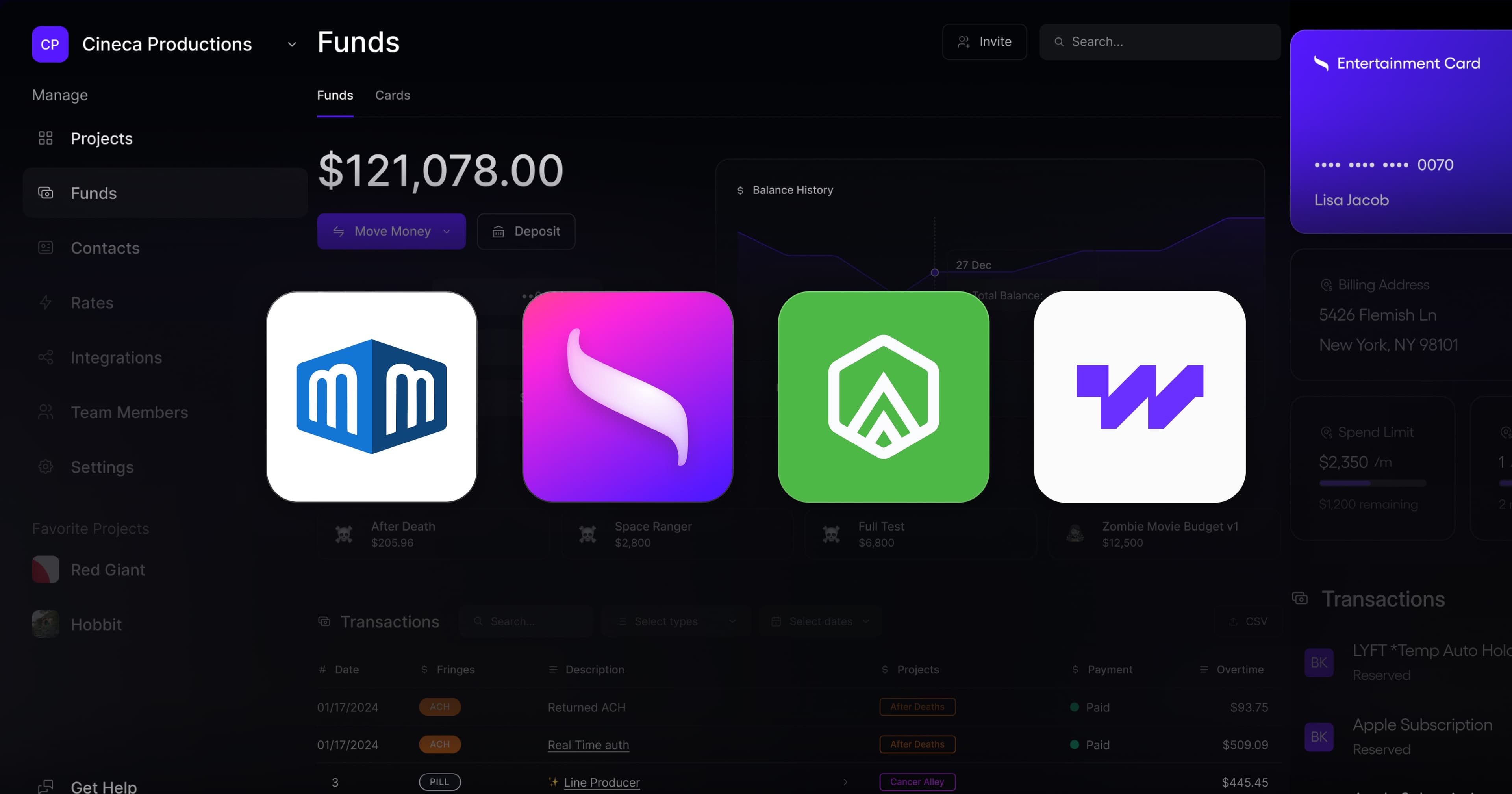
"Financial operating system" is a term that has migrated from fintech into media production over the past 2 years. It describes a platform where every part of production finance runs on the same data (budgets, cards, banking, approvals, invoices, payroll integration, and cost reporting) instead of a stack of disconnected tools exporting spreadsheets to each other. This guide covers what a financial operating system for modern media production teams actually is, how it differs from legacy production accounting, and what to look for when evaluating one.
Why the term matters right now
Most production finance teams run on a stack like this: Movie Magic or Showbiz for the budget, a corporate Amex for spending, a business bank account at a traditional bank, a payroll firm (Wrapbook, Cast and Crew, EP, GreenSlate) for crew, a mix of QuickBooks or Excel for actuals, and a weekly cost report built by hand in Google Sheets. Every handoff between tools is a place where data breaks.
A financial operating system consolidates those workflows onto one platform with shared data. The budget is the source of truth. Cards, invoices, and payroll actuals all flow back into it automatically. Cost reports generate themselves. Producers see the current number, not last week's number.
What a production FinOS includes
At minimum, a production financial operating system handles:
- Production budgeting with collaborative, cloud-native budget files
- Production banking accounts per SPE
- Corporate cards and per-department virtual cards with line-level limits
- Bill pay with invoice intake and approval workflows
- Purchase orders with approval chains and three-way matching
- Approval workflows that span POs, invoices, and card transactions
- Vendor onboarding with W-9, COI, and banking info in one link
- Cost reporting with real-time variance and narrative drafting
- Tax incentive tracking for qualified spend in every filming jurisdiction
- Integrations with payroll partners (Wrapbook, Cast and Crew, EP, GreenSlate)
- AI for auto-coding, variance detection, and cost report drafting
Platforms missing any of these force manual bridges between tools. Every bridge is a labor cost and an error risk.
FinOS vs legacy production accounting stack
The legacy stack evolved over 30 years. Movie Magic Budgeting launched in 1989 as a single-user desktop tool. Corporate Amex cards issued to producers became standard in the 1990s. PSL, Cashet, and SmartAccounting are separate systems bolted together with data exports. The stack works, but it depends on a production accountant spending hours per week keeping it in sync.
A FinOS changes the architecture. Instead of N tools with N-1 integrations, it is one platform. Changes to the budget propagate to cost reports. Card transactions propagate to actuals. Invoice approvals propagate to bill pay. The production accountant stops being a human integration layer.
What to look for in a production FinOS
Shared data model
Every component (budget, cards, banking, bill pay) should reference the same chart of accounts and budget lines. If your cards are on Ramp, banking is on Mercury, and budget is in Movie Magic, they are three data models that do not talk.
Real-time cost reporting
A modern FinOS updates the cost report as transactions happen, not at week end. Producers should see committed and actual spend within minutes of a PO being approved or a card being swiped.
Production-native vs general business
General fintechs (Brex, Ramp, Rho, Mercury) are well-built but use a generic chart of accounts. A production FinOS carries the 100-series to 7000-series production chart, AICP formats, union fringe rules, and tax incentive qualification logic natively. See our Saturation vs Ramp and Saturation vs Brex comparisons.
Security and compliance
Studio and equity-backed productions require SOC 2 Type II. Tax incentive work requires audit trails. Union work requires role-based access. Any FinOS built for production-grade use should have all three by default.
Payroll and accounting integrations
A FinOS does not typically replace your payroll firm. It integrates with payroll partners so crew W-2 payments flow from the FinOS-managed production account without duplicate data entry. Same applies to downstream accounting (QuickBooks, NetSuite, Xero) for post-wrap reconciliation.
Saturation as a production FinOS
Saturation is built as a financial operating system for film, TV, and commercial production. Budgets, cards, banking, bill pay, POs, approvals, vendor onboarding, cost reporting, and tax incentive tracking live on one platform with shared data. Productions using Saturation typically replace 5 to 7 disconnected tools and reduce production accountant time per week by 30 to 50 percent on repetitive tasks.
Alternatives and partial solutions
Other platforms cover subsets of the FinOS scope:
- Wrapbook is strong on payroll and onboarding, adding budgeting and cost tracking. Still payroll-first in architecture.
- GreenSlate is payroll + accounting + incentives management. Strong offering but separate modules rather than unified.
- Entertainment Partners is the long-standing leader with SmartAccounting, PSL, SmartStart, and SmartPO. Separate products, separate logins, integrated over time.
- Movie Magic Budgeting is budgeting only. Not a FinOS.
- General fintechs (Ramp, Brex, Rho, Mercury) are banking and cards only, without production-specific chart of accounts.
Measurable outcomes productions report
Productions that move from a legacy stack to a financial operating system report consistent outcomes:
- Wrap-day cost report finalization drops from 3 to 6 weeks to 7 to 14 days
- Production accountant hours per week on reconciliation drop 30 to 50 percent
- Missing receipts at wrap drop from 5 to 15 percent to under 1 percent
- Vendor payment disputes drop because three-way matching catches discrepancies before payment
- Tax incentive qualified spend capture rises 5 to 15 percentage points due to real-time classification
These are not universal guarantees, but they are the pattern most teams report within the first full production cycle on the new stack. The ROI shows up fastest for production companies running 3 or more projects per year, since the platform fixed costs amortize across shows.
Evaluation checklist for a new FinOS
- Does it replace or integrate with your current budgeting tool?
- Does it replace or integrate with your current card program?
- Does it replace or integrate with your production bank account?
- Does it handle invoice intake, approval, and payment on one workflow?
- Does it track qualified spend for state tax incentives?
- Does it integrate with your payroll partner?
- Is the cost report real-time or weekly?
- Are approval workflows configurable per department and dollar threshold?
- Is it SOC 2 Type II certified with audit trails?
- What is the migration path from the current stack?
Industry resources
For more on where production finance is heading, see MovieLabs 2030 Vision and its technical publications on cloud-first production workflows. For AICP bid format compliance, see AICP.
Frequently asked questions about production financial operating systems
Is a FinOS the same as production accounting software?
No. Production accounting software (PSL, SmartAccounting, PC Ledger) records actuals and generates reports from them. A FinOS is broader: it includes the accounting layer plus cards, banking, bill pay, and budgeting as first-class parts of the same platform. FinOS replaces parts of the accounting software, but also parts of your card program, bank, budget tool, and bill pay.
Can a FinOS replace my payroll firm?
No. A FinOS integrates with payroll firms (Wrapbook, Cast and Crew, EP, GreenSlate) rather than replacing them. Payroll has specialized workflows (union compliance, W-2 issuance, residuals) that belong in a dedicated payroll platform. The FinOS handles the money movement around payroll; the payroll firm handles the tax, union, and compliance logic.
Does a FinOS work for small productions?
Yes. The smallest commercial, short film, or music video still benefits from having budget, cards, and bank on one platform. The FinOS scales down to single-project use and up to multi-show production companies. Pricing should scale with use.
How does a FinOS handle Single Purpose Entities?
A FinOS lets you open an account per SPE with a shared parent organization. Each SPE has its own budget, cards, bank account, and financials; the parent sees consolidated treasury across all active productions. This is standard for multi-show production companies.
Is a FinOS suitable for studio-level productions?
Yes, with the caveat that studio productions often have existing financial infrastructure (studio payroll, studio accounting) that dictates tool choices. On a studio show, a FinOS typically runs on the production side (budget, cards, vendor bill pay) while interfacing with the studio's back-office systems.
What is the migration path from Movie Magic and Excel?
Budget files export from Movie Magic and import into modern FinOS platforms as structured budget data. Card programs can run in parallel during transition; cards move to the FinOS at the start of the next production. Banking moves at SPE opening. Most productions migrate over 2 to 4 weeks of prep.
How does FinOS pricing compare to the legacy stack?
FinOS pricing is typically a per-seat or per-production subscription. The legacy stack charges per-tool (Movie Magic per-seat, bank wire fees, card program fees, payroll processing fees, etc.) and adds production accountant labor for reconciliation. Most teams find FinOS costs less than the legacy stack net of labor savings, especially on productions running 3 or more projects per year.
Can FinOS integrate with NetSuite or QuickBooks for corporate reporting?
Yes. Production-level data from the FinOS exports or syncs into the production company's corporate accounting system (NetSuite, QuickBooks, Xero) at wrap or on an ongoing basis. The FinOS handles production-specific workflows; corporate accounting handles entity-level financial statements.
Related posts
Ready to modernize your production finance?
Join thousands of production teams using Saturation to budget, track expenses, and manage payments.