 Brex
Brex Saturation
Brex Alternative for Film Production: Why Producers Choose Saturation
Brex is built for tech startups, not film production finance. See how Saturation compares on budgeting, AICP format, production cards, and contractor payments.
Feature Comparison
Brex vs Saturation
Feature | Brex | Saturation |
|---|---|---|
Film Budgeting | ❌ | ✅ |
Real-time Collaboration | ✅ | ✅ |
Expense Tracking / Actuals | ✅ | ✅ |
Production Banking + Cards | ✅ | ✅ |
Contractor / Vendor Payments | ✅ | ✅ |
Multi-currency Support | ✅ | ✅ |
Production-specific Workflows | ❌ | ✅ |
Cloud-based / Browser Access | ✅ | ✅ |
Free Plan | ✅ (free) | ✅ |
Price | $0–custom | $25/mo |
Film producers often discover Brex the same way they discover most corporate finance tools: through a startup founder recommendation, a tech-forward accountant, or a Google search for "business expense card." Brex is a genuinely impressive product for the companies it was designed for. The question is whether your production company is one of them.
This page compares Brex and Saturation honestly, covers where Brex excels, where it falls short for film and TV production finance, and helps you figure out which tool fits your situation or whether you need both.
What Is Brex?
Brex is a corporate spend management platform built for startups, high-growth companies, and enterprises. It launched in 2017 targeting Silicon Valley startups that could not qualify for traditional corporate credit cards. Today Brex offers corporate cards, expense management, business banking, bill pay, and travel management in a single platform.
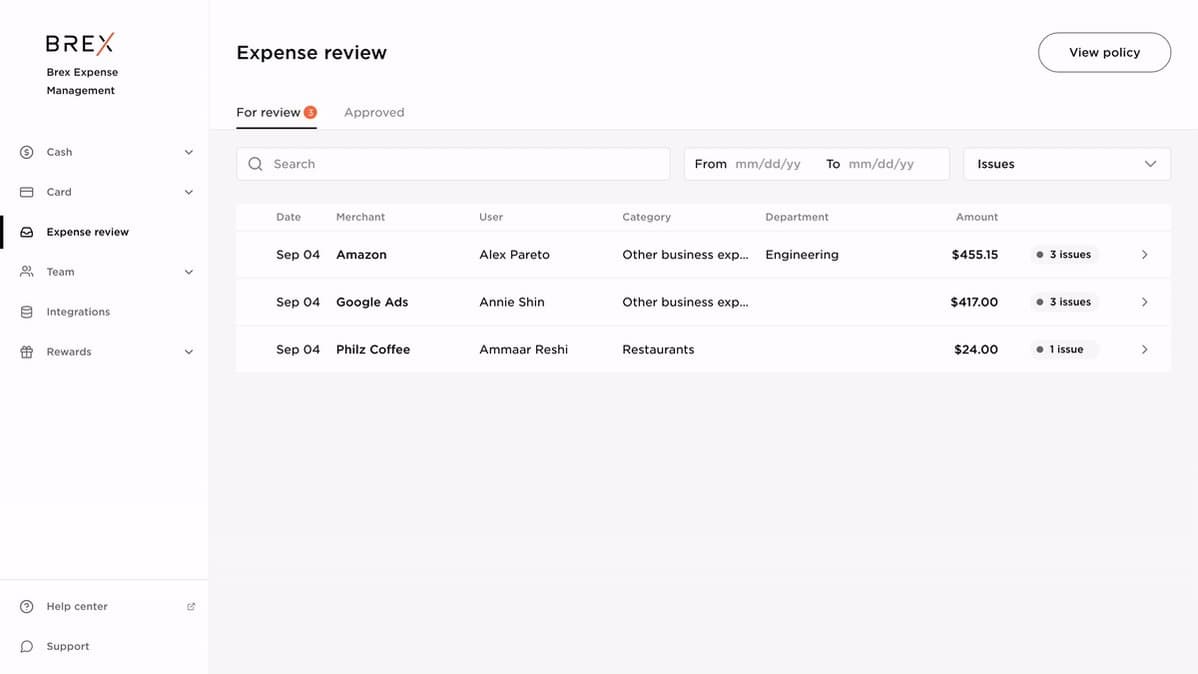
Brex's core value proposition is sophisticated spend control for companies with multiple employees managing budgets across departments. It automates expense categorization, enforces spending policies at the card level, and syncs with accounting systems like QuickBooks and NetSuite.
As of early 2026, Capital One announced an acquisition of Brex valued at approximately $5.15 billion, with the transaction expected to close by mid-2026. The long-term product direction under Capital One ownership is not yet clear.
Brex Pricing (Verified Early 2026)
- Essentials: Free. Includes corporate cards, business banking, bill pay, expense management, and real-time spend reporting.
- Premium: $12 per user per month. Adds advanced expense policy customization, procurement features, and expanded travel functionality.
- Enterprise: Custom pricing. Dedicated account management, unlimited entities, local card issuance.
Brex does not charge card transaction fees on its Essentials plan. Rewards are point-based, not flat cashback, with the Brex Exclusive program offering a rebate of approximately 2.35% on monthly spend for qualifying accounts. The exact rewards structure varies by plan and merchant category, with some categories earning up to 7x points.
Brex Eligibility Requirements
Brex is not available to all businesses. To qualify, companies generally need one of the following:
- A minimum cash balance of $50,000 (for venture-backed startups)
- More than $400,000 in monthly revenue (for mid-market companies)
- More than $1 million in annual revenue (for commercial businesses)
- An equity investment of any amount from an accelerator, angel investor, or VC
Sole proprietors are not eligible. A US EIN, valid US incorporation, and US physical address are required. For a production company that does not meet these thresholds, Brex approval is not guaranteed.
The Core Gap: Brex Is Built for Tech, Not Film Production
Brex is excellent at what it does. But film production finance has requirements that general corporate spend tools were never designed to handle.
A film production budget is not a department budget. It is a highly structured financial document with above-the-line and below-the-line divisions, account code hierarchies, union fringe calculations, tax incentive modeling, and actuals tracking that runs against a constantly changing plan. The budgeting workflow for a $2 million indie feature is categorically different from the expense management workflow for a 50-person software startup.
When a line producer opens a film budget, they expect specific account structures, AICP codes for commercial work, union rate tables, and fringe calculations that update automatically when crew classifications change. None of these exist in Brex. They are not features Brex plans to add. They are outside its product category entirely.
Similarly, Brex's spend management is designed around employees with corporate cards making purchases that map to general ledger accounts. Production finance involves contractors, day players, union crew, vendor invoices, petty cash, purchase orders, and payments to dozens of individuals across a compressed production schedule. The two systems solve different problems.
Brex vs. Saturation: Feature Comparison
Feature | Brex | Saturation |
|---|---|---|
Film production budgeting | No | Yes, full line-by-line budget with fringes |
AICP account code template | No | Yes (commercial production standard) |
Union fringe calculations | No | Yes |
Real-time budget collaboration | No (expense tracking only) | Yes, multiple users simultaneously |
Budget vs. actuals tracking | Basic department budgets | Full production budget-vs-actual reporting |
Contractor and vendor payments | Bill pay (standard AP) | Yes, via Saturation Pay (production-specific) |
Production credit card | Corporate card (general business) | Yes, 3% cash back on production expenses |
Cashback rate | ~2.35% rebate (qualifying accounts, point-based) | 3% flat cash back on production expenses |
Free tier available | Yes (Essentials) | Yes (1 project, full features) |
Eligibility restrictions | Yes ($50K cash balance or VC funding minimum) | No restrictions |
Cloud-based collaboration | Yes | Yes |
Accounting integrations (QuickBooks, NetSuite) | Yes (strong) | In development |
Multi-entity support | Yes (Enterprise tier) | Yes |
Built for film/TV/commercial production | No | Yes (by a working film producer) |
Personal guarantee required | No | No |
Feature-by-Feature Breakdown
Corporate Cards and Rewards
Brex's corporate card is a genuine strength. No personal guarantee, no annual fee, credit limits based on company cash balance rather than personal credit history, and a rewards structure that scales with spending. For an established production company with substantial cash on hand, Brex's card is a competitive option for general company expenses.
The limitation for film production is specificity. Brex's rewards are optimized for categories like SaaS subscriptions, travel, and restaurants. Production spending includes equipment rentals, expendables, grip truck rentals, studio time, catering, and location fees. Brex does not recognize these as distinct categories and does not offer elevated rewards for them.
Saturation's production credit card earns 3% cash back on production expenses across the board. On a $500,000 commercial shoot, 3% back is $15,000 returned to the production. The card is purpose-built for the spending categories that productions actually generate.
Expense Management
Brex's expense management is designed for employees submitting expenses against company policies. You set spending limits, Brex auto-categorizes transactions, AI flags out-of-policy spending, and everything syncs to your accounting system. For a production company managing its own overhead (office rent, software subscriptions, team salaries), this is solid.
Production expense management is different. Expenses come from dozens of sources simultaneously: petty cash floats, vendor invoices, purchase orders, union payroll (handled separately), and individual crew purchases. Tracking actuals against a line-item production budget requires a system that understands production account structures, not general ledger categories. Brex does not have this layer.
Saturation tracks production expenses against the actual budget, line by line. You see what you planned to spend on camera rentals, what you have spent, and what remains. That budget-vs-actual visibility is what a production accountant or line producer needs to manage a shoot, and it is not something Brex was built to provide.
Bill Pay and Contractor Payments
Brex includes bill pay functionality for standard accounts payable workflows. You can pay vendors, schedule bills, and sync with accounting software. This works well for recurring company expenses and supplier invoices.
Saturation Pay handles contractor and vendor payments specifically within the context of production finance. This is not the same as standard AP. On a production, you are paying a cinematographer for 15 shooting days, a grip rental house for a package, a caterer on a per-person basis, and a location owner for a fee negotiated against a location agreement. The payment context is production finance, and Saturation Pay is built for it.
Important: Saturation Pay is for contractor and vendor payments only. It is not a W-2 payroll service. If your production runs a union or non-union cast and crew on W-2 payroll, you still need a payroll company like Wrapbook or Cast and Crew for that piece. Saturation handles the production budgeting and contractor payment layer that sits alongside payroll.
Budget Building for Film
This is the sharpest difference between the two platforms. Brex does not have a film budget tool. It has department-level budget tracking that lets you set spending limits by team and monitor whether you are staying within them. For a startup managing marketing spend, engineering costs, and operations budgets, this is appropriate.
A film budget is a different document. It has a title page, a topsheet, and detailed accounts organized by standard industry categories: story and rights, producer fees, director fees, cast, travel and living, art department, camera, lighting, sound, grip, stunts, VFX, post-production, insurance, contingency. Each line has fringes applied at different rates depending on whether the crew member is union or non-union, SAG or IATSE, and which state the work is performed in.
Saturation is built around this structure. You build the budget the way a line producer builds a budget, with the account codes, fringe tables, globals, and department breakdowns that production finance requires. When actuals come in, they map to the correct accounts. You can see if camera is tracking over budget on day 12 and adjust accordingly.
Brex cannot do any of this. It was not designed to.
Production-Specific Workflows
Film and television production has workflows that are specific to the industry. AICP account codes are the standard format for commercial production budgets. Union fringe calculations vary by union, state, and deal structure. Tax incentive modeling affects where productions choose to shoot. None of these have equivalents in the startup finance world that Brex serves.
Saturation includes an AICP account code template for commercial producers, the standard that advertising agencies and brand clients expect when they review a commercial budget. It is the format a production company bidding agency work needs to use, and it is built into Saturation out of the box.
Brex has no production account structure, no AICP support, and no union fringe functionality. A commercial producer using Brex for budgeting would need to build their AICP structure from scratch in a spreadsheet and manage fringes manually. That is exactly the problem Saturation was built to eliminate.
Who Should Use Brex?
- VC-backed startups and high-growth tech companies that meet Brex's minimum cash balance or funding requirements
- Production companies managing significant overhead costs (office, software, team) who need sophisticated corporate card controls
- Companies with large employee headcount who need policy enforcement, expense approvals, and accounting system integration at scale
- Enterprise media companies or studios managing multi-entity spend across multiple departments and legal entities
- Production companies that primarily need general corporate spend management, not production-specific financial workflows
Who Should Use Saturation?
- Film, television, commercial, and music video producers who need to build and manage actual production budgets
- Line producers and production managers who need budget-vs-actuals tracking through production
- Independent filmmakers who want professional budget management without the cost and complexity of legacy desktop software
- Commercial producers who need AICP account code templates and format-compliant budgets for agency clients
- Producers who want a production credit card that earns 3% cash back on the specific expense categories productions generate
- Any production company that wants real-time collaborative budgeting where multiple team members can work simultaneously
Can You Use Both?
Yes, and some production companies do. The use case is a clear division of scope: Brex for corporate overhead and general company expenses, Saturation for production budgeting and production finance.
A production company with a permanent staff running multiple projects might use Brex to manage office expenses, software subscriptions, and employee spending on general operations. When a project greenlit and production begins, Saturation handles the project budget, expense tracking, and contractor payments that are specific to that production.
This is not redundant if the spending categories are genuinely separate. The risk is complexity: two finance systems mean two sets of card controls, two reporting streams, and reconciliation between them. Many production companies find it simpler to use Saturation's production credit card for all production-related spending and handle the limited overhead through a simpler solution.
If you are a production company that does nothing but produce projects (no permanent staff overhead to speak of), there is little reason to add Brex's complexity. Saturation covers the production finance workflow end to end.
Frequently Asked Questions
Does Brex work for film production budgeting?
Brex does not have a film production budgeting tool. It offers department-level budget tracking that works well for general company spend, but it has no production account structures, no AICP format, no union fringe calculations, and no budget-vs-actuals reporting designed for production finance. For production budgeting, you need a dedicated tool like Saturation.
Can I get a Brex card for my production company?
Brex requires a minimum cash balance (typically $50,000 for startups), VC funding, or significant revenue to qualify. Sole proprietors are not eligible. Many production companies, particularly smaller independents and single-project LLCs, may not meet Brex's qualification thresholds. Saturation's production credit card has no such restrictions.
What does the Saturation production credit card earn?
Saturation's production credit card earns 3% cash back on production expenses. Brex's Exclusive rewards program offers approximately 2.35% on monthly spend for qualifying accounts, though this is point-based rather than flat cashback and varies by merchant category.
Is Brex being acquired and will that change anything?
Capital One announced an acquisition of Brex expected to close by mid-2026. The product roadmap and feature set under Capital One's ownership are not yet clear. If you are evaluating a long-term production finance solution, this uncertainty is worth factoring into your decision.
Does Saturation replace Brex for general company expenses?
Saturation is focused on production finance, not general corporate spend management. If you have significant company overhead outside of production (staff, office, software), Brex's expense management may be useful for that piece. Saturation covers the production budgeting, expense tracking, and contractor payment workflow.
What is Saturation Pay and how does it differ from Brex bill pay?
Saturation Pay handles contractor and vendor payments in the context of production finance. It is designed for the payment patterns of film and TV production: day players, rental houses, location fees, vendor invoices tied to production accounts. Brex bill pay is standard AP for recurring company invoices. Both pay vendors, but the context and integration differ significantly. Note: Saturation Pay is for contractors and vendors, not W-2 payroll.
Is Saturation free to start?
Yes. Saturation's free tier includes a single project with full budgeting features. There is no credit card required and no cash balance minimum. You can build and manage a complete production budget without paying anything until you need multiple concurrent projects.
Ready to Build Your Production Budget?
If you are a film, television, or commercial producer looking for a platform that understands production finance, not just corporate spend management, Saturation is built for exactly that workflow. Start free with a single project and see why producers building projects at every budget level choose Saturation over generic corporate finance tools.
Ready to Switch? Start Free with Saturation
Saturation is built for production companies, with budgeting, expense tracking, and production payments designed for the film and TV industry, not tech startups. Start your free Saturation account.
Banking, cards, and payments, built into Saturation
Spend from production banking, issue cards to the crew, and approve every dollar in one place.
Banking
Saturation Pay: accounts, cards and bill pay in one place. Send ACH, wire or same-day.
Issue Cards
Virtual cards spend instantly, physical ships in a week. One at a time or twenty-five at once.


Payments
Every payment, in one place.
Credit
A charge card that codes itself, earns up to 3% cash back, and unlocks discounts on production tools.
Flows
Branch it, delay it, dry-run it.
Receipt scanning
Receipts arrive already coded.