 Wrapbook
 Saturation
Wrapbook Alternative: Why Producers Choose Saturation for Budgeting
Wrapbook handles payroll. Saturation handles budgeting, expenses, and contractor payments. Compare features, pricing, and find out which your production needs.
Feature Comparison
Wrapbook vs Saturation
Feature | Wrapbook | Saturation |
|---|---|---|
Film Budgeting | ❌ | ✅ |
Real-time Collaboration | ✅ | ✅ |
Expense Tracking / Actuals | ✅ | ✅ |
Production Banking + Cards | ❌ | ✅ |
Contractor / Vendor Payments | ❌ | ✅ |
W-2 Payroll Processing | ✅ | ❌ |
Cloud-based / Browser Access | ✅ | ✅ |
Free Plan | ❌ | ✅ |
Price | 0.75–1.49% of payroll | $25/mo |
Wrapbook Alternative: Why Producers Choose Saturation for Budgeting
By Jens Jacob | Film Producer (After Death, The Heart of Man) and Co-founder of Saturation.io | Updated February 2026
If you are searching for a Wrapbook alternative, the answer depends on what you actually need. Wrapbook is a payroll platform. Saturation is a production finance platform covering budgeting, expense management, contractor payments, and production banking. They do different jobs. Many productions run both simultaneously and use the direct integration between them to eliminate manual reconciliation. This guide explains what each platform does, where they differ, how they work together, and how to decide what your production needs.
What Is Wrapbook?
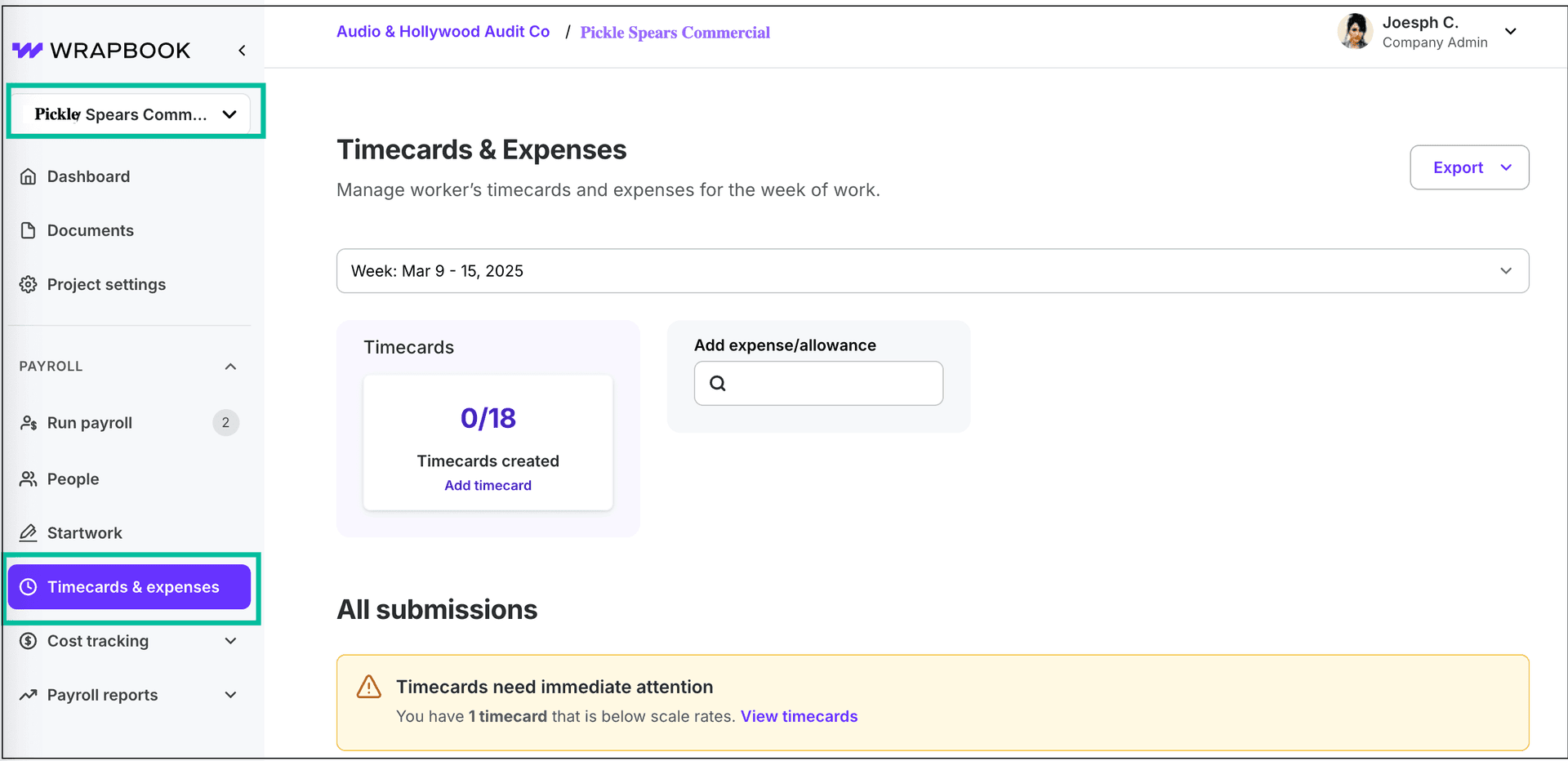
Wrapbook is a production payroll and accounting platform founded in 2019. It replaces the paper-heavy, phone-driven payroll process that has defined the entertainment industry for decades. The platform handles crew onboarding (I-9, W-4, deal memos), timecard management, W-2 payroll processing, union compliance for SAG-AFTRA, DGA, and IATSE, workers compensation coverage, and multi-state tax withholding.
Wrapbook also offers the Production Accounting Suite (PAS), which adds budget tracking, accounts payable, and expense management on top of payroll. The PAS budget tracker imports existing budgets from Movie Magic, Hot Budget, or Showbiz and reflects payroll transactions against those imports. It is a tracking tool, not a budget-building tool.
What Is Saturation?
Saturation is a cloud-based production finance platform built by film producers for film producers. It covers budgeting, expense tracking, contractor and vendor payments (Saturation Pay), and production banking including an expense card that earns 3% cash back on all production spending. Every function is connected: payments made through Saturation Pay automatically update actuals on the corresponding budget line in real time.
Saturation integrates directly with Wrapbook. Payroll actuals from Wrapbook flow into the Saturation budget automatically, giving productions a unified view of all costs without manual reconciliation between systems. Saturation does not process W-2 payroll. Saturation Pay is for contractor and vendor payments only.
Wrapbook solves the payroll problem: how to pay W-2 crew legally, compliantly, and without the administrative burden of paper start packages, manual timecard processing, and multi-state tax filings. Every union production with SAG-AFTRA, DGA, or IATSE crew needs a payroll processor. Wrapbook is built specifically for that job in film and television. It applies correct union wage scales, overtime rules, and fringe calculations automatically and handles multi-state withholding forms across all 43 states that require them. Workers compensation is integrated rather than managed separately.
Saturation solves the production finance problem: how to build a budget, track actual spending against it in real time, manage contractor and vendor payments, and keep the financial picture clear from development through delivery. Before you hire your first crew member, Saturation is where your budget lives. After production wraps, Saturation is where your final cost report comes from.
These are parallel functions. Many productions run both simultaneously: Wrapbook for payroll, Saturation for budgeting and vendor payments. The two platforms integrate directly so no manual reconciliation is required.
Film Budgeting
Wrapbook's PAS Budget Tracker lets you import a budget from Movie Magic, Hot Budget, or Showbiz and track payroll and expense transactions against it. This is useful if you already built your budget elsewhere and want payroll actuals reflected against those line items. It is not a full budgeting tool. You cannot build a production budget from scratch inside Wrapbook, run what-if scenarios, manage fringe calculation settings, or do collaborative department-level line item work within the platform.
Saturation is built around budgeting as the core workflow. You build your budget in Saturation, configure fringe rates, manage department line items collaboratively, and track actuals against the budget you built, all in the same platform. Multiple collaborators (line producer, production coordinator, department heads) can work on the same budget simultaneously in real time. For productions that want to start from scratch with a professional cloud-based budget rather than importing from a legacy desktop tool, Saturation handles that job end to end.
Crew Payroll and Union Compliance
Wrapbook processes W-2 payroll for union and non-union crew. The platform automatically applies SAG-AFTRA, DGA, and IATSE wage scales, overtime rules, and fringe calculations based on the relevant collective bargaining agreement. Multi-state tax withholding is handled across all 43 states that require withholding forms. Digital crew onboarding including I-9 verification, W-4, state tax forms, and deal memos all happen within the platform before day one of production. Workers compensation coverage is integrated.
Saturation does not process W-2 payroll. Saturation Pay is for contractor and vendor payments: paying your location scout, equipment rental house, post facility, visual effects studio, or any 1099 vendor. For union W-2 crew, productions pair Wrapbook with Saturation rather than replacing one with the other.
Contractor and Vendor Payments
Both platforms handle vendor payments, and this is where their roles come closest to overlapping. Wrapbook's PAS includes accounts payable for vendor invoices and purchase orders designed to sit alongside W-2 payroll in a unified production accounting workflow. Saturation Pay is a contractor and vendor payment tool that works within the Saturation budgeting platform. Payments made through Saturation Pay automatically feed into actuals on the corresponding budget lines, so the budget stays current without manual entry.
For productions running Wrapbook for payroll, Saturation Pay handles contractor payments outside the payroll workflow with all spending visible in the Saturation budget. Both sets of costs (Wrapbook payroll and Saturation contractor payments) appear in a unified cost view through the Wrapbook integration.
Production Banking and Expense Cards
Wrapbook does not offer production banking or expense cards. Saturation includes a production credit card that earns 3% cash back on all production expenses. Cards can be issued to department heads with individual spend controls and real-time visibility across the production's accounts. Spending on the Saturation card flows directly into the budget categories, giving you a live view of budget versus actual spend without manual reconciliation. For productions with significant below-the-line vendor spending, the 3% cash back can meaningfully offset platform costs.
Budget Import vs. Budget Build
If your production already has a budget in Movie Magic or Hot Budget, Wrapbook PAS can import that file and track actuals against it. Saturation can also receive budget imports, but it is equally capable as a starting point for new budgets. The two workflows are not mutually exclusive. Some productions build in Saturation and export to Movie Magic for delivery to a studio, while others build in Movie Magic and import into Saturation for ongoing tracking. Saturation's collaborative cloud interface is particularly useful during development and pre-production when the budget is being actively revised by multiple stakeholders.
Free Access
Wrapbook does not offer a free tier. There is no way to access the platform without running a paid payroll transaction. The nature of payroll software makes this logical: the product only provides value when payroll is being processed.
Saturation offers a permanently free tier with full budgeting and expense tracking for a single active project. No credit card is required and there is no expiration date. Independent filmmakers, emerging producers, and student productions can build and manage a complete production budget on the free plan. This makes Saturation the accessible entry point for productions that cannot yet justify enterprise payroll costs.
Pricing Comparison
Cost Element | Wrapbook | Saturation |
|---|---|---|
Free tier | No | Yes (1 project, no expiration) |
Pricing model | Percentage of payroll processed | Free tier plus flat paid plans |
Platform fee rate | 0.75% to 1.5% of gross wages | Not applicable (flat plans) |
Setup fee | $249 one-time (if setup assistance requested) | None |
Workers compensation | Additional (calculated by role and state) | Not applicable |
Example: $500K payroll at 1.0% | $5,000 platform fee | Not applicable |
Example: $500K payroll at 1.5% | $7,500 platform fee | Not applicable |
Crew cost to use platform | Free for crew members | Not applicable |
Wrapbook offers an interactive payroll cost estimator at wrapbook.com to project total costs before committing. Saturation pricing is available at saturation.io.
Who Should Use Wrapbook?
Wrapbook is the right choice when your production has W-2 crew and needs compliant payroll processing:
- Union productions: Any production with SAG-AFTRA, DGA, or IATSE crew needs payroll software that handles union scales, fringes, and agreement-specific rules automatically. Wrapbook is built for this. Attempting to handle union payroll manually or through generic payroll software creates compliance exposure.
- Multi-state productions: Shooting across multiple states means multiple state withholding forms, different overtime rules, and state-specific tax filings. Wrapbook handles all 43 states that require withholding forms, which eliminates one of the most administratively complex parts of production payroll.
- Productions needing integrated workers compensation: If you want workers comp bundled with payroll rather than managed separately, Wrapbook includes coverage with the payroll service.
- Large W-2 crew counts: The more W-2 crew you have, the more value you get from Wrapbook's digital onboarding, timecard management, and union compliance features. A 100-person union crew is a significant administrative undertaking without a platform built for it.
- Productions moving away from legacy payroll processors: Wrapbook is a modern alternative to Cast and Crew, Entertainment Partners, and other legacy entertainment payroll services. If you are paying high processing fees or managing paper-based workflows with an older provider, Wrapbook offers a digital-first experience at competitive percentage rates.
Who Should Use Saturation?
Saturation is the right choice when you need to manage production finances from the budgeting stage through delivery:
- Any production building a budget: Whether you are budgeting a $15,000 short film or a multi-million-dollar feature, Saturation's free tier makes professional cloud-based budgeting accessible. There is no reason to build your first budget in a spreadsheet when a purpose-built tool is free.
- Productions tracking expenses against a live budget: Every purchase needs to be reconciled against the budget. Saturation's expense tracking and receipt capture handles this in real time rather than waiting for month-end reports or manual imports.
- Productions paying contractors and vendors: Paying a director of photography, location owner, visual effects studio, or any 1099 vendor through Saturation Pay automatically updates the corresponding budget line. The budget stays accurate without a separate reconciliation step.
- Independent and micro-budget productions: The free tier makes Saturation accessible to filmmakers who cannot yet afford enterprise payroll software. This is the segment that legacy tools have historically underserved. A first-time producer with a $50,000 budget has access to the same professional budgeting tool as a seasoned line producer.
- Commercial and music video productions: AICP account code templates, fast setup, and integrated expense tracking are designed for the compressed timelines of commercial production. When crew are primarily independent contractors rather than W-2 employees, Saturation alone often covers the complete financial workflow for a shoot.
- Productions wanting banking integrated with budgeting: The Saturation production credit card keeps all spending inside the same platform as the budget. The 3% cash back offsets costs for high-spend productions.
- Teams requiring real-time collaboration: Line producers, production coordinators, and department heads can work on the same budget simultaneously. Changes are visible to all collaborators without sending spreadsheet versions back and forth.
Can You Use Both Wrapbook and Saturation?
Yes, and many productions do. Using both platforms together gives you complete coverage of the production finance workflow without any gaps.
The standard combined workflow looks like this: Saturation holds the production budget from day one of development. Department heads manage their line items in Saturation. As pre-production progresses, contractors and vendors are paid through Saturation Pay, and those payments flow automatically into budget actuals. When production starts and W-2 crew are hired, Wrapbook handles onboarding, timecards, union compliance, and payroll processing. Through the Wrapbook integration, payroll actuals from Wrapbook appear in the Saturation budget automatically. At any point during production, the Saturation budget reflects both Wrapbook payroll costs and Saturation contractor and vendor costs in a single unified view. The production accountant and line producer have a complete picture without manual reconciliation between systems.
This combined approach is particularly effective for productions that span above-the-line talent (contractors, package deals, vendor agreements handled through Saturation Pay) and below-the-line union crew (W-2 payroll handled through Wrapbook). The integration eliminates the traditional friction between the payroll processor and the production accountant.
How to Get Started with Saturation
- Create a free account. Go to app.saturation.io/signup. The free tier requires no credit card. Choose the template that matches your production type, including AICP templates for commercial work.
- Build your budget. Start from a template or a blank budget. Add your above-the-line and below-the-line line items, set fringe rates, and invite collaborators. Department heads can be added to manage their own sections with real-time sync.
- Connect Wrapbook if you use it for payroll. If your production uses Wrapbook for crew payroll, connect the integration so payroll actuals flow automatically into your Saturation budget. No manual exports or imports needed.
- Set up Saturation Pay for vendor payments. Configure Saturation Pay for contractor and vendor payments. These feed directly into budget actuals as payments are made.
- Issue production expense cards. Distribute Saturation expense cards to department heads with per-card spend controls. All card spending appears in real time against the corresponding budget lines.
Frequently Asked Questions
Does Saturation compete with Wrapbook?
Not directly. Wrapbook is a payroll platform. Saturation is a production finance platform covering budgeting, expense tracking, vendor payments, and production banking. They serve different parts of the production workflow and integrate with each other. Many productions run both simultaneously.
Can Saturation process W-2 payroll?
No. Saturation Pay handles contractor and vendor payments only. It is not a W-2 payroll processor. If your production has union crew or W-2 employees, you need a payroll service like Wrapbook for that function alongside Saturation for budgeting and vendor payments.
Does Wrapbook handle film budgeting?
Wrapbook's PAS includes a Budget Tracker that imports budgets from Movie Magic, Hot Budget, or Showbiz and reflects payroll and expense transactions against those imports. This is a tracking tool rather than a full budgeting platform. Building a production budget from scratch, running collaborative department-level budgeting, or doing pre-production fringe calculations are not Wrapbook use cases.
How does Wrapbook pricing work?
Wrapbook charges a processing fee of 0.75% to 1.5% of gross wages processed. There are no monthly subscription fees, no annual fees, and no tech fees. You pay based on what you actually process. Workers compensation premiums are additional and calculated based on role classifications and state requirements. A one-time $249 setup fee applies if you request company setup assistance. Wrapbook provides an interactive cost estimator at wrapbook.com to project total payroll spend before committing.
Is Saturation free to use?
Yes. Saturation offers a permanently free tier with full budgeting and expense tracking for a single active project. No credit card is required and there is no expiration date on the free tier. Paid plans add multi-project access, advanced collaboration features, Saturation Pay for contractor and vendor payments, and production banking with expense cards.
Do Wrapbook and Saturation integrate with each other?
Yes. Saturation has a direct Wrapbook integration that allows payroll actuals from Wrapbook to flow automatically into the Saturation budget. Productions running both platforms get a unified view of all costs, including W-2 payroll from Wrapbook and contractor and vendor payments from Saturation, in one place without manual reconciliation.
Which platform is better for a micro-budget film?
For a micro-budget production with primarily independent contractor crew, Saturation is the right starting point. The free tier covers collaborative budgeting, expense tracking, and contractor payments at no cost. If your micro-budget production is SAG Ultra Low Budget (under $300,000) and has union actors, you will need to add a payroll service like Wrapbook for the union talent while using Saturation for the rest of the production finances.
What does Saturation Pay do?
Saturation Pay is a contractor and vendor payment tool built into the Saturation platform. It handles 1099 payments to independent contractors, equipment rental houses, location owners, post facilities, and other vendors. Payments made through Saturation Pay automatically update the corresponding actuals on your budget. It is not a W-2 payroll service and does not replace Wrapbook for union or employee payroll.
What production types does Wrapbook serve?
Wrapbook serves feature films, episodic television, commercials, music videos, and specialty content. The platform supports both union and non-union productions. Following the Cinapse acquisition in December 2025, Wrapbook is building toward an integrated scheduling, budgeting, cost reporting, and payroll platform. Major clients include productions for Netflix, Disney, Apple TV, NBCUniversal, and Sony.
What is the Cinapse acquisition and what does it mean for Wrapbook?
In December 2025, Wrapbook acquired Cinapse, a scheduling platform that has powered more than $6 billion in productions including Euphoria, The Boys, Shrinking, and Outer Banks. The acquisition expands Wrapbook's scope from payroll and accounting into scheduling. Wrapbook's stated goal is to connect scheduling, payroll, and accounts payable into one unified back office. That integration is in development as of early 2026 and is not yet available as a complete connected product.
Ready to see how Saturation handles your production finances? Start free at saturation.io. No credit card required. For a broader comparison of production finance tools, see our guide to the best film budgeting software.
Banking, cards, and payments, built into Saturation
Spend from production banking, issue cards to the crew, and approve every dollar in one place.
Banking
Saturation Pay: accounts, cards and bill pay in one place. Send ACH, wire or same-day.
Issue Cards
Virtual cards spend instantly, physical ships in a week. One at a time or twenty-five at once.


Payments
Every payment, in one place.
Credit
A charge card that codes itself, earns up to 3% cash back, and unlocks discounts on production tools.
Flows
Branch it, delay it, dry-run it.
Receipt scanning
Receipts arrive already coded.