
Virtual Cards for Film Production: Complete Guide (2026)
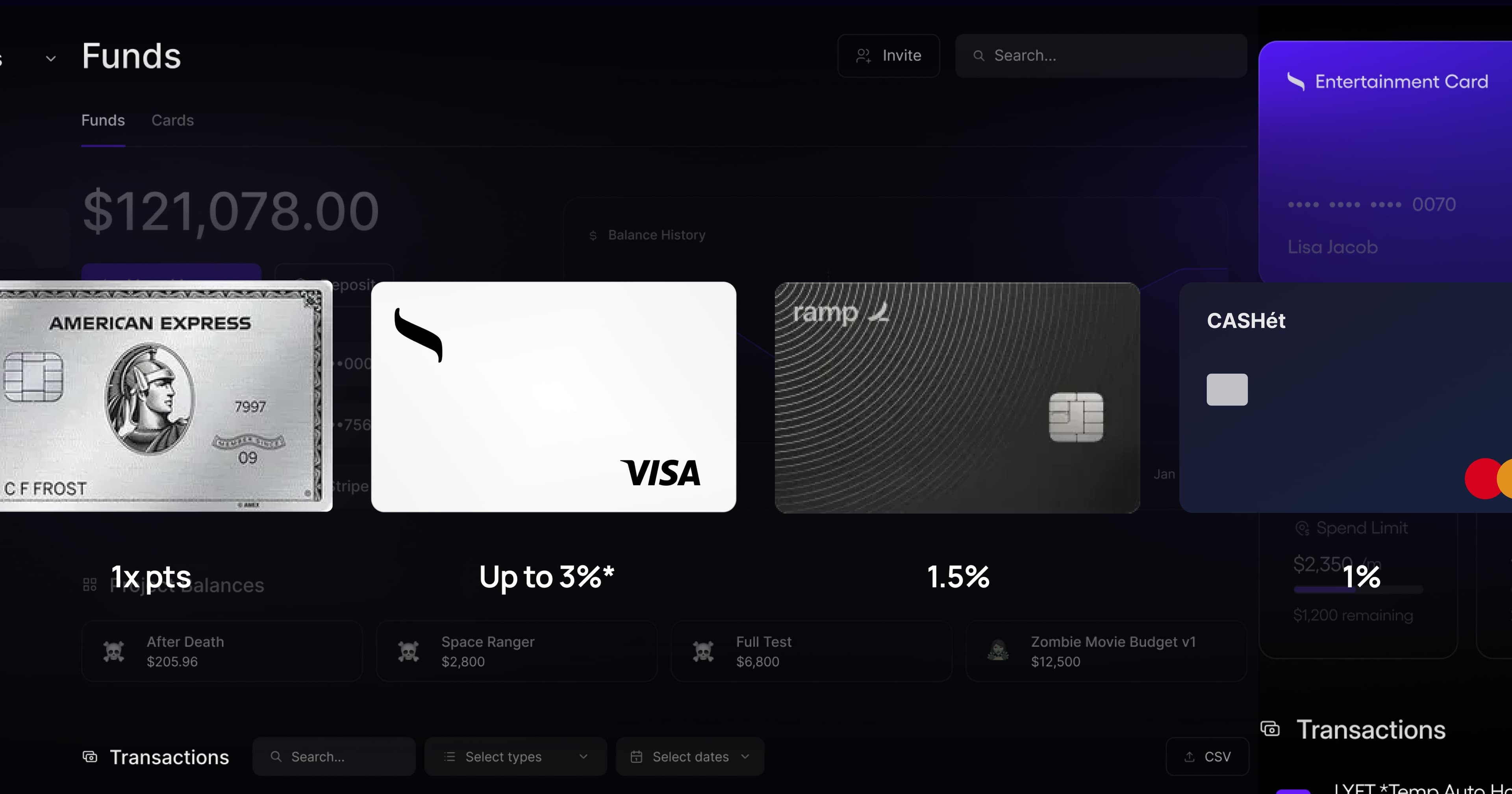
Virtual cards have quietly become the default payment method on most modern productions. They let producers issue a card to every department head, cap spend at the line level, and see every transaction coded to the right budget line without a receipt envelope in sight.
This guide covers how virtual cards work in film production, what to look for in a card program, and how they compare to corporate cards and petty cash on set.
Why productions moved to virtual cards
Five years ago, production companies ran on a mix of corporate Amex cards, a petty cash float per department, and personal reimbursements. That model had known problems:
- No spend control. A single corporate card shared across 8 departments meant producers found out about overspend weeks later.
- Receipt chaos. Department heads accumulated envelopes of receipts, handed them to an accountant at wrap, and the accountant spent days coding them against the budget.
- Personal credit risk. Freelance DPs, production designers, and ADs were putting $5K–$50K of production spend on personal cards and waiting weeks for reimbursement.
- No real-time visibility. Cost reports were based on estimated spend, not actuals. The gap showed up at wrap.
Virtual cards fix all four problems. Each department head gets a dedicated card (physical or digital), spend is controlled at the line level, receipts are captured on the phone at the time of purchase, and the CFO sees every transaction live.
What to look for in a virtual card program
Per-card spend and vendor controls
You should be able to set:
- Dollar limit per day, week, or total
- Approved vendor categories (e.g., fuel, catering, equipment rental)
- Blocked categories (e.g., travel, entertainment) for specific roles
- Geographic restrictions (useful for international shoots)
Corporate cards from Amex, Chase, and Capital One don't offer this granularity. They're designed for business travel, not department-level on-set spend.
Automatic budget coding
The payoff for a production accountant isn't the card itself — it's that every transaction auto-codes to the correct budget line. Look for a platform that maps the card → department → chart of accounts → specific budget line automatically, and uses AI to improve over time as accountants correct mis-codes.
Receipt capture built in
When a card is swiped, the cardholder should get an immediate prompt on their phone to photograph the receipt. The OCR extracts vendor, amount, and tax, and attaches it to the transaction. No envelope collection at wrap.
Real-time budget visibility
Department heads should see their line remaining on their phone, not in a weekly report. This changes behavior: a DP who sees they have $1,200 left on lighting rentals will price-check before committing spend.
Integration with the rest of production finance
Cards are one payment method out of many. Look for a platform where cards, bill pay, purchase orders, payroll, and cost reporting all live in the same place — so the money moves end-to-end without exports or spreadsheets.
Saturation's virtual card program
Saturation issues both virtual and physical cards designed specifically for film production.
- Per-line budget caps. Cards are issued against specific budget lines, not generic budgets. When 80% of a line is used, the cardholder and production accountant get an alert.
- Department-level cards. Each department head gets their own card(s) with spend controls matched to their line authority.
- Auto-coding against your chart of accounts. Transactions map to the exact budget line automatically. AI learns your production's pattern within a few weeks.
- Integrated with production budgeting and banking. The cards sit on top of your Saturation budget and production banking, so every actual flows back into cost reporting without re-entry.
- SOC 2 certified. Role-based access, audit trails, and compliance workflows for studio, equity, and tax incentive reporting.
- Issued on business revenue, not personal credit. Production companies get approved based on project financing and revenue — the cardholder never posts a personal guarantee.
Saturation also offers the Saturation Credit Card — a charge card with up to 3% cash back on production-related spending, designed for production company–level purchases.
Alternatives to Saturation virtual cards
Several card programs market to productions. Here's the honest breakdown:
- Ramp — general business expense cards with strong AI. Not production-specific; accountants have to map transactions to budget lines manually.
- Brex — similar to Ramp. Good for startups and general business spend; requires custom setup for production use.
- CASHét — production-specific, long-established. More traditional than Saturation; less modern UI and AI.
- Bill.com — focused on AP and bill payment; cards are a secondary feature.
- Amex Platinum / Business Cards — personal or single-card issuance. No line-level controls, no automatic budget coding.
How to roll out virtual cards on a production
- Start mid-prep. Set up cards during pre-production so department heads are trained before principal photography.
- Issue per department, not per person. One card for the AD team, one for art, one for camera, etc. Sub-cards to individuals only if needed.
- Configure spend controls first. Every card should have per-day and total limits before it's handed out.
- Require receipts for every transaction. Most platforms enforce this via the mobile app. Don't let exceptions creep in early.
- Reconcile daily, not weekly. Production accountants should spot-check card transactions every evening. Weekly cycles lead to accumulated issues.
- Set budget line alerts at 70–80%. Department heads should know when a line is running tight before it's at 100%.
- Integrate with payroll at wrap. Any card transactions that should flow to contractor payments (W-9s, per-diems) should sync with your payroll partner.
Frequently asked questions about virtual cards for film production
What's the difference between virtual cards and corporate cards for productions?
Virtual cards can be issued per department, per person, per vendor, or per purpose — with distinct spend limits, category restrictions, and budget line associations on each. Corporate cards (Amex, Chase) are typically one-per-company with a shared limit and no line-level controls.
Do virtual cards require a personal credit check?
Reputable production card programs (Saturation, CASHét, Ramp) approve based on business revenue and project financing. Personal credit checks are not required, and the cardholder does not sign a personal guarantee.
Can virtual cards work internationally?
Yes. Most virtual card platforms support international transactions. Watch for FX fees (1–3%) and local network acceptance — rural locations in some countries still prefer cash or local payment methods.
How do virtual cards handle petty cash needs?
For small cash needs (craft, tips, ground crew), a department head can use their virtual card to load a small prepaid amount and distribute cash, logging each disbursement against the budget line. Fully cashless productions are possible but not always practical.
Do production accountants still need to code transactions manually?
With modern virtual card platforms, AI auto-codes 90%+ of transactions. Production accountants review the 5–10% edge cases in batch. This vs. hand-coding every transaction is where the labor savings come from.
Are virtual cards SOC 2 compliant?
The best ones are. SOC 2 Type II is the standard to look for — it covers security, availability, processing integrity, confidentiality, and privacy. Saturation's card program is SOC 2 certified with full audit trails.
Can virtual cards integrate with tax incentive reporting?
Yes, if the card is coded against the budget, the transaction inherits the qualified/non-qualified status of the line. Platforms like Saturation let you see qualified spend in real time and export reports for state tax incentive applications.
Related posts


Ready to modernize your production finance?
Join thousands of production teams using Saturation to budget, track expenses, and manage payments.