
AI Tools for Film Production Budgeting & Actualization (2026)
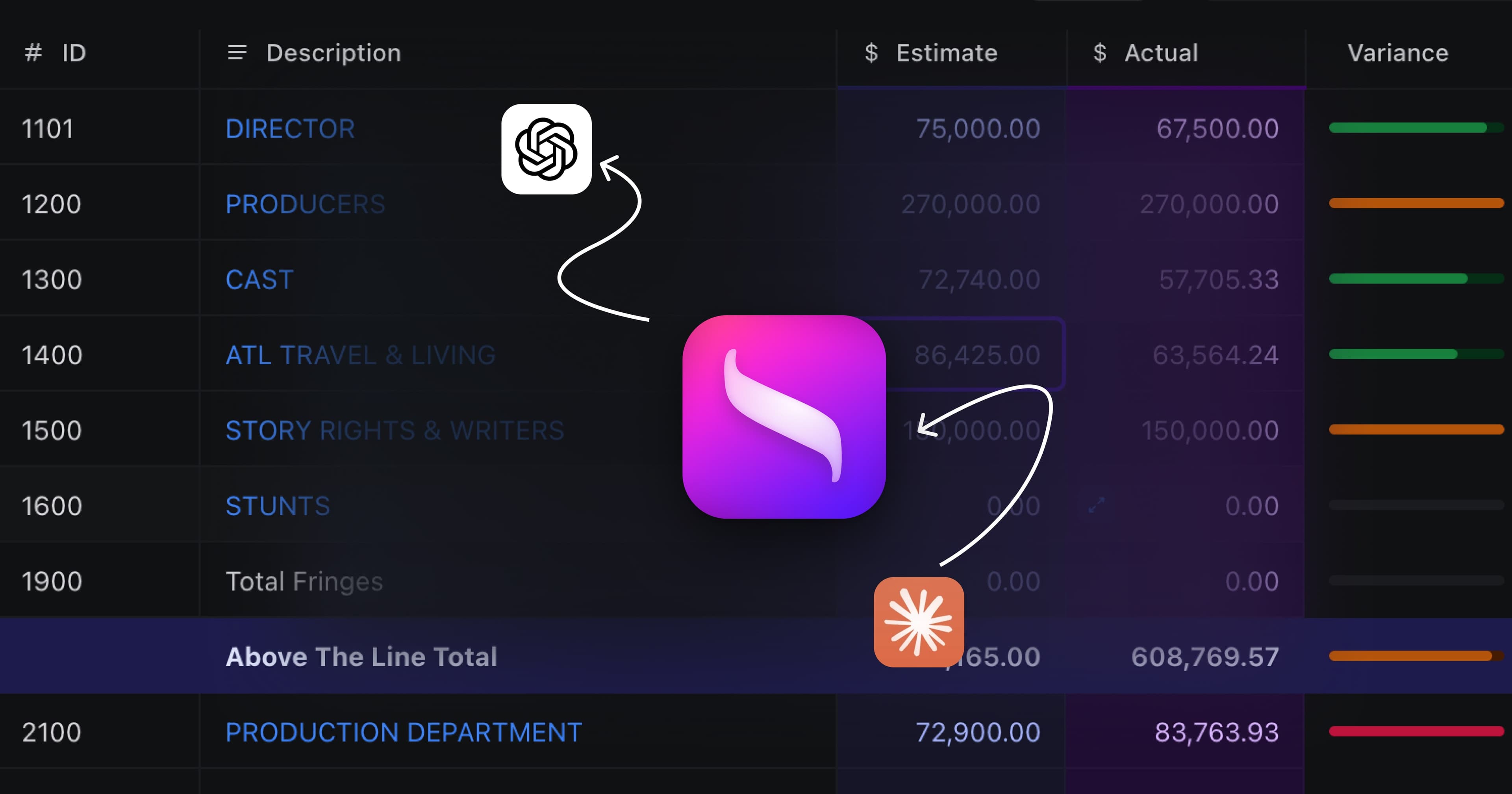
Production finance teams are drowning in line items. A typical feature film budget has 600–2,000 lines across 30+ departments, and every one needs actualization during production. AI tools for film production budgeting and actualization handle the repetitive work — categorizing expenses, matching receipts to line items, generating cost reports — so production accountants can focus on the parts that actually need judgment.
This guide covers what AI tools can and can't do for production finance, what to look for in a platform, and how film-specific AI differs from generic expense management AI.
What AI actually does in production finance
"AI" in this context is not a single feature — it's a cluster of automations that sit on top of a production budget. The useful ones today:
- Expense categorization. When a receipt, invoice, or card transaction lands, AI reads the merchant, amount, department context, and line-item history to suggest the right budget line. Good systems learn from your corrections.
- Receipt OCR. Photograph a receipt on set, AI extracts vendor, date, total, and tax. Production accountants don't retype anything.
- Invoice parsing. Pulls line items, vendor identity, and GL codes from vendor invoices. Matches against purchase orders.
- Actualization suggestions. When actuals come in against an estimated line, AI surfaces variance early and suggests re-forecasting — before the weekly cost report.
- Cost report narrative. Draft the executive summary of a cost report based on the raw variance data. The producer still reviews and edits — but they aren't starting from a blank page.
What AI shouldn't replace
Film accounting has edge cases that generic AI gets wrong. AI tools should augment, not replace, production accountants on:
- Union fringes. IATSE, DGA, SAG-AFTRA fringes vary by agreement, location, and role. Any tool that guesses fringes without consulting the actual agreement will get this wrong on a regular basis.
- Tax incentive qualification. Rules around what counts as a qualified expense vary by state and country. AI can suggest — but a production accountant should confirm before an expense hits the qualified pool.
- Rate negotiation context. An invoice from a DP might be $8,500/week because it was negotiated that way; it doesn't mean the line was under-budgeted.
- Cost report narrative. AI can draft it; you still need to explain why something happened to the studio or equity partner.
What to look for in an AI production finance platform
Generic expense tools (Expensify, Ramp, Brex) have AI for business spend. Film production needs industry-specific AI that understands:
- Production chart of accounts. 100-series through 7000-series account structures. AI should map against the AICP, indie, or custom chart you're running on — not a generic SaaS chart.
- Episode/project-level cost centers. For TV, AI should cost-code by episode, not by month.
- Department-level context. A $2,800 charge from an equipment rental house means something different in camera vs. grip vs. lighting.
- Fringe, tax, and overtime awareness. AI should know what's a raw cost vs. what carries fringes.
- Real-time variance alerts. AI that waits until the weekly cost report to flag overspend is too late. You want alerts when a line crosses 80%, not after it's at 150%.
- Learns from your corrections. When a production accountant re-codes a suggested category, the model should improve for the next similar transaction.
Saturation's approach to AI in production finance
Saturation Production Intelligence is built specifically for how film and TV finance teams work. It integrates with the budget, cards, and actuals you're already running on — not bolted-on as a separate AI product.
- Every card transaction, receipt, invoice, and PO is auto-coded to the correct budget line based on the production's chart of accounts, department, and historical patterns.
- Cost reports generate themselves: AI drafts the variance narrative, you review and edit before sending to producers.
- Real-time variance detection surfaces overspend as it happens, not when the cost report is due.
- Fringes, overtime, and tax-qualified spend are tracked against the agreements and state rules actually in effect on your show.
- The platform works on top of Saturation's production budgeting, production banking, and expense cards — all your spend flows through one system.
How other production tools handle AI
Most legacy film budgeting tools (Movie Magic, Showbiz Budgeting, Hot Budget) were designed before AI was practical. They're file-based, desktop-first, and treat actualization as a manual data-entry workflow. Spreadsheets are worse — there's no AI at all, and every line is typed or pasted.
Modern production tools are starting to add AI layers:
- Wrapbook has some AI for payroll/crew onboarding but not budgeting or actualization.
- GreenSlate is primarily payroll-focused.
- StudioBinder is production management, not financial actualization.
- Filmustage applies AI to pre-production script breakdown — a different layer.
The only platform built end-to-end around AI for production finance — budgeting, cards, banking, actuals, and reporting in one system — is Saturation.
Practical adoption for productions
If you're evaluating AI tools for your next production, here's what we'd recommend:
- Start with actualization, not budgeting. Building a budget is still a judgment exercise. Actualizing receipts, invoices, and card transactions against that budget is where AI saves real hours per week.
- Adopt on one show first. Run a pilot on a single commercial, short, or pilot episode. Measure hours saved per week, then expand.
- Keep humans in the approval loop. AI suggests categorizations; production accountants approve in bulk. Don't auto-apply without review in the first cycle.
- Integrate with payroll. AI budgeting + payroll disconnect = duplicate data entry. Whichever platform you choose should integrate with your payroll partner.
- Use real-time reporting, not end-of-week. The point of AI is faster feedback loops. If your AI tool still only reports weekly, you've lost half the value.
Frequently asked questions about AI production finance
Is AI for film production budgeting just Copilot or ChatGPT?
No. Generic LLM tools like ChatGPT don't know your chart of accounts, department structure, fringes, tax incentives, or production history. Film production AI is purpose-built on that data — it's an AI that understands production finance, not a chatbot bolted onto a budget.
Can AI replace a production accountant?
No, and any platform that claims this is misleading. Production accountants still make judgment calls on cost reporting, tax incentive qualification, fringes, overtime, and studio/equity relationships. AI removes the repetitive data entry so accountants spend their time on the high-value work.
How accurate is AI expense categorization?
On Saturation, AI categorization is 90%+ accurate out of the box on most productions, and improves above 95% within a few weeks as the model learns from corrections. The remaining 5–10% are edge cases — production accountants review them in batch rather than every single transaction.
Does AI work for commercial and music video production, or only features?
It works best on any production with a structured budget and chart of accounts. Saturation's AI runs on commercial, music video, feature film, TV, and documentary productions — because each has the same underlying structure of budget → actuals → variance reporting.
How do AI tools handle union fringes and tax incentives?
Good AI tools don't guess these rules — they reference the actual agreements and state rules in effect on the show. Saturation syncs with the union agreements you specify and the tax incentive rules for each jurisdiction you're filming in.
What's the difference between AI for budgeting and AI for cost reporting?
Budgeting is pre-production — AI helps by suggesting line rates from historical productions. Cost reporting is during production — AI helps by summarizing variance, flagging risks, and drafting the executive narrative. Both should work off the same platform so estimates flow directly into actuals.
Is AI production finance safe for studio and equity reporting?
Yes, provided the platform has SOC 2 compliance, role-based access control, and full audit trails. AI suggestions are recommendations — every actualization, cost report, and financial statement still flows through your approval workflow before it leaves your team.
Related posts
Ready to modernize your production finance?
Join thousands of production teams using Saturation to budget, track expenses, and manage payments.