Indie Film Budget Template: Complete Guide (2026)
Feb 21, 2026

Every indie film starts with a budget. Not a guess, not a wishlist. A real, line-by-line budget that tells you what you can actually make for what you actually have.

The problem? Most indie filmmakers either use a template built for $50M studio productions (overwhelming and useless) or they cobble something together in a spreadsheet that falls apart by week two of pre-production.

This guide gives you a free indie film budget template built specifically for independent productions, explains every major category, and shows you how to adapt it for your specific budget size, whether you're shooting for $5,000 or $500,000.

What Makes a Good Indie Film Budget Template?

A useful indie film budget template does three things:

  • Covers all the categories you'll actually encounter in production without burying you in line items designed for union features with 200-person crews

  • Scales to your budget size: a $20K short film has different needs than a $500K feature

  • Tracks actuals alongside estimates so you know if you're over budget before it's too late

Most free templates you'll find online fail on at least one of these. Smartsheet and Airtable offer generic templates with no film-specific line items. StudioBinder's template is useful but doesn't explain how to calculate fringes or contingency. Reddit threads give you outdated Excel files from 2015.

Below is a complete indie film budget template with every major category, plus explanations of how to calculate the tricky line items like fringes, overtime, and contingency.

The Standard Indie Film Budget Template (All Categories)

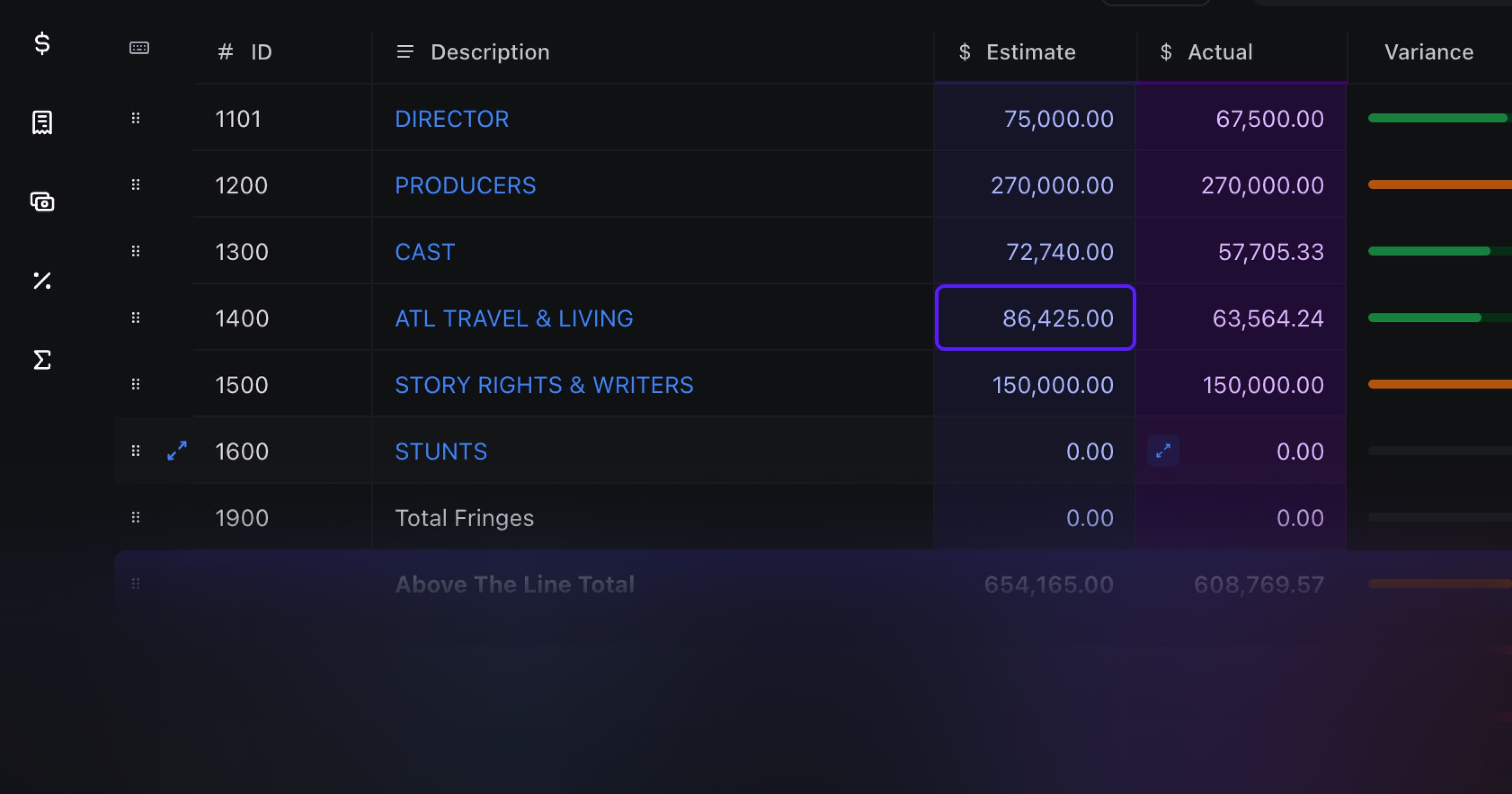
Film budgets are divided into two main sections: Above the Line (ATL) and Below the Line (BTL). Think of ATL as the creative talent and BTL as everything else.

Above the Line (ATL)

ATL covers the creative team whose fees are negotiated before the budget is locked. For indie films, these are often deferred or reduced.

Category

Line Items

Notes

Story & Screenplay

Script purchase, option fees, WGA fees

Often $0 for writer-directors

Producers

Producer fee, line producer fee, associate producers

Frequently deferred on micro-budget

Director

Director fee, DGA fees (if applicable)

Scale is $0 on micro-budget, $5K-$50K+ on mid-range

Cast

Principal cast fees, SAG minimums, casting director

SAG ULB: $300K ceiling, $232-$241/day minimums

Below the Line: Pre-Production

Category

Line Items

Notes

Casting

Casting director, audition space, extras casting

Often flat fee for indie

Location Scouting

Scout fees, mileage, permits research

Budget 1-3% of total for location-heavy scripts

Art Direction

Production designer, art director, research materials

Pre-pro design work separate from shoot costs

Rehearsals

Studio space, actor per diems during rehearsal

Often skipped on micro-budget

Below the Line: Production

This is the largest section of any indie film budget. It covers everything that happens during principal photography.

Department

Key Line Items

Production Staff

1st AD, 2nd AD, script supervisor, production coordinator, PA salaries

Camera

DP fee, camera operator, 1st AC, 2nd AC, DIT, camera package rental

Lighting/Grip

Gaffer, best boy electric, key grip, best boy grip, lighting package, grip package

Sound

Production sound mixer, boom operator, sound package rental

Art Department

Production designer, art director, set decorator, prop master, props budget

Costume/Wardrobe

Costume designer, wardrobe supervisor, costume rental/purchase

Hair & Makeup

Department head, artist fees, kit fees, supplies

Locations

Location fees, permits, scouting costs, parking, location manager

Transportation

Production vehicles, fuel, driver wages, equipment transport

Catering/Craft

Catering per meal per person, craft service daily allowance

VFX on Set

VFX supervisor (if needed), witness cameras, reference shoots

Second Unit

Second unit director, crew, equipment (if applicable)

Below the Line: Post-Production

Category

Key Line Items

Editing

Editor fee, assistant editor, editing suite/software

VFX/Graphics

VFX artists, compositing, motion graphics, title design

Music

Composer fee, score recording, music licensing, music supervisor

Sound Post

Sound design, dialogue editing, ADR, foley, mix studio

Color Grading

Colorist fee, suite rental, deliverable formatting

Legal

E&O insurance, clearances, contracts, rights agreements

Deliverables

DCP creation, closed captions, festival screeners, digital masters

Other Budget Categories

Category

Key Line Items

Insurance

Production insurance, liability, equipment, worker's comp

Publicity

EPK, stills photographer, press materials

Fringes

Payroll taxes, union fringes (calculated as % of wages)

Contingency

10% of total budget (standard industry buffer)

How to Calculate the Tricky Line Items

Fringes

Fringes are the employer-side costs on top of wages: payroll taxes, health, pension, and union contributions. For indie non-union productions, fringes are primarily payroll taxes.

Standard fringe rates for indie productions:

  • Non-union, contractor payments: 0% (contractors pay their own taxes)

  • Non-union, employees (W-2): 18-22% of wages (FICA, FUTA, state)

  • SAG-AFTRA ultra low budget: Add 14.3% health and pension on top of wages

  • Full union (IATSE, Teamsters): 30-45% depending on local

Most indie productions under $1M pay key crew as contractors (1099) and don't owe union fringes. Always confirm with a production accountant for your specific jurisdiction.

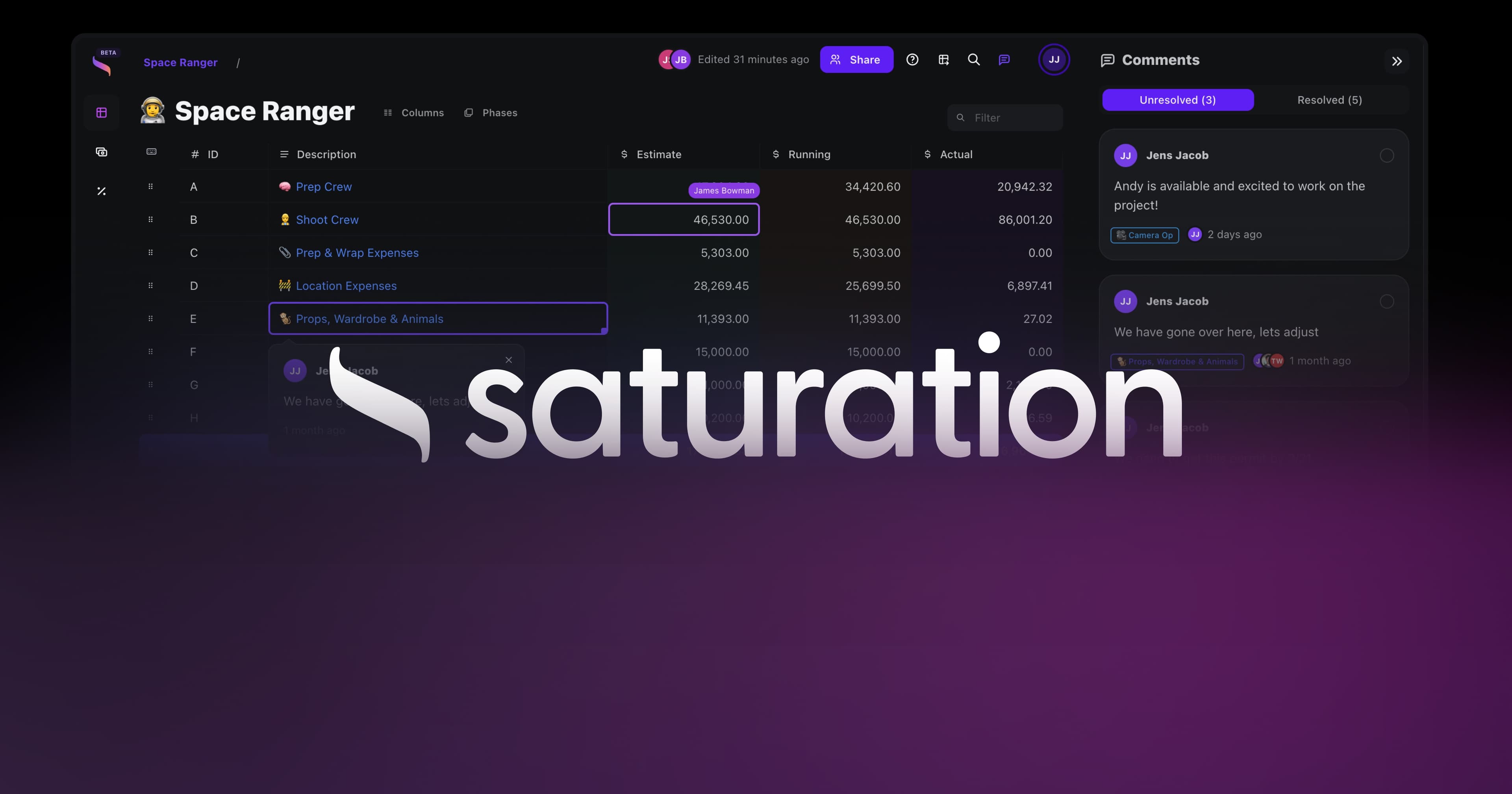
If you're using Saturation to manage your budget, fringe calculations are built in. You set the rate per crew member and the system applies it automatically across all wage line items. No manual math per department.

Contingency

Contingency is 10% of your total below-the-line budget, set aside for overages. It is not optional.

Weather delays, equipment failures, actor illness, permits taking longer than expected. Any of these can eat your budget if you haven't reserved a buffer. Studios typically budget 10-15% contingency. Indie films often try to skip it. Don't.

Overtime

For union productions, overtime kicks in after 8 hours (or 10 on some agreements). For non-union indie productions, whether you pay OT is a negotiation, but plan for it. A 10-hour shoot day with a 12-hour crew call means OT for the last two hours.

Budget overtime as a percentage add-on to your daily crew rates. For shoots expecting long days, add 15-25% to your labor line.

Free Indie Film Budget Template by Budget Size

Not all indie film budgets look the same. Here's how to adapt the template to your specific range.

Micro-Budget Template ($0-$25,000)

At this level, nearly everything is deferred or favored-nation (everyone gets the same rate, often $0-$100/day). Your budget is mostly equipment rental, locations, food, and materials.

Key adjustments:

  • ATL: Director/writer/producer fees all deferred

  • Cast: SAG Short Film Agreement or student/indie waiver ($0 or nominal)

  • Crew: Most positions filled by crew working for credit or very low pay

  • Post: Editor may be deferred; use free/low-cost software (DaVinci Resolve, Premiere)

  • Contingency: Still 10%, which at this level is $1,000-$2,500

For a deeper dive on this budget tier, read our guide to micro-budget filmmaking, which covers how films like Tangerine ($8,000) and Primer ($7,000) were made.

Low-Budget Feature Template ($25,000-$250,000)

This is where most serious indie features live. You're paying at least some crew, likely using the SAG Ultra Low Budget Agreement, and renting proper equipment.

Key adjustments:

  • ATL: Director fee $5K-$25K, producer fee $5K-$20K (often deferred in part)

  • Cast: SAG ULB minimums ($232-$241/day), casting director $3K-$8K flat

  • Camera: DP $500-$1,500/day, camera package $500-$2,000/day

  • Post: Budget $15K-$40K for editor, mix, color, and VFX

  • Insurance: Production package $2K-$6K for a 3-4 week shoot

Mid-Budget Indie Template ($250,000-$1,000,000)

At this level you're paying everyone, dealing with more union obligations, and need a real line producer and production accountant.

Key adjustments:

  • Hire a line producer: $10K-$30K for a feature (critical at this level)

  • Production accountant: $8K-$20K (non-negotiable; you need real cost reports)

  • Fringes: Budget 20-35% on top of union crew wages

  • Legal: $10K-$25K for contracts, clearances, E&O

  • Post: Budget $80K-$200K for full post pipeline

At this budget tier, using a spreadsheet to track actuals is a real risk. A dedicated budgeting tool that connects your estimate to your actuals and shows you cost-to-complete in real time becomes essential. See how film production accounting software changes the process at this level.

Excel vs. Google Sheets vs. Cloud Budgeting Software

Most indie film budget templates come as Excel files or Google Sheets. Here's what you need to know about each option.

Excel (.xlsx)

Pros: Works offline, powerful formulas, widely used by line producers and ACs

Cons: Not collaborative in real time, version control is a nightmare, no mobile access, fringe calculations are manual

Best for: Solo producers who don't need to share the budget with a team

Google Sheets

Pros: Free, real-time collaboration, accessible anywhere, comments and version history

Cons: No industry-standard formatting, limited functions for production-specific math, can get slow with large budgets, no built-in fringe calculation

Best for: Small crews where collaboration matters more than professional formatting

Movie Magic Budgeting

Pros: Industry standard, used by studios and experienced line producers, AICP and union fringe tables built in

Cons: $42.99/month, desktop-only (Mac and Windows), no real-time collaboration, steep learning curve

Best for: Mid-budget and studio productions with professional line producers

Saturation (Cloud-Native)

Pros: Free tier available, real-time collaboration, built-in fringe calculations, expense tracking that connects to your budget, Saturation Pay for contractor payments, accessible from any device, AICP template for commercial productions

Cons: Newer platform, not yet as widely recognized by veteran line producers accustomed to Movie Magic

Best for: Indie producers who want a modern, collaborative budgeting tool that grows with them from micro-budget to mid-budget

The key advantage of Saturation over any static template: your budget and your actuals live in the same system. When you pay a crew member through Saturation Pay, that payment automatically updates your cost report. You don't have to manually reconcile your budget against your expenses. The system does it for you.

You can start with a free account and build your first indie film budget without a credit card. For productions ready to track actuals, the paid plans start at $25/month.

Common Indie Film Budgeting Mistakes

1. Forgetting Fringe on Union Positions

If you hire SAG actors, you owe health and pension contributions on top of their minimums. Many first-time producers budget the day rate and forget the 14.3% fringe on top. That oversight on a $50K cast budget is an extra $7,150 you didn't plan for.

2. Underestimating Post-Production

Post is expensive and takes longer than expected. Rookie mistake: spending 80% of the budget on production and then scrambling to finish post on $5,000. A well-structured indie budget allocates 20-30% to post for features.

3. No Contingency

We said it before: 10% contingency is not optional. Skipping it doesn't make your film cheaper. It means your film will go over budget and you'll scramble to find emergency funds.

4. Ignoring Location-Related Costs

Beyond the location fee, you need permits (often $500-$5,000 per location depending on city), liability insurance for filming on private or public property, parking for crew vehicles, and generator fees if the location doesn't have adequate power. Budget these separately from your location fees.

5. Budgeting for 8-Hour Days

Indie shoots rarely run 8 hours. Budget for 10-12 hour days minimum, and include overtime rates or a per-day flat that accounts for longer days.

6. Missing the Soft Costs

Accountant fees, payroll service fees, bank charges, wire transfer fees, legal review of contracts. None of these are glamorous, but they add up to 3-5% of your total budget on features. Build them into your production overhead line.

Building Your Budget: Step by Step

  1. Start with your script breakdown. Count the locations, cast, props, and special requirements in every scene. This tells you what departments you actually need.

  2. Get your shooting schedule. Total shoot days determine your crew days, equipment rental periods, and catering costs. Everything else in your budget is a function of how many days you're shooting. For detailed guidance, see our guide to creating a shooting schedule.

  3. Price out your key departments. Get quotes from DP, production designer, sound mixer, and editor before locking the budget. These four departments often represent 40-60% of a mid-budget indie's below-the-line costs.

  4. Add fringes and overhead. Apply your fringe rate to all wage line items. Add production overhead (accounting, legal, bank charges) as a separate line.

  5. Apply 10% contingency. Calculate 10% of your total BTL budget and add it as a contingency line.

  6. Reconcile with your financing. If your total is over your financing cap, identify which departments have flex. Locations, camera packages, and catering are usually the most adjustable. ATL fees are often the last to be cut.

Frequently Asked Questions

What is a typical indie film budget template format?

Most indie film budget templates use the standard ATL/BTL structure with categories for story, producers, director, cast, production departments (camera, lighting, sound, art, wardrobe, hair/makeup), locations, transportation, catering, post-production departments (editing, VFX, sound, music, color), insurance, fringes, and contingency. The AICP format adds a commercial-specific structure for commercial productions.

Can I get an indie film budget template for free?

Yes. Saturation offers a free account that includes a full production budget template pre-loaded with all the standard categories. You can also find free Excel and Google Sheets templates on sites like StudioBinder and No Film School, though these don't include built-in fringe calculation or actual expense tracking.

How much should I budget for a short film?

Short film budgets vary widely. A one-day shoot with a small crew might cost $500-$2,000. A 5-day short with paid union cast could run $10,000-$50,000. Key cost drivers are shoot days, cast size, locations, and post-production complexity. Use the same ATL/BTL template structure regardless of budget size.

What is the difference between a film budget and a cost report?

A film budget is your estimate before production starts. A cost report (also called a DCR or daily cost report) tracks what you've actually spent against that estimate during and after production. The budget sets your plan; the cost report shows your reality. Good budgeting software like Saturation connects both so you can see your cost-to-complete at any point in production.

Do I need Movie Magic Budgeting for an indie film?

Not necessarily. Movie Magic Budgeting is the industry standard at the studio level and for productions working closely with studio-trained line producers. For indie productions under $1M, a well-structured Excel, Google Sheets, or cloud-based budget template works fine. Movie Magic becomes more valuable when you're working with union fringe tables and need the format that production accountants and financiers are accustomed to seeing.

How do I calculate fringes on my indie film budget?

For non-union productions with contractors (1099 workers), fringes are $0; contractors handle their own taxes. For employees (W-2), add 18-22% to cover FICA, FUTA, and state unemployment taxes. For SAG actors on the Ultra Low Budget Agreement, add 14.3% health and pension contributions on top of the day rate. For full union crew (IATSE), fringe rates vary by local but typically run 30-45%. Always confirm current rates with a production accountant.

What percentage of an indie film budget should go to post-production?

Plan for 20-30% of your total budget for post-production on a feature. This covers editor, assistant editor, VFX, sound design, ADR, foley, mix, music (composer plus licensing), color grading, and deliverables. First-time producers consistently underestimate post costs and run out of money before finishing.

Should I use Excel or Google Sheets for my indie film budget?

Google Sheets is better for collaboration, so your line producer, department heads, and investors can all view the budget in real time. Excel is better for complex formulas and offline use. For productions that also need to track actual expenses, a purpose-built tool like Saturation combines budgeting and expense tracking in one platform, eliminating the need to manually reconcile two spreadsheets.

Every indie film starts with a budget. Not a guess, not a wishlist. A real, line-by-line budget that tells you what you can actually make for what you actually have.

The problem? Most indie filmmakers either use a template built for $50M studio productions (overwhelming and useless) or they cobble something together in a spreadsheet that falls apart by week two of pre-production.

This guide gives you a free indie film budget template built specifically for independent productions, explains every major category, and shows you how to adapt it for your specific budget size, whether you're shooting for $5,000 or $500,000.

What Makes a Good Indie Film Budget Template?

A useful indie film budget template does three things:

  • Covers all the categories you'll actually encounter in production without burying you in line items designed for union features with 200-person crews

  • Scales to your budget size: a $20K short film has different needs than a $500K feature

  • Tracks actuals alongside estimates so you know if you're over budget before it's too late

Most free templates you'll find online fail on at least one of these. Smartsheet and Airtable offer generic templates with no film-specific line items. StudioBinder's template is useful but doesn't explain how to calculate fringes or contingency. Reddit threads give you outdated Excel files from 2015.

Below is a complete indie film budget template with every major category, plus explanations of how to calculate the tricky line items like fringes, overtime, and contingency.

The Standard Indie Film Budget Template (All Categories)

Film budgets are divided into two main sections: Above the Line (ATL) and Below the Line (BTL). Think of ATL as the creative talent and BTL as everything else.

Above the Line (ATL)

ATL covers the creative team whose fees are negotiated before the budget is locked. For indie films, these are often deferred or reduced.

Category

Line Items

Notes

Story & Screenplay

Script purchase, option fees, WGA fees

Often $0 for writer-directors

Producers

Producer fee, line producer fee, associate producers

Frequently deferred on micro-budget

Director

Director fee, DGA fees (if applicable)

Scale is $0 on micro-budget, $5K-$50K+ on mid-range

Cast

Principal cast fees, SAG minimums, casting director

SAG ULB: $300K ceiling, $232-$241/day minimums

Below the Line: Pre-Production

Category

Line Items

Notes

Casting

Casting director, audition space, extras casting

Often flat fee for indie

Location Scouting

Scout fees, mileage, permits research

Budget 1-3% of total for location-heavy scripts

Art Direction

Production designer, art director, research materials

Pre-pro design work separate from shoot costs

Rehearsals

Studio space, actor per diems during rehearsal

Often skipped on micro-budget

Below the Line: Production

This is the largest section of any indie film budget. It covers everything that happens during principal photography.

Department

Key Line Items

Production Staff

1st AD, 2nd AD, script supervisor, production coordinator, PA salaries

Camera

DP fee, camera operator, 1st AC, 2nd AC, DIT, camera package rental

Lighting/Grip

Gaffer, best boy electric, key grip, best boy grip, lighting package, grip package

Sound

Production sound mixer, boom operator, sound package rental

Art Department

Production designer, art director, set decorator, prop master, props budget

Costume/Wardrobe

Costume designer, wardrobe supervisor, costume rental/purchase

Hair & Makeup

Department head, artist fees, kit fees, supplies

Locations

Location fees, permits, scouting costs, parking, location manager

Transportation

Production vehicles, fuel, driver wages, equipment transport

Catering/Craft

Catering per meal per person, craft service daily allowance

VFX on Set

VFX supervisor (if needed), witness cameras, reference shoots

Second Unit

Second unit director, crew, equipment (if applicable)

Below the Line: Post-Production

Category

Key Line Items

Editing

Editor fee, assistant editor, editing suite/software

VFX/Graphics

VFX artists, compositing, motion graphics, title design

Music

Composer fee, score recording, music licensing, music supervisor

Sound Post

Sound design, dialogue editing, ADR, foley, mix studio

Color Grading

Colorist fee, suite rental, deliverable formatting

Legal

E&O insurance, clearances, contracts, rights agreements

Deliverables

DCP creation, closed captions, festival screeners, digital masters

Other Budget Categories

Category

Key Line Items

Insurance

Production insurance, liability, equipment, worker's comp

Publicity

EPK, stills photographer, press materials

Fringes

Payroll taxes, union fringes (calculated as % of wages)

Contingency

10% of total budget (standard industry buffer)

How to Calculate the Tricky Line Items

Fringes

Fringes are the employer-side costs on top of wages: payroll taxes, health, pension, and union contributions. For indie non-union productions, fringes are primarily payroll taxes.

Standard fringe rates for indie productions:

  • Non-union, contractor payments: 0% (contractors pay their own taxes)

  • Non-union, employees (W-2): 18-22% of wages (FICA, FUTA, state)

  • SAG-AFTRA ultra low budget: Add 14.3% health and pension on top of wages

  • Full union (IATSE, Teamsters): 30-45% depending on local

Most indie productions under $1M pay key crew as contractors (1099) and don't owe union fringes. Always confirm with a production accountant for your specific jurisdiction.

If you're using Saturation to manage your budget, fringe calculations are built in. You set the rate per crew member and the system applies it automatically across all wage line items. No manual math per department.

Contingency

Contingency is 10% of your total below-the-line budget, set aside for overages. It is not optional.

Weather delays, equipment failures, actor illness, permits taking longer than expected. Any of these can eat your budget if you haven't reserved a buffer. Studios typically budget 10-15% contingency. Indie films often try to skip it. Don't.

Overtime

For union productions, overtime kicks in after 8 hours (or 10 on some agreements). For non-union indie productions, whether you pay OT is a negotiation, but plan for it. A 10-hour shoot day with a 12-hour crew call means OT for the last two hours.

Budget overtime as a percentage add-on to your daily crew rates. For shoots expecting long days, add 15-25% to your labor line.

Free Indie Film Budget Template by Budget Size

Not all indie film budgets look the same. Here's how to adapt the template to your specific range.

Micro-Budget Template ($0-$25,000)

At this level, nearly everything is deferred or favored-nation (everyone gets the same rate, often $0-$100/day). Your budget is mostly equipment rental, locations, food, and materials.

Key adjustments:

  • ATL: Director/writer/producer fees all deferred

  • Cast: SAG Short Film Agreement or student/indie waiver ($0 or nominal)

  • Crew: Most positions filled by crew working for credit or very low pay

  • Post: Editor may be deferred; use free/low-cost software (DaVinci Resolve, Premiere)

  • Contingency: Still 10%, which at this level is $1,000-$2,500

For a deeper dive on this budget tier, read our guide to micro-budget filmmaking, which covers how films like Tangerine ($8,000) and Primer ($7,000) were made.

Low-Budget Feature Template ($25,000-$250,000)

This is where most serious indie features live. You're paying at least some crew, likely using the SAG Ultra Low Budget Agreement, and renting proper equipment.

Key adjustments:

  • ATL: Director fee $5K-$25K, producer fee $5K-$20K (often deferred in part)

  • Cast: SAG ULB minimums ($232-$241/day), casting director $3K-$8K flat

  • Camera: DP $500-$1,500/day, camera package $500-$2,000/day

  • Post: Budget $15K-$40K for editor, mix, color, and VFX

  • Insurance: Production package $2K-$6K for a 3-4 week shoot

Mid-Budget Indie Template ($250,000-$1,000,000)

At this level you're paying everyone, dealing with more union obligations, and need a real line producer and production accountant.

Key adjustments:

  • Hire a line producer: $10K-$30K for a feature (critical at this level)

  • Production accountant: $8K-$20K (non-negotiable; you need real cost reports)

  • Fringes: Budget 20-35% on top of union crew wages

  • Legal: $10K-$25K for contracts, clearances, E&O

  • Post: Budget $80K-$200K for full post pipeline

At this budget tier, using a spreadsheet to track actuals is a real risk. A dedicated budgeting tool that connects your estimate to your actuals and shows you cost-to-complete in real time becomes essential. See how film production accounting software changes the process at this level.

Excel vs. Google Sheets vs. Cloud Budgeting Software

Most indie film budget templates come as Excel files or Google Sheets. Here's what you need to know about each option.

Excel (.xlsx)

Pros: Works offline, powerful formulas, widely used by line producers and ACs

Cons: Not collaborative in real time, version control is a nightmare, no mobile access, fringe calculations are manual

Best for: Solo producers who don't need to share the budget with a team

Google Sheets

Pros: Free, real-time collaboration, accessible anywhere, comments and version history

Cons: No industry-standard formatting, limited functions for production-specific math, can get slow with large budgets, no built-in fringe calculation

Best for: Small crews where collaboration matters more than professional formatting

Movie Magic Budgeting

Pros: Industry standard, used by studios and experienced line producers, AICP and union fringe tables built in

Cons: $42.99/month, desktop-only (Mac and Windows), no real-time collaboration, steep learning curve

Best for: Mid-budget and studio productions with professional line producers

Saturation (Cloud-Native)

Pros: Free tier available, real-time collaboration, built-in fringe calculations, expense tracking that connects to your budget, Saturation Pay for contractor payments, accessible from any device, AICP template for commercial productions

Cons: Newer platform, not yet as widely recognized by veteran line producers accustomed to Movie Magic

Best for: Indie producers who want a modern, collaborative budgeting tool that grows with them from micro-budget to mid-budget

The key advantage of Saturation over any static template: your budget and your actuals live in the same system. When you pay a crew member through Saturation Pay, that payment automatically updates your cost report. You don't have to manually reconcile your budget against your expenses. The system does it for you.

You can start with a free account and build your first indie film budget without a credit card. For productions ready to track actuals, the paid plans start at $25/month.

Common Indie Film Budgeting Mistakes

1. Forgetting Fringe on Union Positions

If you hire SAG actors, you owe health and pension contributions on top of their minimums. Many first-time producers budget the day rate and forget the 14.3% fringe on top. That oversight on a $50K cast budget is an extra $7,150 you didn't plan for.

2. Underestimating Post-Production

Post is expensive and takes longer than expected. Rookie mistake: spending 80% of the budget on production and then scrambling to finish post on $5,000. A well-structured indie budget allocates 20-30% to post for features.

3. No Contingency

We said it before: 10% contingency is not optional. Skipping it doesn't make your film cheaper. It means your film will go over budget and you'll scramble to find emergency funds.

4. Ignoring Location-Related Costs

Beyond the location fee, you need permits (often $500-$5,000 per location depending on city), liability insurance for filming on private or public property, parking for crew vehicles, and generator fees if the location doesn't have adequate power. Budget these separately from your location fees.

5. Budgeting for 8-Hour Days

Indie shoots rarely run 8 hours. Budget for 10-12 hour days minimum, and include overtime rates or a per-day flat that accounts for longer days.

6. Missing the Soft Costs

Accountant fees, payroll service fees, bank charges, wire transfer fees, legal review of contracts. None of these are glamorous, but they add up to 3-5% of your total budget on features. Build them into your production overhead line.

Building Your Budget: Step by Step

  1. Start with your script breakdown. Count the locations, cast, props, and special requirements in every scene. This tells you what departments you actually need.

  2. Get your shooting schedule. Total shoot days determine your crew days, equipment rental periods, and catering costs. Everything else in your budget is a function of how many days you're shooting. For detailed guidance, see our guide to creating a shooting schedule.

  3. Price out your key departments. Get quotes from DP, production designer, sound mixer, and editor before locking the budget. These four departments often represent 40-60% of a mid-budget indie's below-the-line costs.

  4. Add fringes and overhead. Apply your fringe rate to all wage line items. Add production overhead (accounting, legal, bank charges) as a separate line.

  5. Apply 10% contingency. Calculate 10% of your total BTL budget and add it as a contingency line.

  6. Reconcile with your financing. If your total is over your financing cap, identify which departments have flex. Locations, camera packages, and catering are usually the most adjustable. ATL fees are often the last to be cut.

Frequently Asked Questions

What is a typical indie film budget template format?

Most indie film budget templates use the standard ATL/BTL structure with categories for story, producers, director, cast, production departments (camera, lighting, sound, art, wardrobe, hair/makeup), locations, transportation, catering, post-production departments (editing, VFX, sound, music, color), insurance, fringes, and contingency. The AICP format adds a commercial-specific structure for commercial productions.

Can I get an indie film budget template for free?

Yes. Saturation offers a free account that includes a full production budget template pre-loaded with all the standard categories. You can also find free Excel and Google Sheets templates on sites like StudioBinder and No Film School, though these don't include built-in fringe calculation or actual expense tracking.

How much should I budget for a short film?

Short film budgets vary widely. A one-day shoot with a small crew might cost $500-$2,000. A 5-day short with paid union cast could run $10,000-$50,000. Key cost drivers are shoot days, cast size, locations, and post-production complexity. Use the same ATL/BTL template structure regardless of budget size.

What is the difference between a film budget and a cost report?

A film budget is your estimate before production starts. A cost report (also called a DCR or daily cost report) tracks what you've actually spent against that estimate during and after production. The budget sets your plan; the cost report shows your reality. Good budgeting software like Saturation connects both so you can see your cost-to-complete at any point in production.

Do I need Movie Magic Budgeting for an indie film?

Not necessarily. Movie Magic Budgeting is the industry standard at the studio level and for productions working closely with studio-trained line producers. For indie productions under $1M, a well-structured Excel, Google Sheets, or cloud-based budget template works fine. Movie Magic becomes more valuable when you're working with union fringe tables and need the format that production accountants and financiers are accustomed to seeing.

How do I calculate fringes on my indie film budget?

For non-union productions with contractors (1099 workers), fringes are $0; contractors handle their own taxes. For employees (W-2), add 18-22% to cover FICA, FUTA, and state unemployment taxes. For SAG actors on the Ultra Low Budget Agreement, add 14.3% health and pension contributions on top of the day rate. For full union crew (IATSE), fringe rates vary by local but typically run 30-45%. Always confirm current rates with a production accountant.

What percentage of an indie film budget should go to post-production?

Plan for 20-30% of your total budget for post-production on a feature. This covers editor, assistant editor, VFX, sound design, ADR, foley, mix, music (composer plus licensing), color grading, and deliverables. First-time producers consistently underestimate post costs and run out of money before finishing.

Should I use Excel or Google Sheets for my indie film budget?

Google Sheets is better for collaboration, so your line producer, department heads, and investors can all view the budget in real time. Excel is better for complex formulas and offline use. For productions that also need to track actual expenses, a purpose-built tool like Saturation combines budgeting and expense tracking in one platform, eliminating the need to manually reconcile two spreadsheets.

Every indie film starts with a budget. Not a guess, not a wishlist. A real, line-by-line budget that tells you what you can actually make for what you actually have.

The problem? Most indie filmmakers either use a template built for $50M studio productions (overwhelming and useless) or they cobble something together in a spreadsheet that falls apart by week two of pre-production.

This guide gives you a free indie film budget template built specifically for independent productions, explains every major category, and shows you how to adapt it for your specific budget size, whether you're shooting for $5,000 or $500,000.

What Makes a Good Indie Film Budget Template?

A useful indie film budget template does three things:

  • Covers all the categories you'll actually encounter in production without burying you in line items designed for union features with 200-person crews

  • Scales to your budget size: a $20K short film has different needs than a $500K feature

  • Tracks actuals alongside estimates so you know if you're over budget before it's too late

Most free templates you'll find online fail on at least one of these. Smartsheet and Airtable offer generic templates with no film-specific line items. StudioBinder's template is useful but doesn't explain how to calculate fringes or contingency. Reddit threads give you outdated Excel files from 2015.

Below is a complete indie film budget template with every major category, plus explanations of how to calculate the tricky line items like fringes, overtime, and contingency.

The Standard Indie Film Budget Template (All Categories)

Film budgets are divided into two main sections: Above the Line (ATL) and Below the Line (BTL). Think of ATL as the creative talent and BTL as everything else.

Above the Line (ATL)

ATL covers the creative team whose fees are negotiated before the budget is locked. For indie films, these are often deferred or reduced.

Category

Line Items

Notes

Story & Screenplay

Script purchase, option fees, WGA fees

Often $0 for writer-directors

Producers

Producer fee, line producer fee, associate producers

Frequently deferred on micro-budget

Director

Director fee, DGA fees (if applicable)

Scale is $0 on micro-budget, $5K-$50K+ on mid-range

Cast

Principal cast fees, SAG minimums, casting director

SAG ULB: $300K ceiling, $232-$241/day minimums

Below the Line: Pre-Production

Category

Line Items

Notes

Casting

Casting director, audition space, extras casting

Often flat fee for indie

Location Scouting

Scout fees, mileage, permits research

Budget 1-3% of total for location-heavy scripts

Art Direction

Production designer, art director, research materials

Pre-pro design work separate from shoot costs

Rehearsals

Studio space, actor per diems during rehearsal

Often skipped on micro-budget

Below the Line: Production

This is the largest section of any indie film budget. It covers everything that happens during principal photography.

Department

Key Line Items

Production Staff

1st AD, 2nd AD, script supervisor, production coordinator, PA salaries

Camera

DP fee, camera operator, 1st AC, 2nd AC, DIT, camera package rental

Lighting/Grip

Gaffer, best boy electric, key grip, best boy grip, lighting package, grip package

Sound

Production sound mixer, boom operator, sound package rental

Art Department

Production designer, art director, set decorator, prop master, props budget

Costume/Wardrobe

Costume designer, wardrobe supervisor, costume rental/purchase

Hair & Makeup

Department head, artist fees, kit fees, supplies

Locations

Location fees, permits, scouting costs, parking, location manager

Transportation

Production vehicles, fuel, driver wages, equipment transport

Catering/Craft

Catering per meal per person, craft service daily allowance

VFX on Set

VFX supervisor (if needed), witness cameras, reference shoots

Second Unit

Second unit director, crew, equipment (if applicable)

Below the Line: Post-Production

Category

Key Line Items

Editing

Editor fee, assistant editor, editing suite/software

VFX/Graphics

VFX artists, compositing, motion graphics, title design

Music

Composer fee, score recording, music licensing, music supervisor

Sound Post

Sound design, dialogue editing, ADR, foley, mix studio

Color Grading

Colorist fee, suite rental, deliverable formatting

Legal

E&O insurance, clearances, contracts, rights agreements

Deliverables

DCP creation, closed captions, festival screeners, digital masters

Other Budget Categories

Category

Key Line Items

Insurance

Production insurance, liability, equipment, worker's comp

Publicity

EPK, stills photographer, press materials

Fringes

Payroll taxes, union fringes (calculated as % of wages)

Contingency

10% of total budget (standard industry buffer)

How to Calculate the Tricky Line Items

Fringes

Fringes are the employer-side costs on top of wages: payroll taxes, health, pension, and union contributions. For indie non-union productions, fringes are primarily payroll taxes.

Standard fringe rates for indie productions:

  • Non-union, contractor payments: 0% (contractors pay their own taxes)

  • Non-union, employees (W-2): 18-22% of wages (FICA, FUTA, state)

  • SAG-AFTRA ultra low budget: Add 14.3% health and pension on top of wages

  • Full union (IATSE, Teamsters): 30-45% depending on local

Most indie productions under $1M pay key crew as contractors (1099) and don't owe union fringes. Always confirm with a production accountant for your specific jurisdiction.

If you're using Saturation to manage your budget, fringe calculations are built in. You set the rate per crew member and the system applies it automatically across all wage line items. No manual math per department.

Contingency

Contingency is 10% of your total below-the-line budget, set aside for overages. It is not optional.

Weather delays, equipment failures, actor illness, permits taking longer than expected. Any of these can eat your budget if you haven't reserved a buffer. Studios typically budget 10-15% contingency. Indie films often try to skip it. Don't.

Overtime

For union productions, overtime kicks in after 8 hours (or 10 on some agreements). For non-union indie productions, whether you pay OT is a negotiation, but plan for it. A 10-hour shoot day with a 12-hour crew call means OT for the last two hours.

Budget overtime as a percentage add-on to your daily crew rates. For shoots expecting long days, add 15-25% to your labor line.

Free Indie Film Budget Template by Budget Size

Not all indie film budgets look the same. Here's how to adapt the template to your specific range.

Micro-Budget Template ($0-$25,000)

At this level, nearly everything is deferred or favored-nation (everyone gets the same rate, often $0-$100/day). Your budget is mostly equipment rental, locations, food, and materials.

Key adjustments:

  • ATL: Director/writer/producer fees all deferred

  • Cast: SAG Short Film Agreement or student/indie waiver ($0 or nominal)

  • Crew: Most positions filled by crew working for credit or very low pay

  • Post: Editor may be deferred; use free/low-cost software (DaVinci Resolve, Premiere)

  • Contingency: Still 10%, which at this level is $1,000-$2,500

For a deeper dive on this budget tier, read our guide to micro-budget filmmaking, which covers how films like Tangerine ($8,000) and Primer ($7,000) were made.

Low-Budget Feature Template ($25,000-$250,000)

This is where most serious indie features live. You're paying at least some crew, likely using the SAG Ultra Low Budget Agreement, and renting proper equipment.

Key adjustments:

  • ATL: Director fee $5K-$25K, producer fee $5K-$20K (often deferred in part)

  • Cast: SAG ULB minimums ($232-$241/day), casting director $3K-$8K flat

  • Camera: DP $500-$1,500/day, camera package $500-$2,000/day

  • Post: Budget $15K-$40K for editor, mix, color, and VFX

  • Insurance: Production package $2K-$6K for a 3-4 week shoot

Mid-Budget Indie Template ($250,000-$1,000,000)

At this level you're paying everyone, dealing with more union obligations, and need a real line producer and production accountant.

Key adjustments:

  • Hire a line producer: $10K-$30K for a feature (critical at this level)

  • Production accountant: $8K-$20K (non-negotiable; you need real cost reports)

  • Fringes: Budget 20-35% on top of union crew wages

  • Legal: $10K-$25K for contracts, clearances, E&O

  • Post: Budget $80K-$200K for full post pipeline

At this budget tier, using a spreadsheet to track actuals is a real risk. A dedicated budgeting tool that connects your estimate to your actuals and shows you cost-to-complete in real time becomes essential. See how film production accounting software changes the process at this level.

Excel vs. Google Sheets vs. Cloud Budgeting Software

Most indie film budget templates come as Excel files or Google Sheets. Here's what you need to know about each option.

Excel (.xlsx)

Pros: Works offline, powerful formulas, widely used by line producers and ACs

Cons: Not collaborative in real time, version control is a nightmare, no mobile access, fringe calculations are manual

Best for: Solo producers who don't need to share the budget with a team

Google Sheets

Pros: Free, real-time collaboration, accessible anywhere, comments and version history

Cons: No industry-standard formatting, limited functions for production-specific math, can get slow with large budgets, no built-in fringe calculation

Best for: Small crews where collaboration matters more than professional formatting

Movie Magic Budgeting

Pros: Industry standard, used by studios and experienced line producers, AICP and union fringe tables built in

Cons: $42.99/month, desktop-only (Mac and Windows), no real-time collaboration, steep learning curve

Best for: Mid-budget and studio productions with professional line producers

Saturation (Cloud-Native)

Pros: Free tier available, real-time collaboration, built-in fringe calculations, expense tracking that connects to your budget, Saturation Pay for contractor payments, accessible from any device, AICP template for commercial productions

Cons: Newer platform, not yet as widely recognized by veteran line producers accustomed to Movie Magic

Best for: Indie producers who want a modern, collaborative budgeting tool that grows with them from micro-budget to mid-budget

The key advantage of Saturation over any static template: your budget and your actuals live in the same system. When you pay a crew member through Saturation Pay, that payment automatically updates your cost report. You don't have to manually reconcile your budget against your expenses. The system does it for you.

You can start with a free account and build your first indie film budget without a credit card. For productions ready to track actuals, the paid plans start at $25/month.

Common Indie Film Budgeting Mistakes

1. Forgetting Fringe on Union Positions

If you hire SAG actors, you owe health and pension contributions on top of their minimums. Many first-time producers budget the day rate and forget the 14.3% fringe on top. That oversight on a $50K cast budget is an extra $7,150 you didn't plan for.

2. Underestimating Post-Production

Post is expensive and takes longer than expected. Rookie mistake: spending 80% of the budget on production and then scrambling to finish post on $5,000. A well-structured indie budget allocates 20-30% to post for features.

3. No Contingency

We said it before: 10% contingency is not optional. Skipping it doesn't make your film cheaper. It means your film will go over budget and you'll scramble to find emergency funds.

4. Ignoring Location-Related Costs

Beyond the location fee, you need permits (often $500-$5,000 per location depending on city), liability insurance for filming on private or public property, parking for crew vehicles, and generator fees if the location doesn't have adequate power. Budget these separately from your location fees.

5. Budgeting for 8-Hour Days

Indie shoots rarely run 8 hours. Budget for 10-12 hour days minimum, and include overtime rates or a per-day flat that accounts for longer days.

6. Missing the Soft Costs

Accountant fees, payroll service fees, bank charges, wire transfer fees, legal review of contracts. None of these are glamorous, but they add up to 3-5% of your total budget on features. Build them into your production overhead line.

Building Your Budget: Step by Step

  1. Start with your script breakdown. Count the locations, cast, props, and special requirements in every scene. This tells you what departments you actually need.

  2. Get your shooting schedule. Total shoot days determine your crew days, equipment rental periods, and catering costs. Everything else in your budget is a function of how many days you're shooting. For detailed guidance, see our guide to creating a shooting schedule.

  3. Price out your key departments. Get quotes from DP, production designer, sound mixer, and editor before locking the budget. These four departments often represent 40-60% of a mid-budget indie's below-the-line costs.

  4. Add fringes and overhead. Apply your fringe rate to all wage line items. Add production overhead (accounting, legal, bank charges) as a separate line.

  5. Apply 10% contingency. Calculate 10% of your total BTL budget and add it as a contingency line.

  6. Reconcile with your financing. If your total is over your financing cap, identify which departments have flex. Locations, camera packages, and catering are usually the most adjustable. ATL fees are often the last to be cut.

Frequently Asked Questions

What is a typical indie film budget template format?

Most indie film budget templates use the standard ATL/BTL structure with categories for story, producers, director, cast, production departments (camera, lighting, sound, art, wardrobe, hair/makeup), locations, transportation, catering, post-production departments (editing, VFX, sound, music, color), insurance, fringes, and contingency. The AICP format adds a commercial-specific structure for commercial productions.

Can I get an indie film budget template for free?

Yes. Saturation offers a free account that includes a full production budget template pre-loaded with all the standard categories. You can also find free Excel and Google Sheets templates on sites like StudioBinder and No Film School, though these don't include built-in fringe calculation or actual expense tracking.

How much should I budget for a short film?

Short film budgets vary widely. A one-day shoot with a small crew might cost $500-$2,000. A 5-day short with paid union cast could run $10,000-$50,000. Key cost drivers are shoot days, cast size, locations, and post-production complexity. Use the same ATL/BTL template structure regardless of budget size.

What is the difference between a film budget and a cost report?

A film budget is your estimate before production starts. A cost report (also called a DCR or daily cost report) tracks what you've actually spent against that estimate during and after production. The budget sets your plan; the cost report shows your reality. Good budgeting software like Saturation connects both so you can see your cost-to-complete at any point in production.

Do I need Movie Magic Budgeting for an indie film?

Not necessarily. Movie Magic Budgeting is the industry standard at the studio level and for productions working closely with studio-trained line producers. For indie productions under $1M, a well-structured Excel, Google Sheets, or cloud-based budget template works fine. Movie Magic becomes more valuable when you're working with union fringe tables and need the format that production accountants and financiers are accustomed to seeing.

How do I calculate fringes on my indie film budget?

For non-union productions with contractors (1099 workers), fringes are $0; contractors handle their own taxes. For employees (W-2), add 18-22% to cover FICA, FUTA, and state unemployment taxes. For SAG actors on the Ultra Low Budget Agreement, add 14.3% health and pension contributions on top of the day rate. For full union crew (IATSE), fringe rates vary by local but typically run 30-45%. Always confirm current rates with a production accountant.

What percentage of an indie film budget should go to post-production?

Plan for 20-30% of your total budget for post-production on a feature. This covers editor, assistant editor, VFX, sound design, ADR, foley, mix, music (composer plus licensing), color grading, and deliverables. First-time producers consistently underestimate post costs and run out of money before finishing.

Should I use Excel or Google Sheets for my indie film budget?

Google Sheets is better for collaboration, so your line producer, department heads, and investors can all view the budget in real time. Excel is better for complex formulas and offline use. For productions that also need to track actual expenses, a purpose-built tool like Saturation combines budgeting and expense tracking in one platform, eliminating the need to manually reconcile two spreadsheets.

Try Saturation today with our
free budget templates.

Get Free Template