
Best Receipt Capture & Expense Coding for On-Set Production
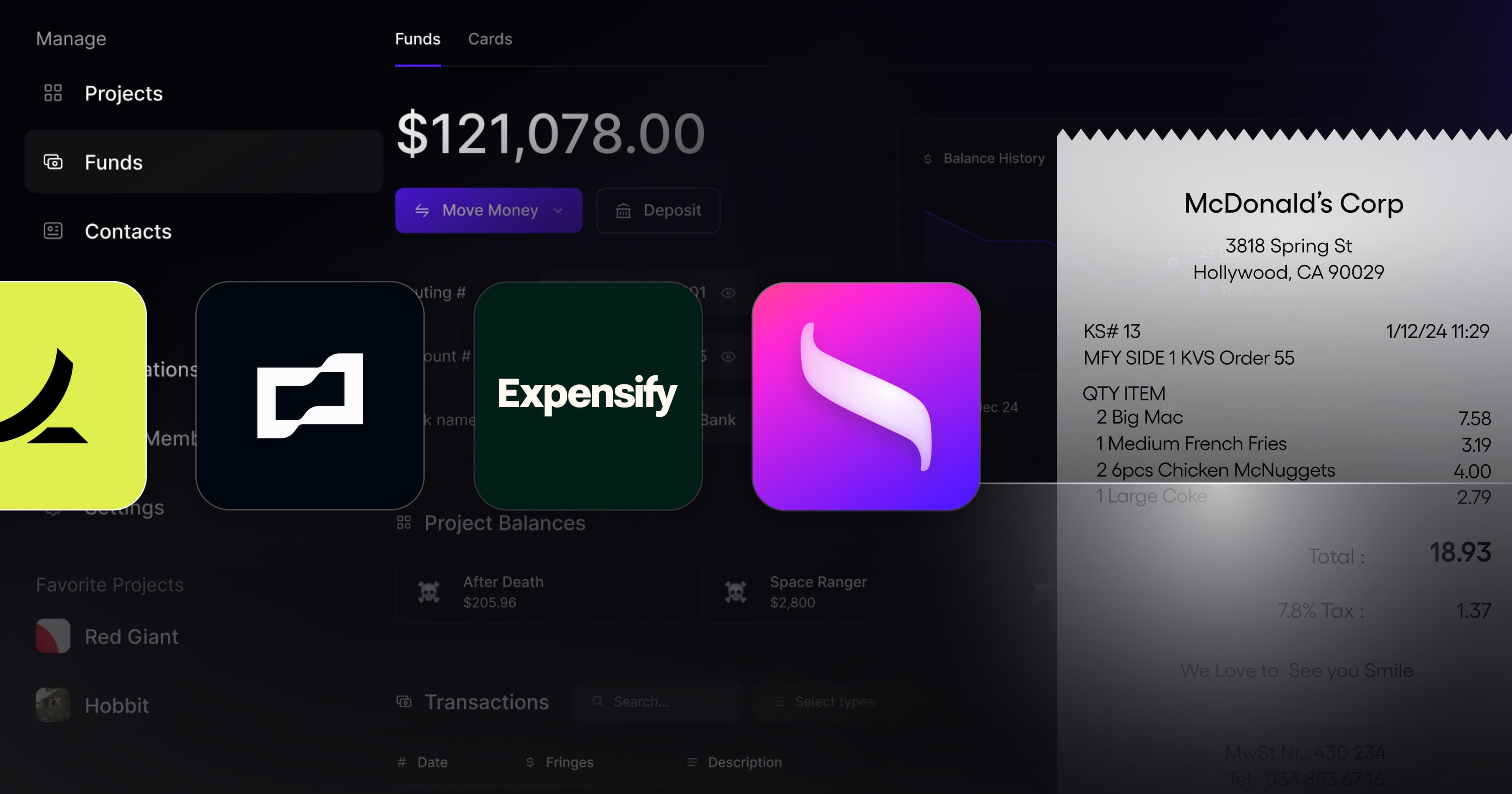
The receipt envelope is the most universally hated wrap task in production. Department heads hand over weeks of accumulated receipts. A production accountant spends 40 to 80 hours reconciling them, matching each to a budget line, and chasing missing documentation. Half the time, the final cost report still misses something. This guide covers the best receipt capture and expense coding tools for on-set production, how AI has changed the workflow, and what to look for when choosing a platform for your next show.
Why on-set receipt capture is different from office expenses
Generic expense tools (Expensify, Ramp, Brex) are built for business travel and general corporate spend. On set, the workflow is different:
- Department-level spend with line-level budgets, not personal expense reports
- Receipts for the same vendor show up across multiple departments (equipment houses, lumber yards, craft)
- Production-specific coding (AICP line numbers, union fringes, tax incentive qualification)
- High volume in compressed windows (500+ receipts in a shoot week)
- Remote locations, bad signal, and environments where a quick phone scan is the only option
An office expense tool treated as production software will work, but it will force production accountants to re-code every transaction against the production chart of accounts and budget lines. Production-specific receipt capture avoids that.
What to look for in on-set receipt capture
Immediate mobile capture
The cardholder should photograph the receipt within seconds of the purchase. The mobile app captures the image, runs OCR to extract vendor, amount, date, and tax, and attaches it to the transaction. Any delay makes receipt loss more likely. Good platforms prompt for receipt capture via push notification immediately after a card swipe.
Automatic budget line coding
After capture, AI should code the transaction to the correct budget line based on vendor, department, amount, and historical patterns. A charge from a lumber yard assigned to the art department should route to the construction and set dressing line. A charge from an equipment rental house assigned to camera should route to camera rentals.
The best systems learn from corrections. When a production accountant recodes a transaction from one line to another, the model updates and stops making that same mistake.
Three-way reconciliation with cards and invoices
A receipt is only useful if it ties back to a payment (card swipe, invoice, or PO). Modern platforms match the receipt to the transaction automatically. If the receipt amount does not match the card charge, it flags for review. If a receipt is missing for a completed transaction, it prompts the cardholder.
Real-time budget line awareness
When a receipt is coded to a line at 85 percent of budget, the cardholder and department head should get a notification. This changes behavior on the next purchase. Waiting until the weekly cost report to flag overspend means the 85 percent is already 120 percent.
Production chart of accounts support
The tool should read your AICP or custom production chart of accounts natively. Generic tools use generic charts (Cost of Goods, SG&A) that do not map to production lines (100-series above the line, 2500-series camera, 6000-series post-production).
Receipt loss prevention
Proactive reminders for missing receipts, notifications for transactions over a threshold, and easy forwarding of emailed receipts to the expense platform all reduce the wrap-time backlog. The goal is zero missing receipts at wrap, which is only possible if the system captures them in real time during production.
Offline mode
Remote locations and soundstage basements have bad cell service. The mobile app should let the cardholder capture a receipt offline, queue it, and sync when signal returns. Tools that require a live connection lose receipts on location.
Top tools for on-set receipt capture and coding
Saturation
Saturation Production Intelligence handles receipt capture and coding as part of the integrated production finance platform. When a production P-card is swiped, the cardholder receives a mobile prompt to photograph the receipt. OCR extracts vendor and amount, AI codes to the right budget line, and the transaction flows into the budget as an actual. Works offline, syncs when reconnected, and learns from production accountant corrections.
Clyr
Clyr offers AI-powered receipt capture with 95 percent OCR accuracy, real-time transaction notifications, and 2-way integration with 25+ accounting platforms. Not production-specific but strong on AI coding for job-based industries.
Expensify
Expensify is the long-standing default for general business expense management. Scan receipts via mobile app, forward emailed receipts, or text them in. Auto-codes through two-way sync with QuickBooks, Sage, NetSuite, and Xero. Not production-specific but works for smaller productions that want general tools.
Ramp and Brex
Ramp and Brex are corporate card platforms with built-in receipt capture and AI coding. Strong for general business spend. For production use, they require mapping transactions to a production chart of accounts, which is manual work. See the Saturation vs Ramp and Saturation vs Brex comparisons.
Production-specific payment platforms
CASHét (acquired by EP in 2025) and Cast and Crew's Start+ handle production spend with receipt capture built in. Strong fit for productions running on their payroll ecosystems.
How receipt capture should fit into the full finance workflow
Receipts are one piece of production finance, not a standalone workflow. The platform you pick should integrate with:
- Card issuance and transactions (production P-cards and corporate cards)
- Production budget and line items
- Bill pay and vendor invoices
- Purchase orders for three-way matching
- Cost reporting for weekly executive updates
- Tax incentive qualification per jurisdiction
If receipt capture sits in a silo, accountants end up reconciling across multiple tools every week. If it sits on one platform, the receipt coded on set today is in tomorrow's cost report without extra work.
What receipt capture changes on wrap day
Production accountants wrap on one of two timelines. The fast path: final cost report within 5 to 10 days of wrap, because actuals, receipts, and coding were reconciled daily during the shoot. The slow path: 3 to 6 weeks because 500+ receipts are in envelopes that need to be coded, matched to transactions, and substantiated after the fact.
Real-time receipt capture compresses this. Most productions running modern tools close the final cost report within 7 to 14 days of wrap because:
- Every card transaction has a receipt attached in real time, not at wrap
- AI coding handled 90 to 95 percent of classifications during the shoot, with corrections applied daily
- Missing receipts were resolved within 24 hours of the transaction, not weeks later
- Variance was flagged during the shoot, so the cost report narrative is already drafted
For studio and equity-backed productions, faster final reporting is not a nice-to-have. Completion bond insurers and studio finance teams often require final reports within specific windows. Receipt capture is what makes those windows realistic.
Compliance and standards resources
For digital receipt retention guidance, see the IRS on substantiation and electronic records. For AICP bid format compliance, which affects how receipts and actuals map to commercial production budgets, see AICP.
How to roll out receipt capture on a production
- Issue cards with receipt capture requirements baked in. Every card swipe prompts for a receipt photo.
- Train department heads in the first prep week. The mobile app should take less than 10 minutes to learn.
- Set the missing-receipt threshold low. 24 hours is typical. After 24 hours without a receipt, the platform sends a reminder.
- Review AI coding daily during prep, weekly during production. Corrections teach the model your production's patterns.
- Wrap the receipt workflow daily, not weekly. End each day with a clean receipt list, not 50 outstanding items.
- At wrap, audit the final receipt log. Any missing items should be resolved before the final cost report.
Frequently asked questions about on-set receipt capture
Can the IRS accept digital receipts?
Yes. The IRS has accepted digital receipts as substantiation since 1997 (Rev. Proc. 97-22), provided they are legible and retain the required information (vendor, date, amount, tax). All major production platforms store compliant digital copies.
What if a cardholder forgets to capture a receipt?
The platform should prompt via push notification after the transaction. If the cardholder still forgets, the account manager gets an escalation. For truly lost receipts, most platforms let a cardholder submit a manual expense report with a reason.
How accurate is AI expense coding?
On modern platforms, 90 percent accuracy out of the box, improving to 95 percent after a few weeks of production corrections. The remaining 5 to 10 percent are edge cases (same vendor serving multiple departments, ambiguous merchant names) that need accountant review.
Does receipt capture work for cash expenses?
Yes. The cardholder photographs the receipt and enters the amount manually. The platform treats it as a cash transaction against the petty cash float. For fully cashless productions, cash workflows are rare, but they still exist for tips and craft.
Can receipt capture handle foreign currency?
Yes. OCR extracts the amount in the local currency, and the platform converts to the production's base currency using the transaction-date FX rate. Reconciliation against the card statement confirms the final amount in base currency.
What about per diem receipts?
Per diem is typically not substantiated per receipt (it is a flat allowance). The platform records the per diem payment, which does not require a receipt. For productions that require receipts for per diem, the same capture workflow applies.
Is receipt data sensitive from a compliance perspective?
Receipts can contain merchant data, bank partial numbers, and occasional PII. SOC 2 Type II compliance covers the storage and access controls. For studio and equity-backed productions, confirm the platform's trust center before rollout.
Can receipt coding flow into tax incentive qualification?
Yes, on production-specific platforms. A receipt coded to a line marked qualified for a state tax incentive inherits qualification automatically. A production accountant still reviews for edge cases, but the bulk of the classification is automatic.
Related posts

Ready to modernize your production finance?
Join thousands of production teams using Saturation to budget, track expenses, and manage payments.