
Borat Budget
 Comedy1h 24m
अपडेट किया गया
Synopsis
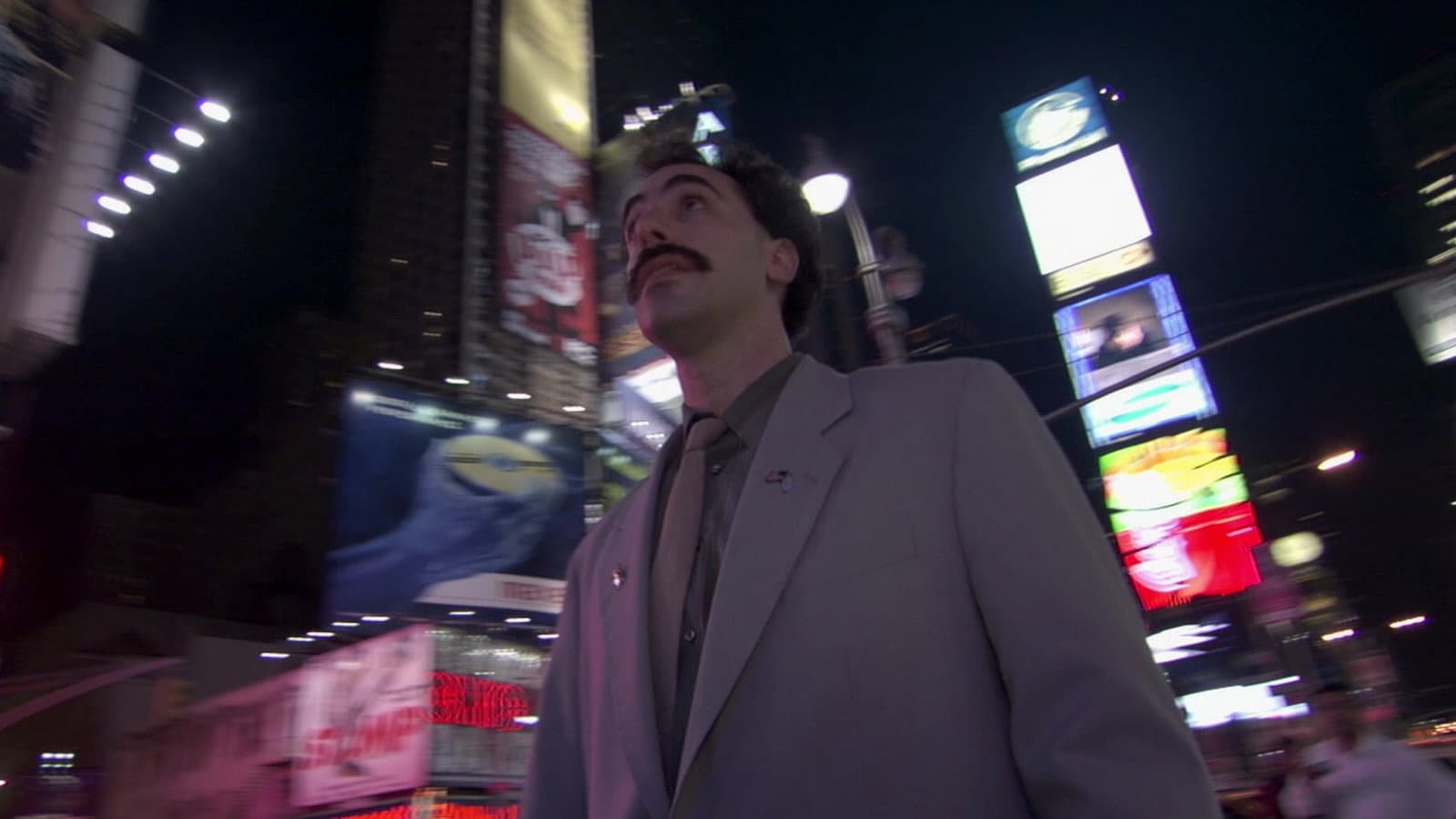
Kazakh television reporter Borat Sagdiyev travels to the United States with his producer, Azamat Bagatov, to make a documentary about American culture. After seeing Baywatch in New York, he becomes infatuated with Pamela Anderson and sets out across the country in an old ice cream truck to make her his wife, offending and baffling the real Americans he meets along the way.
What Is the Budget of Borat?
Borat! Cultural Learnings of America for Make Benefit Glorious Nation of Kazakhstan (2006), the mockumentary directed by Larry Charles and starring Sacha Baron Cohen, had a production budget of $18,000,000. That is the figure Box Office Mojo and The Numbers list, and the one Deadline's Nikki Finke reported on the film's opening weekend, when she wrote that on a budget that small the film was certain to make money. No source has published a different number, and 20th Century Fox, which distributed the film, never released a cost breakdown.
The budget was small because of how the film was made. Baron Cohen and producer Jay Roach shot it like a documentary, with a crew of eight to twenty people filming real Americans who believed they were helping a foreign journalist, so there were almost no sets and only four performers. What the production did need was travel across a dozen states and Washington, D.C., a location shoot in a village in Romania, editors for hundreds of hours of footage and lawyers to clear what was filmed. A sequel, Borat Subsequent Moviefilm (2020), followed fourteen years later.
Key Budget Allocation Categories
Fox has never published a line-item budget for Borat, but the production record shows where the money went.
- Small Traveling Crew: Rolling Stone reported a crew of between eight and twenty people. Participants were approached by a production company called One America, presented as making a documentary about a foreign visitor, and each scene got a single take, because the people being filmed did not know what the film really was.
- Footage and Editing: The crew shot about 400 hours of interviews and about 50 hours of behind-the-scenes material, according to Rolling Stone. Three editors, Peter Teschner, James Thomas and Craig Alpert, cut that down to an 84-minute film.
- Legal Clearance: Participants signed release forms agreeing not to take legal action, and a lawyer was kept on retainer and consulted before each scene. After release the film drew suits from the villagers who played Borat's neighbors, two college fraternity members who gave him a ride, a driving instructor and others; the suits by the villagers, the students and the instructor were dismissed.
- Payments to Participants: Driving instructor Michael Psenicska was paid $500 in cash for Borat's lesson. Villagers in Glod said they were paid between three lei and $100 each; Fox said Baron Cohen had donated $5,000 to the village on top of a location fee and bought computers and school supplies for residents.
- Location Shoot in Romania: Borat's home village in "Kazakhstan" was filmed in Glod, a mostly Roma village in Romania, whose residents appear as his neighbors.
- Cast and Music: Only four roles were played by performers: Baron Cohen, Ken Davitian as Azamat Bagatov, Luenell and Pamela Anderson as herself. Erran Baron Cohen, the star's brother, scored the film, alongside Balkan and Romani music largely by Goran Bregović and Emir Kusturica.
How Does Borat's Budget Compare to Similar Films?
At $18,000,000, Borat sat at the low end of studio comedy budgets. The films below are the closest comparisons by format, year or filmmaker, with Box Office Mojo's figures across all releases.
- Fahrenheit 9/11 (2004): Budget $6,000,000 | Worldwide $222,446,882. The documentary whose 868-theater opening Fox's distribution chief cited as the precedent for Borat's limited release; Borat cost three times as much and grossed $40,106,011 more worldwide.
- Little Miss Sunshine (2006): Budget $8,000,000 | Worldwide $100,523,784. The other low-budget comedy breakout of 2006 cost $10,000,000 less, but Borat grossed 2.6 times as much.
- Superbad (2007): Budget $20,000,000 | Worldwide $170,066,523. An R-rated comedy on a similar budget the following year; it earned 71.4% of its gross at home, while Borat earned 51.1% of its total overseas.
- The Hangover (2009): Budget $35,000,000 | Worldwide $469,329,319. Directed by Todd Phillips, Borat's original director, who kept a story credit and an Oscar nomination on Borat. With a conventional script and cast it cost nearly twice as much and grossed 1.8 times as much.
- Brüno (2009): Budget $42,000,000 | Worldwide $138,805,831. Baron Cohen's next film in the same format cost 2.3 times as much and grossed 53% of Borat's total. Its budget is The Numbers' figure; Box Office Mojo lists none.
Borat Box Office Performance
Fox originally planned to open Borat in about 2,000 theaters but cut the release to 837 after tracking showed low awareness outside big cities: even after opening weekend, tracking reported by Variety found only 57% of people aware of the film, against 90% for The Santa Clause 3. It opened in the United States and Canada on November 3, 2006, and took $26,455,463 for the weekend, an average of $31,607 per theater, to finish at No. 1 ahead of films playing in four times as many theaters. It was the biggest opening at the time for a film released in fewer than 1,000 theaters. "For an R-rated movie, it'll perform better in the towns where it will open this Friday than it would have if we had gone in cold," Fox distribution president Bruce Snyder told Variety.
The next weekend Fox expanded to 2,566 theaters and the film grossed $28,269,900, 6.9% more than its opening, holding No. 1 for a second week. It peaked at 2,611 theaters and played until March 25, 2007, finishing with $128,505,958 in the United States and Canada and $134,046,935 internationally, for $262,552,893 worldwide, according to Box Office Mojo.
Box Office Breakdown
Borat

International markets supplied 51.1% of the total. The United Kingdom, Baron Cohen's home market, was the largest at $46,020,502 after an $11,865,318 opening, about 34% of the international gross, followed by Australia at $14,625,480 and Germany at $13,486,198. Borat finished 15th on Box Office Mojo's 2006 worldwide chart, and its worldwide gross came to 14.6 times the production budget, a measure of the box office against the negative cost rather than of profit. Home video added more: the DVD came out in March 2007, and The Numbers estimates domestic DVD sales at $63,706,700.
Fox never disclosed what it spent on prints and advertising for Borat, and no trade estimate has been published, so there is no return per dollar figure: the total estimated investment is unknown.
Borat Production History
Borat Sagdiyev, a fictional reporter from Kazakhstan, began as one of Sacha Baron Cohen's characters on Da Ali G Show. According to Entertainment Weekly, Baron Cohen took the idea for a Borat film to Jay Roach in spring 2003, Roach agreed to produce, and 20th Century Fox agreed to distribute. Baron Cohen first approached Trey Parker and Matt Stone, who chose to make their own film, and then hired Todd Phillips to direct. An early version had an American crew making a documentary about Borat, an idea dropped because it put a buffer between Borat and the people he met.
Filming was underway by January 2005. Borat's appearance at a rodeo in Salem, Virginia, where he roused the crowd with jingoistic remarks and then sang a fake Kazakh national anthem to the tune of "The Star-Spangled Banner", nearly caused a riot, and the rodeo's producer said he had been approached by One America about a documentary on an immigrant. Phillips left the production shortly afterward over creative differences with Baron Cohen, and Larry Charles took over as director. The producer character Azamat was added in Charles's version; Ken Davitian won the part by posing as an immigrant at his audition.
The shoot moved across the country, with Baron Cohen staying in character from the moment he left his hotel until the crew wrapped each day. Locations included Jackson, Mississippi, where Borat appeared on a local news broadcast, Birmingham and Helena in Alabama, South Carolina, Louisiana, Texas, Oklahoma, West Virginia, Maryland, Newton, Massachusetts, Washington, D.C., New York City and Hollywood in California, with the Kazakhstan scenes shot in Glod. The Secret Service questioned the crew outside the White House, Louisiana state troopers investigated, and the FBI followed them.
Borat was shown early in several places: a sneak preview in Cannes on May 23, 2006, a preview at Comic-Con in San Diego on July 21, and its first paying audience at the Traverse City Film Festival in August, where it won the Excellence in Filmmaking Award. Its official premiere at the Toronto International Film Festival on September 7 broke down when the projector failed twenty minutes in, and it was screened successfully the next night. Baron Cohen did the entire publicity campaign in character.
Kazakhstan's government denounced the film. Its Foreign Ministry had threatened to sue Baron Cohen in 2005, and Fox's Central Asian distributor agreed not to release the film there; it was also banned in most of the Arab world. Within a few years the response changed: in 2012 Kazakhstan's foreign minister credited Borat with a tenfold rise in visas issued to visitors, and in 2020 the country adopted "Very Nice" as a tourism slogan. On Borat's opening weekend, Deadline reported that Universal had signed Baron Cohen for Brüno in a $42,500,000 deal, and Baron Cohen later secretly filmed a sequel during the COVID-19 pandemic, which Amazon released on October 23, 2020.
Awards and Recognition
Borat was recognized mainly for its screenplay and for Sacha Baron Cohen's performance.
- Academy Awards: Nominated for Best Adapted Screenplay at the 79th Academy Awards, for Sacha Baron Cohen, Anthony Hines, Peter Baynham, Dan Mazer and Todd Phillips.
- Golden Globe Awards: Baron Cohen won Best Actor in a Motion Picture, Musical or Comedy, and the film was nominated for Best Motion Picture, Musical or Comedy.
- Writers Guild of America Awards: Nominated for Best Adapted Screenplay.
- Critics' Choice Awards: Won Best Comedy.
- Critics Groups: Baron Cohen won Best Actor from the Los Angeles Film Critics Association, tied with Forest Whitaker for The Last King of Scotland, and from the San Francisco Bay Area Film Critics Circle and the Toronto Film Critics Association, plus the Online Film Critics Society award for Best Breakthrough Performance.
- Festivals: Won the Excellence in Filmmaking Award at the 2006 Traverse City Film Festival.
Its standing has grown since. The Guardian ranked Borat second among the best films of the 2000s and in 2019 named it the 23rd best film of the 21st century. Members of the Writers Guild of America voted its screenplay 93rd among the 101 greatest of the century so far in 2021, and in 2025 The New York Times placed it 53rd on its list of the 100 best movies of the 21st century.
Critical Reception
Reviews were overwhelmingly positive. Borat holds 90% on Rotten Tomatoes from 219 critics, with an average rating of 8.3/10, and a Metacritic score of 89 out of 100 from 38 critics, indicating universal acclaim. Audiences polled by CinemaScore gave it a B+. The Rotten Tomatoes consensus reads: "Part satire, part shockumentary, Borat gets high-fives almost all-around for being offensive in the funniest possible way. Jagshemash!"
Ty Burr of The Boston Globe called the film "silliness at its most trenchant" and the funniest film of the year, Peter Travers of Rolling Stone wrote, "You won't know what outrageous fun is until you see Borat. High-five!", and The Atlantic said it "may be the funniest film in a decade." Not everyone agreed: Joe Queenan, writing in The Guardian, called Baron Cohen an "odious twit." In Slate, Christopher Hitchens answered critics who saw the film as anti-American by arguing that it showed how much patience its unwitting subjects had, citing the guests at the Southern dinner party. Before release the Anti-Defamation League said it understood the film was using Borat to expose prejudice but worried that some viewers would miss the joke.
अक्सर पूछे जाने वाले सवाल
How much did it cost to make Borat (2006)?
Borat had a production budget of $18,000,000, the figure listed by Box Office Mojo and The Numbers and reported by Deadline on opening weekend. The low cost reflects how it was made: a small crew filming real people, with only four performers.
How much did Borat (2006) make at the box office?
Borat grossed $262,552,893 worldwide, including $128,505,958 in the United States and Canada and $134,046,935 internationally, according to Box Office Mojo. It opened to $26,455,463 from just 837 theaters.
Was Borat (2006) profitable?
An exact return cannot be calculated, because Fox never disclosed its marketing spend. What is known: the worldwide gross of $262,552,893 is 14.6 times the $18,000,000 production budget, and The Numbers estimates domestic DVD sales at a further $63,706,700.
Why did Borat open in only 837 theaters?
Fox had planned about 2,000 theaters but cut the opening to 837 after tracking showed low awareness outside big cities. Even after opening weekend, only 57% of people polled knew the film, against 90% for The Santa Clause 3. It averaged $31,607 per theater and expanded to 2,566 theaters the next weekend, when it grossed more than it had on opening weekend.
Where was Borat filmed?
The Kazakhstan scenes were filmed in Glod, a village in Romania. The American scenes were shot on the road in Virginia, Mississippi, Alabama, South Carolina, Louisiana, Texas, Oklahoma, West Virginia, Maryland, Massachusetts, Washington, D.C., New York City and Hollywood.
Were the people in Borat actors?
Mostly not. Only Sacha Baron Cohen, Ken Davitian as Azamat, Luenell and Pamela Anderson were performers. Nearly everyone else was a real person who had been told they were taking part in a documentary and had signed a release form.
Did anyone sue over Borat?
Yes. The villagers of Glod, two University of South Carolina fraternity members, a Baltimore driving instructor paid $500 for Borat's lesson, and several others sued. The suits by the villagers, the students and the driving instructor were dismissed.
Who directed Borat (2006)?
Larry Charles directed Borat. Todd Phillips was the original director and shot the Salem, Virginia rodeo scene in January 2005 before leaving over creative differences with Sacha Baron Cohen. Phillips kept a story credit and shared the film's Oscar nomination for Best Adapted Screenplay.
What awards did Borat win?
Sacha Baron Cohen won the Golden Globe for Best Actor in a Motion Picture, Musical or Comedy, and the film won the Critics' Choice Award for Best Comedy. Its screenplay was nominated for the Academy Award and the Writers Guild of America Award for Best Adapted Screenplay.
How does Borat's budget compare to Brüno?
Brüno (2009), Baron Cohen's next film in the same format, cost $42,000,000 according to The Numbers, 2.3 times Borat's $18,000,000, and grossed $138,805,831 worldwide, about 53% of Borat's $262,552,893.
Filmmakers
Borat

Official Trailer
Saturation में ऐसे ही budgets बनाएं
Industry-standard feature film template से शुरू करें, अपना मौजूदा schedule और rates import करें, और खर्च के साथ cost report को अपने आप अपडेट होते देखें। Real-time collaboration, बिना spreadsheets।