Little Miss Sunshine Budget
 ComedyDrama1h 42m
Updated
Synopsis
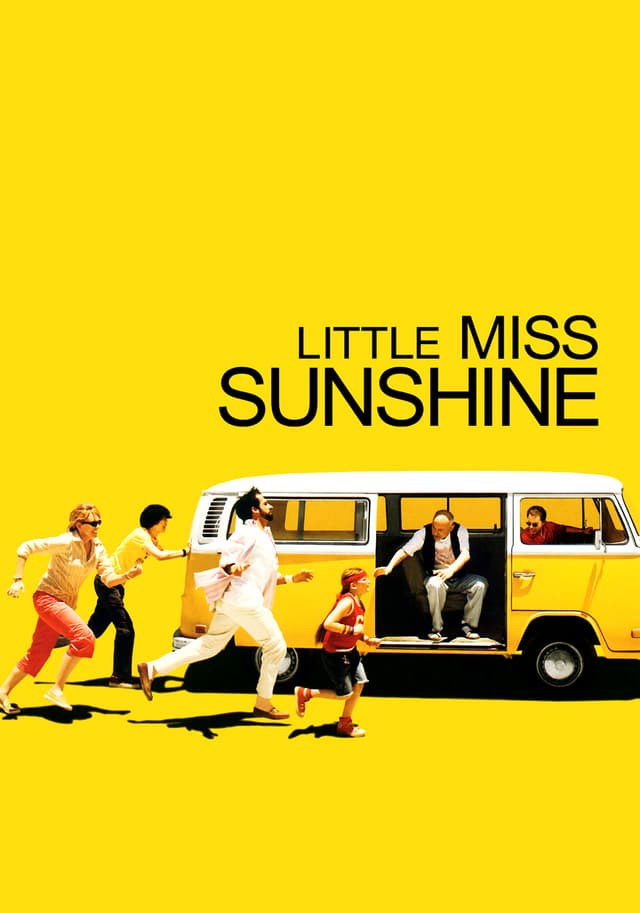
In Albuquerque, Sheryl Hoover brings her suicidal brother Frank to the breast of her dysfunctional and emotionally bankrupted family. Frank is homosexual, an expert in Proust. He tried to commit suicide when he was rejected by his boyfriend and his great competitor became renowned and recognized as number one in the field of Proust. Sheryl's husband Richard is unsuccessfully trying to sell his self-help and self-improvement technique using nine steps to reach success, but he is actually a complete loser. Her son Dwayne has taken a vow of silence as a follower of Nietzsche and aims to be a jet pilot. Dwayne's grandfather Edwin was sent away from the institution for elders (Sunset Manor) and is addicted in heroin. When her seven-year-old daughter Olive has a chance to dispute the Little Miss Sunshine pageant in Redondo Beach, California, the whole family travels together in their old Volkswagen Type 2 (Kombi) in a funny journey of hope of winning the talent contest and to make a dream come true.
What is the budget of Little Miss Sunshine?
"Little Miss Sunshine," a comedy released in 2006, was directed by Valerie Faris, Jonathan Dayton and stars Greg Kinnear, Toni Collette. The production budget was $8,000,000, placing it in the low-budget range for comedy productions of its era.
Key Budget Allocation Categories
While specific budget breakdowns are not publicly available, typical cost drivers for a comedy production like this include:
- Talent Salaries & Producing Deals: Established comedic talent can command $15 to 20 million per film, with top-tier stars earning even more through producing credits and backend deals.
- Production & Location Filming: While comedies generally avoid the VFX costs of action films, location shooting in recognizable cities or exotic locales adds meaningful production expense.
- Marketing & P&A (Prints & Advertising): Comedies rely heavily on marketing to build opening-weekend momentum.
- Development: The script was written by Michael Arndt and was originally about an East Coast road trip from Maryland to Florida, but was shifted to a journey from New Mexico to California because of budget issues.
What were the major cost factors in Little Miss Sunshine?
Several factors contributed to the overall production costs of "Little Miss Sunshine."
- Talent Salaries: Talent Salaries & Producing Deals is one of the primary cost drivers in comedy productions of this scale.
- Production: Production & Location Filming is one of the primary cost drivers in comedy productions of this scale.
- Marketing: Marketing & P&A (Prints & Advertising) is one of the primary cost drivers in comedy productions of this scale.
How Does Little Miss Sunshine's Budget Compare to Similar Films?
At $8,000,000, Little Miss Sunshine sits in the low-budget range. Here is how it compares to productions with a similar budget:
- Mutant Chronicles (2008): Budget $8,000,000, Worldwide Gross $2,131,057
- I'm Still Here (2024): Budget $8,000,000, Worldwide Gross $36,361,572
- Pulp Fiction (1994): Budget $8,000,000, Worldwide Gross $213,928,762
- My Life as a Zucchini (2016): Budget $8,000,000, Worldwide Gross $5,873,256
- Stand by Me (1986): Budget $8,000,000, Worldwide Gross $52,289,686
The median budget for wide-release comedy films in the 2000s ranges from $30 to 80M for mid-budget to $150M+ for tentpoles.
Little Miss Sunshine Box Office Performance
"Little Miss Sunshine" earned $59,891,098 domestically and $100,523,351 worldwide at the box office. Against a production budget of $8,000,000, the film performed strongly at the box office.
A film typically needs to earn approximately twice its production budget to cover marketing and distribution costs. For "Little Miss Sunshine," that break-even threshold was roughly $16,000,000. With worldwide earnings of $100,523,351, the film cleared that threshold comfortably.
Box Office Breakdown
Little Miss Sunshine

At 1156.5%, "Little Miss Sunshine" earned roughly $12.57 for every $1 invested in production.
Little Miss Sunshine Production History
The script was written by Michael Arndt and was originally about an East Coast road trip from Maryland to Florida, but was shifted to a journey from New Mexico to California because of budget issues. Arndt started the script on May 23, 2000, and completed the first rough draft by May 26. He had initially planned on shooting the film himself by raising several thousand dollars and using a camcorder.
Principal photography began on June 6, 2005. Filming took place over 30 days in Arizona and southern California, with scenes shot in keeping with the chronological order of the script. Arndt re-wrote the ending to the film six weeks before the film's premiere at the Sundance Film Festival, and this was filmed that December during the post-production of Little Miss Sunshine in 2005.
The soundtrack reached No. 42 on the "Top Independent Albums" list and No. 24 on "Top Soundtracks" in the U.S.
Awards and Recognition
Won 2 Oscars. 73 wins & 112 nominations total
- Academy Award for Best Writing, Original Screenplay: Michael Arndt (79th Academy Awards)
- National Board of Review: Top Ten Films
- Academy Award for Best Supporting Actor: Alan Arkin (79th Academy Awards)
- Grand prix du Festival de Deauville (2006 Deauville American Film Festival)
- César Award for Best Foreign Film
Frequently Asked Questions
How much did it cost to make Little Miss Sunshine (2006)?
The production budget was $8,000,000, covering principal photography, cast and crew salaries, locations, sets, post-production, and music. Marketing and distribution (P&A) costs are estimated at an additional $4,000,000 - $6,400,000, bringing the total studio investment to approximately $12,000,000 - $14,400,000.
How much did Little Miss Sunshine (2006) earn at the box office?
Little Miss Sunshine grossed $59,891,098 domestic, $40,632,253 international, totaling $100,523,351 worldwide.
Was Little Miss Sunshine (2006) profitable?
Yes. Against a production budget of $8,000,000 and estimated total costs of ~$20,000,000, the film earned $100,523,351 theatrically - a 1157% ROI on production costs alone.
What were the biggest costs in producing Little Miss Sunshine?
The primary cost drivers were above-the-line talent (Greg Kinnear, Toni Collette, Steve Carell); star comedian salaries, location filming, and aggressive marketing campaigns.
How does Little Miss Sunshine's budget compare to similar comedy films?
At $8,000,000, Little Miss Sunshine is classified as a micro-budget production. The median budget for wide-release comedy films in the 2000s ranges from $30 - 80M for mid-budget to $150M+ for tentpoles. Comparable budgets: Mutant Chronicles (2008, $8,000,000); I'm Still Here (2024, $8,000,000); Pulp Fiction (1994, $8,000,000).
Did Little Miss Sunshine (2006) go over budget?
There are no widely reported accounts of significant budget overruns for this production. However, studios rarely disclose precise budget overrun figures publicly. The reported production budget reflects the final estimated cost.
What was the return on investment (ROI) for Little Miss Sunshine?
The theatrical ROI was 1156.5%, calculated as ($100,523,351 − $8,000,000) ÷ $8,000,000 × 100. This measures gross revenue against production budget only - it does not account for P&A or exhibitor shares.
What awards did Little Miss Sunshine (2006) win?
Won 2 Oscars. 73 wins & 112 nominations total.
Who directed Little Miss Sunshine and who were the key crew members?
Directed by Valerie Faris, Jonathan Dayton, written by Michael Arndt, shot by Tim Suhrstedt, with music by DeVotchKa, Mychael Danna, edited by Pamela Martin.
Where was Little Miss Sunshine filmed?
Little Miss Sunshine was filmed in United States of America. Principal photography began on June 6, 2005. Filming took place over 30 days in Arizona and southern California, with scenes shot in keeping with the chronological order of the script.
Filmmakers
Little Miss Sunshine

Official Trailer
Build budgets like this one in Saturation
Start from an industry-standard feature film template, import the schedule and rates you already have, and let the cost report keep itself current as you spend. Real-time collaboration, no spreadsheets.