The Greatest Story Ever Told Budget
 Drama
DramaUpdated
Synopsis
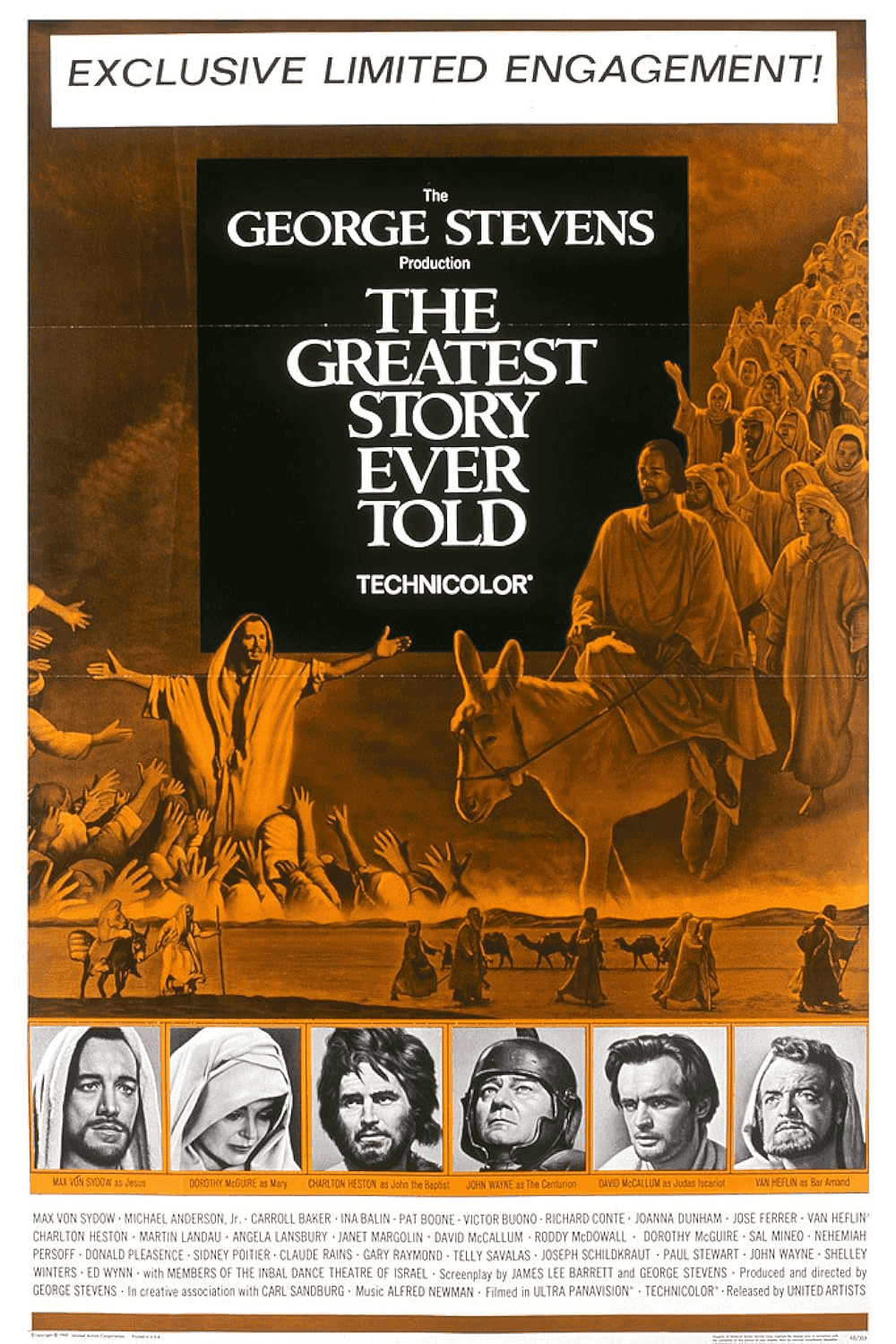
An all-star, large-scale epic that chronicles the life and ministry of Jesus of Nazareth. Max von Sydow in his first English-language role plays the messiah, with the narrative tracing the events of the New Testament from the Nativity through the Crucifixion and Resurrection across the desert and hill country of the Holy Land.
What Is the Budget of The Greatest Story Ever Told (1965)?
The Greatest Story Ever Told (1965), directed by George Stevens and distributed by United Artists, was produced on a reported budget of $20,000,000, with some industry sources placing the final figure as high as $25,000,000 once the picture's extended seven-year production cycle is accounted for. The film adapted Fulton Oursler's 1949 book and the New Testament source material into a three-hour-plus biblical epic in the Stevens prestige tradition. Max von Sydow, in his first English-language role, played Jesus of Nazareth, with a star-studded supporting cast that included Charlton Heston, Telly Savalas, Sidney Poitier, John Wayne, Carroll Baker, and Claude Rains.
The investment reflected one of the largest production commitments in the mid-1960s biblical-epic cycle, alongside Anthony Mann's King of Kings (1961) and the contemporaneous Cleopatra (1963). Originally developed at 20th Century Fox under producer Darryl F. Zanuck, the project was sold to United Artists in 1963 after Fox's Cleopatra cost overruns made the studio unwilling to continue financing a comparably ambitious biblical production. United Artists assumed the in-progress production at a roughly $10,000,000 spent-to-date figure and committed an additional $10,000,000 to complete the picture.
Key Budget Allocation Categories
The Greatest Story Ever Told's reported $20,000,000 to $25,000,000 budget was distributed across several core production areas:
- Above-the-Line Talent: Director George Stevens (Shane, Giant, A Place in the Sun) commanded a top-tier prestige director's rate. The all-star supporting cast represented one of the largest pay-to-headliner spends in mid-1960s Hollywood, with Charlton Heston, John Wayne, Sidney Poitier, Telly Savalas, Claude Rains, Carroll Baker, Pat Boone, Shelley Winters, Ed Wynn, and dozens of additional star cameos requiring scale-plus-celebrity premiums. Max von Sydow, then primarily known for his Ingmar Bergman collaborations, anchored the production at a more modest international-rate quote.
- Location Production in Utah and Arizona: Principal photography took place primarily in the Utah and Arizona Southwestern desert, doubling for the Holy Land. The unit shot extensively at Lake Powell, Glen Canyon, Pyramid Lake, the Colorado River, Bryce Canyon, Capitol Reef, and surrounding Utah and Arizona locations. Location lodging, regional crew, transportation, and the construction of large-scale practical sets in remote desert environments represented one of the production's single largest line items.
- Production Design and Set Construction: Production designer William J. Creber and his department constructed Jerusalem, Bethlehem, Galilee fishing villages, Herod's palace, the Temple courtyard, Pontius Pilate's judgment chamber, and the Crucifixion site Calvary on location. The build represented one of the most-extensive practical-set construction projects in 1960s biblical epic history.
- Costume Design: Costume designer Vittorio Nino Novarese (Captain from Castile) designed and constructed period wardrobes for the principal cast and thousands of extras, with multiple bespoke wardrobes per principal accommodating the multi-year production cycle, character transformations, and the lavish Herod-and-Pontius-Pilate court sequences.
- Score by Alfred Newman: Composer Alfred Newman scored the film, conducting the Nashville Symphony Orchestra. The soundtrack budget covered extensive original composition, orchestra recording, choral arrangements for the Crucifixion-and-Resurrection sequences, and the picture's use of the Hallelujah Chorus from Handel's Messiah.
- Production Delays and Reshoots: The film's seven-year production cycle (1960 to 1965) generated substantial additional costs from cast and crew unavailability, weather delays at the Utah and Arizona locations, the studio handoff from 20th Century Fox to United Artists, and reshoots in mid-1965 to address pre-release studio concerns about pacing and length.
How Does The Greatest Story Ever Told's Budget Compare to Similar Films?
At a reported $20,000,000 to $25,000,000, The Greatest Story Ever Told sat at the high end of the mid-1960s biblical-epic and roadshow-prestige bracket. The comparison set frames its commercial outcome:
- Cleopatra (1963): Budget $44,000,000 | Worldwide $57,000,000. The Joseph L. Mankiewicz 20th Century Fox epic released two years earlier cost roughly double and earned 3.7 times the worldwide total, an outcome that nonetheless nearly bankrupted the studio and informed United Artists's nervous willingness to assume the Greatest Story production.
- King of Kings (1961): Budget $5,000,000 | Worldwide $15,000,000. Anthony Mann's MGM Jesus biopic, released four years earlier, cost one quarter and earned roughly the same as Greatest Story, illustrating how a more modestly priced biblical film could match the prestige production's commercial outcome.
- The Sound of Music (1965): Budget $8,200,000 | Worldwide $286,200,000. Robert Wise's 20th Century Fox musical released three weeks after Greatest Story cost less than half and earned more than eighteen times the worldwide total, the in-corridor comparison that demolished any commercial defense of Greatest Story's prestige economics.
- Ben-Hur (1959): Budget $15,000,000 | Worldwide $146,900,000. William Wyler's MGM biblical epic, released six years earlier, cost 25% less and earned more than nine times the worldwide total, the prestige-biblical benchmark Stevens's production had targeted and decisively missed.
- Doctor Zhivago (1965): Budget $11,000,000 | Worldwide $111,700,000. David Lean's MGM epic released eight months after Greatest Story cost roughly half and earned seven times the worldwide total, the contemporaneous prestige-epic comparison that further isolated Greatest Story as an outlier underperformer.
The Greatest Story Ever Told Box Office Performance
The Greatest Story Ever Told opened in roadshow exclusive engagements on February 15, 1965, with the New York City premiere at the Warner Cinerama Theatre. The picture played in a reserved-seat roadshow format through 1965 and into 1966 before transitioning to general release at a reduced run-time after United Artists ordered substantial post-release cuts. The original roadshow cut ran 260 minutes (4 hours, 20 minutes); United Artists subsequently released shortened versions at 238 minutes, 198 minutes, and finally 195 minutes for general release.
Against a reported production budget of $20,000,000 to $25,000,000, the film needed approximately $45,000,000 to $55,000,000 in worldwide gross to reach profitability when accounting for marketing and roadshow-distribution costs. Here is the financial breakdown:
Box Office Breakdown
The Greatest Story Ever Told (1965)

The Greatest Story Ever Told returned approximately $0.48 to $0.62 in worldwide theatrical revenue for every $1 invested when measured against total estimated production and marketing spend, placing it among the most decisive prestige losses on United Artists's 1965 slate. The picture's underperformance, combined with the contemporaneous prestige successes of The Sound of Music and Doctor Zhivago in the same release window, has been cited in trade-press histories as the inflection point that ended the mid-1960s biblical-epic cycle.
The financial result effectively closed Hollywood's commitment to biblical-prestige cinema for more than two decades. United Artists subsequently retrenched, the Catholic-Christian audience that the biblical epics had targeted began shifting to television and church-distributed media, and the next major Jesus-themed feature, Franco Zeffirelli's Jesus of Nazareth (1977), was a television miniseries rather than a theatrical release. George Stevens, then 60, made one more feature, The Only Game in Town (1970), before retiring.
The Greatest Story Ever Told Production History
Development on a feature adaptation of Fulton Oursler's The Greatest Story Ever Told began at 20th Century Fox in 1958 under producer Darryl F. Zanuck. George Stevens attached as producer-director in 1960 on the strength of his recent prestige run (Shane, Giant, The Diary of Anne Frank). Stevens commissioned multiple screenplay drafts from James Lee Barrett, Carl Sandburg, and Stevens himself, with research trips to the Holy Land informing the screenplay's historical details.
Casting of Jesus was the production's defining creative decision. Stevens considered Marlon Brando, Paul Newman, and Charlton Heston (who eventually played John the Baptist) before settling on Max von Sydow, then 31 and primarily known for his Ingmar Bergman collaborations including The Seventh Seal (1957) and The Virgin Spring (1960). The casting represented one of the most-significant English-language debuts for a European art-house actor in 1960s Hollywood.
Principal photography began on October 29, 1962 in Utah, with extensive location work at Lake Powell, Glen Canyon, Bryce Canyon, Capitol Reef, and surrounding desert locations doubling for the Holy Land. Additional unit work took place in Arizona at the Colorado River, Pyramid Lake, and the Pyramid Lake Reservation, and at Nevada locations including the Valley of Fire. Shooting continued in fits and starts through 1963, with multiple production stops and restarts caused by location-weather delays, cast availability, and the 1963 studio handoff from 20th Century Fox to United Artists. The production wrapped its initial photography in July 1963 after approximately nine months of intermittent principal photography.
Post-production ran through 1964 with the studio handoff requiring significant editorial reorganization. United Artists assumed the production at a roughly $10,000,000 spent-to-date figure in mid-1963 and committed an additional $10,000,000 to complete the picture, with David Lean reportedly consulted on editorial during the long post-production process. Reshoots in mid-1965, including additional Crucifixion-and-Resurrection coverage, added further cost late in post-production. The final cut was approximately 260 minutes (4 hours, 20 minutes) for the original roadshow release in February 1965.
Awards and Recognition
The Greatest Story Ever Told received five Academy Award nominations at the 38th ceremony in April 1966: Best Cinematography (William C. Mellor and Loyal Griggs), Best Art Direction (Richard Day, William J. Creber, David S. Hall, Ray Moyer, Norman Rockett, Fred M. MacLean), Best Costume Design (Vittorio Nino Novarese), Best Visual Effects (J. McMillan Johnson), and Best Original Score (Alfred Newman). The film did not win any of the nominations, losing variously to The Sound of Music, Doctor Zhivago, and Thunderball.
The film also received four Golden Globe nominations including Best Motion Picture Drama, which it lost to Doctor Zhivago. Composer Alfred Newman received a Grammy nomination for Best Original Score, which he did not win. The mixed awards reception reflected the bifurcated critical response.
Critical Reception
The Greatest Story Ever Told received polarized reviews. The film holds a 48% approval rating on Rotten Tomatoes based on 27 critic reviews, with the consensus describing it as visually stunning but pacing-impaired. Mainstream critics on release were sharply divided between those who praised the prestige-production scale and those who criticized the running time and the all-star casting choices.
Bosley Crowther in The New York Times wrote that the film "is undeniably a beautiful piece of cinematography, but it never quite locates its dramatic pulse," and Time magazine's reviewer observed that "all-star supporting cameos repeatedly distract from Max von Sydow's grave central performance." The Hollywood Reporter's James Powers was more supportive, calling the film "the most reverent telling of the New Testament that Hollywood has ever produced."
Particularly criticized was John Wayne's brief cameo as the Roman centurion at the Crucifixion ("Truly this Man was the Son of God"), which became notorious in subsequent decades for its tonal incongruity. Sidney Poitier's Simon of Cyrene and Charlton Heston's John the Baptist received more sympathetic reviews. The reception, combined with the commercial collapse, has cemented The Greatest Story Ever Told's reputation as a fascinating prestige failure that nonetheless retains advocates among biblical-epic and George Stevens enthusiasts.
Frequently Asked Questions
How much did it cost to make The Greatest Story Ever Told (1965)?
The reported production budget was $20,000,000, with some industry sources placing the final figure as high as $25,000,000 once the picture's extended seven-year production cycle (1958 to 1965) and the 1963 studio handoff from 20th Century Fox to United Artists are accounted for. United Artists assumed the in-progress production at a roughly $10,000,000 spent-to-date figure and committed an additional $10,000,000 to complete the picture.
How much did The Greatest Story Ever Told earn at the box office?
The film grossed approximately $15,473,333 worldwide. It opened in roadshow exclusive engagements on February 15, 1965 with the New York City premiere at the Warner Cinerama Theatre, played in reserved-seat roadshow format through 1965 and into 1966, and then transitioned to general release at progressively reduced run-times after United Artists ordered substantial post-release cuts.
Was The Greatest Story Ever Told a box office bomb?
Yes. Against a $20,000,000 to $25,000,000 production budget and an estimated $5,000,000 to $7,000,000 in roadshow marketing spend, the film returned approximately $0.48 to $0.62 in worldwide gross for every $1 invested. The picture's underperformance, combined with the contemporaneous prestige successes of The Sound of Music and Doctor Zhivago, has been cited in trade-press histories as the inflection point that ended the mid-1960s biblical-epic cycle.
Who directed The Greatest Story Ever Told?
George Stevens directed the film, working from a screenplay he co-wrote with James Lee Barrett. Stevens had previously directed A Place in the Sun (1951), Shane (1953), Giant (1956), and The Diary of Anne Frank (1959) before this assignment, and he attached as producer-director in 1960 after the project was originally developed at 20th Century Fox under Darryl F. Zanuck.
Who played Jesus in The Greatest Story Ever Told?
Max von Sydow played Jesus of Nazareth in his first English-language role. The Swedish actor, then 31, was primarily known for his Ingmar Bergman collaborations including The Seventh Seal (1957) and The Virgin Spring (1960). The casting represented one of the most-significant English-language debuts for a European art-house actor in 1960s Hollywood.
Where was The Greatest Story Ever Told filmed?
Principal photography began on October 29, 1962 in Utah, with extensive location work at Lake Powell, Glen Canyon, Bryce Canyon, Capitol Reef, and surrounding desert locations doubling for the Holy Land. Additional unit work took place in Arizona at the Colorado River and surrounding Reservation locations, and at Nevada's Valley of Fire. Shooting continued in fits and starts through 1963, wrapping its initial photography in July 1963 after approximately nine months of intermittent principal photography.
Did The Greatest Story Ever Told win any awards?
No, the film won no Academy Awards but received five nominations at the 38th ceremony in April 1966: Best Cinematography, Best Art Direction, Best Costume Design, Best Visual Effects, and Best Original Score. The film lost variously to The Sound of Music, Doctor Zhivago, and Thunderball. It also received four Golden Globe nominations including Best Motion Picture Drama, which it lost to Doctor Zhivago.
How long is The Greatest Story Ever Told?
The original 1965 roadshow release ran 260 minutes (4 hours, 20 minutes). United Artists subsequently released progressively shortened versions at 238 minutes, 198 minutes, and finally 195 minutes for general release after the original roadshow underperformed commercially. The 197-minute version is the most commonly circulated runtime in subsequent home-video releases.
Why is John Wayne's cameo so famous?
John Wayne appears briefly as the Roman centurion at the Crucifixion, delivering the line "Truly this Man was the Son of God." The cameo became notorious in subsequent decades for its tonal incongruity (a heavily American-accented John Wayne speaking biblical English at one of the New Testament's most-sacred moments) and is frequently cited in lists of awkward star cameos in Hollywood history. Apocryphal anecdotes that Stevens asked Wayne to deliver the line "with awe" (mishearing it as "with awe... e") are widely repeated but cannot be reliably documented.
What did critics think of The Greatest Story Ever Told?
The film received polarized reviews, with a 48% approval rating on Rotten Tomatoes (based on 27 critics). Bosley Crowther in The New York Times noted that the film never quite located its dramatic pulse, and Time magazine criticized the distracting all-star cameos. The Hollywood Reporter's James Powers was more supportive, calling it the most reverent Hollywood telling of the New Testament. The reception, combined with the commercial collapse, has cemented the film's reputation as a fascinating prestige failure.
Filmmakers
The Greatest Story Ever Told (1965)

Build budgets like this one in Saturation
Start from an industry-standard feature film template, import the schedule and rates you already have, and let the cost report keep itself current as you spend. Real-time collaboration, no spreadsheets.