Incentive:
30-45%
Annual Cap: $15M per year
Project Cap: None
More Info:
How the Washington State Film Incentive Works
Washington State's film incentive is a direct cash rebate program administered by Washington Filmworks, a nonprofit organization funded by the state. Unlike a tax credit, the rebate delivers direct cash payments to productions after qualifying expenditures are verified, making it accessible to any production regardless of state tax liability. The program was established in 2006 and has been expanded several times, most recently with a 2022 increase that raised annual funding from $3.5 million to $15 million. The program is currently authorized through June 30, 2030.
The base rebate rate depends on who is performing work and what type of production is being made. For most productions, resident above-the-line and below-the-line labor earns 30% back, while non-resident below-the-line labor earns 15%. An additional 10% uplift is available for productions filming in rural counties or telling stories that authentically depict underrepresented communities. Episodic series with at least six episodes qualify for an additional 5% on top of the base rate. The result is a maximum combined rebate of up to 45% for episodic productions that hit both bonus tiers.
Washington Filmworks awards allocations on a competitive, merit-based process rather than first-come-first-served. The organization evaluates each applicant's projected economic impact, Washington resident crew utilization, and geographic reach across the state before committing program dollars. This means earlier applications do not automatically receive priority, and productions benefit from submitting strong economic impact projections with their applications.
Washington Film Rebate Rates
The program calculates rebates based on expenditure category and crew residency status:
Washington resident above-the-line labor: 30%
Washington resident below-the-line labor: 30%
Non-resident below-the-line labor working in-state: 15%
Qualified goods and services from Washington vendors: 30%
Rural county or underrepresented community filming uplift: additional 10%
Episodic series with six or more episodes: additional 5%
Non-resident above-the-line compensation (stars, directors, producers) is capped at $50,000 per person for purposes of the rebate calculation. Any compensation above that threshold does not count toward the qualified spend base.
Minimum Spend Thresholds
Washington Filmworks requires minimum qualifying in-state spend by project type:
Feature films: $500,000
Television productions: $300,000
Commercials: $150,000
Post-production only projects are reviewed case-by-case. Projects below these thresholds are not eligible for the standard incentive but may qualify for Washington Filmworks' smaller project support programs.
Annual Program Cap and Application Timeline
The annual allocation is $15 million. Washington Filmworks typically opens the preliminary application window in the first quarter of each year. Productions that miss the window or apply after the annual cap is committed may be placed in a pipeline for the following year's funding cycle. The program is authorized through June 30, 2030, giving productions a multi-year planning horizon.
Productions are strongly encouraged to contact Washington Filmworks before the formal application window opens to discuss project eligibility and current fund availability. Washington Filmworks staff can advise on how to structure a production to maximize rebate eligibility, including crew composition, vendor selection, and location strategy.
Eligible Production Types
The Washington Filmworks program covers:
Feature films (narrative and documentary)
Scripted television series
Unscripted and reality television (case-by-case)
Pilots
Animation
Commercials
Video games
Game shows and talk shows
Post-production only (case-by-case review)
Reality and documentary productions are eligible but require additional review to confirm they meet the program's economic impact and employment criteria. Washington Filmworks makes case-by-case determinations for non-scripted formats.
What Counts as a Qualified Washington Expenditure
Qualified expenditures are costs directly related to production that are paid to Washington-based businesses or to Washington-resident workers performing work in-state. Eligible expense categories include:
Wages paid to Washington resident cast and crew performing work in-state
Non-resident below-the-line wages for crew performing work in Washington
Location fees paid to Washington property owners
Equipment rentals from Washington companies
Set construction materials from Washington vendors
Catering and craft services provided by Washington caterers
Lodging costs for production personnel while in-state
Wardrobe purchased or rented from Washington businesses
Transportation and vehicle rentals from in-state vendors
Post-production work performed by Washington facilities
Costs that do not qualify include story and scenario rights, music rights, marketing and distribution expenses, and above-the-line compensation for non-residents above the $50,000 cap.
The Rural County and Underrepresented Communities Bonus
Washington Filmworks created the 10% bonus tier to direct production activity toward areas of the state outside the Seattle metro area, and toward stories about communities that are historically underrepresented in mainstream media. A production qualifies for this bonus by satisfying one of the following criteria:
The majority of principal photography takes place in rural counties as defined by Washington Filmworks
The production authentically depicts underrepresented communities within Washington state
Productions that qualify for this bonus and also produce episodic content with six or more episodes can reach the program's maximum combined rate of 45%. For a production with $3 million in qualifying Washington spend at the 45% rate, the rebate would total $1.35 million, a meaningful contribution to any production budget.
Episodic Series Bonus
Television series and streaming productions with at least six episodes produced in Washington earn an additional 5% rebate on top of the base rate. This tier was designed to attract long-form episodic content that generates recurring economic impact across multiple production cycles. Series that return to Washington for subsequent seasons receive the bonus for each production cycle that qualifies under the program.
Washington Filmworks has used this structure successfully to build relationships with streaming platforms and broadcast networks looking for consistent production capacity in the Pacific Northwest. A series that establishes roots in Washington, builds relationships with local vendors, and trains local crew provides exactly the type of recurring economic benefit that the episodic bonus was designed to reward.
How to Apply: Step-by-Step Process
Step 1: Pre-Application Contact
Contact Washington Filmworks before the formal application window to discuss your project, its production scope, and how Washington locations fit your creative needs. Washington Filmworks staff can help identify which bonus tiers your project might qualify for and what documentation to prepare.
Step 2: Preliminary Application
Submit the preliminary application during Washington Filmworks' Q1 application window. This application covers your project summary, estimated budget, projected Washington in-state spend, planned shoot dates, locations, and a breakdown of resident vs. non-resident crew. Washington Filmworks evaluates applications on a merit basis and selects projects that best align with the program's economic impact and employment goals.
Step 3: Conditional Approval
Washington Filmworks issues a conditional approval letter to selected projects, specifying the rebate allocation amount. Principal photography may not begin in Washington before this letter is issued, as expenditures incurred before approval are not eligible for the rebate.
Step 4: Production and Record-Keeping
During production, maintain detailed records of all qualifying expenditures, organized by vendor residency status, expense category, and crew residency. Washington Filmworks will require this documentation during the post-production review. Productions that track expenditures precisely from day one avoid the administrative burden of reconstructing records at the close of production.
Step 5: Post-Production Submission and CPA Review
After principal photography wraps in Washington, submit the final cost report with supporting documentation to Washington Filmworks. Depending on the project size and rebate amount, Washington Filmworks may require a CPA audit of the expenditure report. CPA audit costs are typically borne by the production and should be budgeted in advance.
Step 6: Rebate Payment
Following approval of the final cost report and any required audit, Washington Filmworks issues the rebate payment. Budget approximately 60 to 90 days from submission to receipt of funds for your cash flow planning.
Washington Film Locations
Washington's geography provides a range of shooting environments accessible within a reasonable drive from Seattle, the state's primary production hub:
Seattle Metro
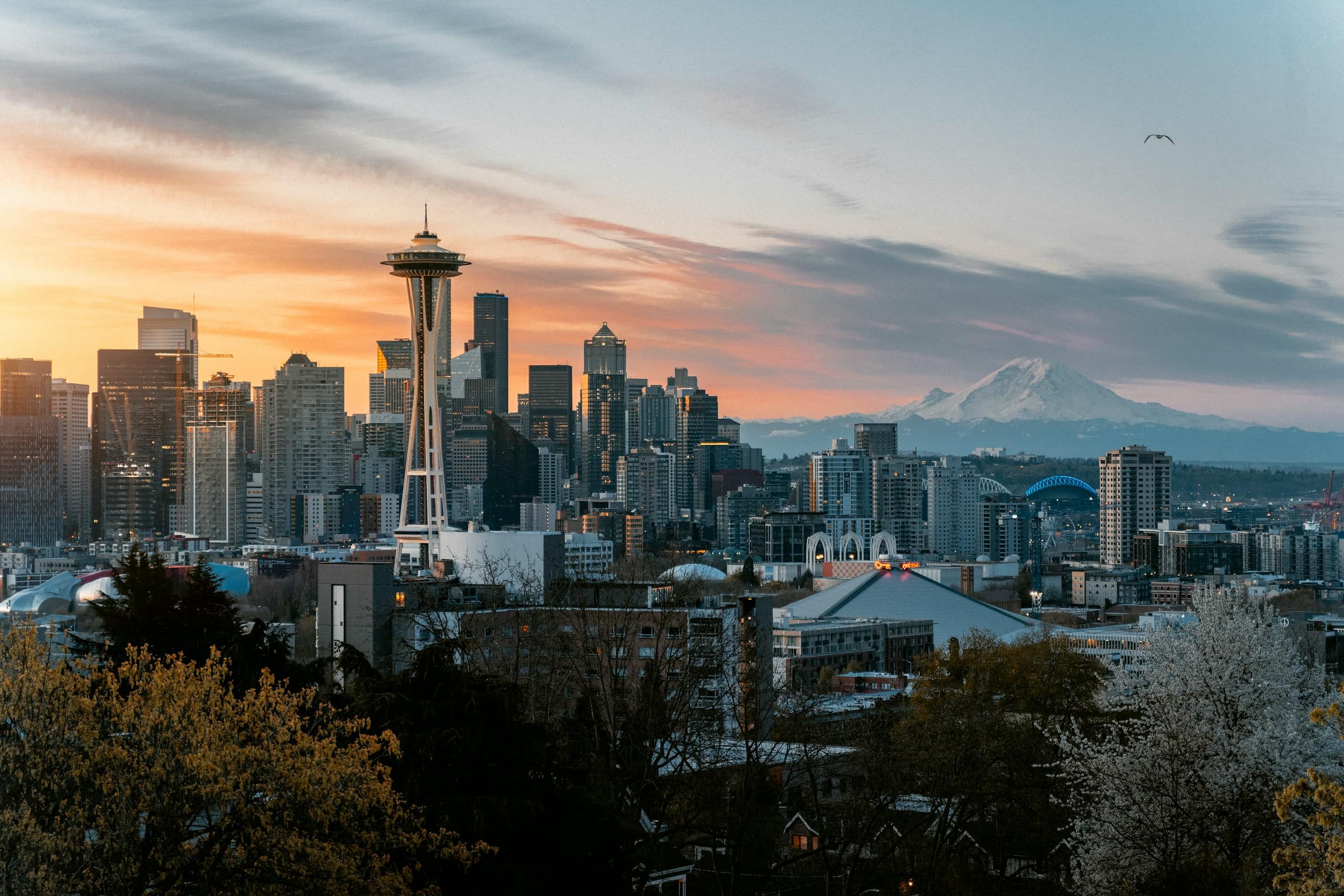
Seattle offers a modern urban environment with the waterfront, Pike Place Market, the Space Needle, Pioneer Square's historic architecture, Capitol Hill, and the University District. The city is recognizable globally while also serving as a flexible stand-in for other coastal cities. Tacoma, 30 miles south, provides additional urban locations with a distinct industrial and historic character.
Cascade Mountains
The Cascades provide mountain terrain from accessible passes like Snoqualmie and Stevens to more remote wilderness. The range includes dense old-growth forest, subalpine meadows, glaciated peaks, and dramatic river gorges. Winter access to mountain locations is available for productions needing snow-covered environments.
Eastern Washington
East of the Cascades, Washington transforms into a high desert and agricultural landscape. The Palouse region's rolling wheat fields, the Columbia River Gorge, the Channeled Scablands, and the Spokane metro area all offer visual profiles distinct from western Washington. Eastern Washington has doubled for the American Southwest in multiple productions while qualifying for the rural county bonus.
Olympic Peninsula
The Olympic Peninsula is home to the Hoh Rain Forest, one of only four temperate rainforests in the world, along with rugged Pacific coastline, sea stacks, and old-growth timber landscapes. The Peninsula's visual distinctiveness has attracted productions seeking environments that cannot be found elsewhere in the lower 48 states.
Rural Counties
Productions that locate the majority of their shoot in rural counties defined by Washington Filmworks qualify for the 10% bonus. Rural counties across eastern Washington, the coast, and the Olympic and Cascade foothills all qualify, giving productions significant geographic flexibility in designing a shoot that captures the bonus.
Washington Film Production Infrastructure
Seattle's production services community has grown substantially over the past two decades:
IATSE Local 488 and Teamsters Local 174 provide a trained union crew workforce across departments
Multiple grip and electric rental houses serve the greater Puget Sound area
Sound stages in Seattle and surrounding communities support controlled environment shoots
A large SAG-AFTRA talent pool in Seattle includes principal cast performers and experienced background talent
Post-production facilities in Seattle offer editorial, visual effects, color grading, and sound mixing services
A robust commercial and advertising production community provides a trained crew base that transfers readily to longer-form productions
The state's tech industry concentration, with Amazon and Microsoft headquartered in the Seattle area, has also created steady demand for corporate film and video production, which has in turn supported the growth of production infrastructure that feature and television productions can draw on.
How Washington Compares to Other Western States
Washington vs. Oregon
Oregon offers a 20% cash rebate through its Oregon Production Investment Fund (OPIF) plus a 16% labor credit for Oregon resident wages. Oregon's program has historically exhausted its annual allocation early in the year, creating uncertainty for productions that apply late. Washington's $15 million cap is larger than Oregon's base fund, and Washington's rural and episodic bonus tiers can push its effective rate substantially above Oregon's for qualifying productions.
Washington vs. New Mexico
New Mexico provides up to 40% on qualifying expenditures including resident labor but requires productions to meet specific facility usage requirements and in-state spending ratios. Washington's program is more flexible on facility requirements and does not require productions to work from specific studio campuses to qualify for the top rates.
Washington vs. California
California's film tax credit program is heavily oversubscribed, with many qualifying productions unable to secure an allocation. Washington's program is smaller in absolute dollar terms but offers more reliable access for mid-budget independent productions that cannot secure a California credit allocation. Productions that want Pacific Coast locations without California's permitting complexity and cost structure frequently choose Washington.
Washington No-Film-Tax-Credit History
Washington is unique in offering a cash rebate rather than a transferable tax credit. This distinction matters practically: productions do not need to broker a credit sale with a financial intermediary to realize the program's value. The rebate comes directly from Washington Filmworks as a cash payment, which simplifies the incentive realization process for independent productions and single-purpose LLCs that lack Washington state tax liability.
The cash rebate structure also eliminates the haircut that productions typically accept when selling transferable credits at a discount to brokers. A 30% Washington rebate returns 30 cents on every qualifying dollar, whereas a 30% transferable credit sold at 87 cents on the dollar effectively returns closer to 26 cents. For tight-budget productions, that difference is meaningful.
Managing Washington Production Budgets with Saturation
Tracking qualified expenditures for the Washington Filmworks rebate requires systematic record-keeping from the first day of pre-production. Washington Filmworks requires documentation of every expense that contributes to the rebate calculation, organized by vendor residency, crew residency, and expense category.
Saturation's cloud-based production budgeting software supports this workflow directly. Productions can tag expenditures by vendor location, crew residency, and production phase from the moment purchase orders are issued, generating qualified spend reports for Washington Filmworks without manual data reconstruction. When the production wraps, the documentation Washington Filmworks needs is already organized and exportable.
For productions filming across multiple states, Saturation keeps each state's qualified spend separated so that your Washington rebate calculation does not get conflated with expenditures that belong to another state's program. The result is a cleaner audit trail and faster approval of your rebate application.
Frequently Asked Questions
Does Washington require a CPA audit to receive the rebate?
Washington Filmworks may require a CPA audit depending on the project size and the rebate amount requested. Productions should budget for potential audit costs when planning the incentive application, as these costs are not reimbursed from the rebate itself.
Can a production apply after the annual cap is fully committed?
Productions that apply after the annual allocation is committed may be placed in a pipeline for the following year's funding cycle. Washington Filmworks communicates program availability on its website and directly to production companies in active discussions with the office.
Is non-resident above-the-line labor eligible at all?
Non-resident above-the-line labor is eligible for the rebate calculation but is capped at $50,000 per person. A director paid $500,000 contributes only $50,000 toward the qualified spend calculation. This cap encourages productions to hire Washington residents in above-the-line roles where possible.
Can a commercial production qualify for the rural bonus?
Yes. Commercial productions that film the majority of their shoot in rural counties as defined by Washington Filmworks qualify for the 10% rural bonus in addition to the base 30% rebate, for a combined 40% return on qualifying rural spend.
Is Washington's incentive available to out-of-state production companies?
Yes. The production company does not need to be headquartered in Washington. The key requirements are that qualifying expenditures occur in Washington, the project meets the minimum spend thresholds, and the application passes Washington Filmworks' competitive review process.
Contact Washington Filmworks
Washington Filmworks administers the Motion Picture Competitiveness Program and serves as the first point of contact for productions considering Washington. Amy Lillard serves as Executive Director and can be reached at 206.264.0667. Additional information, including application guidelines, program updates, and location resources, is available at washingtonfilmworks.org.
Productions are encouraged to reach out to Washington Filmworks early in development, well before the annual application window, to discuss project fit and explore whether Washington locations and the rebate program can support your production goals.
Washington Film Office:
Applying for the credit?
Get Free Template
Use our budget template to add qualified expenses to the proper chart of accounts as required by the state.