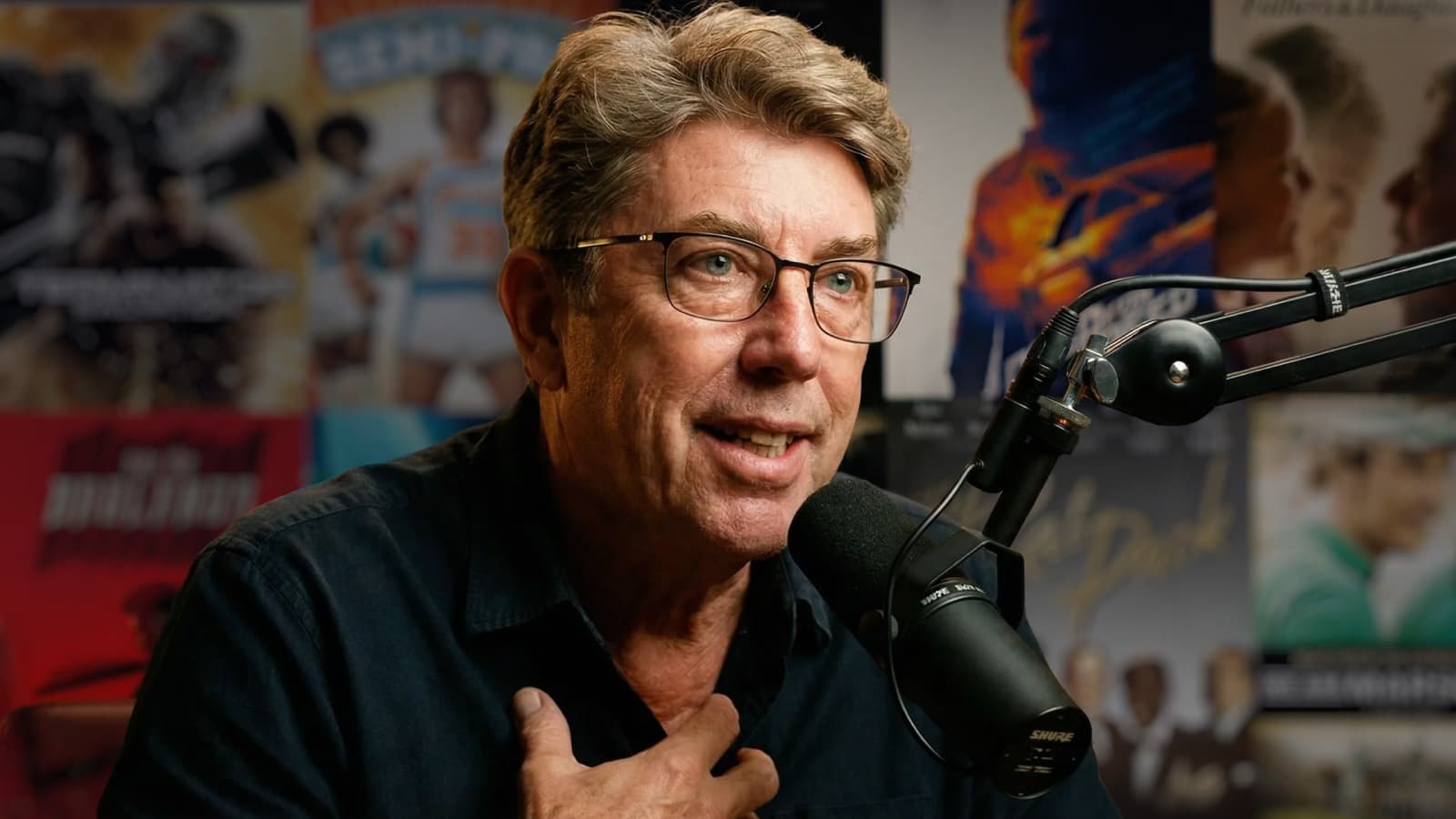
Shane Hurlbut, ASC, on Produced With
 Apple Podcasts
with Shane Hurlbut, ASC
Twenty-five Canon 5D bodies were destroyed on purpose. Shane Hurlbut, ASC mounted them to helmets, put them under cars, and let mini guns and explosions obliterate them across the two and a half year shoot of Act of Valor, the Navy SEAL feature he made for under $4 million. The logic was economic before it was creative. Nobody sacrifices a $350,000 film camera, but a still camera with video enabled on its sensor was cheap enough to lose, and losing it bought a point of view no one had filmed.
That film became, by his account, the first feature shot on a Canon 5D to reach theaters, playing in over 9,000 of them including twelve IMAX screens. He had arrived there from the opposite end of the business. Terminator Salvation put 298 people under him in camera, grip and electric alone, on a $200 million production. He also shot Drumline and Need for Speed, and shot videos for Nirvana, Guns N' Roses and The Rolling Stones. His first feature, The Rat Pack, made him the youngest ASC nominee in history at 34.
A thousand dollars of AI tools sits at the other end of that arc. Hurlbut had already written the shot list; the tools could not produce the first shot on it. He walked host Jens through both ends on Produced With.
How a ten person crew limit put a Canon 5D on Act of Valor
The 5D was not a stylistic preference on Act of Valor; it was the only camera that fit the deal. The Navy offered two years of access to real training missions, Ospreys, nuclear submarines, Night Stalker helicopters, mini guns and live fire, on a hard cap of ten people. Hurlbut wanted the audience inside a mission, tracking hand signals and a movement he compared to ballet. Neither film nor the bulky digital cameras of the day could do that with a crew that size. Then, at an ASC function at Sammy's Camera, he picked up a 5D and saw 35 millimeter depth of field in a still body.
Surviving a 9,000 screen release meant rebuilding the camera around it. He fitted Panavision mounts rather than shoot Canon glass. Preston follow focus kept familiar tools in his focus pullers' hands. He engineered helmet rigs that could still rack focus, and wrote his own picture profiles to protect latitude in the grade.
Why Terminator Salvation left him disenfranchised with blockbusters
His biggest film before Terminator Salvation had been 50 or 60 million. After it he was, in his word, disenfranchised with the blockbuster experience, and specifically with how much of a $200 million budget the producers took against how much he had left to make the movie with.
Act of Valor was the correction, a rebirth of why he became a filmmaker. Terminator Salvation gave him 298 crew across three departments; on Act of Valor he was the director of photography, the camera operator, the gaffer, frequently the key grip, and the travel coordinator. The ten person crew flew around the world twice while its Navy SEAL cast kept getting deployed. Its directors, Scott Waugh and Mike McCoy of Bandito Brothers, put costs on their own credit cards to keep it alive.
What the DSLR revolution set off next
The DSLR era was the genesis of the wider digital shift, Hurlbut argued, not a footnote to it. Once a small body had carried a theatrical action movie, the manufacturers followed: the Alexa Mini, the Red Epic and Dragon, the Sony Rialto. The gimbal revolution started because there was finally something light enough for one.
Glass changed with them. Small bodies let him use still lenses that had sat untouched for twenty or thirty years, so he began harvesting Leica R and Nikon AI series glass. Demand for rehousing followed, which turned K35s and Super Baltars into sought after lenses and fed the anamorphic revival.
Access opened up as well. Someone with a story but no way to fund stock and processing could buy a camera for $2,500, finish on a laptop, then run an HDMI cable to a 60 foot screen.
Why he started Filmmakers Academy instead of gatekeeping
The blog began in a Puerto Rico hotel room during the Act of Valor shoot, when his wife Lydia suggested they publish what he was working out. His peers told him not to, and the advice was unanimous: do not share this, make it your own, do not expand anyone else's creativity.
He published anyway, on the blog that grew into Filmmakers Academy, and got a return he had not expected. A reader in Switzerland wrote in to point out that the Canon's noise floor was dramatically cleaner at ISO 160, 320 and 640, and that it produced fixed pattern noise anywhere in between. The exchange ran both ways, he said: "Once we started that conversation, as much as I shared, I got twice back in return."
He and Lydia went on to build it out. A filmmaker in Nigeria, he said, took its beginner cinematography career path, built a school around it, taught 2,000 female filmmakers and helped start a film festival.
From grip truck driver to the youngest ASC nominee at 34
His route in was slow and repeatedly restarted. He grew up in Aurora, New York, a town of 500, and left film school wanting to produce, not to light. Doors slammed on him across Boston, so he went back to the rental house he had interned at and packed grip trucks for $3.50 an hour. Los Angeles meant starting over at $5 an hour at Key Light, where he made a point of running while everyone told him to hit his quota and check out. A producer watching from an office window hired him to drive the grip truck on Phantasm II.
The turn came in a stairwell on that set. A third electric named Brian Coyne stopped him mid errand and asked whether he would be scared: every nook and cranny was lit, there was no shadow, and so no suspense. From that grip truck in 1988 he got to shooting Nirvana's Come As You Are in 1991. A Donna Summer video led to Rob Cohen, who hired him on The Rat Pack after he became the first candidate to bring reference books into the interview.
What AI could not generate on a real action sequence
Prepping a television series whose first episode climaxes in a shootout modelled on Michael Mann's Heat, he broke seven to ten scenes into a shot list, spent over a thousand dollars on tools including Runway, and worked through them with his son.
The opener was one continuous move: clouds, a crane down past palm trees onto a Beverly Hills street, a motorcycle officer calling in a plate, a wrap around to the taillight that was out, then a settle over his shoulder as the window comes down and a muzzle flashes. Seven tools could not generate it. One had the officer shooting out of his finger. A single image that still was not right cost him, he said, three to six to ten thousand prompts.
He is not writing it off. He expects AI to land as an efficiency layer, and he is moving toward Blackmagic Cloud and DaVinci for end to end post. Alongside those sit what he called AI enabled budgeting platforms such as Saturation, which track a production in ways a human mind cannot. What he does not expect a model to reach is emotion, vulnerability and the unseen choices that make an audience feel something without knowing why.
Key takeaways
- Let the constraint pick the camera. A ten person cap from the Navy put a Canon 5D on Act of Valor, and surviving over 9,000 theaters then took Panavision mounts, Preston follow focus and custom helmet rigs.
- Do not confuse budget size with creative freedom. Hurlbut's biggest film before Terminator Salvation was 50 or 60 million, and he left the $200 million tier because too little of it reached the screen.
- Watch what a cheap tool unlocks, not just what it shoots. The 5D era pulled in the Alexa Mini and the Sony Rialto, revived K35s through rehousing, and let a $2,500 camera finish on a laptop.
- Publish what you are working out, even when every peer says not to. Doing it brought back the Canon's clean ISO points of 160, 320 and 640 from a reader in Switzerland who had found fixed pattern noise in between.
- Leave something unlit. On Phantasm II a third electric named Brian Coyne stopped Hurlbut in a stairwell and asked whether he would be scared: every nook and cranny was lit, so there was no shadow and no suspense.
- Test AI against a real shot list first: seven tools could not generate the opening move, and one had the officer shooting out of his finger. "AI doesn't like failure, but it fails a lot."

Share this episode
Meet Shane Hurlbut, ASC
Shane Hurlbut is an ASC cinematographer and educational pioneer who revolutionized modern filmmaking by spearheading the DSLR camera revolution with "Act of Valor" (2012) the first major theatrical release shot using the Canon 5D, playing in over 9,000 theaters including IMAX. As the youngest ASC nominee in history at 34 for his debut feature "The Rat Pack," he established a career spanning blockbusters like "Terminator Salvation," "Drumline," and "Need for Speed" alongside iconic music videos for Nirvana, Guns N' Roses, and The Rolling Stones. Shane’s journey exemplifies his philosophy that "every choice you make has a massive ripple effect." A vocal advocate against industry gatekeeping, he co-founded Filmmakers Academy with his wife Lydia, an immersive online film education platform offering courses from beginner to advanced levels taught by industry professionals, featuring live virtual events, masterclasses, and a global community of filmmakers. The platform provides "practical on-the-job knowledge from industry-leading professionals" with downloadable resources, cutting-edge industry knowledge, and real-time mentoring, empowering thousands of creators worldwide. As an Academy of Motion Picture Arts and Sciences member known for sharing knowledge rather than hoarding it, Shane continues to push technological boundaries while proving that collaboration amplifies rather than diminishes creative power.


Producing something of your own?
Saturation is the production platform behind this show: industry budget templates, expense management, and a company card. Start 14 days free on the Team plan, no credit card.