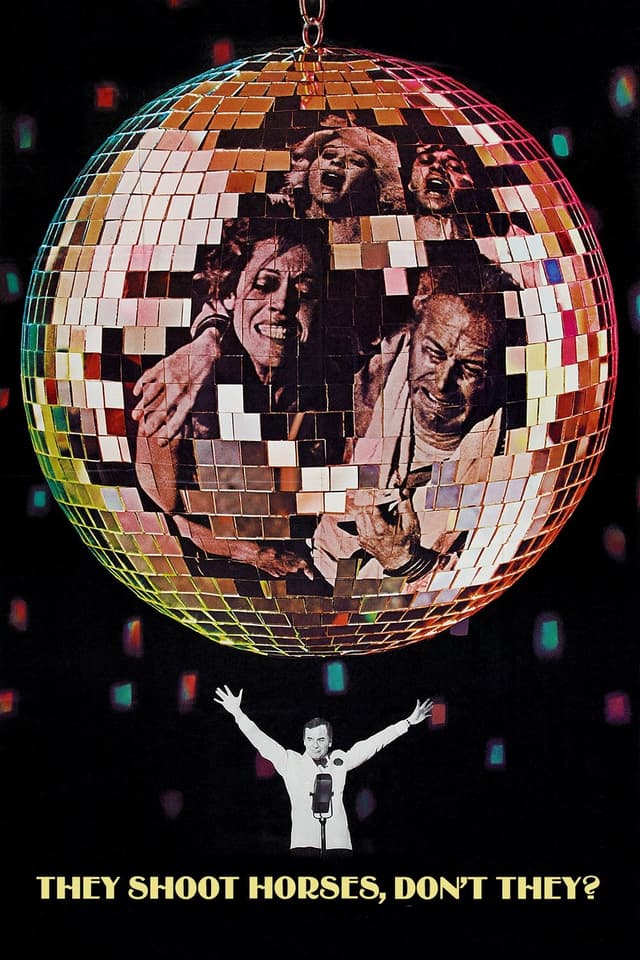
They Shoot Horses, Don't They Budget
 Drama2h
Updated
Synopsis
In Depression-era Los Angeles, a disparate group of desperate strangers enter a grueling dance marathon at a shabby ballroom on the Santa Monica Pier, competing for a $1,500 cash prize and hoping to be spotted by Hollywood talent scouts in the audience. As the contest stretches into weeks and the contestants are pushed past the point of human endurance by emcee Rocky Gravo, embittered drifter Gloria Beatty and naive newcomer Robert Syverton form a brittle partnership that will end in a moment of mercy and a question that gives the film its title.
What Is the Budget of They Shoot Horses, Don't They? (1969)?
They Shoot Horses, Don't They? (1969), directed by Sydney Pollack and adapted from Horace McCoy's 1935 Hollywood novel, was produced on a budget of $4,860,000. The bleak Depression-era drama was financed by ABC Pictures, the short-lived theatrical film arm of the American Broadcasting Company, in partnership with Palomar Pictures, with Cinerama Releasing Corporation handling theatrical distribution. Producers Robert Chartoff and Irwin Winkler, near the start of what would become a decades-long collaboration (later Rocky, Raging Bull, Goodfellas), shepherded the project from a long-stalled property to one of the most acclaimed studio releases of the year.
The budget represented a significant commitment for a single-location drama with no movie stars in the conventional 1969 sense. Original packager Edward Scherick had wanted to make the picture for $900,000 with screenwriter James Poe directing, but creative disputes and a series of casting near-misses (including Mia Farrow, whose $500,000 fee Scherick rejected) inflated the eventual price. By the time Sydney Pollack inherited the project, ABC Pictures had agreed to escalate the budget to roughly $4,000,000, and the final negative cost landed at $4,860,000 after location interiors, period-accurate art direction by Harry Horner, and a marathon shooting schedule that mirrored its subject matter.
Key Budget Allocation Categories
The $4,860,000 budget was distributed across the categories that define a chamber drama: cast salaries, an obsessive single-set build, period costume and choreography, and a Johnny Green score:
- Above-the-Line Talent: Jane Fonda commanded a substantial fee on the strength of recent leads in Barefoot in the Park (1967) and Barbarella (1968), and signed on after her then-husband Roger Vadim pressed her to consider the script. Michael Sarrazin was borrowed from Universal Pictures for the male lead. Gig Young, a veteran character actor working his way back from career instability, took the emcee role of Rocky for a quote well below his peak studio rates. Susannah York, Red Buttons, Bonnie Bedelia, and a young Bruce Dern filled out the marathon couples.
- Director and Producer Fees: Sydney Pollack drew his director fee through his own deal at ABC Pictures; producers Robert Chartoff and Irwin Winkler split a producing fee through their Chartoff-Winkler Productions banner. Screenwriters James Poe and Robert E. Thompson were paid for the adaptation of McCoy's 1935 novel, with Poe also retaining a piece of the project after originating it as the long-term rights holder.
- Single-Set Construction: Production designer Harry Horner built an elaborate full-scale Depression-era ballroom interior on a soundstage at the Warner Bros. lot in Burbank, complete with a working bandstand, balcony seating for the spectators, kitchen and locker room areas, and the encircling dance floor that the camera would not leave for most of the running time. The set was dressed to weather progressively across 1,500 dance-marathon hours of fictional time.
- Period Costume and Choreography: Costume designer Donfeld dressed roughly two dozen marathon couples in increasingly threadbare 1932 attire, with detailed continuity tracking required as the picture's chronology stretched across weeks of competition. Choreographer Tom Panko staged the dance derbies, the foxtrots, and the late-stage stumbling crawls that punctuate the film, working with the cast across weeks of pre-production rehearsal so that the staged exhaustion would read as authentic.
- Cinematography and Camera Package: Cinematographer Philip H. Lathrop, fresh off The Cincinnati Kid and Point Blank, used long lenses and a mobile camera to lock the audience inside the ballroom. The shooting style demanded extended dolly track on the dance floor, custom lighting rigs built into the standing set, and a dedicated grip and electric crew working long hours on a constrained stage footprint.
- Score and Soundtrack: Veteran MGM musical director Johnny Green, an Oscar winner for An American in Paris, scored the film and adapted period dance-band standards including "Easy Come, Easy Go" and Hoagy Carmichael source music. Music publishing licenses for the 1930s-era catalog and an on-camera house band added measurable cost on top of original orchestration.
- Editing and Post-Production: Editor Fredric Steinkamp cut the picture in Los Angeles, integrating Pollack's flash-forward inserts to the courtroom framing device that bookends the action. The non-linear structure required extensive trim work and demanded a longer post schedule than a conventional linear drama of its era.
How Does They Shoot Horses, Don't They?'s Budget Compare to Similar Films?
At $4,860,000 in 1969 dollars (roughly $42,000,000 adjusted to 2026), the film sat at the upper end of mid-budget character dramas of its time and below the era's roadshow musicals. The comparison set illustrates how it landed commercially relative to its peers:
- Bonnie and Clyde (1967): Budget $2,500,000 | Worldwide $50,700,000. Arthur Penn's Depression-era crime drama cost roughly half as much and earned more than four times They Shoot Horses' worldwide gross, signaling the studio appetite for revisionist period material that the Pollack film tapped two years later.
- Midnight Cowboy (1969): Budget $3,200,000 | Worldwide $44,800,000. The Best Picture winner of the same year cost about a third less and grossed over three times the worldwide total, illustrating the upper ceiling for an American character drama at the close of the 1960s.
- Easy Rider (1969): Budget $360,000 | Worldwide $60,000,000. Dennis Hopper's countercultural road movie cost a fraction of They Shoot Horses and outperformed it by a wide margin, demonstrating the period's appetite for unconventional structure and youth-oriented marketing.
- Paper Moon (1973): Budget $2,500,000 | Worldwide $30,900,000. Peter Bogdanovich's Depression-era road comedy followed They Shoot Horses by four years at half the budget and showed that the period remained commercially viable through the early 1970s.
- Klute (1971): Budget $2,500,000 | Worldwide $12,500,000. Jane Fonda's next major role, for which she won the Oscar that her Gloria nomination set up, cost half as much as They Shoot Horses and earned roughly the same worldwide, marking the consolidation of her standing as a top-tier dramatic lead.
- The Way We Were (1973): Budget $5,000,000 | Worldwide $49,900,000. Pollack's next collaboration with Barbra Streisand and Robert Redford cost a comparable amount and earned roughly four times the worldwide gross, confirming the director's commercial trajectory after the They Shoot Horses breakthrough.
They Shoot Horses, Don't They? Box Office Performance
They Shoot Horses, Don't They? premiered at the Fine Arts Theatre in Beverly Hills on December 10, 1969, for an Academy-qualifying run before expanding domestically in early 1970. The film grossed $28,000 in its opening week on a limited-release platform, well below the wider commercial openings of musicals and roadshow releases that dominated late-1969 distribution. Strong word of mouth, glowing reviews, and Oscar attention drove the picture to a successful theatrical run that played into mid-1970.
Against a $4,860,000 production budget, the film needed roughly $9,000,000 to $11,000,000 in worldwide gross to clear marketing and distribution costs and reach profitability. Here is the financial breakdown:
Box Office Breakdown
They Shoot Horses, Don't They

They Shoot Horses, Don't They? returned approximately $1.51 in theatrical revenue for every $1 invested when measured against total estimated production and marketing spend, a strong outcome for a single-set adult drama in the prestige tier. Theatrical rentals (the studio share remitted by exhibitors) reached $5,980,000 in the United States and Canada, making the film the 16th highest-grossing release of 1969 in North America by that measure.
The picture's commercial success at this scale, combined with its sweep of nine Academy Award nominations the following spring, validated ABC Pictures' theatrical ambitions for several years and cemented Sydney Pollack as a top-tier studio director. Re-release earnings, a 1970 Cannes Film Festival premiere outside the competition, and home video and television licensing revenue in subsequent decades added incremental gross beyond the original theatrical window.
They Shoot Horses, Don't They? Production History
Development on a film adaptation of Horace McCoy's 1935 novel stretched across decades. Charlie Chaplin had purchased the rights in 1952 for $3,000, intending to cast his son Sydney Chaplin and a then-unknown Marilyn Monroe before his US re-entry difficulties shelved the project. The rights reverted to McCoy's estate after his 1955 death and sat dormant until 1966, when screenwriter James Poe acquired them for development. Poe and producer Edward Scherick attempted to make the picture for $900,000 with Poe directing, but ABC Pictures head Martin Baum took control of the project and replaced both producer and director.
Sydney Pollack came aboard in 1968 after a shortlist that included William Friedkin, Jack Clayton, Larry Peerce, Roger Vadim, and Jack Smight. Robert Chartoff and Irwin Winkler took producer credit, with Chartoff-Winkler arranging the deal at ABC. Robert E. Thompson was brought in to rewrite James Poe's screenplay, retaining a co-credit and the WGA-arbitrated structure that would earn the writers an Oscar nomination. Pollack and his collaborators read the novel for what Pollack later described as its allegory of the country itself, with the dance marathon standing in for the American capitalist machinery that grinds participants to exhaustion for a dwindling prize.
Filming was pushed from December 1968 to February 1969 to accommodate rewrites and recasting. Principal photography ran February through April 1969 on a single sound stage at the Warner Bros. studio lot in Burbank, California, with Harry Horner's elaborate Depression-era ballroom built to scale and the cast confined to it for the duration of the schedule. Pollack worked the actors in long, choreographed takes that mirrored the physical attrition of a real marathon, with cinematographer Philip H. Lathrop keeping the camera inside the dance floor for hours of running time. Susannah York and Jane Fonda both reported significant physical exhaustion during the shoot, which Pollack used and shaped on camera.
Casting frictions defined the early months. Mia Farrow was interested at one point but priced herself out; Carol Lynley was tested. Jane Fonda was the eventual choice for Gloria after her husband Roger Vadim, who saw the script's bleakness as cousin to his own European art-film sensibilities, pushed her to read it. Fonda later said her first meeting with Pollack, in which he asked her opinion of the material, was the first time a director had treated her as a creative partner rather than a hired performer, and the experience reshaped her relationship to her own career. Gig Young's casting as Rocky Gravo, the marathon emcee, was suggested by Martin Baum over Pollack's initial preference and produced the film's only Oscar win the following spring.
Post-production took place in Los Angeles through summer and early autumn 1969. Editor Fredric Steinkamp built the courtroom flash-forwards that bookend Robert's narration into a structurally adventurous final cut. Johnny Green's score combined original cues with period dance-band standards. The picture premiered at the Fine Arts Theatre on December 10, 1969, for an Academy-qualifying run before its 1970 wide release and its out-of-competition slot at the 1970 Cannes Film Festival.
Awards and Recognition
They Shoot Horses, Don't They? received nine nominations at the 42nd Academy Awards, the most of any film at the ceremony. Gig Young won Best Supporting Actor for his performance as Rocky Gravo, the only competitive Oscar the film took home. The other eight nominations were Best Director (Sydney Pollack), Best Actress (Jane Fonda), Best Supporting Actress (Susannah York), Best Adapted Screenplay (James Poe and Robert E. Thompson), Best Art Direction (Harry Horner; production design Phil Abramson), Best Costume Design (Donfeld), Best Film Editing (Fredric Steinkamp), and Best Original Score for a Comedy or Drama (Johnny Green and Albert Woodbury). The picture holds the record for the most Academy Award nominations of any film not nominated for Best Picture.
At the BAFTA Awards, Susannah York won Best Actress in a Supporting Role, with nominations also going to Jane Fonda (Best Actress), Gig Young (Best Supporting Actor), the screenplay, and Fredric Steinkamp's editing. The Golden Globe Awards recognized the film with five nominations, including Best Motion Picture Drama, Best Director, and Best Actress (Drama) for Fonda, with Gig Young winning Best Supporting Actor. The National Board of Review named it Best Film of 1969 and gave Sydney Pollack its Best Director award. Jane Fonda took the New York Film Critics Circle and Kansas City Film Critics Circle awards for Best Actress, and the Writers Guild of America nominated Poe and Thompson for Best Drama Adapted from Another Medium.
At the 1970 Cannes Film Festival, the picture was screened out of competition as a prestige American showcase. The film's awards record, particularly the never-broken record for most Oscar nominations without a Best Picture slot, has remained a recurring data point in Academy histories and a touchstone for the New Hollywood era it helped define.
Critical Reception
They Shoot Horses, Don't They? received broadly enthusiastic reviews on release and has held its critical reputation across five decades. The film holds an 82% approval rating on Rotten Tomatoes based on 34 critic reviews, with the consensus framing it as a masterful re-creation of the Depression-era dance-marathon spectacle and a still-pointed allegory of the American striver. The film does not have a Metacritic score (the aggregator covers films released after 2000), but contemporaneous reviews from the major US dailies, weekly news magazines, and trade press were uniformly strong.
Roger Ebert wrote in the Chicago Sun-Times that the film holds the audience because it tells us something we didn't know about human nature and American society. Vincent Canby of The New York Times praised Pollack's direction and the central performances by Fonda and Young, with the New York Film Critics Circle subsequently honoring the picture in its year-end voting. Variety's December 1969 review highlighted the rigor of the production design and the discipline of the long-take ballroom sequences. Owen Gleiberman of Entertainment Weekly later observed that Pollack's dance-marathon movie has probably aged better than any American film of its time.
The film's reputation has continued to grow. It was selected for the National Film Registry's preservation list and is regularly cited in critic surveys of the best American films of the 1960s. Jane Fonda has named her work on the picture as the inflection point at which she began to think of herself as a serious dramatic actress, and the film is frequently taught in screenwriting and directing programs as an example of single-location storytelling at its most rigorous. Detractors have been few, with occasional contemporary criticism (notably from Pauline Kael) focusing on the film's relentlessness as a structural choice rather than a flaw of execution.
Frequently Asked Questions
How much did it cost to make They Shoot Horses, Don't They? (1969)?
The production budget was $4,860,000. ABC Pictures co-financed the film with Palomar Pictures, with producers Robert Chartoff and Irwin Winkler shepherding the project. The original packager Edward Scherick had wanted to make the picture for $900,000, but creative and casting changes raised the eventual budget to roughly $4,000,000, with the final negative cost landing at $4,860,000.
How much did They Shoot Horses, Don't They? earn at the box office?
The film grossed $12,600,000 worldwide on a $4,860,000 budget. Theatrical rentals reached $5,980,000 in the United States and Canada, making it the 16th highest-grossing release of 1969 in North America. The film opened with $28,000 in its first week during a limited Academy-qualifying run at the Fine Arts Theatre in Beverly Hills on December 10, 1969.
Who directed They Shoot Horses, Don't They?
Sydney Pollack directed the film, working from a screenplay by James Poe and Robert E. Thompson based on Horace McCoy's 1935 novel. Pollack was attached in 1968 after a shortlist that included William Friedkin, Jack Clayton, Larry Peerce, Roger Vadim, and Jack Smight. The film established Pollack as a top-tier studio director and led to his later collaborations on The Way We Were (1973), Tootsie (1982), and Out of Africa (1985).
Where was They Shoot Horses, Don't They? filmed?
Principal photography took place on a single sound stage at the Warner Bros. studio lot in Burbank, California, from February through April 1969. Production designer Harry Horner built a full-scale Depression-era ballroom interior on the soundstage, including a bandstand, balcony seating, kitchen, locker room areas, and the dance floor. The cast was confined to this single location for the duration of the shoot to mirror the physical attrition of an actual marathon.
How many Oscar nominations did They Shoot Horses, Don't They? receive?
The film received nine nominations at the 42nd Academy Awards, the most of any film at the ceremony. Gig Young won Best Supporting Actor for his performance as the emcee Rocky Gravo. The other eight nominations were Best Director, Best Actress (Jane Fonda), Best Supporting Actress (Susannah York), Best Adapted Screenplay, Best Art Direction, Best Costume Design, Best Film Editing, and Best Original Score. The film holds the record for the most Oscar nominations of any film not nominated for Best Picture.
What was Jane Fonda's role in They Shoot Horses, Don't They?
Jane Fonda played Gloria Beatty, an embittered drifter who partners with the naive Robert Syverton (Michael Sarrazin) in the marathon. Fonda received her first Academy Award nomination for the role and later cited her work on the film as the inflection point at which she began to think of herself as a serious dramatic actress. The performance preceded her wins for Klute (1971) and Coming Home (1978).
Is the film based on a book?
Yes. The screenplay adapts Horace McCoy's 1935 Hollywood novel of the same name, a Depression-era dance-marathon story long considered a touchstone of American existentialist fiction. Charlie Chaplin purchased the rights in 1952 for $3,000, intending to cast his son Sydney Chaplin and Marilyn Monroe, but the project was shelved. The rights reverted to McCoy's estate after his 1955 death and were acquired in 1966 by screenwriter James Poe.
Is They Shoot Horses, Don't They? a true story?
It is a fictional story based on a real social phenomenon. Dance marathons were a widespread Depression-era entertainment in which couples competed for cash prizes by staying on their feet for days or weeks at a time, often eliminated only when they collapsed. Horace McCoy worked as a bouncer at one such marathon in Santa Monica, California, and used the experience as the basis for his 1935 novel. The film is set in 1932 at a ballroom on the Santa Monica Pier.
How does They Shoot Horses, Don't They? compare to other Sydney Pollack films?
It was Pollack's commercial breakthrough and set up his decade-defining run on The Way We Were (1973, budget $5,000,000, worldwide $49,900,000), Three Days of the Condor (1975), Tootsie (1982, worldwide $241,000,000), and Out of Africa (1985, Best Picture Oscar winner). Among his early features, They Shoot Horses earned the most nominations and the strongest critical consensus, and it remains the work most often taught in directing programs alongside his later studio successes.
What did critics think of They Shoot Horses, Don't They?
The film received broadly enthusiastic reviews on release and holds an 82% approval rating on Rotten Tomatoes from 34 critic reviews. Roger Ebert wrote that the film holds the audience because it tells us something about human nature and American society. Vincent Canby of The New York Times praised Pollack's direction and the lead performances, and the National Board of Review named it Best Film of 1969. Owen Gleiberman of Entertainment Weekly later observed that the picture has probably aged better than any American film of its time.
Filmmakers
They Shoot Horses, Don't They

Build budgets like this one in Saturation
Start from an industry-standard feature film template, import the schedule and rates you already have, and let the cost report keep itself current as you spend. Real-time collaboration, no spreadsheets.