Shrek the Third Budget
 FantasyAdventureAnimationComedyFamily1h 33m
Updated
Synopsis
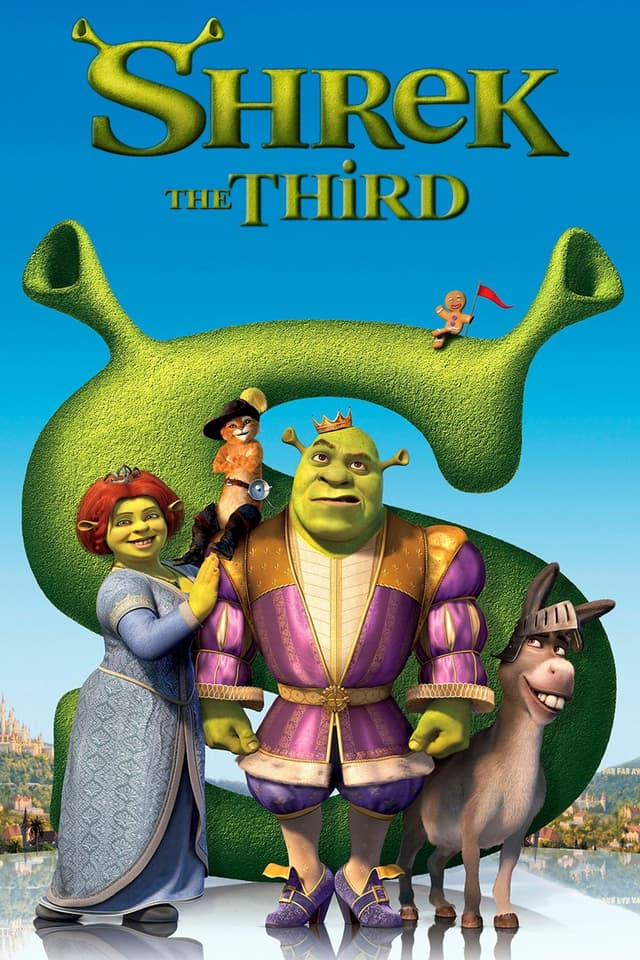
When his frog father-in-law King Harold falls ill, Shrek is faced with the prospect of becoming the next king of Far Far Away unless he can find the rightful heir. Together with Donkey and Puss in Boots, Shrek sets off to track down a young Arthur "Artie" Pendragon, while back home Princess Fiona must defend the kingdom from a coup led by Prince Charming and an army of fairy-tale villains.
What Is the Budget of Shrek the Third (2007)?
Shrek the Third (2007), directed by Chris Miller and co-directed by Raman Hui, was produced on a reported budget of $160,000,000, making it one of the most expensive animated films ever made at the time of its release. The film was financed by DreamWorks Animation and distributed by Paramount Pictures, which had taken over distribution of the studio's output after the dissolution of the DreamWorks/Universal home video partnership. Production was anchored at DreamWorks Animation's Glendale, California campus and at PDI/DreamWorks in Redwood City, the studio's Northern California facility that had handled significant portions of the previous two Shrek films.
The $160,000,000 outlay represented a meaningful step up from the reported $150,000,000 spent on Shrek 2 (2004) and roughly triple the $60,000,000 cost of the original Shrek (2001). The budget reflected DreamWorks Animation's status as a newly public company under intense pressure to deliver another billion-dollar tentpole, the expanded voice cast that added Justin Timberlake, John Cleese, Eric Idle, and Ian McShane to a returning lineup of Mike Myers, Eddie Murphy, Cameron Diaz, Antonio Banderas, and Julie Andrews, and the technical demands of staging an ensemble fairy-tale story with dozens of new character rigs, costume sets, and environment builds.
Key Budget Allocation Categories
Shrek the Third's reported $160,000,000 budget was distributed across the following core production areas:
- Above-the-Line Voice Cast: The ensemble cast was one of the most expensive in animation history to that point. Returning leads Mike Myers, Eddie Murphy, Cameron Diaz, and Antonio Banderas commanded back-end participations alongside upfront fees that reflected the franchise's billion-dollar earnings track record. New principal additions included Justin Timberlake as Artie Pendragon, Eric Idle as Merlin, John Cleese as King Harold, Julie Andrews as Queen Lillian, Ian McShane as Captain Hook, and Susanne Blakeslee as the Evil Queen.
- Animation and CG Production: Roughly 250 animators, modelers, and technical directors split between Glendale and Redwood City spent more than three years on the film. Industry estimates place the average all-in cost of a finished animated minute at this scale at roughly $1,500,000 to $1,800,000, meaning the 93-minute feature absorbed well over $140,000,000 in production labor alone before above-the-line and marketing.
- Character and Environment Builds: The film introduced more than a dozen new principal characters with bespoke rigs, hair systems, and cloth simulations, including Artie, Merlin, the high-school-themed Worcestershire Academy ensemble, the medieval Far Far Away royal court, and the entire Evil Queen-led princess villain group. Each new character build at DreamWorks at the time cost in the high six figures to low seven figures fully loaded.
- Score, Songs, and Music Licensing: Composer Harry Gregson-Williams returned to score the film, with the music budget covering original composition, orchestra and choir recording at Abbey Road and Sony Pictures Studios, and licensing of high-profile needle drops including Heart's Barracuda, Wings' Live and Let Die, and Led Zeppelin's Immigrant Song. The Shrek franchise had become a benchmark for expensive licensed soundtracks in animation.
- Marketing and Global Rollout: DreamWorks and Paramount spent an estimated $150,000,000 to $175,000,000 on worldwide marketing and prints. The campaign included a wide promotional partnership network covering McDonald's, M&Ms, Pepsi, and Hewlett-Packard, plus television spots through the 2007 NBA Playoffs and an aggressive international press tour during May 2007.
- Stereoscopic 3D and Theme Park Tie-Ins: While the theatrical release was 2D, the production created Shrek 4-D content and Universal Studios theme park assets concurrently, with allocated cost coming back through cross-studio accounting. Royal Far Far Away attractions opened at Universal Studios Florida and Hollywood ahead of the film's release.
- Post-Production and Finishing: Editor Michael Andrews handled the picture cut at DreamWorks, with sound design, Dolby Digital and DTS mixing, and final color completed in the months leading up to the May 18, 2007 release. Post-production overlap with marketing finishing required dedicated final-mix passes for international dub versions in more than 40 languages.
How Does Shrek the Third's Budget Compare to Similar Films?
At $160,000,000, Shrek the Third sits squarely in the upper tier of animated tentpole productions of its era. The comparison set illustrates how its commercial outcome stacked up against franchise siblings and 2007 animated competitors:
- Shrek (2001): Budget $60,000,000 | Worldwide $487,853,320. The original cost roughly 37% of what the third installment spent and earned around 60% of its worldwide gross, a far better return that established the franchise economics DreamWorks would never quite replicate.
- Shrek 2 (2004): Budget $150,000,000 | Worldwide $935,289,557. The franchise peak earned 16% more worldwide than Shrek the Third on a budget that was $10,000,000 lower, exposing the sequel-fatigue dynamic that the third film could not escape despite a bigger marketing push.
- Shrek Forever After (2010): Budget $165,000,000 | Worldwide $752,600,867. The fourth installment cost slightly more and earned 7% less than Shrek the Third, confirming the franchise's commercial trajectory after critical regard collapsed on the third entry.
- Ratatouille (2007): Budget $150,000,000 | Worldwide $623,722,818. Pixar's 2007 summer release cost $10,000,000 less than Shrek the Third and earned 23% less worldwide, but won the Academy Award for Best Animated Feature against Shrek the Third's notable awards shutout.
- Bee Movie (2007): Budget $150,000,000 | Worldwide $293,706,294. DreamWorks Animation's other 2007 release, a Jerry Seinfeld vehicle, cost $10,000,000 less than Shrek the Third but earned only 36% of its worldwide total, underscoring how franchise equity carried the third Shrek even as critical reception faltered.
- The Simpsons Movie (2007): Budget $75,000,000 | Worldwide $536,400,000. Fox's rival 2007 animated property cost less than half of Shrek the Third and earned roughly two-thirds of its worldwide gross, a far stronger return ratio that pressured DreamWorks Animation's newly public-company economics.
Shrek the Third Box Office Performance
Shrek the Third opened on May 18, 2007 to a domestic gross of $121,629,270 over its three-day opening weekend, setting a new record at the time for the largest animated opening in North American history and surpassing the $108,000,000 opening of Shrek 2. The opening day alone delivered $38,335,651, also an animated record. Internationally, the film opened in major territories across late May and June 2007, with strong launches in the United Kingdom, Germany, Australia, France, and Japan that mirrored the franchise's entrenched global footprint.
Against a $160,000,000 production budget, Shrek the Third needed approximately $375,000,000 worldwide to break even after marketing and distribution costs. Here is the financial breakdown:
Box Office Breakdown
Shrek the Third

Shrek the Third returned approximately $2.43 to $2.62 in theatrical revenue for every $1 invested when measured against total estimated production and marketing spend, a strong commercial outcome that nonetheless represented a sharp regression from Shrek 2's nearly $1,000,000,000 worldwide haul. Domestic gross of $322,719,944 against an international total of $490,647,436 produced a roughly 40/60 split that confirmed the franchise's global reach but also signaled that domestic enthusiasm had peaked with Shrek 2.
The film was the fourth-highest grossing release of 2007 worldwide, behind Pirates of the Caribbean: At World's End, Harry Potter and the Order of the Phoenix, and Spider-Man 3, and it remained the highest-grossing animated film of 2007 by a wide margin. The robust theatrical performance carried over into home video, where the DVD release in November 2007 became one of the year's top sellers and helped DreamWorks Animation deliver one of its strongest fiscal years as a public company.
Shrek the Third Production History
Development on Shrek the Third began in earnest in 2004 immediately after Shrek 2 grossed more than $900,000,000 worldwide. DreamWorks Animation, which had become a publicly traded company in October 2004 with Jeffrey Katzenberg as chief executive, treated the third installment as a critical proof point for its slate-financed business model. Andrew Adamson, who had directed the first two films, stepped back to a producing role to focus on the Chronicles of Narnia franchise at Walden Media. Shrek 2 storyboard supervisor and former Walt Disney Animation veteran Chris Miller was promoted to direct, with Hong Kong-born Raman Hui, a longtime DreamWorks Animation supervising animator, attached as co-director.
The screenplay was developed by Jeffrey Price and Peter S. Seaman, with story credit shared by Miller, producer Aron Warner, and writer-of-record Andrew Adamson. The plot premise reverse-engineered the franchise structure by separating Shrek from Fiona for much of the runtime, sending him on a quest to find the heir to the Far Far Away throne while Fiona was pregnant and besieged by Prince Charming's coup attempt. Justin Timberlake was cast as Artie in mid-2005, his casting timed to the height of his solo music career and ahead of his Saturday Night Live host gigs that would become a major marketing platform.
Production was concentrated at DreamWorks Animation's Glendale, California campus and at PDI/DreamWorks in Redwood City. Both California facilities benefited from the state's production base prior to the introduction of California's formal film and television tax credit program, with DreamWorks operating its in-house animation pipeline on Linux render farms expanded specifically for the increased shot count of the third film. The production employed roughly 250 artists across animation, modeling, lighting, effects, and rendering, with the largest crew of any DreamWorks Animation film to date.
Voice recording sessions ran intermittently from 2005 through 2006, with Mike Myers, Eddie Murphy, and Cameron Diaz recording at sound stages in Los Angeles, Antonio Banderas in Spain and Los Angeles, and Eric Idle and John Cleese sessions captured in London. Justin Timberlake's recording schedule was coordinated around his FutureSex/LoveSounds tour. Composer Harry Gregson-Williams returned to score the film after collaborating on the first two installments, with the score recorded in early 2007.
The film locked picture in early 2007 for a May 18 release. DreamWorks Animation and Paramount Pictures coordinated a global promotional campaign that included a Cannes Film Festival out-of-competition premiere on May 15, 2007, three days ahead of the wide North American release. The Cannes screening positioned the third Shrek alongside that year's Pixar entry Ratatouille as one of the two highest-profile animated releases of the summer.
Awards and Recognition
Shrek the Third's awards profile was significantly weaker than its predecessors. The original Shrek had won the inaugural Academy Award for Best Animated Feature in 2002, and Shrek 2 had earned a nomination in the same category in 2005, but Shrek the Third was not nominated for Best Animated Feature at the 80th Academy Awards. The category that year went to Ratatouille, with Surf's Up and Persepolis filling the other two slots.
At the 61st British Academy Film Awards in 2008, Shrek the Third was nominated for the BAFTA Award for Best Animated Film, losing to Ratatouille. At the 35th Annie Awards, the film received nominations for Directing in an Animated Feature Production (Chris Miller and Raman Hui), Best Animated Feature, Best Sound Editing in an Animated Feature, and Outstanding Effects in an Animated Motion Picture, with the bulk of category wins going to Ratatouille and The Simpsons Movie. At the 2008 Kids' Choice Awards, the film was nominated for Best Animated Movie alongside Bee Movie, with Ratatouille taking the trophy.
Razzie attention was limited. The Golden Raspberry Awards focused on live-action targets that year and Shrek the Third avoided nominations despite its critical regression, a function of voter focus on Norbit, I Know Who Killed Me, and Daddy Day Camp rather than DreamWorks' tentpole animation slate.
Critical Reception
Shrek the Third received mixed-to-negative reviews, a sharp decline from the critical embrace that had greeted the first two installments. The film holds a 41% approval rating on Rotten Tomatoes based on 207 critic reviews, with a critical consensus that called the third entry tired and overstuffed. On Metacritic, the film scored 58 out of 100, indicating mixed or average reviews. Audiences surveyed by CinemaScore gave the film a B+, the lowest grade of the franchise to that point and a notable softening from the A and A- grades earned by Shrek and Shrek 2.
Critics broadly praised the visual polish, the expanded fairy-tale ensemble, and individual performances from Eric Idle as Merlin and Justin Timberlake as Artie, but objected to the diluted satirical voice, the formulaic quest structure, and a perceived shift toward a younger target audience. Roger Ebert of the Chicago Sun-Times gave the film two stars, writing that "the series' freshness and energy has begun to congeal." Manohla Dargis of The New York Times noted that the film had "lost its bounce," while Variety's Brian Lowry called it "a pleasing but predictable installment that relies heavily on franchise goodwill."
Genre and family-film press were more divided. Empire awarded three stars and singled out the action sequences and the medieval high-school motif, while The A.V. Club's Scott Tobias gave the film a C and criticized the loss of the pop-culture irreverence that had defined the original. The mixed critical reception, set against the still-massive commercial outcome, established the template that would define the rest of the Shrek franchise: declining critical regard paired with durable box office and merchandise revenue. Shrek Forever After (2010) and the Puss in Boots spin-offs would extend that pattern through the next decade and a half.
Frequently Asked Questions
How much did it cost to make Shrek the Third (2007)?
The reported production budget was $160,000,000, financed by DreamWorks Animation. The figure represented one of the largest animated production budgets ever committed at the time and marked a $10,000,000 step up from the $150,000,000 spent on Shrek 2 (2004).
How much did Shrek the Third earn at the box office?
The film grossed $322,719,944 domestically and $490,647,436 internationally, for a worldwide total of $813,367,380. It opened to $121,629,270 in North America on May 18, 2007, setting a new record at the time for the largest animated opening weekend in domestic history.
Was Shrek the Third a box office success?
Yes. Against a $160,000,000 production budget and an estimated $150,000,000 to $175,000,000 in marketing spend, the film returned approximately $2.43 to $2.62 in worldwide gross for every $1 invested. It was the fourth-highest grossing film of 2007 worldwide and the highest-grossing animated film of the year by a wide margin.
Who directed Shrek the Third?
Chris Miller directed the film, with Raman Hui co-directing. Miller had served as storyboard supervisor on Shrek 2 before being promoted to director, and Hui was a longtime DreamWorks Animation supervising animator. The film was their first feature directorial credit at the studio.
Where was Shrek the Third produced?
Production was concentrated at DreamWorks Animation's Glendale, California campus and at PDI/DreamWorks in Redwood City, the studio's Northern California facility. Voice recording sessions took place in Los Angeles, London, and Spain across 2005 and 2006, with score recording at Abbey Road and Sony Pictures Studios in early 2007.
How does Shrek the Third compare to other Shrek films?
Shrek the Third earned $813,367,380 worldwide against a $160,000,000 budget, ranking third among the four original Shrek theatrical films. Shrek 2 (2004) earned $935,289,557 against $150,000,000, Shrek Forever After (2010) earned $752,600,867 against $165,000,000, and the original Shrek (2001) earned $487,853,320 against just $60,000,000. The third installment marked the franchise's critical low point but maintained strong box office momentum.
Who voiced Artie in Shrek the Third?
Justin Timberlake voiced young Artie Pendragon, the awkward Worcestershire Academy student whom Shrek recruits as the next king of Far Far Away. Timberlake was cast at the height of his FutureSex/LoveSounds tour and the role marked his first major animated film performance.
Why did critical reception decline for Shrek the Third?
Critics widely viewed the third installment as a regression from the satirical sharpness of the first two films, citing a more formulaic quest structure, a perceived shift toward a younger target audience, and diluted pop-culture commentary. The film holds a 41% Rotten Tomatoes score compared with 88% for Shrek and 89% for Shrek 2, the steepest one-film drop in franchise history.
Did Shrek the Third win any awards?
The film was not nominated for the Academy Award for Best Animated Feature, ending the franchise's Oscar streak (the original Shrek won the inaugural prize in 2002 and Shrek 2 was nominated in 2005). It received a BAFTA nomination for Best Animated Film, four Annie Award nominations including directing, and a Kids' Choice Award nomination for Best Animated Movie. Ratatouille won the major animated categories that year.
What did critics think of Shrek the Third?
The film received mixed-to-negative reviews, with a 41% approval rating on Rotten Tomatoes based on 207 critic reviews and a 58 out of 100 score on Metacritic. Audiences gave it a B+ CinemaScore, the lowest in the franchise to that point. Roger Ebert wrote that "the series' freshness and energy has begun to congeal," while Manohla Dargis of The New York Times said the film had "lost its bounce."
Filmmakers
Shrek the Third

Official Trailer
Build budgets like this one in Saturation
Start from an industry-standard feature film template, import the schedule and rates you already have, and let the cost report keep itself current as you spend. Real-time collaboration, no spreadsheets.