Ratatouille Budget
 AnimationComedyFamilyFantasy1h 51m
Updated
Synopsis
Remy, a young rat with an extraordinary sense of taste and smell, dreams of becoming a chef in Paris. After being separated from his colony, he finds himself beneath Gusteau's, a once-celebrated restaurant that has fallen from its five-star status. Remy forms an unlikely alliance with Alfredo Linguini, a clumsy garbage boy with no culinary talent, secretly controlling his movements from beneath his chef's hat. Together they must navigate the cutthroat world of French haute cuisine while hiding Remy's true identity from the kitchen staff and the scheming head chef Skinner.
What Is the Budget of Ratatouille?
Ratatouille (2007), directed by Brad Bird and distributed by Walt Disney Studios Motion Pictures, was produced by Pixar Animation Studios on a budget of $150,000,000. Brad Lewis produced the film, which was Pixar's eighth feature and the first to undergo a major directorial change during production. Bird took over from Jan Pinkava in 2005, substantially reworking the story while retaining the core concept of a rat who dreams of becoming a chef in Paris.
At $150 million, Ratatouille represented a significant investment even by Pixar's standards. The film required recreating Paris in painstaking detail, developing new technology for rendering food that looked genuinely appetizing on screen, and simulating the movement of hundreds of rats with individual fur dynamics. The budget reflects the studio's commitment to a project that many in the industry considered commercially risky: an animated film about French haute cuisine with a rat protagonist, aimed at an audience more accustomed to talking cars and superhero families.
Key Budget Allocation Categories
Ratatouille's $150 million budget was distributed across the production areas that define Pixar's filmmaking process:
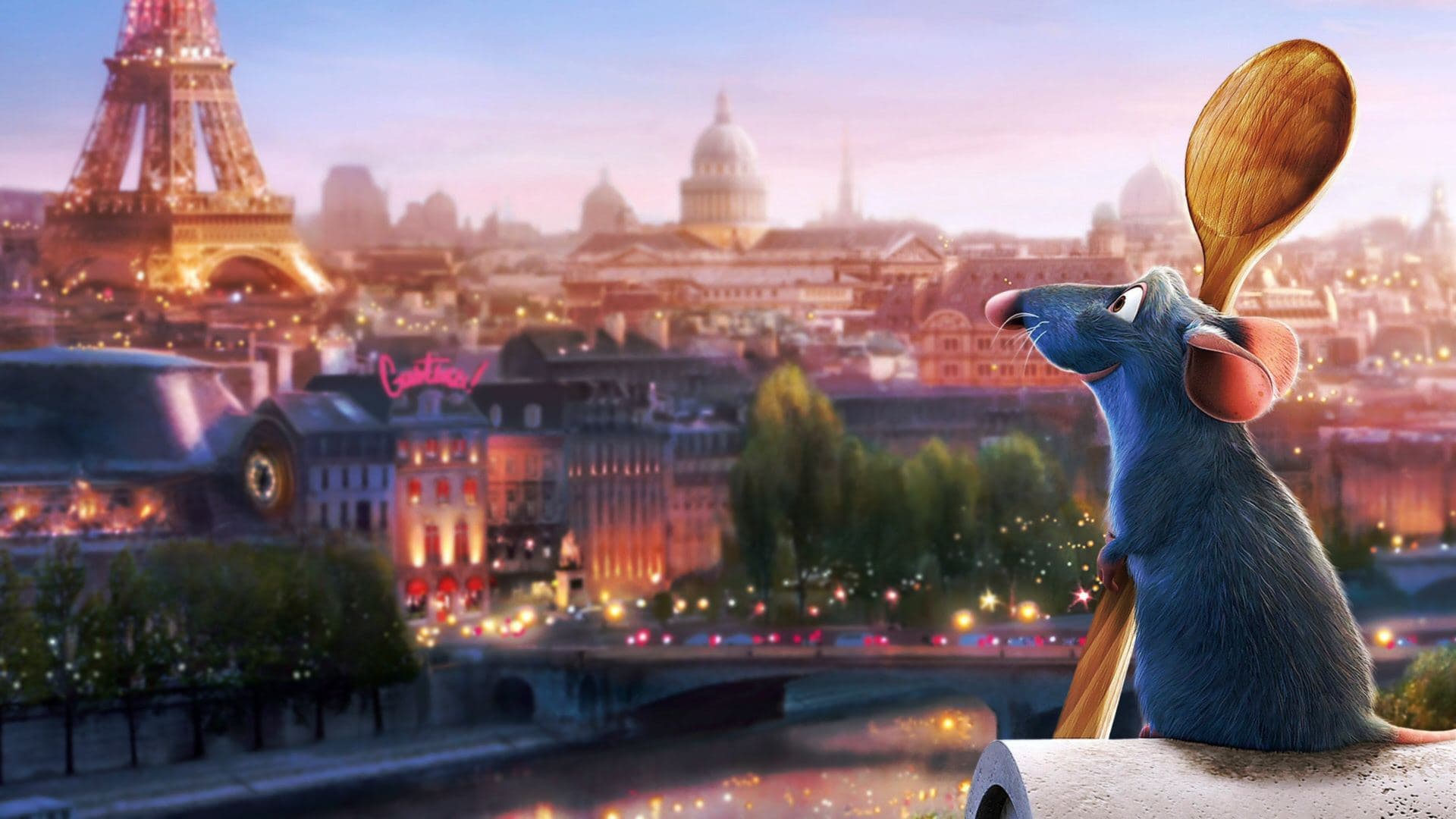
- Environment Design and Paris Recreation: Pixar artists traveled to Paris multiple times to photograph, sketch, and study the city's architecture, lighting, and atmosphere. The production team documented the kitchens of renowned restaurants, the sewers beneath the streets, and the rooftops above them. Every Parisian environment in the film, from Gusteau's restaurant interior to the view across the Seine at sunset, was built from direct observation rather than stylized approximation.
- Food Rendering Technology: Pixar developed proprietary shading and lighting tools specifically to make the food in Ratatouille look realistic and appetizing. Chef Thomas Keller of The French Laundry served as a culinary consultant, and the animation team studied how sauces glisten, how vegetables bruise, and how steam rises from a freshly plated dish. The food needed to function as a character in its own right, conveying Remy's passion through visual appeal alone.
- Fur and Character Simulation: Rendering Remy and the colony of rats required advances in fur simulation technology. Each rat had individual strands of fur that responded to movement, water, and contact with surfaces. Scenes involving hundreds of rats in the kitchen climax pushed the render farm to its limits, with individual frames taking hours to complete. The character animation team also developed a system for Remy's puppeteering of Linguini that conveyed physical comedy through precise movement choreography.
- Liquid and Steam Effects: A film set largely in a professional kitchen demanded convincing fluid dynamics for soups, sauces, boiling water, and steam. Pixar's effects team built custom simulation tools for liquids at various viscosities, from thin consomme to thick ratatouille. The Paris sewer sequences required a separate water simulation pipeline for flowing water, splashes, and reflections in underground environments.
- Score and Sound Design: Michael Giacchino composed the original score, blending orchestral arrangements with Parisian-influenced instrumentation to evoke the city's atmosphere. The sound design team recorded in professional kitchens to capture the specific acoustics of knife work, sizzling pans, and restaurant service. Giacchino's score needed to shift seamlessly between comedic action sequences and quieter moments of culinary artistry.
How Does Ratatouille's Budget Compare to Similar Films?
At $150,000,000, Ratatouille sits in the mid-range of major studio animated features from its era. The comparison with contemporaneous films illustrates the production economics of premium animation:
- Cars (2006): Budget $120,000,000 | Worldwide $461,983,149. Pixar's previous release cost less and earned less theatrically, though its merchandise revenue dwarfed all other Pixar properties.
- The Incredibles (2004): Budget $92,000,000 | Worldwide $631,607,053. Brad Bird's first Pixar film achieved higher worldwide gross at a substantially lower budget, establishing him as one of the most commercially efficient directors at the studio.
- Shrek the Third (2007): Budget $160,000,000 | Worldwide $813,367,380. DreamWorks' sequel spent more than Ratatouille and earned more worldwide, though it received a fraction of the critical acclaim.
- Kung Fu Panda (2008): Budget $130,000,000 | Worldwide $631,744,560. DreamWorks' martial arts comedy achieved similar worldwide returns at a lower production cost, signaling that the studio had closed the quality gap with Pixar.
- Up (2009): Budget $175,000,000 | Worldwide $735,103,954. Pixar's next collaboration with Giacchino carried a higher budget and delivered stronger worldwide performance, continuing the studio's pattern of escalating production costs.
Ratatouille Box Office Performance
Ratatouille opened on June 29, 2007, earning $47,027,395 in its domestic opening weekend. It was the ninth-highest-grossing film of 2007, performing solidly if unspectacularly by Pixar standards. The opening was notably lower than Cars ($60.1 million) and Finding Nemo ($70.3 million), fueling industry speculation about whether the unusual subject matter had limited the film's mass appeal.
Against a production budget of $150,000,000, the film needed approximately $350,000,000 to $400,000,000 worldwide to reach profitability when accounting for marketing and distribution costs. Here is the financial breakdown:
Box Office Breakdown
Ratatouille

At 316% ROI on production costs, Ratatouille was a clear financial success, though it represented one of Pixar's more modest theatrical performers relative to budget. The film's international performance was particularly strong, with $417 million from overseas markets accounting for 67% of the worldwide total. France, where the film is set, was a standout territory. Home video sales and the film's long-tail reputation as one of Pixar's finest artistic achievements have contributed to its commercial legacy well beyond the initial theatrical window.
Ratatouille Production History
Ratatouille originated with Jan Pinkava, a Czech-born animator who had won the 1997 Academy Award for Best Animated Short Film for Geri's Game. Pinkava developed the concept of a rat who wants to become a chef in Paris, and Pixar greenlit the project with Pinkava as writer and director. By 2004, however, the production had encountered significant story problems, and Pixar leadership decided to bring in a new director.
Brad Bird, fresh from the critical and commercial success of The Incredibles (2004), took over Ratatouille in early 2005. Bird rewrote the screenplay substantially, reshaping Remy's character arc and reworking the relationship between the rat and Linguini, the clumsy garbage boy who becomes Remy's unlikely partner in the kitchen. Bird retained Pinkava's original concept and some design work but restructured the narrative from the ground up, compressing the production timeline to meet the 2007 release date.
To ensure culinary authenticity, Pixar brought in Thomas Keller, chef and owner of The French Laundry in Napa Valley, as a consultant. Keller taught Pixar artists how to hold a knife, how professional kitchens operate during service, and how dishes are constructed. Several Pixar team members staged at The French Laundry and other restaurants to observe the rhythms of a working kitchen firsthand. The film's signature dish, a deconstructed ratatouille presented as a confit byaldi, was designed by Keller specifically for the movie.
Pixar artists made multiple research trips to Paris, photographing and sketching the city's rooftops, alleys, restaurants, and sewers. The production team gained access to the Paris sewer system to document its architecture and lighting conditions. The research extended to Parisian food markets, where the team studied the colors and textures of produce to inform the film's palette. Bird pushed for a level of environmental detail that would make Paris feel lived-in rather than postcard-perfect, insisting that surfaces show age, grime, and character.
Awards and Recognition
Ratatouille won the Academy Award for Best Animated Feature at the 80th Academy Awards, extending Pixar's dominance of the category. The film received four additional Oscar nominations: Best Original Screenplay (Brad Bird), Best Original Score (Michael Giacchino), Best Sound Editing, and Best Sound Mixing. It won the BAFTA for Best Animated Film and took home five Annie Awards, including Best Animated Feature.
The film also received the Golden Globe for Best Animated Feature Film and was named one of the top ten films of 2007 by the American Film Institute. Critics' organizations including the Los Angeles Film Critics Association, the National Society of Film Critics, and the Broadcast Film Critics Association recognized it as the year's best animated film. The film's influence on food culture extended beyond cinema, with the ratatouille dish experiencing a documented surge in restaurant orders and home cooking interest following the film's release.
Critical Reception
Ratatouille earned a 96% approval rating on Rotten Tomatoes based on 272 reviews, with an average rating of 8.5 out of 10. On Metacritic, the film scored 96 out of 100, indicating "universal acclaim" and making it one of the highest-rated animated films on the platform. Audiences gave it an A CinemaScore.
Critics praised Brad Bird's screenplay for treating its audience with intelligence, refusing to condescend or simplify the film's themes about artistic integrity, class, and the democratization of creativity. The character of Anton Ego, voiced by Peter O'Toole, and his climactic review were singled out as a masterful statement about the relationship between critics and artists. Roger Ebert awarded the film four stars, calling it "clearly one of the best of the year" and praising its refusal to compromise its vision for commercial safety.
The film's reputation has grown steadily since its release. It is frequently cited as one of Pixar's greatest artistic achievements, a film that prioritized storytelling ambition over marketability. Bird's direction brought a distinctly adult sensibility to the material, treating the Parisian setting and culinary world with a respect unusual in family animation. The closing monologue by Anton Ego, in which the critic reflects on the meaning of creativity and the courage required to defend something new, has become one of the most quoted passages in modern animated filmmaking.
Frequently Asked Questions
How much did it cost to make Ratatouille (2007)?
The production budget was $150,000,000, covering Pixar's multi-year animation pipeline including environment recreation of Paris, proprietary food rendering technology, fur simulation for hundreds of rats, and liquid and steam effects for kitchen sequences.
How much did Ratatouille (2007) earn at the box office?
Ratatouille grossed $206,445,654 domestically and $417,277,164 internationally, totaling $623,722,818 worldwide. It opened with $47,027,395 in its domestic opening weekend.
Was Ratatouille (2007) profitable?
Yes. Against a production budget of $150,000,000 and estimated total costs of $275,000,000 to $300,000,000, the film earned $623,722,818 theatrically, representing a 316% ROI on production costs. Home video and merchandise revenue added substantially to the total return.
Who directed Ratatouille?
Brad Bird directed Ratatouille, taking over from Jan Pinkava in 2005. Pinkava originated the concept and began development, but Bird rewrote the screenplay and restructured the narrative. Bird had previously directed The Incredibles (2004) for Pixar.
What were the biggest costs in producing Ratatouille?
The primary cost drivers were environment design (requiring multiple research trips to Paris including sewer access), food rendering technology developed specifically for the film, fur simulation for individual rat characters, liquid and steam effects for kitchen scenes, and Michael Giacchino's orchestral score.
How does Ratatouille's budget compare to other Pixar films?
At $150,000,000, Ratatouille sits in the mid-range for Pixar. Comparable budgets: The Incredibles (2004, $92,000,000), Cars (2006, $120,000,000), Up (2009, $175,000,000), Toy Story 3 (2010, $200,000,000). Later Pixar films would regularly exceed $175,000,000.
What awards did Ratatouille win?
Ratatouille won the Academy Award for Best Animated Feature and received four additional Oscar nominations including Best Original Screenplay and Best Original Score. It also won the Golden Globe and BAFTA for Best Animated Film, plus five Annie Awards.
Who voiced the characters in Ratatouille?
Patton Oswalt voiced Remy, Lou Romano played Linguini, Ian Holm was Chef Skinner, Janeane Garofalo voiced Colette, Peter O'Toole played the critic Anton Ego, Brian Dennehy voiced Django, and Brad Garrett played the ghostly Gusteau.
Who was the culinary consultant for Ratatouille?
Thomas Keller, chef and owner of The French Laundry in Napa Valley, served as culinary consultant. Keller taught Pixar artists kitchen techniques, and the film's signature confit byaldi ratatouille dish was designed by Keller specifically for the movie.
What did critics think of Ratatouille (2007)?
Ratatouille earned a 96% Rotten Tomatoes score from 272 critics (8.5/10 average), 96/100 on Metacritic (one of the highest-rated animated films on the platform), and an A CinemaScore. Critics praised Brad Bird's intelligent screenplay and the film's refusal to compromise its artistic vision.
Filmmakers
Ratatouille

Official Trailer
Build budgets like this one in Saturation
Start from an industry-standard feature film template, import the schedule and rates you already have, and let the cost report keep itself current as you spend. Real-time collaboration, no spreadsheets.