Return of the Jedi Budget
 AdventureActionScience Fiction2h 12m
Updated
Synopsis
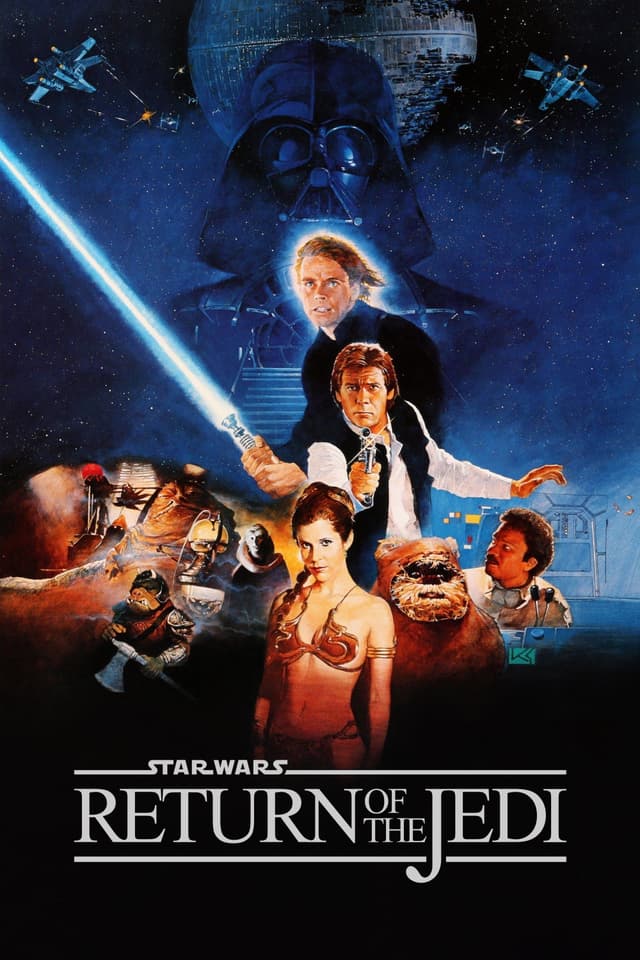
Luke Skywalker leads a daring mission to rescue Han Solo from the clutches of the vile gangster Jabba the Hutt, while the Rebel Alliance prepares to launch a final attack on the Empire's new Death Star. As the galaxy's fate hangs in the balance, Luke confronts Darth Vader and the Emperor in a final showdown that will determine whether the light or dark side of the Force prevails.
What Is the Budget of Star Wars: Return of the Jedi (1983)?
Star Wars: Return of the Jedi (1983), directed by Richard Marquand and produced by George Lucas through Lucasfilm Ltd. for 20th Century Fox, was made on a reported production budget of $32,500,000, with several industry sources placing the all-in figure closer to $42,700,000 once Industrial Light & Magic visual effects, the Skywalker Sound mix, and the dedicated London-based creature shop are folded into the total. Either figure made it the most expensive film ever produced at the time of its release, narrowly exceeding the $33,000,000 spent on the prior installment, The Empire Strikes Back (1980).
Lucas self-financed the production through Lucasfilm and his Star Wars merchandising windfall, repeating the model he had pioneered on Empire. Fox retained domestic theatrical distribution rights but held no ownership stake in the negative, an arrangement that allowed Lucas to plow profits back into building Skywalker Ranch, ILM, and the proprietary effects pipeline that would underpin his next two decades of filmmaking. The investment reflected a calculated bet that the trilogy capper could carry roughly 100 minutes of new creature work, a full second Death Star battle, and a forest planet shoot built largely with practical puppets and miniatures.
Key Budget Allocation Categories
Return of the Jedi's reported $32,500,000 budget was distributed across several core production areas:
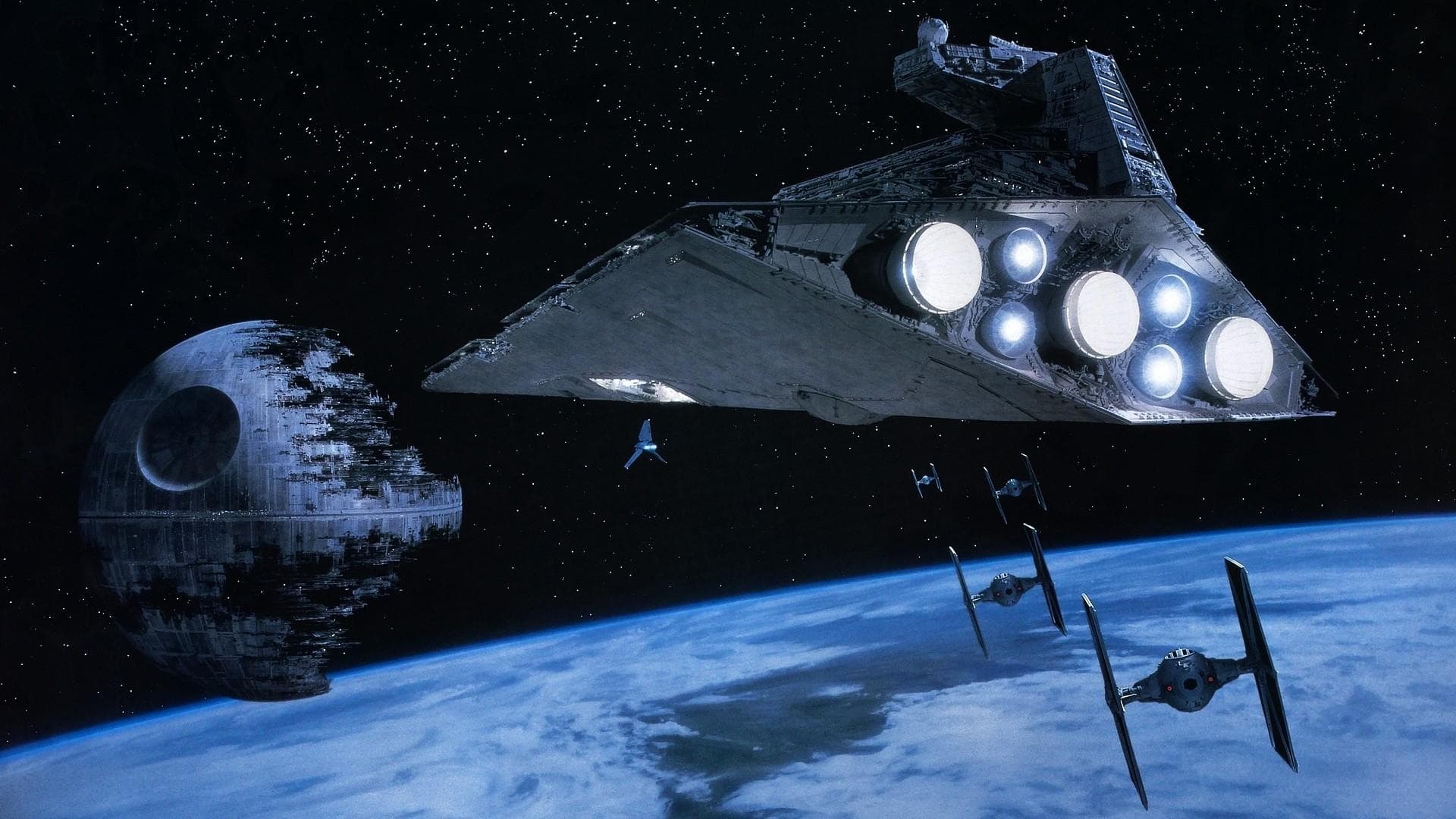
- Visual Effects and Miniatures: Industrial Light & Magic handled more than 900 visual effects shots, the most for any film up to that point. The space battle above the second Death Star alone required hundreds of motion-control passes, with new ILM camera rigs and optical printers built specifically for the production. Miniature work on the Death Star, the Star Destroyers, the Millennium Falcon, and the Imperial fleet consumed several months of stage time at the ILM facility in San Rafael, California.
- Creature Shop and Puppetry: Stuart Freeborn led an enormous practical creature program at Elstree Studios in England. Jabba the Hutt was operated by three puppeteers and required a custom hydraulic rig; the Rancor combined a hand puppet with high-speed photography; Admiral Ackbar, Nien Nunb, and the Mon Calamari bridge crew were full-head animatronic and foam-latex builds; and the Ewok village population required dozens of fitted suits, masks, and animatronic faces. The creature shop was effectively a parallel production unit with its own budget line.
- Above-the-Line Talent: Director Richard Marquand was hired at a price reflecting his pre-Star Wars filmography (Eye of the Needle), well below what an A-list studio director would have commanded. Returning cast members Mark Hamill, Harrison Ford, Carrie Fisher, and Billy Dee Williams negotiated significant raises after the success of Empire, and Ford in particular extracted a back-end participation deal that paid out heavily in the years that followed. James Earl Jones returned to voice Darth Vader and Frank Oz reprised Yoda.
- Music and Score: John Williams composed and conducted his third Star Wars score, recorded with the London Symphony Orchestra over multiple sessions. The score introduced new themes for Jabba's palace, the Emperor, the Ewoks, and Luke and Vader's final duel, expanding the musical vocabulary established in the prior two films. Williams' fee, the LSO recording costs, and the multi-track mix at Skywalker Sound represented a substantial line item.
- Locations and Sets: Principal photography took place primarily on nine sound stages at Elstree Studios outside London, with location work in Yuma, Arizona for Jabba's sail barge and the Sarlacc Pit, Death Valley for additional Tatooine exteriors, Redwood National and State Parks in northern California for the Endor forest exteriors, and Crescent City, California for the speeder bike chase. Endor was selected for its old-growth redwoods, with the production paying for forest access, helicopter shots, and ground rigging.
- Speeder Bike Sequence: The Endor speeder bike chase pioneered a new VistaVision steady-cam technique developed by Garrett Brown, in which an operator walked through the redwoods at one frame per second while bikes and stormtroopers were composited in. The bespoke rigging, the optical compositing, and the months of post-production added a discrete budget line that ILM has since cited as one of the most technically ambitious sequences of the era.
- Marketing and Merchandise Tie-Ins: 20th Century Fox marketed Jedi as a theatrical event, while Kenner Toys mounted the largest film merchandising rollout to date, with Ewok plush lines, action figures, and a Saturday-morning Ewoks cartoon greenlit on the back of the film's success. Marketing and merchandise coordination ran in parallel with production from late 1982.
How Does Return of the Jedi's Budget Compare to Similar Films?
At a reported $32,500,000, Return of the Jedi was the costliest film ever produced as of 1983. Set against its trilogy bookends and the subsequent Lucasfilm tentpoles, the budget reveals how rapidly the franchise scaled and how its theatrical economics evolved:
- Star Wars (1977): Budget $11,000,000 | Worldwide $775,398,007. The original trilogy opener cost roughly a third of Jedi and went on to gross more than 23 times Jedi over its lifetime of theatrical re-releases. The first film established the franchise economics that financed Jedi.
- The Empire Strikes Back (1980): Budget $33,000,000 | Worldwide $547,969,004. The middle chapter cost essentially the same as Jedi, reflecting the cost overruns Lucas absorbed on Empire and his determination to spend at a similar level on the trilogy capper despite Wall Street caution.
- The Phantom Menace (1999): Budget $115,000,000 | Worldwide $1,046,515,409. The prequel trilogy opener cost more than three times Jedi sixteen years later, with the cost increase concentrated in digital VFX and the all-new Skywalker Sound and ILM digital pipeline.
- Raiders of the Lost Ark (1981): Budget $18,000,000 | Worldwide $389,925,971. Lucas' contemporaneous collaboration with Steven Spielberg cost roughly half as much as Jedi and turned a comparable profit, illustrating how heavily the Star Wars sequel budgets were weighted toward effects and creature work rather than principal photography.
- Star Wars: The Force Awakens (2015): Budget $245,000,000 | Worldwide $2,071,310,218. The Disney-era sequel trilogy opener cost roughly 7.5 times Jedi in nominal dollars and earned roughly 3.5 times its worldwide gross, a useful benchmark for how studio franchise economics inflated in the decades after Lucas sold Lucasfilm.
- Rogue One: A Star Wars Story (2016): Budget $200,000,000 | Worldwide $1,058,682,142. The first Star Wars anthology film cost roughly six times Jedi and confirmed that Disney's reboot of the franchise was treating each Star Wars release as a tentpole rather than the relatively self-financed bet Lucas had made in 1983.
Return of the Jedi Box Office Performance
Star Wars: Return of the Jedi opened on May 25, 1983, on 1,002 screens across the United States and Canada, generating a then-record opening weekend of $30,490,619, which was the highest three-day total in box office history at the time and held that record until Ghostbusters II opened in 1989. The film stayed at number one for four consecutive weeks and finished as the highest-grossing film of 1983.
Against a reported production budget of $32,500,000, the film needed approximately $80,000,000 in worldwide gross to reach profitability when accounting for marketing, prints, and distribution costs. Here is the financial breakdown:
Box Office Breakdown
Return of the Jedi

Return of the Jedi earned approximately $9.95 in lifetime worldwide theatrical gross for every $1 invested when measured against total estimated production and marketing spend, placing it among the most profitable releases of the 1980s on a percentage basis. The domestic share of the initial gross was $252,583,617 against an international share of $222,522,560, a near-even 53/47 split that mirrored the international footprint Star Wars had established by the early 1980s.
The film locked in the long-term economics of the original trilogy. Subsequent home video releases on VHS, LaserDisc, the 1997 Special Edition theatrical re-release (which added $45,000,000 in fresh worldwide gross by itself), and the DVD and Blu-ray cycles compounded Lucasfilm's returns for the next two decades and ultimately underwrote the $4,050,000,000 sale of Lucasfilm to Disney in 2012.
Return of the Jedi Production History
Development on the third Star Wars film began in earnest in late 1980, immediately after the release of The Empire Strikes Back. George Lucas wrote the story treatment and brought back Lawrence Kasdan, who had co-written Empire with Leigh Brackett, to share screenplay credit with him. Working titles during pre-production included Revenge of the Jedi, which appeared on early teaser posters and crew jackets before Lucas dropped Revenge in favor of Return, reasoning that revenge was not an emotion a Jedi would pursue.
Lucas declined to direct, citing the exhaustion of his work on the first Star Wars and his desire to focus on building Lucasfilm into a sustainable independent studio. Steven Spielberg was approached but was unable to commit because Directors Guild of America rules conflicted with Lucas' non-DGA Lucasfilm setup. David Lynch turned down the assignment to make Dune; David Cronenberg also declined. Lucas ultimately hired Richard Marquand, a Welsh director with a BBC television background and the espionage feature Eye of the Needle to his name, on the strength of Marquand's collaborative temperament and ability to work efficiently with the practical creature shop.
Principal photography ran from January 11 to May 20, 1983, primarily at Elstree Studios outside London, England, where the production occupied all nine sound stages and converted the back lot into the Death Star throne room, Jabba's palace, and the Ewok village interiors. Stuart Freeborn's creature shop operated as a parallel production. Lucas was on set throughout the shoot, and second-unit director Marquand later acknowledged that Lucas was the de facto creative authority on the film, with Marquand serving as on-set executor of Lucas' shot list and storyboards.
Location work followed in Yuma, Arizona for the Tatooine sail barge sequence, where the production built a full-scale practical Sarlacc Pit set in the Buttercup Valley dunes; Death Valley for additional desert plates; Redwood National and State Parks in northern California and Crescent City for the Endor forest sequences and the speeder bike chase; and various second-unit pickups around the Lucasfilm facilities. The Endor forest selection was a creative response to a logistical problem: the original screenplay called for a planet inhabited by Wookiees, but Lucas rewrote it as the home of the smaller Ewok species, partly to reuse less expensive child performers and short-statured actors in the suits.
Post-production at Industrial Light & Magic ran in parallel with the shoot. The space battle alone required new motion-control rigs and an expanded animation team. Sound designer Ben Burtt and supervising sound editor and re-recording mixers built the film's final mix at Sprocket Systems (the precursor to Skywalker Sound), and John Williams recorded his score with the London Symphony Orchestra in March 1983. The film was released on May 25, 1983, the sixth anniversary of the original Star Wars opening.
Awards and Recognition
Return of the Jedi received four Academy Award nominations at the 56th Academy Awards in 1984: Best Original Score (John Williams), Best Sound (Ben Burtt, Gary Summers, Randy Thom, Tony Dawe), Best Sound Effects Editing (Ben Burtt), and Best Visual Effects (Richard Edlund, Dennis Muren, Ken Ralston, Phil Tippett). The Academy did not award a competitive Best Visual Effects Oscar that year; instead, the film received a Special Achievement Award for visual effects, an honor previously given to Star Wars and Empire. Williams' score lost to Bill Conti's The Right Stuff.
The film won the Saturn Award for Best Science Fiction Film from the Academy of Science Fiction, Fantasy and Horror Films, with additional Saturn wins for Best Director (Marquand), Best Special Effects, and Best Costume (Aggie Guerard Rodgers and Nilo Rodis-Jamero). It received four BAFTA nominations including Best Special Visual Effects, which it won. At the Hugo Awards, Jedi won the 1984 Hugo for Best Dramatic Presentation, joining the prior two Star Wars films in that category.
Critical Reception
Return of the Jedi received generally positive reviews on release, though contemporary critics were more divided than they had been on Empire. The film currently holds an 83% approval rating on Rotten Tomatoes based on 117 critic reviews, with a critical consensus that praises the spectacle and emotional payoff while flagging the Ewok subplot as a commercial concession. On Metacritic, the film scored 58 out of 100 based on 13 retrospective reviews, indicating mixed or average reviews from professional critics. Audiences surveyed by CinemaScore in subsequent re-release polling have rated the film an A.
Roger Ebert of the Chicago Sun-Times gave the film three and a half stars, calling it "a complete entertainment, a feast for the eyes and a delight for the fancy," while noting that the Ewoks felt engineered for merchandising appeal. Vincent Canby of The New York Times was less enthusiastic, writing that the film "has no resonance to speak of" and was "impersonal" compared with Empire. Pauline Kael of The New Yorker famously dismissed the film as "an impersonal, machine-tooled entertainment," extending the critique she had leveled at the prior installments.
Genre and fan reception was more enthusiastic. Variety praised the technical execution and the Battle of Endor, and Time magazine's Richard Corliss highlighted the speeder bike chase and the Vader-Luke-Emperor throne room confrontation. The Ewoks became the most enduring point of contention; supporters credited them with giving the trilogy an emotional finale grounded in family and underdog narrative, while detractors saw them as proof that Lucas had compromised the trilogy's tone for toy sales. Subsequent reassessments, including the 1997 Special Edition theatrical re-release and the inclusion of Jedi in the 2021 National Film Registry list, have largely cemented the film's status as a definitive Hollywood blockbuster and the close of one of cinema's most influential trilogies.
Frequently Asked Questions
How much did it cost to make Star Wars: Return of the Jedi (1983)?
The reported production budget was $32,500,000, with some industry sources placing the all-in figure closer to $42,700,000 once Industrial Light & Magic visual effects, the Skywalker Sound mix, and the dedicated creature shop are folded in. Either figure made it the most expensive film ever produced at the time of its 1983 release.
How much did Return of the Jedi earn at the box office?
The film grossed $252,583,617 domestically and $222,522,560 internationally in its initial 1983 release, for a worldwide total of $475,106,177. Subsequent theatrical re-releases, including the 1997 Special Edition, brought the cumulative worldwide gross to approximately $572,700,000. It was the highest-grossing film of 1983.
Who directed Return of the Jedi?
Richard Marquand directed the film, working from a screenplay by Lawrence Kasdan and George Lucas. Marquand was a Welsh director best known for the espionage thriller Eye of the Needle (1981). Lucas chose him after Steven Spielberg, David Lynch, and David Cronenberg all declined the assignment for various reasons.
Where was Return of the Jedi filmed?
Principal photography ran from January to May 1983 primarily at Elstree Studios outside London, England, where the production occupied all nine sound stages. Location work was conducted in Yuma, Arizona for the Tatooine sail barge sequence, Death Valley for additional desert plates, and Redwood National and State Parks in northern California for the Endor forest sequences and speeder bike chase.
What was the original title of Return of the Jedi?
Early teaser posters and crew jackets carried the working title Revenge of the Jedi. George Lucas changed the title before release, reasoning that revenge was not an emotion a Jedi would pursue. The change was announced in December 1982, six months before the film opened on May 25, 1983.
How does Return of the Jedi compare to the other Star Wars films?
At $32,500,000, Jedi was the most expensive Star Wars film at the time, narrowly above The Empire Strikes Back (1980) at $33,000,000 and roughly three times the original Star Wars (1977) at $11,000,000. The later prequel and sequel trilogy films cost dramatically more in nominal dollars: The Phantom Menace (1999) at $115,000,000 and The Force Awakens (2015) at $245,000,000.
Was Return of the Jedi profitable?
Yes. Against a $32,500,000 production budget and an estimated $20,000,000 to $25,000,000 in marketing spend, the film returned approximately $9.95 in lifetime worldwide gross for every $1 invested, making it one of the most profitable releases of the 1980s. The economics of the original trilogy ultimately underwrote the $4,050,000,000 sale of Lucasfilm to Disney in 2012.
What is the Ewok controversy in Return of the Jedi?
The Ewok subplot has been the most enduring point of critical contention in the film. Detractors, including Pauline Kael, argued that the small forest creatures were engineered for toy sales and undermined the trilogy's tone. Supporters credit them with giving the trilogy an emotional finale grounded in family and underdog narrative. George Lucas rewrote the original Wookiee planet into Endor partly to reuse less expensive child performers and short-statured actors in the suits.
Who composed the music for Return of the Jedi?
John Williams composed and conducted his third Star Wars score, recorded with the London Symphony Orchestra in March 1983. The score introduced new themes for Jabba's palace, the Emperor, the Ewoks, and Luke and Vader's final duel. Williams received an Academy Award nomination for Best Original Score, losing to Bill Conti's The Right Stuff.
Did Return of the Jedi win any Academy Awards?
Return of the Jedi received four Academy Award nominations: Best Original Score, Best Sound, Best Sound Effects Editing, and Best Visual Effects. The Academy did not award a competitive Best Visual Effects Oscar that year; instead, the film received a Special Achievement Award for visual effects from Richard Edlund, Dennis Muren, Ken Ralston, and Phil Tippett at the 56th Academy Awards in 1984.
Filmmakers
Return of the Jedi

Official Trailer
Build budgets like this one in Saturation
Start from an industry-standard feature film template, import the schedule and rates you already have, and let the cost report keep itself current as you spend. Real-time collaboration, no spreadsheets.