Star Wars
Synopsis
The Imperial Forces, under orders from cruel Darth Vader, hold Princess Leia hostage in their efforts to quell the rebellion against the Galactic Empire. Luke Skywalker and Han Solo, captain of the Millennium Falcon, work together with the companionable droid duo R2-D2 and C-3PO to rescue the beautiful princess, help the Rebel Alliance and restore freedom and justice to the Galaxy.
Production Budget Analysis
What was the production budget for Star Wars?
Directed by George Lucas, with Mark Hamill, Harrison Ford, Carrie Fisher leading the cast, Star Wars was produced by Lucasfilm Ltd. with a confirmed budget of $11,000,000, placing it in the low-budget category for adventure films as part of the Star Wars Collection.
At $11,000,000, Star Wars was produced on a modest budget. Lower-budget films benefit from reduced break-even thresholds, with profitability achievable at approximately $27,500,000.
Budget Comparison — Similar Productions
• Forsaken (2015): Budget $11,000,000 | Gross N/A • Barry Lyndon (1975): Budget $11,000,000 | Gross $31,500,000 → ROI: 186% • Alien (1979): Budget $11,000,000 | Gross $104,931,801 → ROI: 854% • The Lighthouse (2019): Budget $11,000,000 | Gross $18,262,464 → ROI: 66% • Gremlins (1984): Budget $11,000,000 | Gross $153,083,102 → ROI: 1292%
Key Budget Allocation Categories
▸ Stunts, Action Sequences & Visual Effects Action films allocate a substantial portion of their budget to choreographing and executing practical stunts, pyrotechnics, and CGI-heavy sequences. For large-scale productions, VFX alone can account for 20–30% of the total budget, with additional costs for stunt coordinators, rigging, and safety crews.
▸ Above-the-Line Talent (Cast & Director) A-list talent commands significant upfront fees plus backend participation. Lead actors in major action franchises typically earn $10–25 million per film, with directors often receiving comparable compensation packages tied to box office performance.
▸ Production Design, Sets & Locations Action films frequently require multiple international shooting locations, large-scale set construction, vehicle acquisitions and modifications, and specialized equipment — all of which drive production costs well above those of dialogue-driven genres.
Key Production Personnel
CAST: Mark Hamill, Harrison Ford, Carrie Fisher, Peter Cushing, Alec Guinness Key roles: Mark Hamill as Luke Skywalker; Harrison Ford as Han Solo; Carrie Fisher as Princess Leia Organa; Peter Cushing as Grand Moff Tarkin
DIRECTOR: George Lucas CINEMATOGRAPHY: Gilbert Taylor MUSIC: John Williams EDITING: Paul Hirsch, Marcia Lucas PRODUCTION: Lucasfilm Ltd., 20th Century Fox FILMED IN: United States of America
Box Office Performance
Star Wars earned $460,998,507 domestically and $314,399,500 internationally, for a worldwide total of $775,398,007. Revenue was split 59% domestic / 41% international.
Break-Even Analysis
Using the industry-standard 2.5x multiplier (P&A + exhibitor shares of 40–50% + distribution fees), Star Wars needed approximately $27,500,000 to break even. The film surpassed this threshold by $747,898,007.
Return on Investment (ROI)
Revenue: $775,398,007 Budget: $11,000,000 Net: $764,398,007 ROI: 6949.1%
Detailed Box Office Notes
Star Wars remains one of the most financially successful films of all time. It earned over $2.5 million in its first six days ($ in dollars), including $1.5 million during its first weekend ( in ). According to Variety weekly box office charts, it was number one at the US box office for its first three weeks. It was dethroned by The Deep, but gradually added screens and returned to number one in its seventh week, building up to $7-million weekends ($ in ) as it entered wide release, and remaining number one for the next 15 weeks. It replaced Jaws as the highest-earning film in North America just six months into release, eventually grossing $221.3 million during its initial theatrical run ($ in dollars). Star Wars entered international release towards the end of the year, and in 1978 became the highest-grossing film of all time worldwide. Its biggest international market was Japan, where it grossed $58.4 million.
Star Wars was still playing in 38 US theaters fourteen months after its initial release. On July 21, 1978, it was expanded to 1,744 theaters, and set a new US weekend record of $10.2 million. The $43.8 million gross from this expansion brought its total domestic gross to over $265 million. Theatrical re-releases in 1979 ($22.5 million), 1981 ($17.2 million), and 1982 ($18 million) brought its cumulative gross in the US and Canada to $323 million, and extended its global earnings to $530 million. Star Wars had become the first film to gross $500 million worldwide, and remained the highest-grossing film of all time until E.T. the Extra-Terrestrial set a new record in 1983. At the North American box office, it ranks second behind Gone with the Wind (1939) on the inflation-adjusted list.
Profitability Assessment
VERDICT: Highly Profitable
Star Wars was a clear financial success, generating $775,398,007 worldwide against a $11,000,000 production budget — a 6949% ROI. After estimated marketing costs, the film still delivered substantial profit to Lucasfilm Ltd..
INDUSTRY IMPACT
Franchise: Star Wars is part of the Star Wars Collection. Its box office performance strengthened the franchise and likely accelerated subsequent installments.
The outsized success of Star Wars likely influenced studio greenlight decisions for similar adventure projects.
Records: Crossed the $500M worldwide threshold, placing it among the top-grossing films of 1977.
PRODUCTION NOTES
▸ Writing
Since commencing the writing process in January 1973, Lucas wrote four different screenplays for Star Wars, searching for "just the right ingredients, characters and storyline." By May 1974, he had expanded the original treatment into a full, 132-page rough draft, which included elements such as the Sith, the Death Star, and a general named Annikin Starkiller. He then changed Starkiller to an adolescent boy, and shifted the general—who came from a family of dwarfs—into a supporting role. Lucas envisioned the Corellian smuggler, Han Solo, as a large, green-skinned monster with gills. He based Chewbacca on his Alaskan Malamute dog, Indiana. She would sit in the passenger seat of his car while he was driving, and he referred to her as his "co-pilot". The dog's name would later be given to the character Indiana Jones.
Lucas completed a second draft in January 1975 entitled Adventures of the Starkiller, Episode One: The Star Wars. He had made substantial simplifications and introduced the young, farm-dwelling hero as Luke Starkiller. In this draft, Luke had several brothers. Annikin became Luke's father, a wise Jedi Knight who played a minor role at the end of the story. Early versions of the characters Han Solo and Chewbacca were present, and closely resemble those seen in the finished film. This draft introduced a mystical energy field called "The Force"; the concept of a Jedi turning to the dark side; and a Jedi who was the first to turn, and who subsequently trained the Sith. The script also included a Jedi Master with a son who trains under his father's friend. This version was more a fairy tale quest than the action-filled adventure story of the previous draft, and ended with a text crawl that previewed the next story in the series. According to Lucas, the second draft was over 200 pages long, which led him to split up the story into multiple films.
▸ Casting
Lucas had a preference for casting unknown or relatively unknown actors, which led him to select Mark Hamill and Carrie Fisher for leading roles. Jodie Foster was offered the role, but turned it down because she was under contract with Disney. Koo Stark was also considered for Leia, but was instead cast as Luke's friend Camie Marstrap, a character that was eventually cut from the film.
Lucas initially resisted casting Harrison Ford as Han Solo, since Ford had previously worked with Lucas on American Graffiti, and was therefore not unknown. Instead, Lucas asked Ford to assist with auditions by reading lines with other actors. He was eventually won over by Ford, and cast him as Han over many other actors who auditioned, including James Caan, Chevy Chase, Robert De Niro, Richard Dreyfuss, Robert Englund, Steve Martin, Bill Murray, Jack Nicholson, Nick Nolte, Burt Reynolds, Kurt Russell, Sylvester Stallone, John Travolta, Glynn Turman, Christopher Walken, and Perry King, who later played Han in the radio series. Al Pacino turned down the part because he did not understand the script.
Lucas believed that he needed an established star to play Obi-Wan Kenobi. He considered Peter Cushing for the role, but decided the actor's lean features would be better employed as the villainous Tarkin. Kurtz felt a strong character actor was required to convey the "stability and gravitas" of Obi-Wan. Lucas credited Guinness with inspiring the cast and crew to work harder, which contributed significantly to the completion of filming. Ford said he admired Guinness' preparation, professionalism and kindness towards the other actors. He recalled Guinness having "a very clear head about how to serve the story."
Anthony Daniels said he wanted the role of C-3PO after he saw a Ralph McQuarrie concept painting of the character and was struck by the vulnerability in the droid's face. After casting Daniels for the physical performance, Lucas intended to hire another actor for the droid's voice.
▸ Filming & Locations
In 1975, Lucas founded the visual effects company Industrial Light & Magic (ILM) after discovering that Fox's visual effects department had been shut down. ILM began its work on Star Wars in a warehouse in Van Nuys, California. Most of the visual effects used pioneering digital motion control photography developed by John Dykstra and his team, which created the illusion of size by employing small models and slowly moving cameras. The technology is now known as the Dykstraflex system.
Visually, Lucas wanted Star Wars to have the "ethereal quality" of a fairy tale, but also "an alien look." He hoped to achieve "the seeming contradiction of [the] strange graphics of fantasy combined with the feel of a documentary." His first choice for cinematographer was Geoffrey Unsworth, who had worked on 2001: A Space Odyssey. Unsworth initially accepted the job, but eventually withdrew to work on the Vincente Minnelli-directed A Matter of Time (1976).
Originally, Lucas envisioned Tatooine as a jungle planet, and Kurtz traveled to the Philippines to scout locations. However, the thought of spending months filming in the jungle made Lucas uncomfortable, so he made Tatooine a desert planet instead. Kurtz then researched various desert locales around the globe. He ultimately decided that Southern Tunisia, on the edge of the Sahara, would make an ideal Tatooine. Principal photography began in Chott el Djerid in March 1976. Meanwhile, a construction crew in nearby Tozeur spent eight weeks creating additional Tatooine locations. The scenes of Luke's Tatooine home were filmed at the Hotel Sidi Driss, in Matmata. Additional Tatooine scenes were shot at Death Valley in the United States.
The filmmakers experienced many problems in Tunisia. Production fell behind schedule in the first week due to malfunctioning props and electronic breakdowns. The radio-controlled R2-D2 models functioned poorly.
▸ Post-Production
Star Wars was originally slated for release on December 25, 1976, but production delays pushed it back to mid-1977. Editor John Jympson began cutting the film while Lucas was still filming in Tunisia; as Lucas noted, the editor was in an "impossible position" because Lucas had not explained any of the film's material to him. When Lucas viewed Jympson's rough cut, he felt the editor's selection of takes was questionable. He felt Jympson did not fully understand the film nor Lucas' style of filmmaking, and he continued to disapprove of Jympson's editing as time went by. Halfway through production, Lucas fired Jympson and replaced him with Paul Hirsch, Richard Chew, and his then-wife, Marcia Lucas. The new editing team felt Jympson's cut lacked excitement, and they sought to inject more dynamism into the film.
Jympson's rough cut of Star Wars (often called the "Lost Cut") differed significantly from the final version. Author David West Reynolds describes Jympson's version as slower-paced, and estimates that it contained 30–40% different footage from the final cut. Although most of the differences relate to extended scenes or alternate takes, there were also scenes in this version which were completely removed to accelerate the pace of the narrative. The most notable of these was a series of scenes from Tatooine, when Luke is first introduced. The scenes depicted Luke's everyday life among his friends in the city of Anchorhead, and showed how their lives are affected by the space battle above the planet. These scenes also introduced Biggs Darklighter, Luke's closest friend who leaves to join the Rebellion. Hirsch said the scenes were removed because they presented too much information in the first few minutes of the film, and they created too many storylines for the audience to follow. The removal of the Anchorhead scenes also helped distinguish Star Wars from Lucas' previous film; Alan Ladd called the deleted scenes "American Graffiti in outer space".
▸ Music & Score
Lucas initially planned to use pre-existing music for Star Wars, rather than an original score. Since the film portrayed alien worlds, he believed recognizable music was needed to create a sense of familiarity. He hired John Williams as a music consultant, and showed him a collection of orchestral pieces he intended to use for the soundtrack. After Williams convinced Lucas that an original score would be preferable, Lucas tasked him with creating it. A few of the composer's finished pieces were influenced by Lucas' initial orchestral selections. The "Main Title Theme" was inspired by the theme from the 1942 film Kings Row, scored by Erich Wolfgang Korngold, and the "Dune Sea of Tatooine" was influenced by the music of the 1948 film Bicycle Thieves, scored by Alessandro Cicognini. Lucas later denied he ever considered using pre-existing music for the film.
Over a period of 12 days in March 1977, Williams and the London Symphony Orchestra recorded the Star Wars score. The soundtrack was released as a double LP in 1977 by 20th Century Fox Records. In 2005, the American Film Institute chose the Star Wars soundtrack as the best film score of all time.
▸ Marketing & Release
While the film was in production, a logo was commissioned from Dan Perri, a title sequence designer who had worked on The Exorcist (1973) and Taxi Driver (1976). Perri created a logotype consisting of block-capital letters filled with stars and leaning towards a vanishing point. The graphic was designed to follow the same perspective as the opening text crawl. Ultimately, Perri's logo was not used for the film's opening title sequence, although it was used widely in pre-release print advertising and on cinema marquees. The logotype eventually selected for on-screen use originated in a promotional brochure that was distributed by Fox to cinema owners in 1976. The brochure was designed by Suzy Rice, a young art director at the Los Angeles advertising agency Seiniger Advertising. On a visit to ILM in Van Nuys, Rice was instructed by Lucas to produce a "very fascist" logo that would intimidate the viewer. Rice employed an outlined and modified Helvetica Black typeface in her initial version. After some feedback from Lucas, Rice joined the S and T of STAR and the R and S of WARS. Kurtz was impressed with Rice's composition and selected it over Perri's design for the film's opening titles, after flattening the pointed tips of the letter W. ILM artist Joe Johnston was responsible for stacking the two words to create the final graphic. The Star Wars logo became one of the most recognizable designs in cinema, though Rice was not credited in the film.
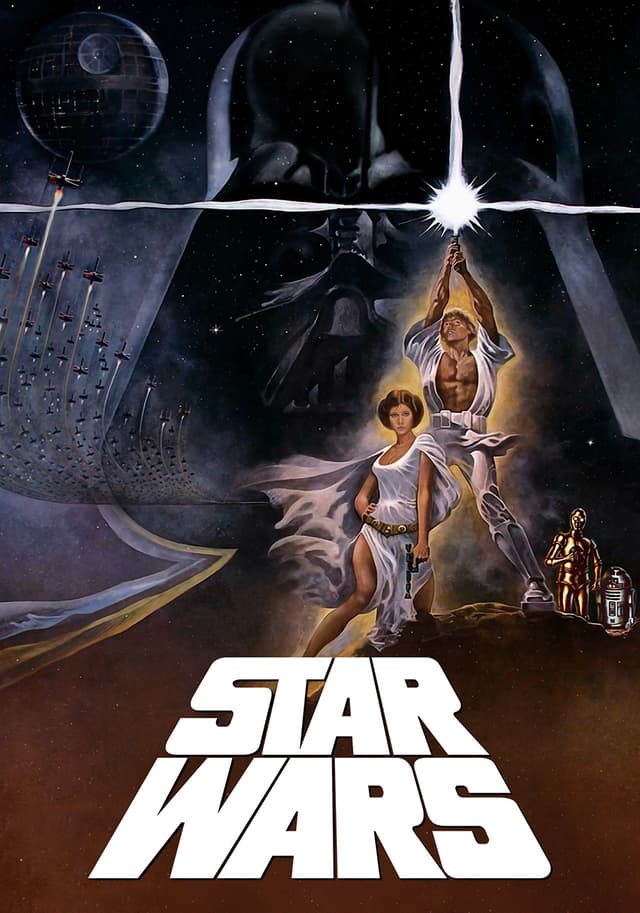
For the film's US release, Fox commissioned a promotional poster from the advertising agency Smolen, Smith and Connolly. The agency contracted the freelance artist Tom Jung, and gave him the phrase "good over evil" as a starting point. His poster, known as Style 'A, depicts Luke standing in a heroic pose, brandishing a shining lightsaber above his head. Leia is slightly below him, and a large image of Vader's helmet looms behind them.
AWARDS & RECOGNITION
Summary: Won 6 Oscars. 70 wins & 31 nominations total
Awards Won: ★ BAFTA Award for Best Original Music (32nd British Academy Film Awards) ★ Saturn Award for Best Director (5th Saturn Awards) ★ Saturn Award for Best Science Fiction Film (5th Saturn Awards) ★ Saturn Award for Best Make-up (5th Saturn Awards) ★ Saturn Award for Best Special Effects (5th Saturn Awards) ★ Special Achievement Academy Award — Ben Burtt ★ Saturn Award for Best Writing (5th Saturn Awards) ★ Academy Award for Best Sound — Bob Minkler (50th Academy Awards) ★ Academy Award for Best Sound — Derek Ball (50th Academy Awards) ★ Academy Award for Best Sound — Don MacDougall (50th Academy Awards) ★ Academy Award for Best Sound — Ray West (50th Academy Awards) ★ National Board of Review: Top Ten Films ★ Golden Globe Award for Best Original Score (35th Golden Globe Awards) ★ Academy Award for Best Costume Design — John Mollo (50th Academy Awards) ★ Academy Award for Best Film Editing — Paul Hirsch (50th Academy Awards) ★ Academy Award for Best Film Editing — Marcia Lucas (50th Academy Awards) ★ Academy Award for Best Film Editing — Richard Chew (50th Academy Awards) ★ Hugo Award for Best Dramatic Presentation ★ Saturn Award for Best Costume (5th Saturn Awards) ★ Academy Award for Best Production Design — Norman Reynolds (50th Academy Awards) ★ Academy Award for Best Production Design — Roger Christian (50th Academy Awards) ★ Academy Award for Best Production Design — John Barry (50th Academy Awards) ★ Academy Award for Best Production Design — Leslie Dilley (50th Academy Awards) ★ Academy Award for Best Original Score — John Williams (50th Academy Awards) ★ Academy Award for Best Visual Effects — Richard Edlund (50th Academy Awards) ★ Academy Award for Best Visual Effects — Q568245 (50th Academy Awards) ★ Academy Award for Best Visual Effects — Grant McCune (50th Academy Awards) ★ Academy Award for Best Visual Effects — John Stears (50th Academy Awards) ★ Academy Award for Best Visual Effects — Robert Blalack (50th Academy Awards) ★ Grammy Award for Best Score Soundtrack for Visual Media — John Williams (20th Annual Grammy Awards) ★ Saturn Award for Best Music (5th Saturn Awards) ★ Saturn Award for Best Supporting Actor (5th Saturn Awards) ★ Saturn Award for Best Set Decoration — Roger Christian
Nominations: ○ Academy Award for Best Supporting Actor (50th Academy Awards) ○ Academy Award for Best Costume Design (50th Academy Awards) ○ Academy Award for Best Director (50th Academy Awards) ○ Academy Award for Best Picture (50th Academy Awards) ○ Academy Award for Best Original Score (50th Academy Awards) ○ Academy Award for Best Sound (50th Academy Awards) ○ Academy Award for Best Visual Effects (50th Academy Awards) ○ Academy Award for Best Film Editing (50th Academy Awards) ○ Academy Award for Best Writing, Original Screenplay (50th Academy Awards) ○ Academy Award for Best Production Design (50th Academy Awards)
Additional Recognition: Star Wars won many awards after its release, including six Academy Awards, two BAFTA Awards, one Golden Globe Award, three Grammy Awards, one Hugo Award, and thirteen Saturn Awards. Additionally, the Academy of Motion Picture Arts and Sciences gave a Special Achievement Academy Award to Ben Burtt, and granted a Scientific and Engineering Award to John Dykstra, Alvah J. Miller, and Jerry Jeffress for the development of the Dykstraflex camera system.
! Organization ! Category ! Nominee ! Result
In its May 30, 1977 issue, Time named Star Wars the "Movie of the Year". It has also been featured in several high-profile audience polls: In 1997, it ranked as the 10th Greatest American Film on the Los Angeles Daily News Readers' Poll; in 2002, Star Wars and its sequel The Empire Strikes Back were voted the greatest films ever made in Channel 4's 100 Greatest Films poll; in 2011, Star Wars ranked as Best Sci-Fi Film on Best in Film: The Greatest Movies of Our Time, a primetime special aired by ABC that ranked the best films as chosen by fans, based on results of a poll conducted by ABC and People magazine; and in 2014, the film placed 11th in a poll by The Hollywood Reporter, which balloted every studio, agency, publicity firm, and production house in the Hollywood region.
In 2008, Empire magazine ranked Star Wars 22nd on its list of the "500 Greatest Movies of All Time".


Budget Templates
Build your own production budget
Create professional budgets with industry-standard feature film templates. Real-time collaboration, no spreadsheets.

Start Budgeting Free