Rain Man Budget
 Drama2h 14m
Updated
Synopsis
When Cincinnati car dealer Charlie Babbitt learns that his estranged father has died and left a $3 million fortune to an older brother Charlie never knew existed, he tracks down Raymond, an autistic savant living at the Wallbrook institution, and pulls him out on a cross-country road trip to Los Angeles to extract his share. What begins as a manipulative gambit slowly becomes a reckoning with family, memory, and the responsibilities Charlie spent his life avoiding.
What Is the Budget of Rain Man (1988)?
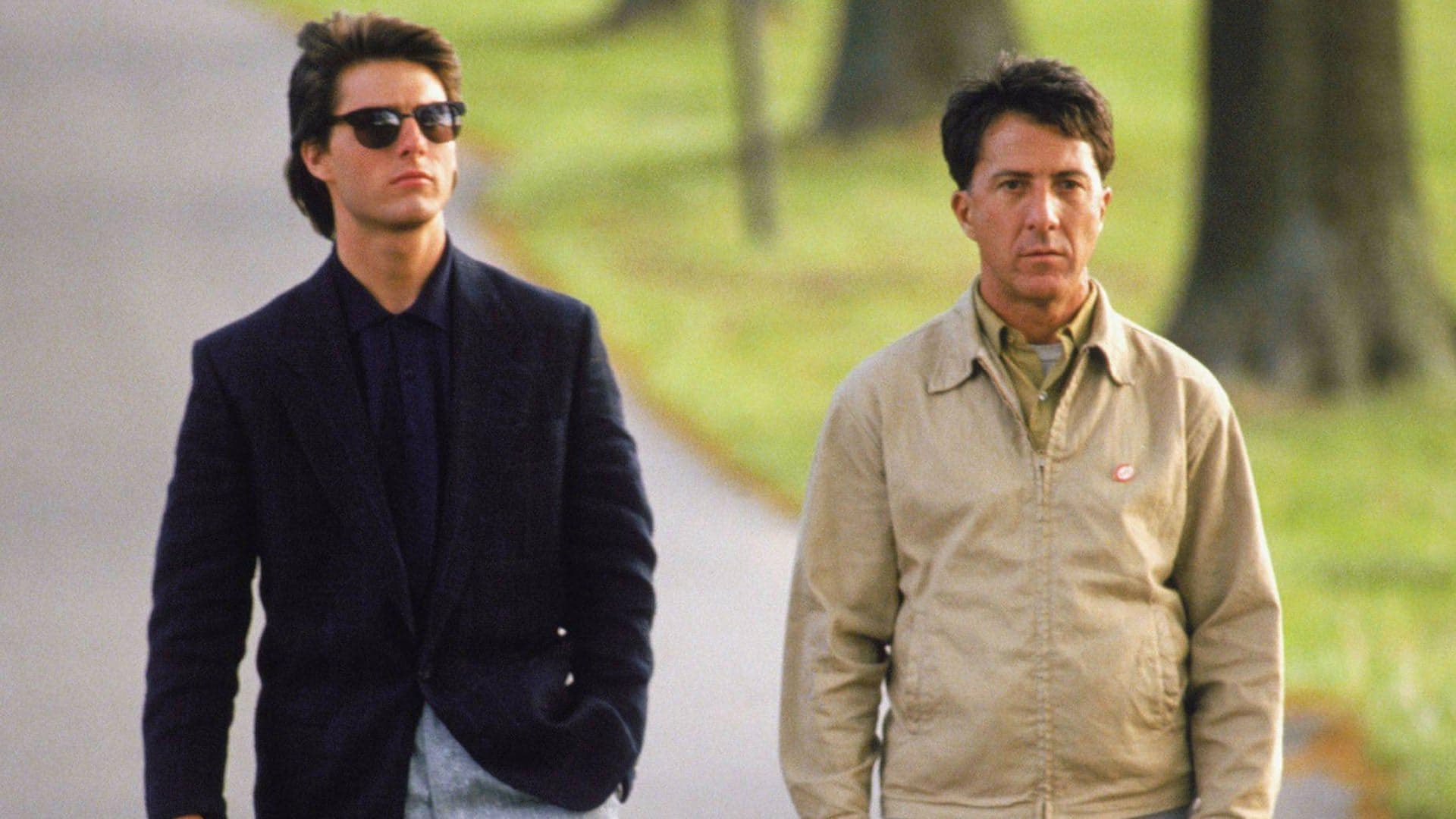
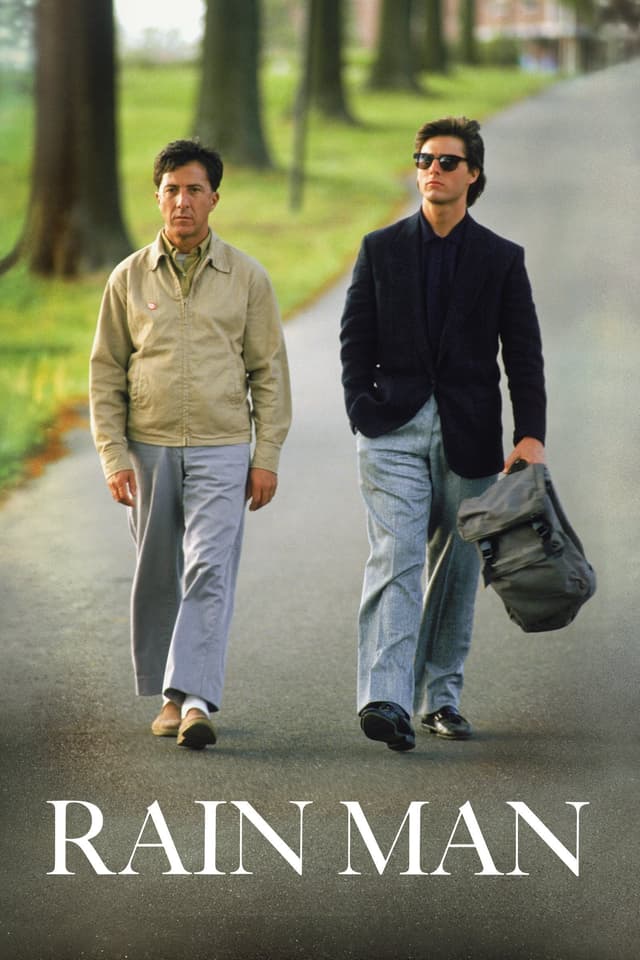
Rain Man (1988), directed by Barry Levinson and released by United Artists through Metro-Goldwyn-Mayer, was produced on a reported budget of $25,000,000. The Mark Johnson production for Guber-Peters Company put two of the era's biggest stars, Dustin Hoffman and Tom Cruise, opposite one another in a road movie about an estranged Cincinnati hustler and his older autistic-savant brother. United Artists, then a struggling unit inside MGM, financed the project largely on the strength of its talent package after the script had cycled through multiple writers, directors, and a near-shutdown.
The $25,000,000 figure reflected a mid-range late-1980s drama investment, expensive by the standards of contained character pieces but modest compared with the action tentpoles of the period such as Die Hard ($28,000,000) or Cruise's own previous hit Top Gun ($15,000,000). MGM/UA covered Hoffman's reported $5,000,000 fee and Cruise's reported $3,000,000 fee plus participation, an above-the-line block that consumed roughly a third of the production budget on its own. The remaining capital funded a 56-day cross-country shoot across Ohio, Oklahoma, Missouri, Arizona, Nevada, and California, plus Hans Zimmer's electronic score and an extensive needle-drop soundtrack.
Key Budget Allocation Categories
Rain Man's $25,000,000 budget was distributed across several core production areas:
- Above-the-Line Talent: Dustin Hoffman commanded approximately $5,000,000 to play Raymond Babbitt, with Tom Cruise paid roughly $3,000,000 plus a percentage of gross to play Charlie Babbitt. Barry Levinson, taking over after a high-profile chain of director departures, was paid a feature-director rate appropriate to his post-Good Morning, Vietnam standing. Producer Mark Johnson and the Guber-Peters Company also drew significant producer fees, with the combined above-the-line block accounting for roughly a third of the total budget.
- Writers and Multiple Drafts: Original screenwriter Barry Morrow developed the story after meeting savant Kim Peek, and Ronald Bass came aboard for substantial rewrites that earned him a co-writing credit and an eventual Oscar. The script also passed through uncredited passes by writers attached to earlier directors, with the studio absorbing those development costs as a sunk cost before Levinson began shooting.
- Cross-Country Location Shoot: Principal photography ran from May to August 1988 across six states, with major sequences in Cincinnati, Las Vegas, Oklahoma, Missouri, the Arizona desert, and Southern California. The cross-country structure required moving the unit, equipment, and lead actors through multiple base camps, with each location adding travel, lodging, per diem, and local crew costs. Las Vegas casino sequences shot at Caesars Palace required practical access agreements and night-shoot premiums.
- Score and Soundtrack Licensing: German composer Hans Zimmer scored the film with an early synthesizer-driven palette that became one of his calling cards. The production also licensed an eclectic needle-drop soundtrack including Aaron Neville, Etta James, and Bananarama, with master and publishing fees for each cue. The combined music budget was substantial by 1988 dramatic-feature standards.
- Production Design: Production designer Ida Random reconstructed the Wallbrook institution interior, Charlie's Cincinnati exotic-car dealership, and a series of period roadside motels and diners that anchor the road sequences. The 1949 Buick Roadmaster convertible central to the story was sourced and matched across multiple shooting days, with backup vehicles maintained for continuity.
- Extended Development Carry: MGM/UA absorbed nearly two years of development costs across the Steven Spielberg, Sydney Pollack, and Martin Brett Ratner-era director attachments before Levinson signed on. Each prior attachment incurred script-development fees, scouting passes, and pay-or-play obligations that flowed through to the final negative cost.
- Research and Consultation: Hoffman spent months in pre-production observing autistic adults and consulting with Kim Peek and Bernard Rimland of the Autism Research Institute. The production retained behavioral consultants and clinicians on set to vet Hoffman's performance and the depiction of savant abilities, an unusual line item for a 1988 commercial drama.
How Does Rain Man's Budget Compare to Similar Films?
At $25,000,000, Rain Man sat in the upper-middle tier of late-1980s dramas. The comparison set shows how its commercial outcome dwarfed its budgetary peers and reset expectations for star-driven character pieces:
- Top Gun (1986): Budget $15,000,000 | Worldwide $356,830,601. Cruise's prior signature hit cost roughly 60 percent of Rain Man and earned a comparable worldwide total, but Rain Man took the Best Picture trophy that the Tony Scott blockbuster never approached.
- Cocktail (1988): Budget $20,000,000 | Worldwide $171,504,781. Cruise's other 1988 release cost less and earned less than half of Rain Man, illustrating how the Hoffman pairing and the Best Picture campaign multiplied the return on the same star.
- Good Morning, Vietnam (1987): Budget $13,000,000 | Worldwide $123,922,370. Levinson's previous film cost roughly half what Rain Man spent, and earned about a third of Rain Man's worldwide haul, a step up the director took with his next outing.
- Sleepers (1996): Budget $44,000,000 | Worldwide $165,649,000. Levinson's later star-driven drama cost nearly twice as much and earned less than half of Rain Man, showing how rarely the Best Picture lightning struck twice for the director.
- Ordinary People (1980): Budget $6,000,000 | Worldwide $54,800,000. Robert Redford's Best Picture-winning family drama from earlier in the decade cost a quarter of Rain Man and earned a small fraction of its gross, demonstrating how the Oscar drama economics had inflated by 1988.
- A Beautiful Mind (2001): Budget $58,000,000 | Worldwide $313,542,341. Ron Howard's later neurodivergent-protagonist Best Picture winner cost more than twice Rain Man and earned a roughly comparable worldwide total, indicating how Rain Man's template aged into a recurring Academy genre.
Rain Man Box Office Performance
Rain Man opened on December 16, 1988 in limited release before expanding nationally on December 23, finishing first at the domestic box office over Christmas weekend with $7,005,275 and going on to dominate the early 1989 marketplace for eight consecutive weekends. The film parlayed strong word of mouth, a December prestige release pattern, and a January 1989 Golden Globe sweep into a domestic gross of $172,825,435 and a worldwide total of $354,825,435.
Against a reported production budget of $25,000,000, the film needed approximately $50,000,000 in worldwide gross to clear breakeven once marketing and distribution were accounted for, a target it cleared by the end of its first month. Here is the financial breakdown:
Box Office Breakdown
Rain Man

Rain Man returned approximately $7.88 in theatrical revenue for every $1 invested when measured against total estimated production and marketing spend, placing it among the most profitable star-driven dramas of the late 1980s. The film was the highest-grossing domestic release of 1988, finishing ahead of Who Framed Roger Rabbit, Coming to America, Big, and Twins in that calendar year.
The international share of the gross approached $182,000,000, a 51/49 split that was unusually balanced for an American character drama of the period and signaled the global commercial reach of both leads. Home video and television rights generated substantial additional revenue for MGM/UA through the 1990s, with the film becoming a perennial cable and rental staple that anchored the studio library through multiple ownership changes.
Rain Man Production History
Development began in 1984 when screenwriter Barry Morrow, prompted by a chance meeting with savant Kim Peek at the Arc of the United States conference, sketched a story about two estranged brothers, one of whom was an institutionalized autistic savant. Morrow's pitch and an early draft sold to United Artists with Hoffman attached, initially in the role of the younger brother Charlie, before he switched to play Raymond. The project then entered a multi-year director carousel that became Hollywood lore.
Martin Brest, fresh off Beverly Hills Cop, was first attached and developed the script for months before departing over creative differences. Steven Spielberg signed on next and worked the project through extensive prep before pulling out in 1987 to direct Indiana Jones and the Last Crusade, leaving the studio with a fully developed package and no helmer. Sydney Pollack came aboard third and brought his own writer for a substantial pass before he too departed in early 1988, leaving United Artists facing an imminent collapse with both stars about to walk over schedule conflicts.
Barry Levinson, coming off the back-to-back successes of Tin Men and Good Morning, Vietnam, agreed to take the project on a compressed timeline in March 1988 and began shooting in May. Principal photography was a 56-day cross-country shoot. The unit began in Cincinnati, Ohio, capturing the exotic-car dealership and the Babbitt family home sequences, before moving to the Wallbrook Institute location at the St. Anne's Convent in Melbourne, Kentucky. The cross-country drive sequences were shot through Missouri, Oklahoma, and Arizona along Route 66 and parallel highways, with the diner sequence filmed at a still-operating roadside establishment in Oklahoma. The unit then moved to Las Vegas, Nevada, for the Caesars Palace casino sequences, before wrapping at the Pomona, California psychiatric facility used for the climactic Wallbrook board hearing.
Hoffman immersed himself in research for the role, observing autistic adults at multiple care facilities and spending extensive time with Kim Peek, the real-life savant whose memory abilities inspired Raymond's portrayal. Hoffman and Cruise lived together briefly during pre-production to develop the brotherly rhythm that anchors the film, and Cruise reportedly took a smaller upfront fee in exchange for a percentage of the gross, a deal that paid him many times his nominal quote once the film became a phenomenon.
Editor Stu Linder cut the film on a tight schedule to meet the December 1988 release window, and Hans Zimmer's score, the composer's first major American studio assignment, was recorded in the final weeks before the lock. Levinson and the producers screened a near-final cut for Hoffman and Cruise in November and made only minor adjustments before delivery.
Awards and Recognition
Rain Man swept the major categories at the 61st Academy Awards held on March 29, 1989, winning four Oscars from eight nominations: Best Picture (Mark Johnson), Best Director (Barry Levinson), Best Actor in a Leading Role (Dustin Hoffman), and Best Original Screenplay (Ronald Bass and Barry Morrow). It also received nominations for Best Cinematography (John Seale), Best Film Editing (Stu Linder), Best Original Score (Hans Zimmer), and Best Art Direction (Ida Random, Linda DeScenna).
At the 46th Golden Globe Awards in January 1989, the film won Best Motion Picture Drama and Best Actor Drama for Hoffman, with additional nominations for Director, Screenplay, and Supporting Actor for Tom Cruise. The 38th Berlin International Film Festival awarded the film the Golden Bear for Best Film in February 1989. The Writers Guild of America gave Bass and Morrow its Best Original Screenplay award, and the Directors Guild of America nominated Levinson for outstanding directorial achievement.
Hoffman's performance won the BAFTA Award for Best Actor in a Leading Role, with additional BAFTA nominations for Best Film, Direction, Original Screenplay, Editing, and Score. The American Film Institute later included Rain Man on its 100 Years...100 Cheers list of the most inspiring American films, and the National Film Registry added the film to its preservation list in subsequent years for its cultural and historical significance.
Critical Reception
Rain Man received broadly positive reviews and has held up across decades of reassessment. The film holds an 89% approval rating on Rotten Tomatoes based on critic reviews, with a critical consensus that praises the chemistry between the leads and Hoffman's textured performance while acknowledging the screenplay's sentimental architecture. On Metacritic, the film scored 65 out of 100, indicating generally favorable reviews. Audiences surveyed by CinemaScore at the time gave the film an A grade, an exceptional mark that helped sustain its eight-week run at the top of the domestic box office.
Roger Ebert awarded the film four stars and wrote that Hoffman's performance was "a triumph of acting as understanding," highlighting how Cruise's Charlie carried the film's actual character arc while Raymond functioned as the unchanging center. Vincent Canby in The New York Times called it "a humane and astonishing film" and singled out Hoffman's refusal to soften Raymond into a sentimental figure. Pauline Kael in The New Yorker was more skeptical, faulting the script for using Raymond as a device for Charlie's redemption rather than as a fully realized character, a critique that recurred in later academic readings of the film.
Contemporary reassessments from autism-community writers and advocacy organizations have credited Rain Man with vastly expanding mainstream awareness of autism while critiquing its conflation of autism with savant abilities, a conflation that influenced public perception for decades and shaped subsequent screen depictions of neurodivergent characters. The film's legacy thus operates on two tracks: an enduring critical and commercial classic, and a cultural touchstone whose representational choices continue to be debated within disability and autism studies.
Frequently Asked Questions
How much did it cost to make Rain Man (1988)?
The reported production budget was $25,000,000. United Artists, then a unit of Metro-Goldwyn-Mayer, financed the film through producer Mark Johnson and the Guber-Peters Company. Roughly a third of the budget went to above-the-line talent, with Dustin Hoffman commanding approximately $5,000,000 and Tom Cruise paid roughly $3,000,000 plus a percentage of the gross.
How much did Rain Man earn at the box office?
Rain Man grossed $172,825,435 domestically and approximately $182,000,000 internationally, for a worldwide total of $354,825,435. It opened to $7,005,275 over the December 16, 1988 limited launch and Christmas weekend, then spent eight consecutive weekends at the top of the domestic box office on its way to becoming the highest-grossing film of 1988.
How many Oscars did Rain Man win?
Rain Man won four Academy Awards at the 61st Oscars ceremony in March 1989: Best Picture, Best Director (Barry Levinson), Best Actor (Dustin Hoffman), and Best Original Screenplay (Ronald Bass and Barry Morrow). The film received eight nominations in total, with additional nods for Cinematography, Editing, Original Score, and Art Direction.
Who directed Rain Man?
Barry Levinson directed Rain Man, taking over the project in March 1988 after Martin Brest, Steven Spielberg, and Sydney Pollack each departed during a multi-year development carousel. Levinson came to the film on the strength of his back-to-back successes Tin Men (1987) and Good Morning, Vietnam (1987) and won the Academy Award for Best Director for his work.
Who starred in Rain Man?
Dustin Hoffman starred as Raymond Babbitt, the autistic savant older brother, and Tom Cruise played Charlie Babbitt, the estranged Cincinnati car dealer. Valeria Golino played Charlie's girlfriend Susanna, with supporting performances from Jerry Molen as Dr. Bruner and Bonnie Hunt in an early-career appearance as a Caesars Palace casino employee.
Where was Rain Man filmed?
Principal photography ran from May to August 1988 across six states. The unit began in Cincinnati, Ohio for the exotic-car dealership and family home sequences, moved to St. Anne's Convent in Melbourne, Kentucky for the Wallbrook institution exteriors, then shot the cross-country drive sequences through Missouri, Oklahoma, and Arizona along Route 66. Las Vegas casino sequences were shot at Caesars Palace in Nevada, with the climactic Wallbrook board hearing filmed in Pomona, California.
How long did it take to make Rain Man?
Development ran from 1984 through early 1988, with the script passing through Barry Morrow, Ronald Bass, and uncredited writers attached to earlier directors. Principal photography was a 56-day shoot from May to August 1988. The film was edited and scored on a tight schedule to meet the December 16, 1988 limited release window, an unusually compressed post-production timeline for a film of its eventual scale.
What did critics think of Rain Man?
Rain Man received broadly positive reviews, with an 89% approval rating on Rotten Tomatoes and a 65 out of 100 score on Metacritic. Audiences gave it an A CinemaScore. Roger Ebert called Hoffman's performance "a triumph of acting as understanding," and Vincent Canby praised the film in The New York Times as "humane and astonishing." Pauline Kael in The New Yorker was more skeptical, faulting the script for using Raymond as a device for Charlie's redemption.
Who composed the Rain Man score?
Hans Zimmer composed the Rain Man score, his first major American studio assignment after relocating from the United Kingdom. The synthesizer-driven palette he developed for the film, including the iconic Iko Iko-style percussion underscoring the road sequences, earned him an Academy Award nomination for Best Original Score and effectively launched his Hollywood career.
How accurate is Rain Man's depiction of autism?
Dustin Hoffman based the character of Raymond on extensive research with savant Kim Peek and consultations with Bernard Rimland of the Autism Research Institute. The film expanded mainstream awareness of autism but has been critiqued by autism-community writers for conflating autism with savant abilities, a conflation that influenced public perception for decades. Most autistic people are not savants, and most savants are not autistic.
Filmmakers
Rain Man

Official Trailer
Build budgets like this one in Saturation
Start from an industry-standard feature film template, import the schedule and rates you already have, and let the cost report keep itself current as you spend. Real-time collaboration, no spreadsheets.