Heaven's Gate Budget
 DramaWesternHistory3h 37m
Updated
Synopsis
Harvard-educated marshal James Averill returns to Johnson County, Wyoming in 1890 to find the wealthy Stock Growers Association preparing a death list of immigrant settlers, in Michael Cimino's epic dramatization of the Johnson County War. As the cattlemen hire mercenaries to clear the county, Averill must choose between his class and the European immigrant townspeople he has come to love.
What Is the Budget of Heaven's Gate (1980)?
Heaven's Gate (1980), written and directed by Michael Cimino and released by United Artists, was produced on a final negative budget of $44,000,000, ballooning from an initial $11,500,000 commitment over the course of an extraordinarily troubled production. United Artists, then owned by Transamerica Corporation, greenlit the project on the back of Cimino's Best Director Academy Award for The Deer Hunter (1978) and progressively lost cost control through three years of expanded ambition, location reconstruction, daily shooting overruns, and an extended post-production cycle.
The investment supported an exhaustively researched 1890 Wyoming reconstruction, including a full-scale period town built and rebuilt from scratch on the Idaho-Montana border, hundreds of trained livestock, period-accurate costumes for thousands of extras, and a principal cast led by Kris Kristofferson, Christopher Walken, Isabelle Huppert, John Hurt, Sam Waterston, and Jeff Bridges. The final cost, in 2026 dollars roughly $175,000,000, was less than the headline-grabbing Hollywood spectacles of subsequent decades but was, at the time of release, one of the most expensive American films ever produced and the most expensive Western.
Key Budget Allocation Categories
Heaven's Gate's $44,000,000 final budget was distributed across several major production areas, each substantially over their original allocations:
- Above-the-Line Talent Michael Cimino commanded a writer-director rate on the back of the Deer Hunter Best Director Oscar, and the ensemble cast (Kris Kristofferson, Christopher Walken, Isabelle Huppert, John Hurt, Sam Waterston, Jeff Bridges, Brad Dourif, Joseph Cotten, Mickey Rourke) was paid at A-list studio scale across an extended principal photography schedule that stretched far past contractual periods.
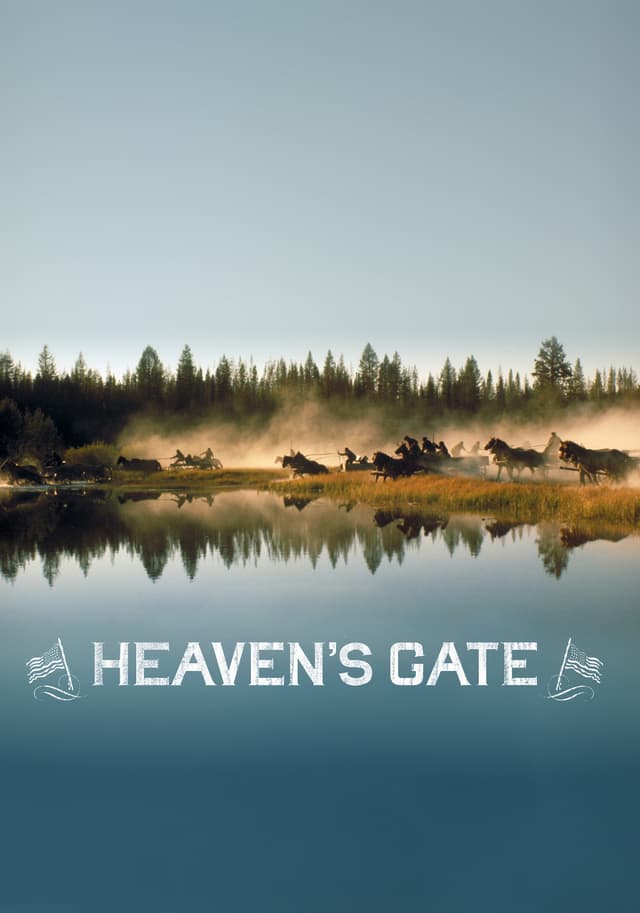
- Town Reconstruction The Sweetwater town set, built and partially rebuilt at the Two Medicine River location in Glacier National Park, Montana, was the single most expensive practical-construction element. Cimino ordered the entire main street reconstructed multiple times after deeming early builds visually inadequate, with sourced period bricks and period-accurate joinery.
- Livestock and Period Vehicles Hundreds of horses, cattle, oxen, and period-accurate wagons were sourced, trained, and maintained on location for the duration of the shoot. The opening Harvard graduation sequence and the climactic immigrant-settler battle both required hundreds of trained livestock, with veterinary, feed, and handler costs running across multiple months.
- Costume Costume designer Allen Highfill oversaw the construction of approximately 3,000 period-accurate costumes, with the principal-cast wardrobe individually tailored and many extras' costumes hand-aged for visual specificity. The extended shooting schedule required replacement wardrobe for weather damage.
- Cinematography and Extended Shooting Schedule Cinematographer Vilmos Zsigmond shot the picture in widescreen on rural Montana locations using extensive natural lighting and complicated dust-and-smoke atmospheric work. Principal photography ran from April 1979 through March 1980, nearly a full year against a planned 70-day schedule. Daily overrun costs accumulated to a meaningful share of the final budget.
- Score Composer David Mansfield delivered an original score that incorporated period instrumentation. The score required a full orchestra recording, multiple revisions during Cimino's protracted post-production, and licensing of period-source music for diegetic sequences.
- Post-Production Cimino's final cut ran 5 hours 25 minutes, subsequently trimmed to 3 hours 39 minutes for the November 1980 premiere and then re-cut to 2 hours 29 minutes for the April 1981 wide release. The extended editorial cycle, multiple lab runs, and additional sound mixing added significant carrying cost.
How Does Heaven's Gate's Budget Compare to Similar Films?
At $44,000,000 in 1980 dollars (roughly $175,000,000 in 2026 dollars), Heaven's Gate was one of the most expensive American films ever produced at the time of release. The comparison set illustrates how its budget sat against contemporaneous productions:
- Apocalypse Now (1979): Budget $31,500,000 | Worldwide $150,000,000. Francis Ford Coppola's previous troubled-production Vietnam epic cost less than Heaven's Gate and earned a massively higher worldwide gross, illustrating the gap between a critically and commercially salvaged ambition and a complete failure.
- The Deer Hunter (1978): Budget $15,000,000 | Worldwide $48,979,328. Cimino's own Best Picture winner cost roughly a third of Heaven's Gate and earned 14 times the worldwide gross, demonstrating the studio confidence the earlier film had earned for him.
- Star Wars (1977): Budget $11,000,000 | Worldwide $775,398,000. George Lucas's franchise launcher cost a quarter of Heaven's Gate and earned more than 200 times the worldwide gross, setting the blockbuster commercial template that made Heaven's Gate's failure look more catastrophic.
- Reds (1981): Budget $32,000,000 | Worldwide $40,000,000. Warren Beatty's similarly ambitious historical epic was produced on a comparable budget and faced similar commercial challenges, though Beatty's politically careful production management produced a Best Director Oscar where Cimino's did not.
- Once Upon a Time in America (1984): Budget $30,000,000 | Worldwide $5,321,508. Sergio Leone's late-career epic cost less than Heaven's Gate and similarly suffered from studio-imposed re-cuts, providing the closest tonal-and-financial comparison from the early 1980s.
Heaven's Gate Box Office Performance
Heaven's Gate premiered in New York on November 19, 1980 in its 3-hour-39-minute cut, was reviewed catastrophically, and was withdrawn from circulation by United Artists within one week. A re-cut 2-hour-29-minute version was released wide on April 24, 1981 with minimal marketing support and equally poor commercial performance.
Against a $44,000,000 production budget, the film needed approximately $100,000,000 worldwide to reach profitability. Here is the financial breakdown:
Box Office Breakdown
Heaven's Gate

Heaven's Gate returned approximately $0.06 in theatrical revenue for every $1 invested when measured against total estimated production and marketing spend, placing it among the most decisive box office disasters in Hollywood history. The catastrophic commercial performance precipitated the sale of United Artists by Transamerica to MGM in 1981, effectively ending the studio's standalone existence after 62 years.
The picture's reputational rehabilitation began in 2012 when the Criterion Collection released a restored director's cut on Blu-ray, drawing on a 4K scan supervised by Cimino himself. Festival screenings in Venice (2012) and at the New York Film Festival drew substantially more positive reception, and a critical reappraisal positioned the picture as a misunderstood masterwork rather than a financial calamity. The home-video reissue has been continuously available since.
Heaven's Gate Production History
Michael Cimino developed the screenplay (titled The Johnson County War in early drafts) through the mid-1970s, drawing on the 1892 Johnson County War in Wyoming, in which the Wyoming Stock Growers Association hired Texas mercenaries to assassinate small ranchers and immigrant homesteaders. The historical material had been previously dramatized in Shane (1953) but Cimino's version expanded the political and class dimensions, framing the conflict as state-sponsored violence against European immigrant labor.
United Artists greenlit the project in 1978 on the back of Cimino's Best Director and Best Picture wins for The Deer Hunter, initially committing $11,500,000. The budget rose to $14,000,000 by the start of principal photography in April 1979 and then continued climbing throughout production as Cimino expanded the scope of the period reconstruction.
Principal photography took place from April 1979 through March 1980 across Glacier National Park in Montana, with secondary unit work in Idaho. Cimino ordered the entire main street of the Sweetwater town set rebuilt multiple times after deeming early builds visually inadequate. The Two Medicine River location, dressed as 1890 Wyoming, became one of the most exhaustively reconstructed period sets in Hollywood history. Daily shooting was characterized by extended take counts (some sequences shot more than 50 times) and continual on-set re-blocking.
Cimino's final cut delivered in late 1980 ran 5 hours 25 minutes. United Artists insisted on a shorter cut for the November 1980 New York premiere, which ran 3 hours 39 minutes. Vincent Canby's New York Times review on opening day called the picture "an unqualified disaster" and "a film so completely unrealized as to be unbearable." Within a week, United Artists withdrew the film from circulation and announced a re-cut. The April 1981 wide release in a 2-hour-29-minute version received equally negative reviews and generated negligible box office. The financial impact was severe enough that Transamerica sold United Artists to MGM in May 1981.
Cimino spent the next three decades attempting to restore his original vision. A director's cut close to his preferred running time was prepared with Criterion Collection in 2012 and supervised by Cimino himself. The restored cut premiered at the Venice Film Festival in September 2012 and the picture's critical reputation began to recover.
Awards and Recognition
Heaven's Gate received an Academy Award nomination for Best Art Direction (Tambi Larsen, James L. Berkey, Spencer Deverill, and Suzanne Smith) at the 53rd Academy Awards. The film also received nominations at the 1981 Golden Globes including Best Original Score (David Mansfield). It won the Silver Ribbon for Best Foreign Director from the Italian National Syndicate of Film Journalists.
At the 1981 Golden Raspberry Awards (the inaugural Razzies), Heaven's Gate was nominated for Worst Picture, with Michael Cimino nominated for Worst Director (a category he won). The picture became the central reference text for the Razzies' early-1980s mission of calling out Hollywood excess. Subsequent retrospective recognition has included continual placement on Sight & Sound critic polls following the 2012 Criterion restoration, with the picture appearing on the 2022 Sight & Sound greatest-films-of-all-time critic poll for the first time.
Critical Reception
Heaven's Gate received catastrophically negative reviews on initial release in November 1980 and remains the textbook example of a studio film destroyed by critical reception. The film today holds a 56% approval rating on Rotten Tomatoes based on 73 critic reviews, a figure that reflects both the original wave of negative criticism and the substantial post-2012 critical reappraisal. On Metacritic, the film does not have a comprehensive 1980-era score, but contemporary reissue coverage scores tilt favorably.
Vincent Canby's New York Times review on opening day called the picture "an unqualified disaster" and "so completely unrealized as to be unbearable." Roger Ebert wrote that the film "is the most scandalous cinematic waste I have ever seen" in his 1981 review of the re-cut version, awarding it half a star out of four. The wave of negative criticism was unusually unanimous across critical outlets and trade press.
The 2012 Criterion Collection restoration triggered a substantial critical reappraisal. The Village Voice's J. Hoberman called the restored cut "one of the great American films" and "a masterpiece denied its full hearing." The Guardian's Peter Bradshaw awarded the restored cut five stars in 2013. The Sight & Sound critics poll of 2022 included the picture for the first time, marking its formal entry into the canon of internationally celebrated American cinema. The retrospective consensus has positioned Heaven's Gate as a misunderstood epic whose initial reception was driven as much by industry politics as by the film's merit.
Frequently Asked Questions
How much did Heaven's Gate (1980) cost to make?
The final negative budget was $44,000,000, ballooning from an initial $11,500,000 commitment over the course of an extraordinarily troubled production. United Artists, then owned by Transamerica Corporation, greenlit the project on the back of Michael Cimino's Best Director Academy Award for The Deer Hunter (1978) and progressively lost cost control through three years of expanded ambition.
How much did Heaven's Gate earn at the box office?
The film grossed $3,484,331 worldwide against its $44,000,000 production budget. It opened on November 19, 1980 in New York, was withdrawn within one week after catastrophic reviews, and was re-released on April 24, 1981 in a 2-hour-29-minute cut with minimal marketing support.
Was Heaven's Gate a box office bomb?
Yes. It is one of the most decisive box office disasters in Hollywood history, returning approximately $0.06 in worldwide gross for every $1 invested against total estimated production and marketing spend. The catastrophic commercial performance precipitated the sale of United Artists by Transamerica to MGM in 1981.
Why did Heaven's Gate fail?
The film's failure was driven by a combination of catastrophic critical reception (Vincent Canby called it "an unqualified disaster" in his New York Times opening-day review), Michael Cimino's extended production overruns that quadrupled the original budget, and United Artists' decision to withdraw the original 3-hour-39-minute cut within a week and re-release a re-cut version that satisfied neither audiences nor critics.
Did Heaven's Gate kill United Artists?
Yes. The financial impact was severe enough that Transamerica Corporation, United Artists' parent company, sold the studio to MGM in May 1981, effectively ending United Artists' standalone existence after 62 years. The collapse is the central historical case study in Steven Bach's book Final Cut (1985), the definitive history of the production.
Where was Heaven's Gate filmed?
Principal photography took place from April 1979 through March 1980 primarily at Glacier National Park in Montana, with secondary unit work in Idaho. The Two Medicine River location was dressed as 1890 Wyoming, with the Sweetwater town set rebuilt multiple times after Cimino deemed early builds visually inadequate.
What is the director's cut of Heaven's Gate?
The director's cut runs 3 hours 36 minutes and was prepared with the Criterion Collection in 2012 under Michael Cimino's supervision. It premiered at the Venice Film Festival in September 2012 and triggered a substantial critical reappraisal. The restored cut is available on Criterion Blu-ray and 4K UHD home video.
Has Heaven's Gate been reappraised?
Yes. The 2012 Criterion Collection restoration drove a substantial critical reappraisal. The Village Voice's J. Hoberman called the restored cut "one of the great American films," and the picture appeared on the 2022 Sight & Sound critics' greatest-films-of-all-time poll for the first time. The retrospective consensus positions the film as a misunderstood epic whose initial reception was partly driven by industry politics.
Who stars in Heaven's Gate?
Kris Kristofferson stars as marshal James Averill, with Christopher Walken as hired gun Nathan Champion, Isabelle Huppert as Madame Ella Watson, John Hurt as Billy Irvine, Sam Waterston as cattle baron Frank Canton, and Jeff Bridges as John Bridges. The ensemble also includes Brad Dourif, Joseph Cotten, and Mickey Rourke in his first significant film role.
What did Roger Ebert say about Heaven's Gate?
Roger Ebert wrote in his 1981 review of the re-cut version that the film "is the most scandalous cinematic waste I have ever seen," awarding it half a star out of four. The review is one of the most negative Ebert published across his career and remains a frequently cited example of contemporaneous critical reaction to the original release.
Filmmakers
Heaven's Gate

Build budgets like this one in Saturation
Start from an industry-standard feature film template, import the schedule and rates you already have, and let the cost report keep itself current as you spend. Real-time collaboration, no spreadsheets.