Monsters vs. Aliens Budget
Updated
Synopsis
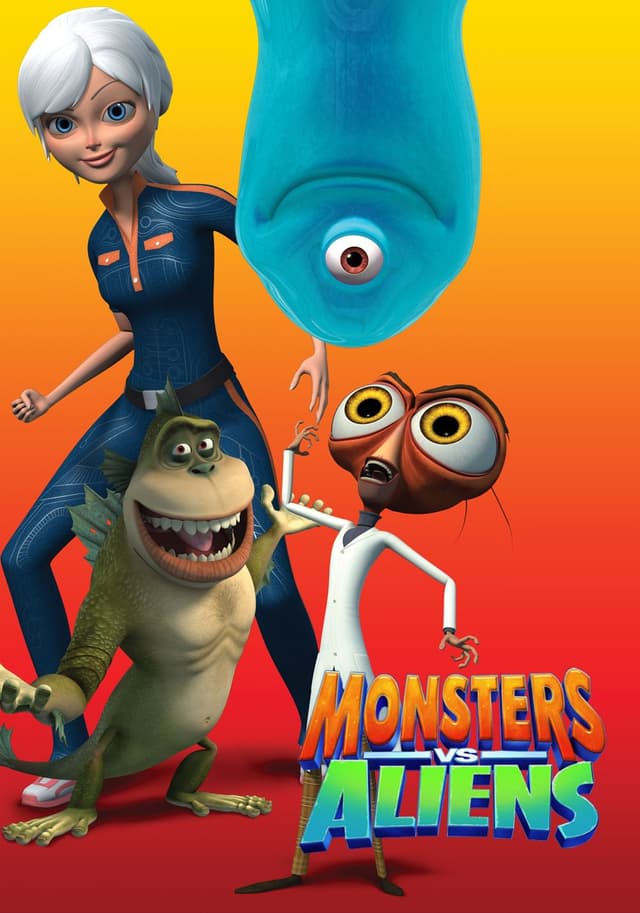
Susan Murphy, a young woman in Modesto, California, is struck by a meteorite on her wedding day and absorbs a substance called quantonium, which causes her to grow to 49 feet tall during the ceremony. Captured by the military and classified as "Ginormica," she is imprisoned in a secret government facility alongside a collection of monsters: B.O.B., an indestructible gelatinous mass; Dr. Cockroach Ph.D., a brilliant scientist with the head of a cockroach; The Missing Link, a prehistoric fish-ape hybrid; and Insectosaurus, a 350-foot grub. When an alien overlord named Gallaxhar sends a giant robot probe to Earth to retrieve the quantonium, General W.R. Monger convinces the President to deploy the monsters as a defense force. After defeating the robot on the Golden Gate Bridge, the team must infiltrate Gallaxhar's mothership to stop him from cloning an invasion army and extracting Susan's power, forcing Susan to choose between returning to her normal life and embracing her identity as a monster.
What Is the Budget of Monsters vs. Aliens?
Monsters vs. Aliens (2009), co-directed by Rob Letterman and Conrad Vernon for DreamWorks Animation and distributed by Paramount Pictures, was produced on a budget of $175,000,000. The film was a landmark production for DreamWorks, becoming the studio's first animated feature designed from the ground up for stereoscopic 3D presentation. It was also the first animated film released in IMAX 3D and InTru 3D, a proprietary stereoscopic process developed by Intel that DreamWorks adopted as its standard going forward.
The $175 million budget reflected the dual cost of producing a large-scale animated action comedy and building the infrastructure for a new 3D pipeline. DreamWorks CEO Jeffrey Katzenberg championed the project as proof of concept for his conviction that 3D would transform the animation industry, investing heavily in proprietary tools and stereoscopic rendering technology that would be reused across the studio's subsequent releases. The film features an ensemble voice cast led by Reese Witherspoon, Seth Rogen, Hugh Laurie, Will Arnett, Kiefer Sutherland, Rainn Wilson, and Stephen Colbert.
Key Budget Allocation Categories
The $175 million budget for Monsters vs. Aliens was distributed across animation production, 3D technology development, and voice talent:
- Stereoscopic 3D Pipeline Development: DreamWorks built a proprietary stereoscopic rendering pipeline for the film, converting its entire production workflow to native 3D rather than post-converting a 2D film. This required custom software tools, additional render farm capacity (stereoscopic frames take roughly twice the processing time), and retraining artists on depth composition. The investment was amortized across subsequent DreamWorks releases, but Monsters vs. Aliens bore the initial development cost.
- Character Animation and Design: The film features five distinct monster characters, each requiring unique animation rigs and movement systems. Ginormica (49 feet tall) required crowd-scale simulation whenever she interacted with normal-sized environments. B.O.B.'s gelatinous body used fluid dynamics simulation rather than traditional skeletal animation. The Insectosaurus character was rendered at a scale that demanded dedicated environment destruction tools. Each monster's distinct physicality multiplied the rigging and animation workload.
- Voice Cast: The ensemble featured Reese Witherspoon as Susan Murphy/Ginormica, Seth Rogen as B.O.B., Hugh Laurie as Dr. Cockroach Ph.D., Will Arnett as The Missing Link, Kiefer Sutherland as General W.R. Monger, Rainn Wilson as Gallaxhar, and Stephen Colbert as President Hathaway. Recording sessions spanned approximately two years as the script evolved through development.
- Action Sequences and Effects: The film's set pieces, including a battle on the Golden Gate Bridge, an alien robot attack on San Francisco, and the climactic assault on Gallaxhar's mothership, required large-scale destruction simulation, particle effects for explosions and debris, and crowd animation for fleeing civilians. These sequences were designed specifically to showcase the depth capabilities of the new 3D pipeline, with objects and debris breaking through the screen plane.
- Score and Sound Design: Hans Zimmer composed the orchestral score, blending sci-fi synthesizer textures with full orchestral arrangements. The sound design team created distinct audio signatures for each monster character and the alien technology, including Gallaxhar's cloning machinery and the quantonium energy effects.
How Does Monsters vs. Aliens' Budget Compare to Similar Films?
At $175,000,000, Monsters vs. Aliens was among the most expensive animated films produced at the time. Here is how it compares to other animated features from the same era:
- Kung Fu Panda (2008): Budget $130,000,000 | Worldwide $631,700,000. DreamWorks' previous hit cost $45 million less and earned significantly more worldwide, demonstrating how strong franchise appeal and critical reception outweighed the premium 3D investment.
- Up (2009): Budget $175,000,000 | Worldwide $735,100,000. Pixar's release the same year matched the budget exactly but earned nearly double worldwide, benefiting from universal critical acclaim and the Pixar brand premium.
- Ice Age: Dawn of the Dinosaurs (2009): Budget $90,000,000 | Worldwide $886,700,000. Blue Sky Studios' sequel cost roughly half of Monsters vs. Aliens and earned more than double worldwide, illustrating the commercial advantage of established franchise IP over original properties.
- Coraline (2009): Budget $60,000,000 | Worldwide $124,600,000. Laika's stop-motion debut cost a fraction of DreamWorks' production but demonstrated that 3D presentation could enhance smaller-scale animated films at proportionally lower risk.
- How to Train Your Dragon (2010): Budget $165,000,000 | Worldwide $494,900,000. DreamWorks' next major release used the 3D pipeline that Monsters vs. Aliens pioneered, achieving better returns with a slightly lower budget and stronger critical reception.
Monsters vs. Aliens Box Office Performance
Monsters vs. Aliens opened on March 27, 2009, earning $59,321,095 in its domestic opening weekend across 4,104 theaters. It was the highest-grossing opening weekend for a non-sequel animated film at the time and the second-highest March opening ever. The 3D and IMAX screenings accounted for approximately 56% of opening weekend revenue despite representing a smaller share of total screens, validating DreamWorks' bet on premium format presentation.
Against a production budget of $175,000,000, the film needed approximately $400,000,000 to $450,000,000 in worldwide gross to reach profitability when factoring in marketing and distribution costs. Here is the financial breakdown:
Box Office Breakdown
Monsters vs. Aliens

At 118% ROI on production costs alone, Monsters vs. Aliens was modestly profitable theatrically but fell short of expectations given the scale of its budget and DreamWorks' marketing push. When factoring in estimated P&A costs, the film's theatrical run alone likely did not fully recoup the total investment. However, home video sales were strong: the DVD and Blu-ray release generated $117 million in domestic sales within the first four months, and the 3D Blu-ray edition became one of the format's early bestsellers. A Halloween television special, Monsters vs. Aliens: Mutant Pumpkins from Outer Space (2009), and a Nickelodeon television series (2013) extended the franchise's commercial life.
The film's international performance was notably weaker than its domestic run, with only $183 million from overseas markets. This represented a domestic-to-international ratio that skewed heavily American, unusual for a major animated release. The film's parody-heavy humor, rooted in American B-movie and sci-fi conventions, may have limited its cross-cultural appeal compared to more universally themed competitors.
Monsters vs. Aliens Production History
The project originated in 2003 as a concept called "Rex Havoc," developed by DreamWorks story artists as a send-up of 1950s monster movies and alien invasion B-films. The premise evolved through several iterations before Rob Letterman, fresh off co-directing Shark Tale (2004), and Conrad Vernon, who had co-directed Shrek 2 (2004), were brought on to shape the film into an ensemble action comedy. The writing team included Maya Forbes and Wallace Wolodarsky, who wrote the initial screenplay, with subsequent revisions by Letterman and the Kung Fu Panda writers Jonathan Aibel and Glenn Berger.
Jeffrey Katzenberg positioned the film as DreamWorks Animation's flagship 3D showcase. He announced in 2007 that all future DreamWorks animated films would be produced in stereoscopic 3D, and Monsters vs. Aliens would be the proof of concept. The studio partnered with Intel to develop InTru 3D, a stereoscopic technology that used Intel processors for real-time 3D rendering. DreamWorks invested in converting its entire production pipeline, training hundreds of artists on stereoscopic composition and depth staging. Katzenberg personally supervised 3D depth decisions on the film, attending dailies focused specifically on stereoscopic effect quality.
The voice cast was assembled over a two-year period. Reese Witherspoon was cast as Susan Murphy, the film's everywoman protagonist who transforms into the 49-foot Ginormica after being struck by a meteorite containing quantonium. Seth Rogen improvised extensively as B.O.B., the brainless indestructible blob. Hugh Laurie, at the height of his House fame, played the eccentric Dr. Cockroach Ph.D. as a riff on Vincent Price's mad scientist persona. Stephen Colbert's performance as the buffoonish President Hathaway was largely improvised, with the animators adapting sequences to match his ad-libbed dialogue.
The film premiered on March 27, 2009, with a special screening at the White House hosted by President Barack Obama, making it the first 3D film ever shown at the presidential residence. DreamWorks released Monsters vs. Aliens on DVD and Blu-ray on September 29, 2009, with a 3D Blu-ray edition following in 2010.
Awards and Recognition
Monsters vs. Aliens received a nomination for Best Animated Feature at the 37th Annie Awards, losing to Up. The film was also nominated for the Kids' Choice Award for Favorite Animated Movie, where it competed against Up, Cloudy with a Chance of Meatballs, and Ice Age: Dawn of the Dinosaurs.
While the film did not win major awards, its technical contribution to the animation industry was widely recognized. The InTru 3D pipeline developed for the production became the standard for all subsequent DreamWorks Animation releases, and the film's commercial demonstration of stereoscopic premium pricing influenced the broader industry's rapid adoption of 3D presentation between 2009 and 2012. The Visual Effects Society recognized the film's technical achievements in stereoscopic compositing.
Critical Reception
Monsters vs. Aliens holds a 72% approval rating on Rotten Tomatoes based on 196 reviews, with an average score of 6.4 out of 10. On Metacritic, the film scored 56 out of 100 from 32 reviews, indicating "mixed or average reviews." Audiences gave it a B+ CinemaScore.
Roger Ebert awarded the film three out of four stars, praising the 3D presentation and calling it "a lot of fun" while noting that the script didn't reach the emotional depth of Pixar's best work. A.O. Scott of The New York Times described the film as "cheerful, swift-moving and enjoyable" but observed that it relied more on pop-culture references and action spectacle than character development. Peter Bradshaw of The Guardian gave it three stars, calling the 3D effects "genuinely impressive" while noting the story felt formulaic.
The critical consensus positioned Monsters vs. Aliens as competent mainstream entertainment that showcased impressive 3D technology without achieving the narrative ambition of its Pixar competitors. Several reviewers noted that the film's strongest element was its voice cast, particularly Rogen's improvised performance as B.O.B. and Colbert's scene-stealing turn as the President. The film's legacy rests primarily on its role as DreamWorks' 3D technology demonstrator rather than as a standalone creative achievement.
Frequently Asked Questions
How much did it cost to make Monsters vs. Aliens (2009)?
The production budget for Monsters vs. Aliens was $175,000,000. A significant portion of this budget went toward developing DreamWorks Animation's proprietary stereoscopic 3D pipeline, making it the first animated film produced natively in 3D rather than post-converted. Additional costs included the ensemble voice cast and large-scale destruction simulation for action sequences.
How much did Monsters vs. Aliens earn at the box office?
Monsters vs. Aliens grossed $198,351,526 domestically and $183,158,344 internationally, totaling $381,509,870 worldwide. It opened with $59,321,095 across 4,104 theaters, with 3D and IMAX screenings accounting for approximately 56% of opening weekend revenue.
Was Monsters vs. Aliens (2009) profitable?
Monsters vs. Aliens was modestly profitable. Against a production budget of $175 million and estimated total costs of approximately $325 million including marketing, the theatrical gross of $381.5 million fell short of full recoupment from ticket sales alone. However, home video sales generated $117 million domestically in the first four months, and a Nickelodeon TV series extended the franchise commercially.
Who directed Monsters vs. Aliens?
Monsters vs. Aliens was co-directed by Rob Letterman and Conrad Vernon. Letterman had previously co-directed Shark Tale (2004), while Vernon had co-directed Shrek 2 (2004). The screenplay was written by Maya Forbes, Wallace Wolodarsky, and Rob Letterman, with revisions by Jonathan Aibel and Glenn Berger.
Who voices the characters in Monsters vs. Aliens?
Reese Witherspoon voices Susan Murphy/Ginormica, Seth Rogen voices B.O.B., Hugh Laurie voices Dr. Cockroach Ph.D., Will Arnett voices The Missing Link, Kiefer Sutherland voices General W.R. Monger, Rainn Wilson voices the villain Gallaxhar, and Stephen Colbert voices President Hathaway. Rogen and Colbert improvised extensively during their recording sessions.
Was Monsters vs. Aliens the first 3D animated film?
Monsters vs. Aliens was not the first 3D animated film, but it was the first animated feature produced natively in stereoscopic 3D using DreamWorks' InTru 3D pipeline (developed with Intel), and the first animated film released in IMAX 3D. Previous animated films had used post-conversion 3D rather than being designed for stereoscopic presentation from the start.
How does Monsters vs. Aliens compare to other DreamWorks films?
At $175 million, Monsters vs. Aliens was more expensive than Kung Fu Panda ($130 million) and comparable to How to Train Your Dragon ($165 million). However, it earned significantly less worldwide ($381.5 million) than either of those films. Its primary legacy is technological: the 3D pipeline developed for the film became the standard for all subsequent DreamWorks Animation releases.
What is Monsters vs. Aliens' Rotten Tomatoes score?
Monsters vs. Aliens holds a 72% approval rating on Rotten Tomatoes from 196 reviews, with an average score of 6.4 out of 10. On Metacritic, it scored 56 out of 100. Critics praised the 3D presentation and voice performances but noted the script lacked the emotional depth of Pixar competitors released the same year.
Was there a Monsters vs. Aliens sequel?
No theatrical sequel was produced. Despite plans for a follow-up, DreamWorks shelved the sequel due to the original's underperformance relative to its budget. The franchise continued through a Halloween television special, Monsters vs. Aliens: Mutant Pumpkins from Outer Space (2009), and a Nickelodeon animated television series that ran from 2013 to 2014.
What awards did Monsters vs. Aliens receive?
Monsters vs. Aliens was nominated for Best Animated Feature at the 37th Annie Awards, losing to Up. It was also nominated for the Kids' Choice Award for Favorite Animated Movie. While it did not win major awards, the film's stereoscopic 3D pipeline was recognized by the Visual Effects Society for its technical achievements.
Filmmakers
Monsters vs. Aliens

Official Trailer
Build budgets like this one in Saturation
Start from an industry-standard feature film template, import the schedule and rates you already have, and let the cost report keep itself current as you spend. Real-time collaboration, no spreadsheets.