King Kong Budget
 AdventureDramaAction3h 8m
Updated
Synopsis
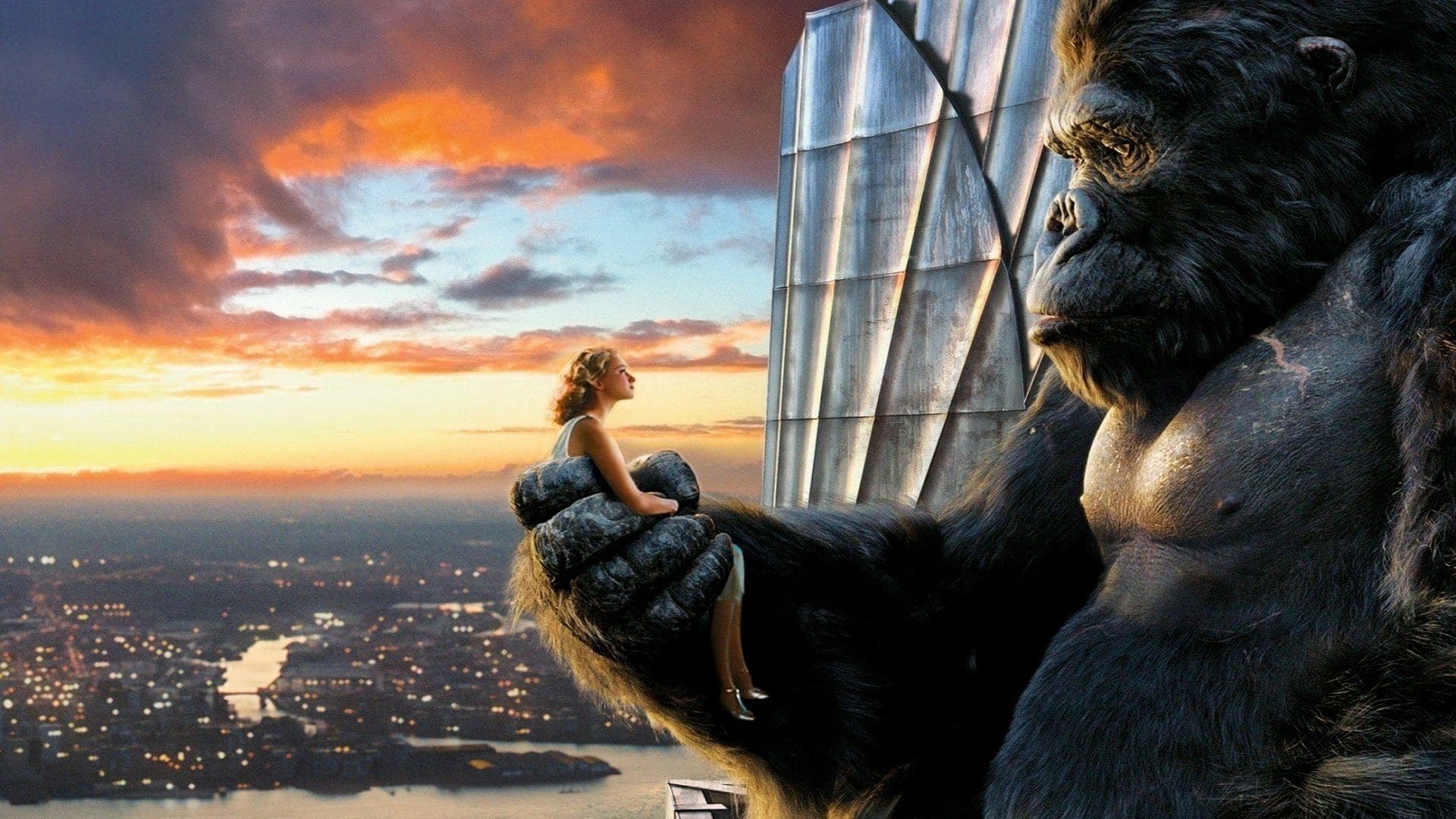
A corporate oil expedition to a remote, fog-shrouded island in the Indian Ocean stumbles onto a giant ape worshipped by the native population. After the creature is captured and shipped back to New York as a publicity stunt, he breaks free and carries the woman who has bewitched him to the top of the World Trade Center, where the United States military closes in for the kill.
What Is the Budget of King Kong (1976)?
King Kong (1976), directed by John Guillermin and produced by Dino De Laurentiis for Paramount Pictures, was made on a reported budget of $24,000,000, an enormous sum for the mid-1970s and roughly double what Universal had spent on Jaws the previous year. The production was conceived by De Laurentiis as a head-to-head challenge to Steven Spielberg's shark picture, with the Italian producer betting that a contemporary, big-budget remake of the 1933 RKO classic could become the next mass-market spectacle. Paramount and De Laurentiis split the financing risk, with the studio acquiring domestic distribution rights while the producer retained foreign rights in most territories.
The $24,000,000 figure covered above-the-line talent, a long location shoot that moved between Los Angeles, Hawaii, and lower Manhattan, and the construction of multiple full-scale and articulated Kong effects. The marketing campaign that surrounded the December 17, 1976 release pushed total production-plus-promotion spend past $30,000,000, making King Kong one of the most expensive films ever greenlit at the time of its release and a defining example of the New Hollywood appetite for high-risk spectacle.
Key Budget Allocation Categories
King Kong's reported $24,000,000 budget was distributed across several core production areas:
- Above-the-Line Talent: Director John Guillermin came directly off The Towering Inferno (1974), one of the top-grossing disaster films of the decade, and commanded a feature-director fee commensurate with that track record. Jeff Bridges, then a two-time Oscar nominee, was cast as paleontologist Jack Prescott, with Charles Grodin as the predatory oil-company executive Fred Wilson. Jessica Lange, an unknown model making her film debut, was paid a relatively modest $1,250 per week against the principals, a deal that became infamous once the film made her a star.
- Carlo Rambaldi Animatronic Kong: De Laurentiis announced during production that a fully mechanical, 40-foot animatronic Kong designed by Italian effects specialist Carlo Rambaldi would carry the picture. The hydraulically operated build cost a reported $1,700,000, weighed roughly six tons, and required dozens of operators. In practice the full-size Kong appeared on screen for only a handful of seconds because the rig was too slow and unreliable for sustained shots, a costly mismatch between the marketing promise and the finished film.
- Rick Baker Ape Suit: Almost all of Kong's screen time was carried by makeup artist and creature performer Rick Baker, wearing a full-body gorilla suit he designed and built specifically for the production. The suit work, combined with a separate giant mechanical hand and arm rig used for the close-up grabbing shots of Dwan, formed the actual effects spine of the film and consumed a substantial share of the practical-effects budget despite Baker's comparatively low credited fee.
- Locations: Hawaii and World Trade Center: Production traveled to Kauai for the Skull Island sequences and shot the climactic finale on the plaza, observation deck, and rooftops of the then-new World Trade Center towers in lower Manhattan. The World Trade Center sequence required exclusive Port Authority access, helicopter unit photography, and crowd extras numbering in the thousands during the 1976 location shoot, all of which carried premium costs over a soundstage substitute.
- John Barry Score and Music: Composer John Barry, fresh off his Bond and Out of Africa run, scored the film with a lush symphonic theme that became one of the production's most enduring assets. Orchestra recording, scoring stage time, and Barry's feature fee were funded out of the post-production line, with the soundtrack album released on Reprise to extend the marketing window.
- Production Design and Miniatures: Production designer Mario Chiari and art director Dale Hennesy oversaw the construction of the Skull Island village, the wall set, the oil-tanker interiors, and a series of miniatures used for long shots of Kong on the city skyline. Glen Robinson, who had won Oscars for Earthquake (1974) and The Hindenburg (1975), handled the mechanical special effects unit.
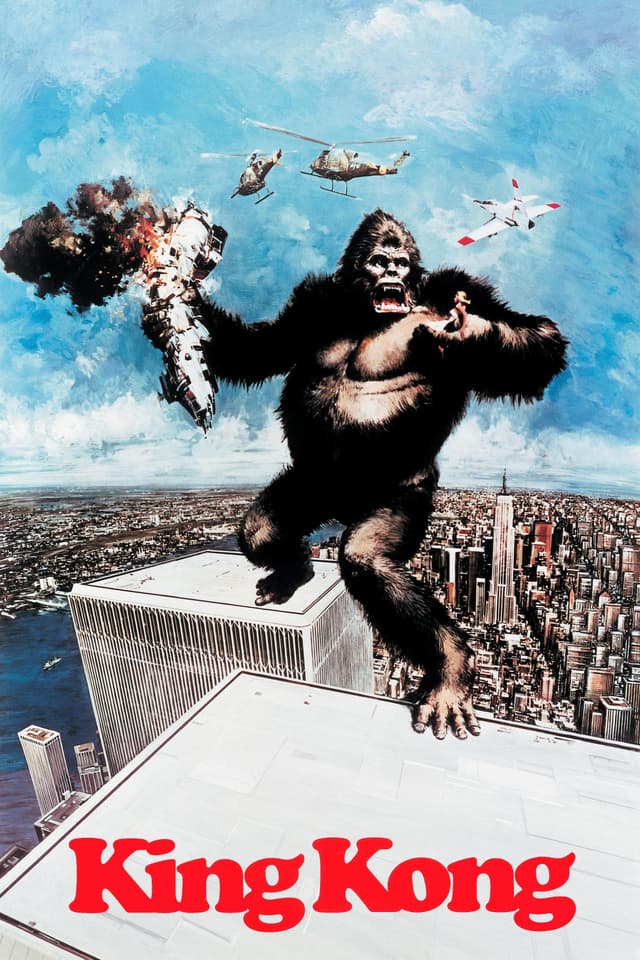
- Marketing and Distribution: De Laurentiis and Paramount spent an unprecedented $6,000,000 on the U.S. marketing campaign, including a saturation television buy and the iconic John Berkey poster image of Kong straddling both Trade Center towers. The campaign reached more than 100 million viewers in the weeks before release, dwarfing the typical 1976 marketing spend for a single film.
How Does King Kong's Budget Compare to Similar Films?
At $24,000,000, King Kong sat at the top of the 1976 cost league and offers a useful benchmark against contemporaneous tentpoles and later Kong reboots:
- King Kong (1933): Budget $672,255 | Worldwide $5,300,000. The original RKO Cooper-Schoedsack production became the template the 1976 remake set out to update, and on an inflation-adjusted basis the 1933 film's budget would be roughly $16,000,000 in 1976 dollars, still meaningfully below what De Laurentiis spent.
- Jaws (1975): Budget $9,000,000 | Worldwide $476,500,000. Spielberg's shark film, the explicit benchmark De Laurentiis was chasing, cost less than 40% of King Kong and grossed more than five times as much, making it the more efficient bet by an enormous margin.
- The Towering Inferno (1974): Budget $14,000,000 | Worldwide $203,300,000. John Guillermin's previous disaster epic was the second-highest-grossing film of 1974 and cost roughly 58% of King Kong, providing the production template (large-scale practical effects, A-list ensemble, holiday release) that Paramount expected Kong to replicate.
- King Kong (2005): Budget $207,000,000 | Worldwide $556,900,000. Peter Jackson's digital-era remake spent more than eight times what De Laurentiis did, used Weta Digital CGI rather than animatronics, and is the closest direct creative descendant of the 1976 picture.
- Kong: Skull Island (2017): Budget $185,000,000 | Worldwide $568,700,000. Legendary's MonsterVerse entry repositioned Kong as a 1970s-set period piece, an aesthetic homage to the De Laurentiis film, and cost more than seven times the 1976 budget while grossing six times its worldwide gross.
- Earthquake (1974): Budget $7,000,000 | Worldwide $80,000,000. Universal's Sensurround disaster film cost less than a third of King Kong and grossed nearly as much worldwide, illustrating how aggressively De Laurentiis was outspending the rest of the 1970s spectacle field.
King Kong Box Office Performance
King Kong opened on December 17, 1976 to $7,023,921 over its first weekend across 1,250 North American screens, the largest opening weekend in Paramount Pictures' history up to that point. Within ten days the film had grossed $26,000,000 worldwide, including $18,000,000 from the United States and Canada, and held the number one position at the domestic box office through the Christmas and New Year corridor.
Against a reported production budget of $24,000,000, the film needed approximately $60,000,000 in worldwide gross to clear marketing and distribution costs. The financial breakdown looked like this:
Box Office Breakdown
King Kong

King Kong returned approximately $2.66 in worldwide gross for every $1 invested in production and marketing, a result that ranked the film as the fifth highest grosser of 1976 behind Rocky, A Star Is Born, All the President's Men, and The Omen. The domestic split was $52,614,445 against an international share of approximately $38,000,000, a 58/42 ratio that confirmed the property's international name recognition.
Despite the strong commercial performance, the cultural narrative that crystallized in the months after release framed the film as a disappointment relative to Jaws, the explicit benchmark De Laurentiis had courted. That reputational damage shaped how the property was discussed for decades and ultimately influenced how Universal and Legendary approached the 2005 and 2017 remakes.
King Kong Production History
Producer Dino De Laurentiis began circling a King Kong remake in 1975 after RKO Pictures, which held the rights to the original 1933 film, became open to relicensing the property. Universal Pictures, which had its own Kong development project running under producer Daniel Selznick, attempted to block De Laurentiis with an injunction, but the parties settled with Universal retaining the right to produce a separate Kong film at a later date, a deal that ultimately produced King Kong Lives (1986). Lorenzo Semple Jr., the screenwriter behind Three Days of the Condor and the 1960s Batman television series, was hired to adapt the property and updated the framing from a 1930s film expedition to a contemporary oil-company exploration mission.
Casting moved quickly through the spring and summer of 1976. Jeff Bridges signed on as the paleontologist hero in May, and Charles Grodin was attached as the corporate antagonist Fred Wilson, a role rewritten to mirror the energy-crisis politics of the mid-1970s. The search for the female lead became a publicity event in itself: more than 1,000 actresses tested for the part of Dwan before De Laurentiis settled on Jessica Lange, a 26-year-old fashion model with no prior screen credits whose seven-year personal-services contract with the producer became a key piece of the film's budgeting because Lange's weekly salary was a fraction of the going rate for an established actress.
Principal photography ran from January through September 1976. The Skull Island exteriors were shot on Kauai, Hawaii, with the Honopu Valley and Honopu Beach standing in for the lost-world interior. The unit then moved to Los Angeles, California for stage work at the Burbank Studios and to New York for the World Trade Center finale, where the Port Authority granted exclusive plaza and rooftop access for the climactic chase sequence. The shoot at the WTC employed thousands of extras, multiple helicopter units, and a giant mechanical hand rig used to grab Lange in close-up. The full-size 40-foot Carlo Rambaldi animatronic Kong, marketed throughout production as the centerpiece of the film, was completed at a cost of $1,700,000 but proved too slow and unreliable for sustained on-camera work, and the production ultimately leaned on Rick Baker in a custom-built ape suit for virtually every Kong shot in the finished cut.
Post-production stretched from late summer through November 1976 at MGM and Burbank, with editor Ralph Winters cutting the picture and John Barry recording his orchestral score in Los Angeles. The film was rushed to a December 17 release to capture the holiday corridor, a schedule that left visual-effects supervisor Glen Robinson and the mechanical-effects unit only weeks to finish key composites. The compressed post-production schedule was widely cited in subsequent interviews as the reason several rear-projection and matte composites in the New York sequences look softer than the rest of the film.
Awards and Recognition
King Kong won the Academy Award for Best Visual Effects at the 49th Academy Awards in 1977, a Special Achievement Award presented to Carlo Rambaldi, Glen Robinson, and Frank Van der Veer that recognized the film's combined animatronic, suit, miniature, and optical effects work. The film also received Oscar nominations for Best Cinematography (Richard H. Kline) and Best Sound (Harry Warren Tetrick, William L. McCaughey, Aaron Rochin, and Jack Solomon).
At the 34th Golden Globe Awards the film won Best New Star of the Year for Jessica Lange in her film debut, the same Golden Globe category that had launched the careers of Ursula Andress and Diana Ross. King Kong was also nominated for the Saturn Award for Best Science Fiction Film by the Academy of Science Fiction, Fantasy and Horror Films and won the Saturn Award for Best Director (John Guillermin) and Best Makeup (Rick Baker). The film received four Razzie nominations decades later when the Golden Raspberry Awards retroactively included it in a Worst Remakes list, a measure of how thoroughly the cultural narrative around the film had soured by the 1980s.
Critical Reception
King Kong (1976) received mixed reviews at the time of release and holds a 51% approval rating on Rotten Tomatoes based on 47 critic reviews, with a critical consensus that calls it "more ambitious in scope than its predecessor, but without the same impact." Metacritic does not maintain a score for the film. Audiences responded more enthusiastically than critics: the picture was the fifth-highest grosser of 1976 in North America and held strong second-run and television viewership through the late 1970s and 1980s.
Roger Ebert gave the film three and a half stars in the Chicago Sun-Times, writing that "this is a beautifully made movie, entertaining and fun" and singling out Lange's performance and the New York climax as the high points of the production. Pauline Kael in The New Yorker was less generous, calling the film "an overblown attempt to redo Jaws with a different animal" while still praising Rick Baker's suit work and the design of the Skull Island sequences. Vincent Canby of The New York Times defended the picture against the early critical pile-on, describing it as "a romantic adventure in the De Laurentiis manner, big and brash and very enjoyable."
The longer-term critical reassessment has been more favorable. Subsequent generations of film historians have framed the 1976 King Kong as a key transitional spectacle between the practical-effects era of the early 1970s disaster cycle and the Star Wars-era blockbuster economy that would dominate by 1977, and Rick Baker's suit work is now considered a foundational text in modern creature performance. The film's mixed reputation, combined with its substantial commercial success, makes it one of the most economically misunderstood productions of the New Hollywood era.
Frequently Asked Questions
How much did it cost to make King Kong (1976)?
The reported production budget was $24,000,000, an extraordinary sum for the mid-1970s and roughly double what Universal had spent on Jaws the previous year. Dino De Laurentiis produced for Paramount Pictures, with the studio handling domestic distribution while De Laurentiis retained most foreign rights.
How much did King Kong (1976) earn at the box office?
The film grossed $52,614,445 domestically and approximately $38,000,000 internationally, for a worldwide total of $90,614,445. It opened to $7,023,921 in North America on December 17, 1976, the biggest opening weekend in Paramount Pictures history up to that point.
Was King Kong (1976) a box office success?
Yes. Against a $24,000,000 production budget and approximately $10,000,000 in marketing, the film returned roughly $2.66 in worldwide gross for every $1 invested. It was the fifth highest grossing film of 1976 in North America, behind Rocky, A Star Is Born, All the President's Men, and The Omen, despite the cultural narrative that framed it as a disappointment relative to Jaws.
Who directed King Kong (1976)?
John Guillermin directed the film, working from a screenplay by Lorenzo Semple Jr. that updated the 1933 RKO premise from a film expedition to a contemporary oil-company exploration mission. Guillermin came directly off The Towering Inferno (1974), one of the top-grossing disaster films of the decade.
Where was King Kong (1976) filmed?
Principal photography ran from January through September 1976 across three primary locations. The Skull Island exteriors were shot on Kauai, Hawaii, using the Honopu Valley and Honopu Beach. Stage work was completed at the Burbank Studios in Los Angeles, California. The climactic finale was filmed on location at the World Trade Center in New York, where the Port Authority granted exclusive plaza and rooftop access.
Who built the giant Kong used in the 1976 film?
Italian effects specialist Carlo Rambaldi built a 40-foot, six-ton hydraulically operated animatronic Kong at a reported cost of $1,700,000. The full-size rig proved too slow and unreliable for sustained shots and appeared on screen for only a handful of seconds. Almost all of Kong's actual screen time was carried by makeup artist Rick Baker wearing a custom ape suit he designed for the production.
How does King Kong (1976) compare to other Kong films?
The 1976 film cost $24,000,000 and grossed $90,614,445 worldwide. The 1933 original cost $672,255 and grossed $5,300,000. Peter Jackson's King Kong (2005) cost $207,000,000 and grossed $556,900,000. Kong: Skull Island (2017) cost $185,000,000 and grossed $568,700,000. The 1976 version remains the most economically efficient post-1933 entry on a return-on-investment basis.
Did King Kong (1976) win any Academy Awards?
Yes. King Kong won the Special Achievement Academy Award for Best Visual Effects, presented to Carlo Rambaldi, Glen Robinson, and Frank Van der Veer at the 49th Academy Awards. The film also received Oscar nominations for Best Cinematography (Richard H. Kline) and Best Sound.
What was Jessica Lange paid for King Kong (1976)?
Lange, then an unknown fashion model making her film debut, was paid a reported $1,250 per week under a seven-year personal-services contract with Dino De Laurentiis. The deal was unusually favorable to the producer and became a key piece of the film's budget arithmetic given that more than 1,000 actresses had tested for the role of Dwan. Lange won the Golden Globe for Best New Star of the Year for the performance.
What did critics think of King Kong (1976)?
Reviews were mixed at the time of release and the film holds a 51% approval rating on Rotten Tomatoes based on 47 critic reviews. Roger Ebert gave the film three and a half stars and praised Jessica Lange and the New York climax. Pauline Kael was more skeptical, while Vincent Canby of The New York Times defended the picture as "big and brash and very enjoyable." Later critical reassessment has been more favorable, framing the film as a key transitional spectacle between the early-1970s disaster cycle and the Star Wars-era blockbuster economy.
Filmmakers
King Kong

Official Trailer
Build budgets like this one in Saturation
Start from an industry-standard feature film template, import the schedule and rates you already have, and let the cost report keep itself current as you spend. Real-time collaboration, no spreadsheets.