King Kong Budget
 Adventure
Updated
Synopsis
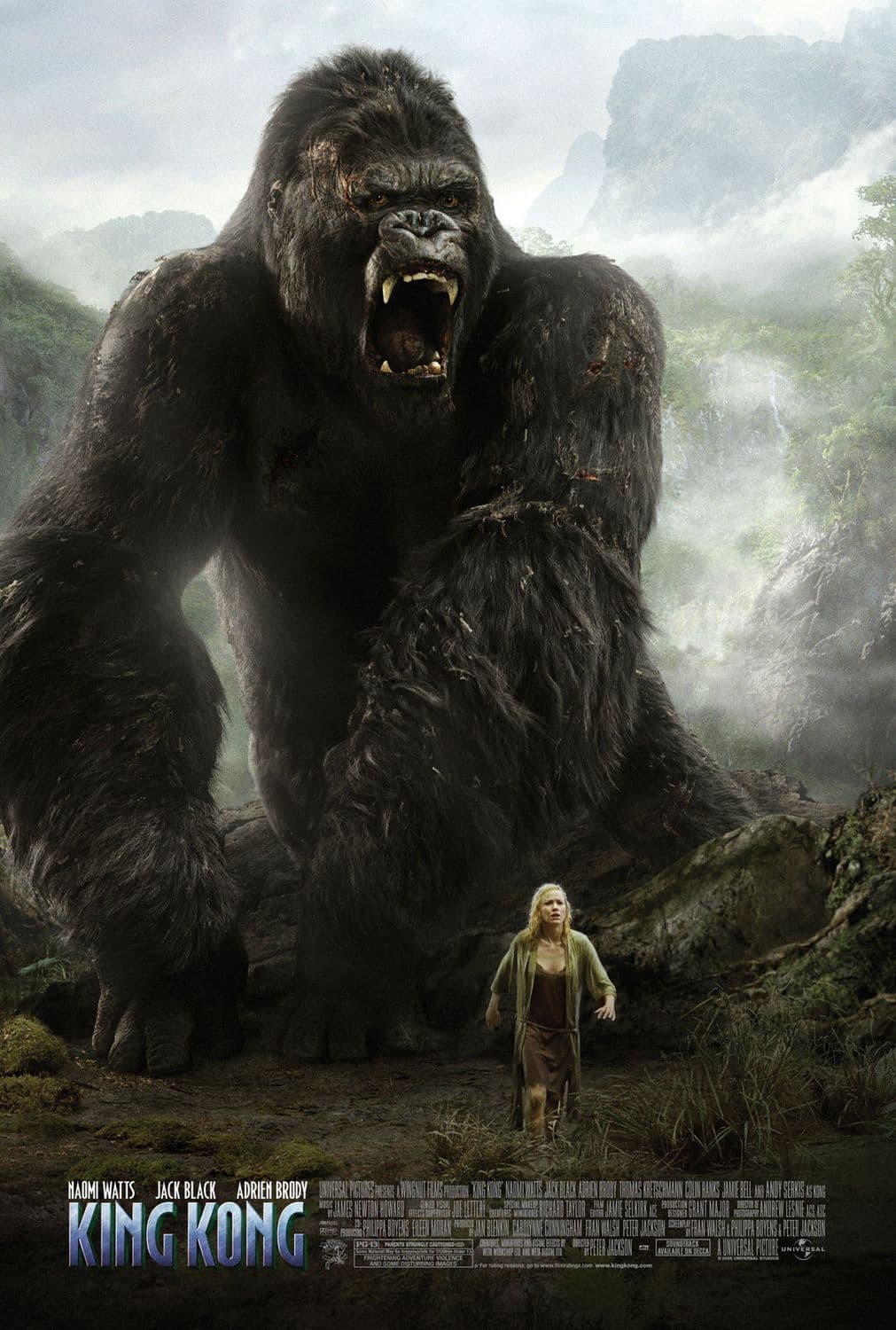
A struggling 1933 New York filmmaker drags his cast and crew to the uncharted Skull Island to shoot a doomed adventure picture, where they encounter a giant ape who becomes captivated by their leading lady. Peter Jackson's lavish remake of the 1933 classic builds toward a tragic Manhattan climax atop the Empire State Building.
What Is the Budget of King Kong (2005)?
King Kong was produced on a budget of approximately $207 million, an enormous outlay reflecting Peter Jackson's ambition to deliver a definitive remake of the 1933 classic. Universal Pictures bankrolled the project after Jackson's success on the Lord of the Rings trilogy, with the budget covering location and stage work in New Zealand, extensive practical and digital creature effects, and a marquee cast.
Key Budget Allocation Categories
Visual Effects, Weta Digital handled the lead creature work for Kong and the Skull Island fauna, requiring over a year of motion capture, facial animation, and digital environment construction.
Stage and Set Construction, period 1933 New York streets, the SS Venture freighter, and the Skull Island village were built as practical sets at Stone Street Studios in Wellington.
Cast Salaries, Naomi Watts, Jack Black, and Adrien Brody headlined an expensive ensemble, with Andy Serkis contributing the lead motion-capture performance for Kong.
Music Score, James Newton Howard composed the score on a tight timeline after replacing original composer Howard Shore, recorded with full orchestra.
Marketing Campaign, Universal mounted a global marketing push exceeding $150 million, including a Volkswagen tie-in, prime-time broadcast specials, and a worldwide premiere tour.
Extended Post-Production, the film's 187 minute runtime and complex digital sequences required nearly nine months of post-production with hundreds of effects artists.
How Does King Kong's Budget Compare to Similar Films?
Kong: Skull Island (2017), Budget $185,000,000 | Worldwide $566,000,000. A leaner action-focused reboot from Legendary Pictures with similar global gross at a lower budget.
Godzilla vs. Kong (2021), Budget $200,000,000 | Worldwide $470,000,000. A monster-versus-monster MonsterVerse entry with comparable scale and slightly lower returns.
The Lord of the Rings: The Return of the King (2003), Budget $94,000,000 | Worldwide $1,142,000,000. Jackson's prior film with less than half the budget and double the worldwide gross.
Avatar (2009), Budget $237,000,000 | Worldwide $2,923,000,000. A similarly priced visual-effects spectacle from later in the decade that vastly outperformed Kong globally.
King Kong Box Office Performance
King Kong opened to $50.1 million in North America over its first five-day Wednesday-launch window in December 2005, with a three-day weekend of $36.9 million. The opening was strong but fell short of Universal's aggressive projections.
Box Office Breakdown
King Kong

On theatrical revenue alone the film returned roughly $1.56 for every $1 invested, recouping the production budget but falling short of the marketing investment before home video. Strong DVD and Blu-ray performance pushed the film into long-term profitability.
The international gross of $338 million represented a 61/39 international-to-domestic split that was strong for a December release, though Universal's internal expectations had been for a $700 million-plus global total based on the Lord of the Rings comparison.
King Kong Production History
Peter Jackson developed King Kong as his dream project for decades before Universal greenlit it in March 2003 on the strength of the Lord of the Rings success. Jackson had initially attempted the film at Universal in 1996 with a $75 million budget, but that version collapsed during pre-production. The revived 2003 project was budgeted at $150 million, climbing to a final $207 million as the scope expanded.
Principal photography began in September 2004 at Stone Street Studios in Wellington and continued through March 2005 on stages and at New Zealand locations. Naomi Watts shot most of her Kong sequences against partial puppets and motion-reference props, with Andy Serkis performing Kong on motion-capture stages.
Weta Digital handled the lead creature work with over 100 artists working for more than a year on Kong's facial animation alone, building on lessons learned from Gollum. Composer Howard Shore left the project late in post-production, with James Newton Howard delivering a complete replacement score in roughly five weeks.
The production schedule was unusually compressed for a film of this scale. Visual effects work continued through November 2005 to meet a December release date, with hundreds of shots completed in the final weeks. The aggressive timeline contributed to the climbing budget and to the eventual underperformance relative to expectations.
Awards and Recognition
King Kong won three Academy Awards in 2006 for Best Sound Mixing, Best Sound Editing, and Best Visual Effects, the latter being Weta Digital's second consecutive Oscar in the category. The film also received a BAFTA Award for Special Visual Effects.
Andy Serkis received industry recognition for his motion-capture work, including a Saturn Award nomination for Best Supporting Actor that helped accelerate broader awards-body acceptance of performance-capture acting. The film won six Saturn Awards from the Academy of Science Fiction, Fantasy and Horror Films.
Industry retrospectives credit King Kong with advancing digital creature performance significantly beyond Gollum, particularly in facial animation and emotional nuance. The film remains a benchmark cited by VFX artists alongside Avatar and the Planet of the Apes reboot trilogy.
Critical Reception
Critical reception was largely positive, with Rotten Tomatoes settling at 84 percent and Metacritic at 81. Reviewers praised the visual effects, Andy Serkis's Kong performance, the New York-set bookend sequences, and the emotional weight Jackson brought to the Ann and Kong relationship. CinemaScore audiences gave the film a B.
Roger Ebert awarded the film four stars and called it "magnificent," writing that Jackson "knows how to put a movie together." Manohla Dargis at The New York Times praised the "extravagant set pieces" while questioning the 187 minute runtime. Several critics highlighted the Skull Island sequences as among the most ambitious creature work ever committed to film.
The most consistent criticism centered on length and pacing, particularly the slow first hour set in New York. Some reviewers argued that the film's emotional scope did not quite match its technical achievement. The film has nevertheless held up well in retrospect and is widely considered the strongest Kong adaptation produced.
Frequently Asked Questions
What is the budget of King Kong (2005)?
King Kong was produced on a budget of approximately $207 million, making it one of the most expensive films ever made at the time of its release.
Who directed King Kong (2005)?
Peter Jackson directed the film as his follow-up to the Lord of the Rings trilogy, having long cited the 1933 original as the movie that made him want to become a filmmaker.
When was King Kong released?
Universal Pictures released King Kong in North America on December 14, 2005, with a global rollout completing through the end of the month.
Where was King Kong filmed?
Principal photography took place almost entirely in New Zealand at WingNut Films and Weta Workshop facilities in Wellington, with location shooting in the Wellington region. Brief second-unit material was shot in New York.
How much did King Kong earn at the box office?
The film earned approximately $218 million domestically and $338 million internationally for a worldwide total of about $556 million.
Who plays Kong in the 2005 film?
Andy Serkis provided the motion-capture performance for Kong, building on the digital character work he had developed as Gollum in the Lord of the Rings trilogy.
How long is King Kong (2005)?
The theatrical release runs 187 minutes. An extended edition released on home video adds approximately 13 minutes for a total of 200 minutes.
Did King Kong win any awards?
The film won three Academy Awards for Best Sound Mixing, Best Sound Editing, and Best Visual Effects, with additional BAFTA and Saturn Award wins for visual effects and production design.
Was King Kong (2005) profitable?
On a $207 million production budget and roughly $150 million in marketing, the film grossed $556 million globally. After studio splits and home video performance, Universal recouped its investment and turned a modest theatrical profit, though the film was viewed internally as underperforming relative to expectations.
How does King Kong compare to the 1933 original?
Jackson's version is roughly twice the runtime of the 1933 film and adapts the same core story with significantly expanded character development for Ann Darrow, Carl Denham, and Kong himself.
Filmmakers
King Kong

Build budgets like this one in Saturation
Start from an industry-standard feature film template, import the schedule and rates you already have, and let the cost report keep itself current as you spend. Real-time collaboration, no spreadsheets.