Harakiri Budget
Updated
Synopsis
In 1630s Edo Japan, an aging masterless samurai arrives at the gate of a feudal lord's manor and requests permission to commit ritual suicide in the courtyard. As the household head interrogates him, a more devastating story unfolds, exposing the cruelty and hypocrisy at the heart of the samurai code.
What Is the Budget of Harakiri (1962)?
Harakiri (1962), directed by Masaki Kobayashi and produced by Shochiku, was made on a production budget that has never been publicly disclosed in Western trade reporting. The Japanese studio system of the early 1960s operated on production budgets typically ranging from 50 million to 200 million yen for prestige period dramas, equivalent to approximately $140,000 to $560,000 in 1962 US dollars or roughly $1,400,000 to $5,600,000 in 2024 purchasing power. Harakiri sat at the upper end of this band, reflecting its location-heavy production, extensive period detail, and access to Shochiku's most experienced craft personnel.
Shochiku was one of the four major Japanese studios (alongside Toho, Daiei, and Toei) and operated the most prestigious prestige-drama production pipeline in Japanese cinema. Kobayashi had just completed the nine-and-a-half-hour Human Condition trilogy (1959 to 1961) for Shochiku, and Harakiri represented a leaner but no less ambitious successor that consolidated his standing as a major art-cinema director.
Key Budget Allocation Categories
Harakiri's production resources were directed across the following categories:
- Above-the-Line Talent: Director Masaki Kobayashi was at the height of his career following The Human Condition. Lead Tatsuya Nakadai (Kobayashi's frequent collaborator) was emerging as one of Japanese cinema's most respected leading men, with co-stars Akira Ishihama, Shima Iwashita, Tetsuro Tamba, Rentaro Mikuni, and the legendary Yoshio Inaba rounding out an experienced cast.
- Studio Set Construction: The film takes place almost entirely on the courtyard and interior sets of the Iyi clan's residence. Production designer Junichi Ozumi built the extensive interior and courtyard sets at Shochiku's Ofuna studios, with Toshiro Narushima's cinematography making elaborate use of the sliding-door geometry.
- Period Costuming and Weapons: The film is set in 1630 during the Tokugawa Shogunate. Costume design, weapons, and propmaking reflected exhaustive research into Tokugawa-period samurai armor, dress, and ceremonial detail.
- Score: Toru Takemitsu, by 1962 already established as the most important modernist composer working in Japanese cinema, scored the film with a stark combination of traditional Japanese instrumentation (including the biwa) and avant-garde percussion.
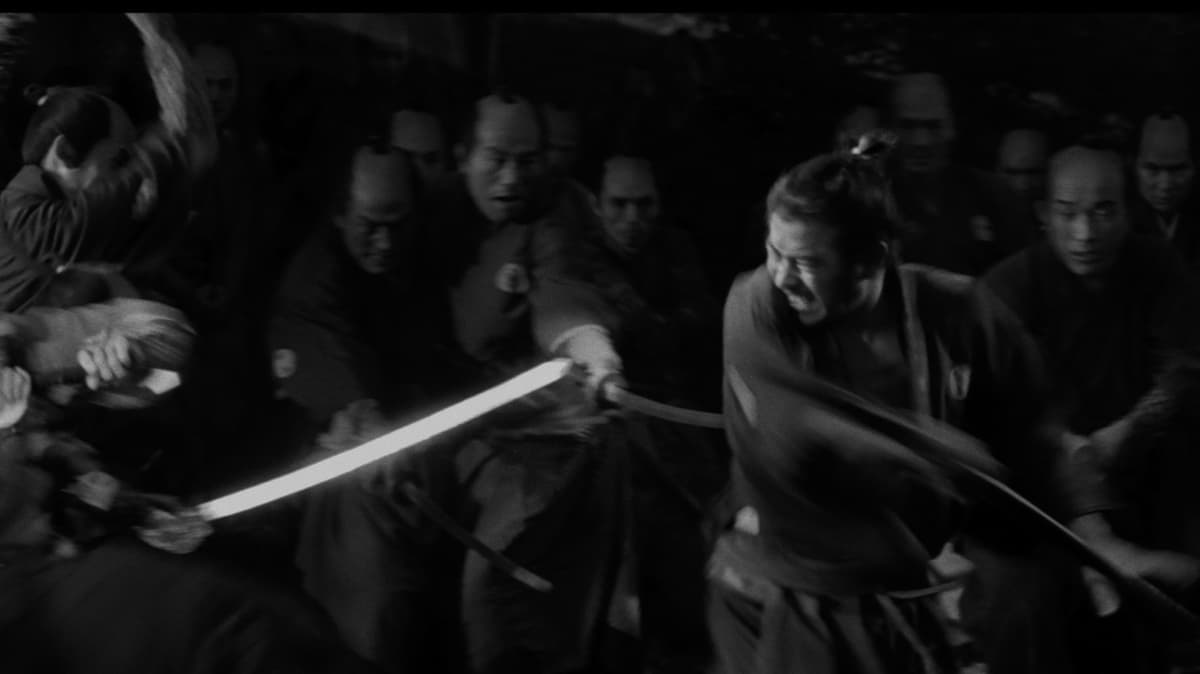
- Choreography: The climactic courtyard battle and the central seppuku set piece required extensive stunt coordination and choreographic preparation, atypical for a prestige Shochiku drama and requiring the involvement of period sword specialists.
- Cinematography: Yoshio Miyajima's black-and-white widescreen cinematography uses the studio's most sophisticated grain stocks and lighting setups, producing a visual style that critics have praised for half a century.
How Does Harakiri's Budget Compare to Similar Films?
Comparable Japanese prestige cinema from the same era offers context for the production scale:
- Yojimbo (1961): Budget undisclosed (estimated similar Toho prestige tier) | Worldwide N/A. Akira Kurosawa's contemporaneous samurai film at Toho operated at a similar production scale and earned international art-house success.
- Sanjuro (1962): Budget undisclosed | Worldwide N/A. Kurosawa's Yojimbo sequel released the same year as Harakiri sat in the same Japanese studio prestige tier.
- Sword of Doom (1966): Budget undisclosed | Worldwide N/A. Kihachi Okamoto's subsequent Toho samurai feature, also starring Tatsuya Nakadai, occupied the same production tier.
- Samurai Rebellion (1967): Budget undisclosed | Worldwide N/A. Kobayashi's subsequent samurai drama, also starring Nakadai, applied the Harakiri template to a different historical conflict.
- Throne of Blood (1957): Budget undisclosed | Worldwide N/A. Kurosawa's Macbeth adaptation provides the closest aesthetic comparison from the era for a Japanese prestige period drama with extensive sword choreography.
Harakiri Box Office Performance
Harakiri opened in Japan on September 16, 1962. Detailed Japanese box office numbers from the 1960s are not consistently archived in Western databases, but the film was a moderate commercial success domestically and a major prestige property at Shochiku. International theatrical performance came primarily through the festival and art-house circuit:
Box Office Breakdown
Harakiri

The film has remained continuously in commercial circulation since 1962, with major re-release windows including its inclusion in The Criterion Collection on DVD (2005) and Blu-ray (2011), the Criterion Channel and HBO Max streaming runs, and theatrical revivals tied to retrospectives of Kobayashi's work and Japanese New Wave programming. The cumulative long-tail revenue has substantially exceeded any single-release box office accounting.
Harakiri's reputation has also driven the commercial value of related Shochiku catalog titles, including Kobayashi's subsequent Kwaidan (1964) and Samurai Rebellion (1967).
Harakiri Production History
Yasuhiko Takiguchi wrote the source novel Ibun Ronin-ki, on which screenwriter Shinobu Hashimoto (Rashomon, Seven Samurai, Throne of Blood) based the screenplay. Hashimoto's script restructured the source material into a frame-narrative format, with the central seppuku set piece serving as the structural axis around which the film's temporal layers spiral. Hashimoto and Kobayashi worked closely with the Shochiku production team through pre-production in 1961 and 1962.
Principal photography took place at Shochiku's Ofuna studios south of Tokyo over the summer of 1962. The production was primarily set-bound, with the Iyi clan residence courtyard reconstructed in fine detail. Tatsuya Nakadai, who would go on to become one of Japanese cinema's most decorated actors, was at this point still establishing his leading-man status, and the Harakiri performance is widely cited as his definitive collaboration with Kobayashi.
Toru Takemitsu, the composer, was already an internationally recognized modernist whose work bridged Western avant-garde and traditional Japanese instrumentation. His Harakiri score, characterized by sparse use of biwa, percussion, and silence, has been studied as one of the foundational examples of how contemporary film scoring can elevate period drama.
Yoshio Miyajima's cinematography deployed Shochiku's widescreen GrandScope format, with elaborate camera movement and depth-of-field staging unusual for set-bound prestige drama of the era. Miyajima's framing of the courtyard sequences and the climactic battle has been the subject of substantial cinematography textbook analysis since the film's release.
Awards and Recognition
Harakiri won the Special Jury Prize at the 1963 Cannes Film Festival, then known as the Jury Special Prize, the festival's second-highest honor that year. The win established the film as a significant international art-cinema property and consolidated Kobayashi's reputation outside Japan. The festival jury, headed by Armand Salacrou, also nominated the film for the Palme d'Or; it was the only Japanese film in the main competition that year.
Domestically, the film won three Kinema Junpo Awards (the highest critical honors in Japanese cinema) in 1963, including Best Film, Best Director (Kobayashi), and Best Screenplay (Hashimoto). The film also received the Mainichi Film Concours' Best Film award. Its sustained critical reputation has earned regular inclusion on retrospective best-of lists, including Sight & Sound's decennial critics' poll, where it has appeared multiple times since the 1970s.
Critical Reception
Harakiri received overwhelmingly positive reviews on initial release and has only grown in critical standing across six decades. The film holds a 100% approval rating on Rotten Tomatoes based on 36 critic reviews, with a critical consensus describing it as "a quietly devastating critique of feudal codes." On Metacritic, the film scores 85 out of 100 from collected reviews.
Roger Ebert added the film to his Great Movies series, writing that "what is so striking about Harakiri is the slow, almost dance-like rhythm of its narrative." Manohla Dargis of The New York Times described the film as "one of the great achievements of Japanese cinema, austere and shattering." Jonathan Rosenbaum wrote for the Chicago Reader that the film "may be the most powerful argument ever made against the samurai code on its own terms."
Contemporary critical analysis has positioned the film as a critique of feudal Tokugawa-period ideology that resonates with mid-1960s Japanese political conditions. Subsequent Japanese filmmakers including Takeshi Kitano and Takashi Miike (whose own 2011 remake titled Hara-Kiri: Death of a Samurai opened in competition at Cannes) have cited Harakiri as foundational. The film's reputation has remained essentially unchallenged since its release, and it appears on most reputable lists of the greatest Japanese films ever made.
Frequently Asked Questions
How much did it cost to make Harakiri (1962)?
The production budget was never publicly disclosed. Japanese prestige period dramas at Shochiku in the early 1960s typically operated on budgets in the 50 million to 200 million yen range, equivalent to approximately $140,000 to $560,000 in 1962 US dollars. Harakiri sat at the upper end of this band, reflecting its location-heavy production and extensive period detail.
Who directed Harakiri?
Masaki Kobayashi directed the film. Kobayashi had just completed the nine-and-a-half-hour Human Condition trilogy (1959 to 1961) for Shochiku before making Harakiri, which consolidated his standing as one of Japan's major art-cinema directors.
Who stars in Harakiri?
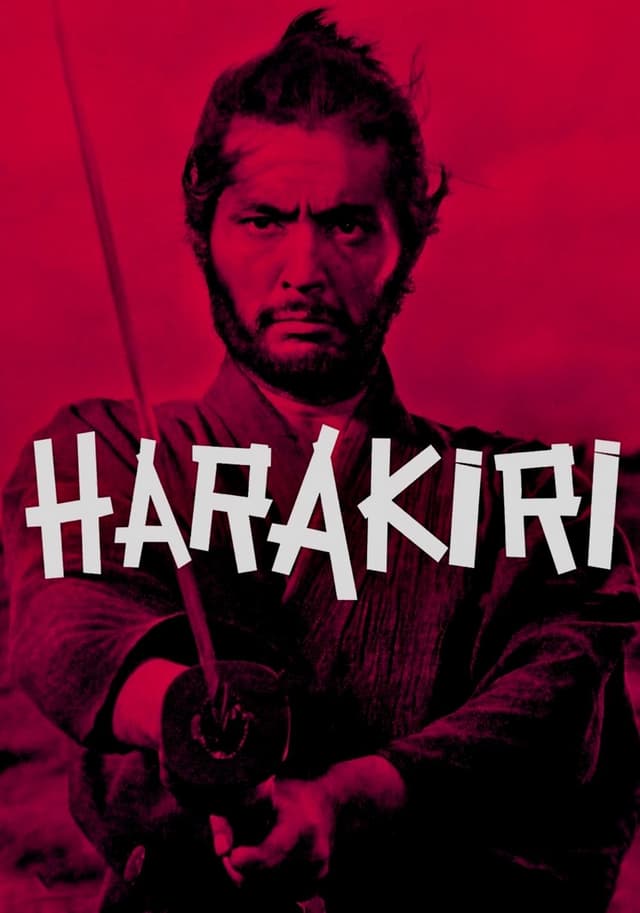
Tatsuya Nakadai stars as Hanshiro Tsugumo, a masterless samurai who comes to the Iyi clan manor seeking permission to commit ritual suicide. The role is widely considered Nakadai's definitive collaboration with Kobayashi.
Did Harakiri win any awards?
Yes. The film won the Special Jury Prize at the 1963 Cannes Film Festival, the festival's second-highest honor that year. It was nominated for the Palme d'Or. Domestically, it won three Kinema Junpo Awards including Best Film, Best Director, and Best Screenplay.
Who composed the music for Harakiri?
Toru Takemitsu composed the score. Takemitsu was already an internationally recognized modernist whose work bridged Western avant-garde and traditional Japanese instrumentation. His Harakiri score uses sparse biwa, percussion, and silence to memorable effect.
Is Harakiri based on a book?
Yes. The screenplay by Shinobu Hashimoto is based on the novel Ibun Ronin-ki by Yasuhiko Takiguchi. Hashimoto, the screenwriter behind Akira Kurosawa's Rashomon (1950) and Seven Samurai (1954), restructured the source material into a frame-narrative format.
When is Harakiri set?
The film is set in 1630, during the early Tokugawa Shogunate, a period of relative peace in Japan when masterless samurai (ronin) were widespread following decades of warlord consolidation. Many former samurai found themselves without livelihoods, leading to a wave of public suicides that the film examines.
What was Harakiri's reception?
The film received overwhelmingly positive reviews on initial release and has only grown in critical standing across six decades. It holds a 100% approval rating on Rotten Tomatoes and a Metacritic score of 85 out of 100. Roger Ebert added it to his Great Movies series.
Has Harakiri been remade?
Yes. Takashi Miike directed a remake, Hara-Kiri: Death of a Samurai, which opened in competition at the 2011 Cannes Film Festival. The Miike version was shot in 3D and received mixed critical reactions, with most critics preferring the Kobayashi original.
Where can I watch Harakiri?
The film is available in The Criterion Collection on DVD and Blu-ray and streams on the Criterion Channel and other licensed platforms. Theatrical revival screenings appear regularly at repertory venues including New York's Film Forum and Los Angeles' New Beverly Cinema.
Filmmakers
Harakiri

Official Trailer
Build budgets like this one in Saturation
Start from an industry-standard feature film template, import the schedule and rates you already have, and let the cost report keep itself current as you spend. Real-time collaboration, no spreadsheets.