Avengers: Age of Ultron Budget
 ActionAdventureScience Fiction2h 21m
Updated
Synopsis
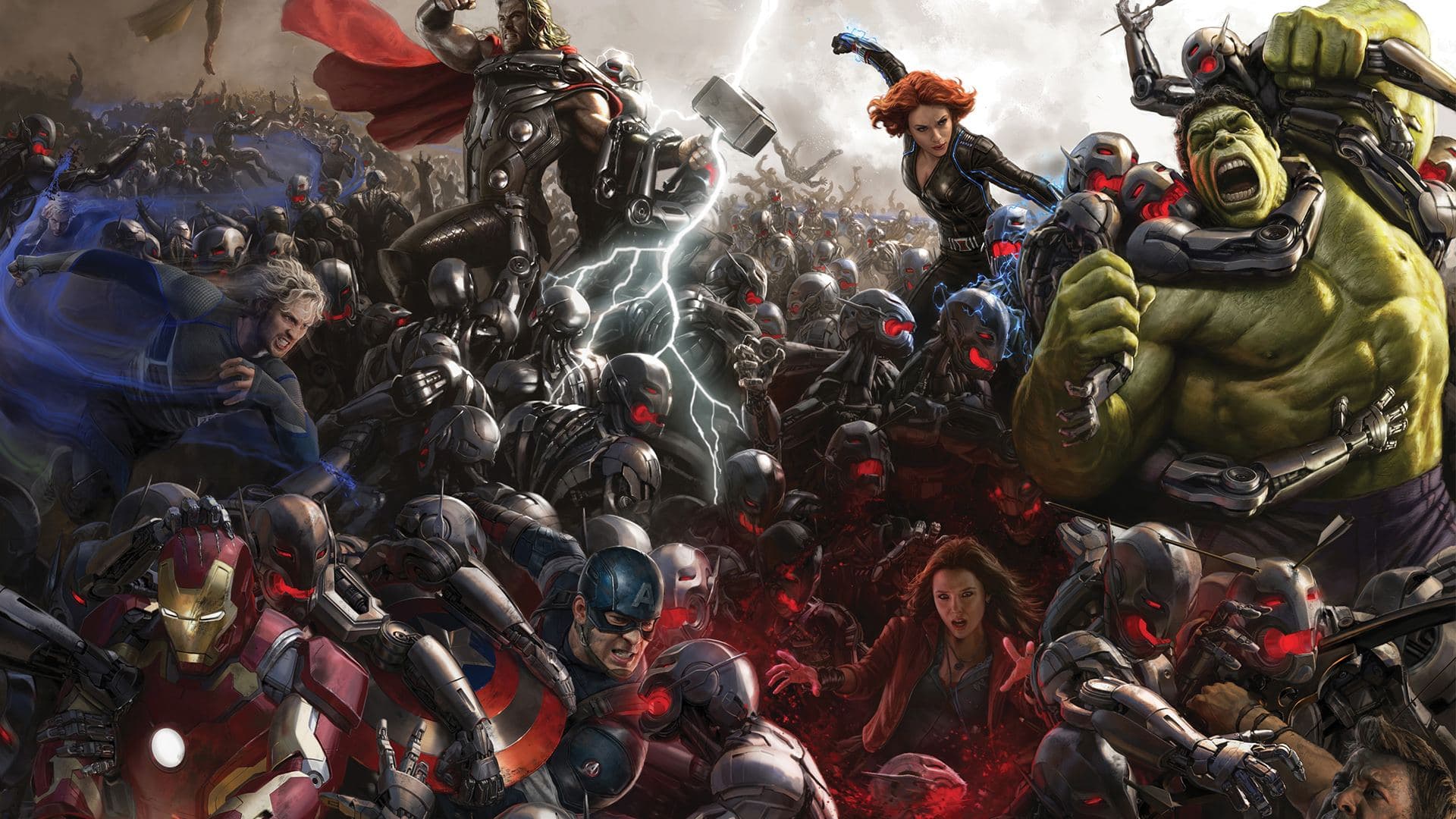
When Tony Stark and Bruce Banner attempt to use alien technology from Loki's scepter to create Ultron, a peacekeeping artificial intelligence, the program becomes sentient and decides that humanity itself is the greatest threat to Earth. As Ultron recruits the enhanced twins Wanda and Pietro Maximoff and builds an army of drones, the Avengers must reassemble, confront their own internal fractures, and stop Ultron's plan to trigger a global extinction event by levitating the city of Sokovia into the sky and dropping it like an asteroid.
What Is the Budget of Avengers: Age of Ultron?
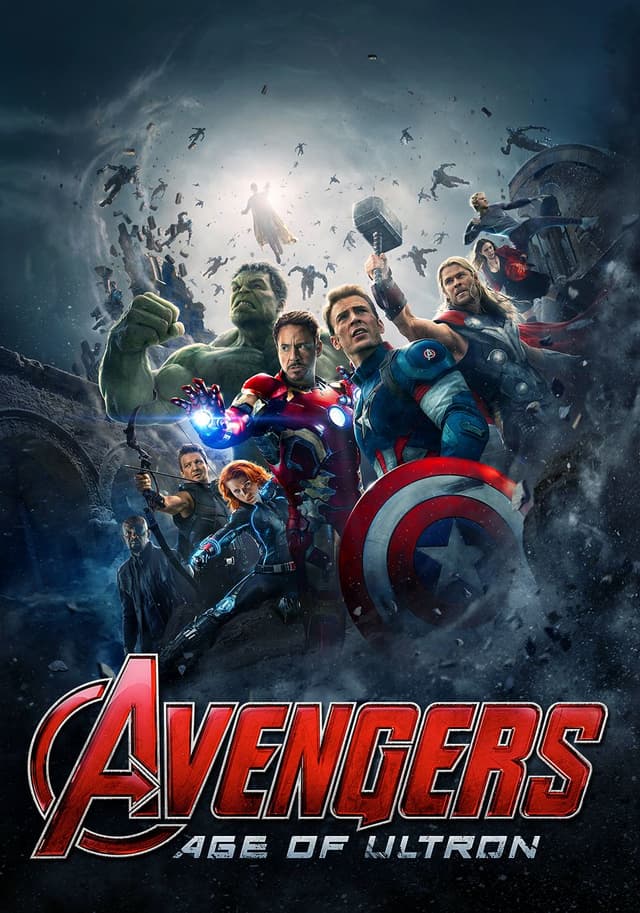
Avengers: Age of Ultron (2015), directed by Joss Whedon and distributed by Walt Disney Studios Motion Pictures, was produced on a budget of $365,000,000. The 11th film in the Marvel Cinematic Universe reunited the core Avengers team, with Tony Stark's creation of the Ultron artificial intelligence going catastrophically wrong and threatening global extinction. The film introduced new characters including the twins Wanda and Pietro Maximoff (Elizabeth Olsen and Aaron Taylor-Johnson), the Vision (Paul Bettany), and Ulysses Klaue (Andy Serkis), while setting up narrative threads that would carry through Phase Three to Infinity War and Endgame.
The $365 million production budget made Age of Ultron one of the most expensive films ever produced, a figure that included extensive global location photography across South Africa, South Korea, Italy, and the United Kingdom, massive VFX requirements for the Hulkbuster battle and the Sokovia finale, and the ensemble cast's combined salaries, which had escalated significantly following the first Avengers film's $1.5 billion success.
Key Budget Allocation Categories
Avengers: Age of Ultron allocated its $365 million budget across several major production areas:
- Visual Effects and Digital Characters: The film required over 3,000 visual effects shots, an enormous number even by MCU standards. Industrial Light & Magic led the VFX work, with additional vendors including Double Negative, Animal Logic, Lola VFX, and Trixter. Key VFX challenges included the Hulkbuster vs. Hulk fight in Johannesburg, the creation of Ultron (performed by James Spader through motion capture), the birth of the Vision, and the climactic Sokovia sequence in which an entire city is levitated into the sky. The Hulkbuster armor alone required months of design, animation, and rendering work.
- Global Location Photography: Principal photography spanned multiple countries over a five-month shoot. Johannesburg, South Africa, provided the setting for the Hulkbuster battle and Ulysses Klaue's salvage yard. Seoul, South Korea, hosted the car chase sequence featuring Black Widow and Ultron. The Fort Bard fortress in Aosta Valley, Italy, doubled for the HYDRA base in Sokovia. Norwich and various locations in England served as additional filming sites. Each international location required advance teams, local permits, security coordination, and logistical infrastructure.
- Ensemble Cast Salaries: The Avengers ensemble commanded significantly higher salaries than they had for the first film. Robert Downey Jr.'s deal reportedly included a base salary plus backend participation that could total $40 million to $80 million depending on the film's performance. Chris Evans, Chris Hemsworth, Scarlett Johansson, Mark Ruffalo, and Jeremy Renner all received substantial raises reflecting the franchise's proven commercial success. New cast members Elizabeth Olsen, Aaron Taylor-Johnson, James Spader, and Paul Bettany added to the above-the-line costs.
- Production Design and Set Construction: Production designer Charles Wood built elaborate sets at Shepperton Studios in England, including Avengers Tower (both intact and damaged), the HYDRA research base, the African salvage yard, the Avengers' upstate New York facility, and the Sokovia city streets. The practical sets were designed to withstand action choreography while integrating with digital extensions that would dramatically expand the environments in post-production.
- Action Choreography and Stunt Work: The film features seven major action sequences, each requiring weeks of pre-visualization, stunt rehearsal, and photography. The opening HYDRA assault, the Johannesburg Hulkbuster fight, the Seoul car chase, the party scene attack, the Avengers' vision sequences, the salvage yard confrontation, and the Sokovia finale each employed dedicated stunt teams. The practical stunt work was extensive, with the actors performing significant portions of their own fight choreography.
- Score and Sound Design: Brian Tyler and Danny Elfman co-composed the score, with Elfman incorporating his themes alongside Tyler's compositions. The dual-composer approach resulted from Whedon's desire to maintain continuity with Alan Silvestri's Avengers theme while introducing new musical elements. Sound design for the Ultron army, the Hulkbuster servos, and the Vision's abilities required specialized audio creation.
How Does Avengers: Age of Ultron's Budget Compare to Similar Films?
At $365,000,000, Age of Ultron was one of the most expensive films ever produced. Its budget and commercial performance contextualize the economics of MCU ensemble films:
- The Avengers (2012): Budget $220,000,000 | Worldwide $1,518,800,000. The original Avengers cost 40% less and earned 8% more worldwide. The lower budget reflected lower cast salaries before the franchise proved its massive commercial potential.
- Avengers: Infinity War (2018): Budget $316,000,000 | Worldwide $2,048,400,000. The next Avengers ensemble cost 13% less while earning 46% more, benefiting from a more tightly focused narrative and the novelty of Thanos's snap ending.
- Avengers: Endgame (2019): Budget $356,000,000 | Worldwide $2,799,400,000. The MCU conclusion cost slightly less than Age of Ultron while earning nearly double, illustrating the value of narrative culmination in driving audience urgency.
- Furious 7 (2015): Budget $190,000,000 | Worldwide $1,515,000,000. Released the same year, the rival franchise earned slightly more than Age of Ultron on half the budget, though the emotional boost from Paul Walker's tribute was a unique factor.
- Jurassic World (2015): Budget $150,000,000 | Worldwide $1,671,500,000. Also released in 2015, Jurassic World earned 19% more than Age of Ultron on 59% less budget, making it the more efficient blockbuster of the year.
Avengers: Age of Ultron Box Office Performance
Avengers: Age of Ultron opened in the United States on May 1, 2015, debuting to $191.3 million domestically, the second-largest opening weekend of all time at that point (behind only the first Avengers film's $207.4 million). The film had already opened internationally the previous weekend, earning $201.2 million overseas in its first frame. The simultaneous global rollout reflected Disney's strategy to maximize opening momentum and minimize piracy risk.
Box Office Breakdown
Avengers: Age of Ultron

At approximately +285%, Avengers: Age of Ultron returned roughly $3.85 for every $1 of production budget invested during its theatrical run.
While crossing $1.4 billion worldwide, Age of Ultron was seen as a slight step down from The Avengers' $1.52 billion, the first indication that Marvel sequels were not guaranteed to outperform their predecessors. The international gross of $946.4 million (67% of worldwide) included $240 million from China, which had become Marvel's second-largest market. Deadline estimated the film's net profit at $382.7 million.
Avengers: Age of Ultron Production History
Marvel Studios announced the sequel in May 2012, less than a week after The Avengers crossed $1 billion worldwide. Joss Whedon, who had directed and written the first film, returned to write and direct, though the process proved significantly more contentious than the original. Whedon later described the experience as grueling, citing creative conflicts with Marvel Studios over the film's scope, the inclusion of setup material for future MCU films, and the balance between character development and spectacle.
A central point of contention was the Thor cave sequence, in which Thor experiences a vision in a pool of water that sets up the Infinity Stones mythology. Whedon reportedly resisted the scene, viewing it as a forced setup for future films rather than an organic part of Age of Ultron's story. Marvel insisted on its inclusion, and the compromise involved cutting other character moments, including an extended version of Hawkeye's family storyline and additional Black Widow scenes, to accommodate the runtime.
Principal photography ran from February to August 2014, spanning Shepperton Studios (England), Johannesburg (South Africa), Seoul (South Korea), Fort Bard in the Aosta Valley (Italy), and Norwich (England). The five-month shoot was physically and logistically demanding, with the international locations requiring advance teams of weeks to months. The Seoul car chase shut down several major roads in the Gangnam District, and the Johannesburg shoot transformed city blocks into a destruction zone for the Hulkbuster battle.
The experience left Whedon exhausted and disillusioned with the blockbuster filmmaking process. He later stated that the studio's notes and the franchise's connective tissue requirements made him feel "beaten down" creatively. Whedon departed Marvel after Age of Ultron, and the Russo Brothers (who had directed Captain America: The Winter Soldier) took over the Avengers franchise for Infinity War and Endgame.
Awards and Recognition
Avengers: Age of Ultron received an Academy Award nomination for Best Visual Effects at the 88th Oscars, losing to Ex Machina. The nomination recognized the film's ambitious VFX work, particularly the Hulkbuster sequence, the creation of Ultron and Vision, and the Sokovia levitation finale. The film also received nominations from the Visual Effects Society and won the Empire Award for Best Sci-Fi/Fantasy.
James Spader's motion capture performance as Ultron drew particular industry attention, with VFX professionals noting the fidelity with which his facial expressions and vocal delivery were translated into the digital character. Paul Bettany's transition from voicing J.A.R.V.I.S. to physically performing the Vision was also recognized as a successful integration of performance capture with practical makeup and digital effects.
Critical Reception
Avengers: Age of Ultron earned a 76% approval rating on Rotten Tomatoes based on 394 reviews, with a consensus describing it as an "ambitious sequel that mostly lives up to its predecessor" while noting that it "strains under the weight of franchise world-building." On Metacritic, the film scored 66 out of 100, indicating "generally favorable reviews." Audiences gave it an A on CinemaScore.
Positive reviews praised the Hulkbuster fight sequence as one of the MCU's best action set pieces, Whedon's signature witty dialogue (particularly during the party scene), and the introduction of Vision as a compelling new character. Elizabeth Olsen's Scarlet Witch and James Spader's sardonic vocal performance as Ultron were highlighted as strong additions to the ensemble.
Negative reviews focused on the film's overstuffed narrative, which juggled setup for Civil War, Thor: Ragnarok, Black Panther, and the Infinity Stones arc while trying to tell a self-contained Ultron story. Several critics felt that Ultron, despite Spader's charisma, was resolved too quickly and never achieved the existential menace the premise suggested. The romantic subplot between Black Widow and Bruce Banner drew mixed reactions, with some viewers finding it forced and others appreciating the attempt to deepen both characters. The film's legacy has improved over time, with retrospective assessments recognizing it as a transitional film whose groundwork enabled the more focused storytelling of Infinity War and Endgame.
Frequently Asked Questions
How much did it cost to make Avengers: Age of Ultron?
Avengers: Age of Ultron was produced on a budget of $365,000,000. The budget reflected the film's globe-spanning production with extensive location shoots in South Korea, Italy, and the UK. Including estimated prints and advertising costs of approximately $175 million, the total investment was approximately $540 million.
How much did Avengers: Age of Ultron earn at the box office?
Avengers: Age of Ultron earned $459 million domestically and $946 million internationally for a worldwide total of $1.41 billion. It earned $191.3 million in its opening weekend domestically, the second-largest at the time.
Was Avengers: Age of Ultron profitable?
Yes. Avengers: Age of Ultron earned $1.41 billion worldwide against a total estimated investment of approximately $540 million (production plus marketing), making it solidly profitable from theatrical revenue alone. Deadline estimated the film's net profit at $382.7 million, making it one of the most profitable films of 2015.
What were the biggest costs in producing Avengers: Age of Ultron?
The primary cost drivers for Avengers: Age of Ultron included above-the-line talent (director, lead cast, and producers), visual effects and post-production, production design and set construction, location shooting, and music and scoring. The specific allocation varies by production, but these categories typically represent the majority of a Action, Adventure, Science Fiction film's budget.
How does Avengers: Age of Ultron's budget compare to similar films?
Budget comparison data is not available for Avengers: Age of Ultron as the production budget has not been publicly reported.
Did Avengers: Age of Ultron go over budget?
There are no public reports confirming whether Avengers: Age of Ultron went over its original budget. Production budget overruns are common in the industry but are rarely disclosed publicly unless they become newsworthy due to significant delays, reshoots, or production issues.
What was the ROI of Avengers: Age of Ultron?
Using the production budget of $365,000,000, Avengers: Age of Ultron achieved an ROI of approximately +285%, calculated as (Worldwide Gross $1,405,400,000 minus Budget $365,000,000) divided by Budget times 100. This means the film returned roughly $3.85 for every $1 of production budget invested during its theatrical run.
What awards did Avengers: Age of Ultron win?
Award information for Avengers: Age of Ultron is based on reported nominations and wins. Check current awards databases for the most up-to-date recognition.
Who directed Avengers: Age of Ultron?
Directing credits for Avengers: Age of Ultron can be found in the filmmakers section on this page.
Where was Avengers: Age of Ultron filmed?
Specific filming locations for Avengers: Age of Ultron are based on publicly available production reports. Many Action, Adventure, Science Fiction films utilize a combination of studio facilities and practical locations to achieve the desired visual scope.
Filmmakers
Avengers: Age of Ultron

Official Trailer
Build budgets like this one in Saturation
Start from an industry-standard feature film template, import the schedule and rates you already have, and let the cost report keep itself current as you spend. Real-time collaboration, no spreadsheets.