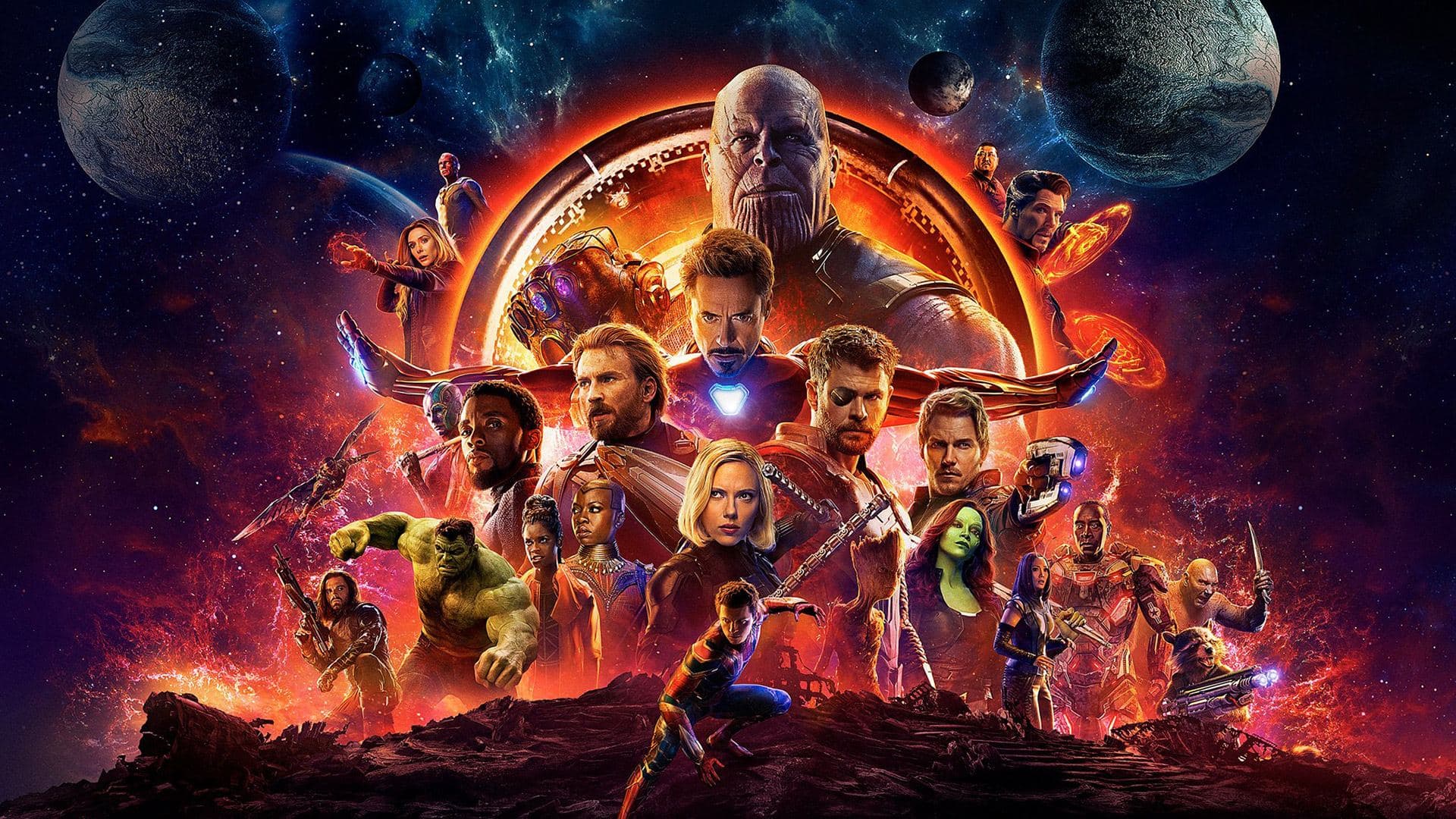
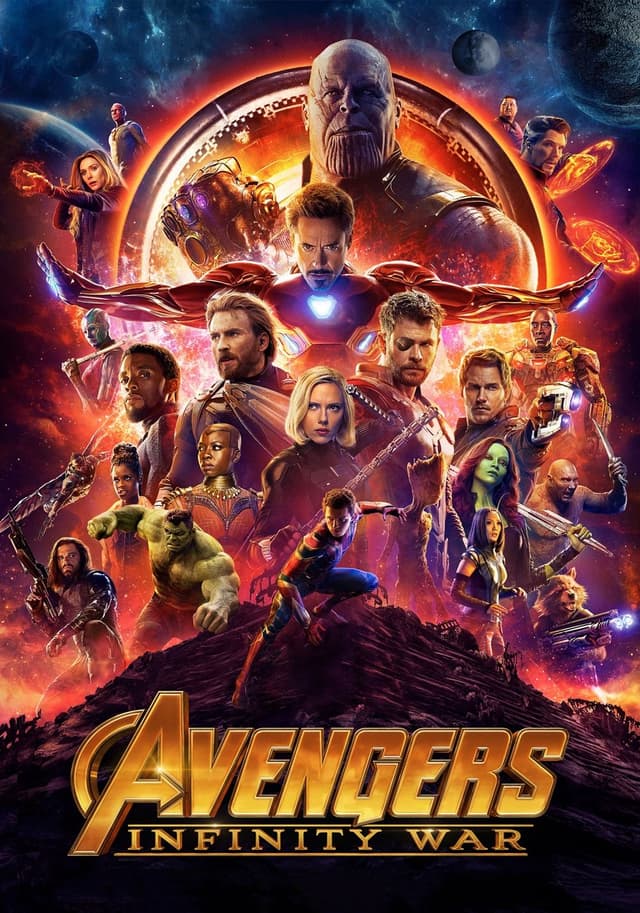
Avengers: Infinity War Budget
 AdventureActionScience Fiction2h 29m
Updated
Synopsis
Thanos, a warlord from Titan, sets out to collect all six Infinity Stones so he can erase half of all life in the universe. With the Avengers still divided, Iron Man, Thor, Captain America and their allies join forces with the Guardians of the Galaxy, Doctor Strange, Spider-Man and the armies of Wakanda to stop him before he completes the set.
What Is the Budget of Avengers: Infinity War (2018)?
Avengers: Infinity War had an estimated production budget of $325,000,000. That is the production cost used in Deadline Hollywood's 2019 profit analysis of the film, which put Disney's combined spend on production and worldwide prints and advertising at $475,000,000. Marvel Studios produced the film and Walt Disney Studios Motion Pictures released it, with Anthony and Joe Russo directing from a screenplay by Christopher Markus and Stephen McFeely. It was shot back-to-back with Avengers: Endgame (2019) at Pinewood Atlanta Studios in Fayette County, Georgia.
Disney has never published a final cost, so the published estimates span a wide band. Variety reported on the film's record opening weekend that it cost between $300,000,000 and $400,000,000. The Numbers lists $300,000,000, Box Office Mojo lists $350,000,000, and Wikipedia gives $325,000,000 to $400,000,000, citing Deadline for the low end and Variety for the high end. None of these sources says whether its figure is measured before or after Georgia's film tax credit, which is worth up to 30% of qualified in-state spend, so the spread reflects uncertainty about the total rather than a known gross and net.
The closest thing to a primary document is the British accounts of Assembled Productions III, the Disney company set up to make the film. Forbes reported in April 2018 that its financial statements for the 15 months to June 30, 2017 showed $321,200,000 spent, and stated that the estimated final cost was in line with the budgeted cost. That snapshot was taken while principal photography was still underway and before post-production was complete, so it is best read as a floor rather than a final cost.
Key Budget Allocation Categories
Infinity War's budget went into an ensemble cast of established stars and an effects workload built around a fully digital villain:
- Cast: The poster bills 19 actors, from Robert Downey Jr., Chris Hemsworth and Chris Evans to Chadwick Boseman, Tom Holland and Josh Brolin. The Hollywood Reporter reported that Evans and Hemsworth each earned $15,000,000 for the film, the same fee Evans had received for Captain America: Civil War (2016) and Hemsworth for Thor: Ragnarok (2017). With leads at that level and a deep bench of returning Marvel stars behind them, cast fees were a major cost line.
- Visual Effects: Ten vendors delivered the effects: Industrial Light & Magic, Framestore, Method Studios, Weta Digital, DNEG, Cinesite, Digital Domain, Rise, Lola VFX and Perception. Thanos alone was split between two houses. Digital Domain produced more than 400 shots of the character, while Weta Digital handled the battle on Titan with about 200 Thanos shots and 250 other effects shots. Framestore delivered 253 shots for the New York fight, including a fully digital Washington Square Park.
- IMAX Digital Capture: Infinity War and Endgame were shot with ARRI Alexa IMAX 2D cameras under cinematographer Trent Opaloch, making them the first Hollywood features shot entirely with IMAX digital cameras. The format paid off in premium screens: the film earned about $140,000,000 worldwide from IMAX, at the time the largest IMAX total for a Marvel film.
- Back-to-Back Production: Infinity War filmed from January 23 to July 14, 2017, and Endgame followed on the same stages from August 10, 2017 to January 11, 2018. Sharing sets, crew and cast schedules spread some fixed costs across both films, but it also kept a blockbuster-scale operation running for a full year, and it makes any single-film budget an allocation rather than a clean number.
- Locations: Beyond the Georgia stages, the production filmed in Scotland, in Edinburgh, Glasgow and the Scottish Highlands, with stage work at Wardpark Studios in Cumbernauld, and on location in downtown Atlanta and in Queens, New York. The closing shot of the Banaue Rice Terraces in Ifugao, Philippines, used footage acquired through Thailand-based Indochina Productions rather than a location unit.
How Does Avengers: Infinity War's Budget Compare to Similar Films?
At $325,000,000, Infinity War sits in the same cost tier as the other Avengers team-ups. Set against Marvel's own tentpoles, it shows how the 2018 film turned a decade of buildup into box office:
- Avengers: Endgame (2019): Budget $356,000,000 | Worldwide $2,799,439,100 (original release). Shot back-to-back with Infinity War on the same stages, Endgame carried a similar budget and grossed more in its original 2019 run, the payoff of the cliffhanger Infinity War set up. Its 2026 Encore re-release has since added more than $140,000,000 to that total.
- Avengers: Age of Ultron (2015): Budget $365,000,000 | Worldwide $1,405,018,048. Age of Ultron is the Avengers film whose cost is on record both ways: FilmL.A. reported $444,000,000 before UK incentives and $365,000,000 after them. Infinity War cost about the same and grossed $647,396,991 more.
- The Avengers (2012): Budget $220,000,000 | Worldwide $1,520,538,536. The first team-up cost about two thirds of Infinity War's budget. Six years and 12 more Marvel films later, Infinity War grossed $531,876,503 more.
- Black Panther (2018): Budget $200,000,000 | Worldwide $1,349,926,083. Released ten weeks earlier, Black Panther introduced the Wakanda that hosts Infinity War's final battle. It returned more per production dollar: about 6.75 times its budget, against about 6.3 times for Infinity War.
Avengers: Infinity War Box Office Performance
Avengers: Infinity War premiered at the Dolby Theatre in Hollywood on April 23, 2018, and Disney released it in the United States on April 27, a week ahead of its original May 4 date, in 4,474 theaters, then the widest release for a Disney title. It took $106,700,000 on its first day, including $39,000,000 from Thursday previews, and opened to $257,698,183 in the United States and Canada, a record at the time. Its $640,500,000 worldwide opening was the largest on record at the time, ahead of The Fate of the Furious (2017) at $541,900,000.
Deadline Hollywood estimated that Disney spent about $150,000,000 on worldwide prints and advertising, bringing production and marketing to a total investment of roughly $475,000,000.
Box Office Breakdown
Avengers: Infinity War

The film finished with $678,815,482 in the United States and Canada and $1,373,599,557 internationally, so about two thirds of its gross came from outside North America. China was its largest overseas market at $359,543,153, followed by the United Kingdom at $96,640,433. It reached $1,000,000,000 worldwide in 11 days, a record at the time, passed $2,000,000,000 on June 12, 2018 as only the fourth film to do so, and finished as the highest-grossing film of 2018. Deadline's profit analysis, which adds home entertainment and television revenue and subtracts talent participations and other costs, put Disney's net profit at about $500,000,000 and ranked the film first in its 2018 Most Valuable Blockbuster tournament.
At 332%, "Avengers: Infinity War" earned roughly $4.32 for every $1 invested.
Avengers: Infinity War Production History
Marvel Studios announced a two-part Avengers sequel in October 2014 as Avengers: Infinity War Part 1 and Part 2, dated May 4, 2018 and May 3, 2019. Anthony and Joe Russo, who had directed Captain America: The Winter Soldier (2014) and Captain America: Civil War (2016), signed on to direct both films in April 2015, and Christopher Markus and Stephen McFeely joined to write them a month later, drawing on Jim Starlin's 1991 comic The Infinity Gauntlet and Jonathan Hickman's 2013 Infinity. In May 2016 the Russos decided to drop the two-part framing so the first film would not read as half a story, and that July Marvel shortened the title to Avengers: Infinity War.
Principal photography began on January 23, 2017, at Pinewood Atlanta Studios under the working title Mary Lou, a nod to gymnast Mary Lou Retton because the production wanted to stick the landing on the Infinity Saga. Filming in Scotland began on February 28, and from March 18 to April 21 the unit worked through Edinburgh's Old Town, including the Royal Mile and Waverley Station, for the ambush on Wanda Maximoff and Vision. Late June and early July brought shoots in downtown Atlanta and Atlanta's Central Park before the unit moved to Queens in mid-July, and filming concluded on July 14, 2017.
The scale invited inflated claims. In March 2017, Pinewood Atlanta co-owner Dan T. Cathy described the two films as the largest film production ever, with a combined $1,000,000,000 budget, a figure Kevin Feige said was false.
The central technical challenge was Thanos, because so much of the film rests on a fully digital character. Before filming, Josh Brolin's facial expressions were captured with ILM's Medusa system. Digital Domain combined that data with his on-set motion capture in Masquerade, a machine learning facial capture tool it spent three to four months building before cameras rolled, to produce a higher-resolution version of Brolin's performance for its animators. Weta Digital built its own version of the character for the Titan battle, using tools developed for the Planet of the Apes films. The work won the Visual Effects Society's award for Outstanding Animated Character in a Photoreal Feature.
Awards and Recognition
Avengers: Infinity War received one Academy Award nomination, for Best Visual Effects at the 91st Academy Awards, recognizing Dan DeLeeuw, Kelly Port, Russell Earl and Dan Sudick. The same team was nominated for Best Special Visual Effects at the 72nd British Academy Film Awards. The film also earned two Critics' Choice nominations, for Best Action Movie and Best Visual Effects, a Screen Actors Guild nomination for its stunt ensemble, and an Annie Award nomination for character animation in a live action production.
Most of its wins came from the effects community and from audience-voted ceremonies. At the 17th Visual Effects Society Awards it won four of its six nominations, including Outstanding Visual Effects in a Photoreal Feature and the animated character award for Thanos, and Josh Brolin won the Saturn Award for Best Supporting Actor, with critics' groups in Austin and Washington, D.C. also honoring his motion capture performance. It was named Movie of 2018 and Action Movie of 2018 at the People's Choice Awards, won Choice Action Movie at the Teen Choice Awards, and took Favorite Movie at the 2019 Kids' Choice Awards. In all it collected 22 wins from 78 nominations, and a 2020 Empire magazine poll ranked it seventh among the greatest films of the 21st century.
Critical Reception
Avengers: Infinity War holds an 85% approval rating on Rotten Tomatoes from 486 reviews, with an average score of 7.7 out of 10, and is Certified Fresh. Metacritic assigns it 68 out of 100 based on 54 critics, indicating generally favorable reviews. Audiences polled by CinemaScore gave it an A on an A+ to F scale, and PostTrak reported an 87% positive score.
Critics singled out Josh Brolin. Todd McCarthy of The Hollywood Reporter wrote that Brolin's reading of Thanos gave the character "an unexpectedly resonant emotional dimension," and Variety's Owen Gleiberman called the motion capture performance "supremely effective" while describing the film as "a brashly entertaining jamboree." Richard Roeper of the Chicago Sun-Times called it Marvel's "biggest and most ambitious movie yet" but concluded that it was not the studio's best.
The main objection was that the film depends on everything that came before it. A. O. Scott of The New York Times wrote that, considered on its own, it "makes very little sense," and Time's Stephanie Zacharek said viewers needed to have seen all 18 previous Marvel Cinematic Universe films to fully follow it. Peter Travers of Rolling Stone captured both reactions at once, writing that it leaves viewers "feeling exhilarated and cheated at the same time."
Frequently Asked Questions
How much did it cost to make Avengers: Infinity War?
Avengers: Infinity War had an estimated production budget of $325,000,000, according to Deadline Hollywood's 2019 profit analysis, which put Disney's combined spend on production and worldwide marketing at $475,000,000. Published estimates range from $300,000,000 to $400,000,000, the band Variety reported at release. UK filings for the film's production company showed $321,200,000 spent by June 30, 2017, before filming had finished. Disney spent about $150,000,000 more on prints and advertising.
How much did Avengers: Infinity War earn at the box office?
Avengers: Infinity War earned $678,815,482 in the United States and Canada and $1,373,599,557 internationally, for a worldwide total of $2,052,415,039. It opened to a then-record $257,698,183 domestically and $640,500,000 worldwide, and China was its largest overseas market at $359,543,153.
Was Avengers: Infinity War profitable?
Yes. Against a production budget of about $325,000,000 and about $150,000,000 in prints and advertising, a total investment of roughly $475,000,000, the film grossed $2,052,415,039 worldwide. Deadline Hollywood estimated Disney's net profit at about $500,000,000 after adding home entertainment and television revenue and subtracting talent participations and other costs, ranking it first among 2018's most valuable blockbusters.
What were the biggest costs in producing Avengers: Infinity War?
The biggest known cost drivers were cast fees and visual effects. The Hollywood Reporter reported that Chris Evans and Chris Hemsworth each earned $15,000,000, in a cast of 19 billed stars led by Robert Downey Jr. Ten effects vendors worked on the film, with Digital Domain producing more than 400 shots of Thanos and Weta Digital about 450 shots for the battle on Titan. The film was also shot entirely on ARRI Alexa IMAX 2D cameras, and its back-to-back production with Avengers: Endgame kept a blockbuster-scale operation running from January 2017 to January 2018.
How does Avengers: Infinity War's budget compare to similar films?
At about $325,000,000, Infinity War sits alongside Avengers: Endgame (2019) at $356,000,000 and Avengers: Age of Ultron (2015) at $365,000,000 after UK incentives, and well above The Avengers (2012) at $220,000,000 and Black Panther (2018) at $200,000,000. Its $2,052,415,039 worldwide gross was larger than that of either earlier Avengers film.
Did Avengers: Infinity War go over budget?
There is no public report that it did. Forbes reported in April 2018 that the UK accounts of Assembled Productions III, the Disney company behind the film, stated that at June 30, 2017 the estimated final cost was in line with the budgeted cost. Kevin Feige also rejected a 2017 claim that Infinity War and its sequel shared a combined $1,000,000,000 budget.
What was the ROI of Avengers: Infinity War?
Measured against a total estimated investment of about $475,000,000, a $325,000,000 production budget plus about $150,000,000 in prints and advertising, the $2,052,415,039 worldwide gross produced a net return of about $1,577,415,039 and an ROI of approximately 332%, or roughly $4.32 for every $1 invested. That covers theatrical gross only; home entertainment, television and streaming revenue came on top of it.
What awards did Avengers: Infinity War win?
It received one Academy Award nomination, for Best Visual Effects at the 91st Academy Awards, and did not win. It won four Visual Effects Society Awards, including Outstanding Animated Character in a Photoreal Feature for Thanos, and Josh Brolin won the Saturn Award for Best Supporting Actor. Audience-voted wins included Movie of 2018 at the People's Choice Awards and Choice Action Movie at the Teen Choice Awards. In total it won 22 awards from 78 nominations.
Who directed Avengers: Infinity War?
Anthony and Joe Russo directed Avengers: Infinity War from a screenplay by Christopher Markus and Stephen McFeely, with Kevin Feige producing. The brothers had previously directed Captain America: The Winter Soldier (2014) and Captain America: Civil War (2016) for Marvel Studios, and they directed Avengers: Endgame (2019) back-to-back with it.
Where was Avengers: Infinity War filmed?
Principal photography took place mainly at Pinewood Atlanta Studios in Fayette County, Georgia, from January 23 to July 14, 2017. Location work included Scotland, with Edinburgh's Old Town, Glasgow and the Scottish Highlands and stage work at Wardpark Studios in Cumbernauld, along with downtown Atlanta and Queens, New York. The final shot of the Banaue Rice Terraces in the Philippines used acquired footage rather than a location shoot.
Filmmakers
Avengers: Infinity War

Official Trailer
Build budgets like this one in Saturation
Start from an industry-standard feature film template, import the schedule and rates you already have, and let the cost report keep itself current as you spend. Real-time collaboration, no spreadsheets.