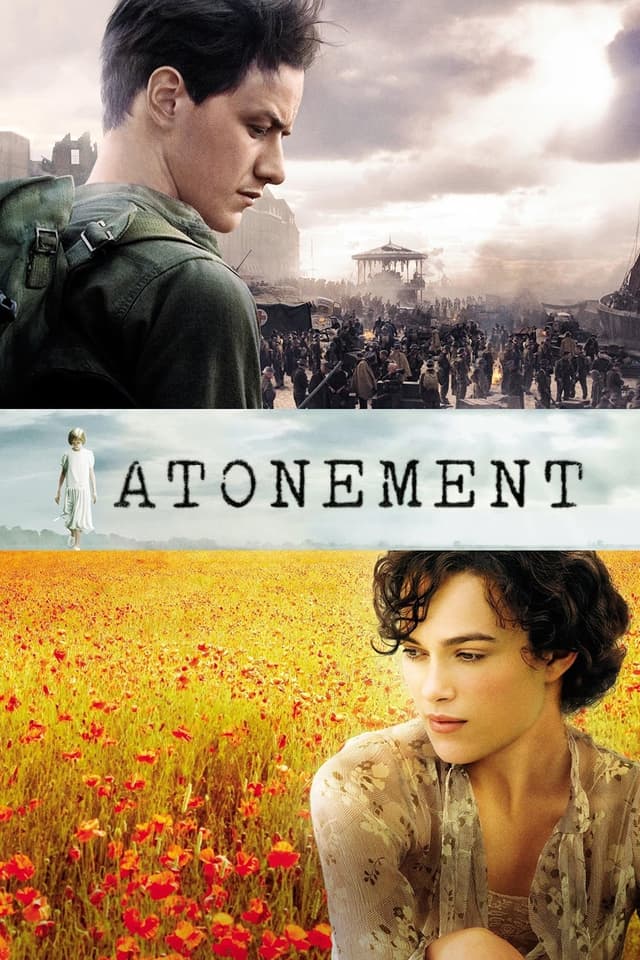
Atonement Budget
 DramaRomance2h 3m
Updated
Synopsis
In 1935 England, thirteen-year-old fledgling writer Briony Tallis misinterprets a moment between her older sister Cecilia and Robbie Turner, the housekeeper's son, and tells a lie that will alter the course of all three lives. As World War II overtakes Europe, Cecilia and Robbie are torn apart, and an older Briony must confront the cost of her childhood imagination across decades of regret.
What Is the Budget of Atonement (2007)?
Atonement (2007), directed by Joe Wright and adapted from Ian McEwan's 2001 Booker Prize-shortlisted novel, was produced on a reported budget of $30,000,000. The film was financed by Working Title Films and StudioCanal, with Universal Pictures handling international distribution and Focus Features releasing the picture in North America. Tim Bevan, Eric Fellner, and Paul Webster produced through Working Title, the company behind Wright's breakout Pride and Prejudice (2005) and a long line of awards-targeted British prestige pictures including Elizabeth, Billy Elliot, and Eastern Promises.
That budget reflected a deliberately calibrated mid-range investment for a period adaptation of a literary property. By comparison, contemporaneous war-set prestige dramas from rival producers ran considerably hotter: The English Patient (1996) had cost $27,000,000 a decade earlier and Atonement absorbed clear inflation in costume drama production. The cost covered an A-list British cast led by Keira Knightley and James McAvoy, a multi-region UK shoot spanning Shropshire, Yorkshire, and Lincolnshire, the elaborate Dunkirk evacuation sequence shot in a single five-and-a-half-minute Steadicam take on Redcar beach, and a Dario Marianelli score recorded with the English Chamber Orchestra that would go on to win the Academy Award for Best Original Score.
Key Budget Allocation Categories
Atonement's reported $30,000,000 budget was distributed across the production areas typical of a period literary adaptation targeting both awards recognition and commercial returns:
- Above-the-Line Talent: Joe Wright came in on a feature-director rate consistent with his Pride and Prejudice follow-up positioning, while Keira Knightley returned to the Working Title fold for her second Wright collaboration after the 2005 Austen adaptation. James McAvoy, fresh off The Last King of Scotland and the BAFTA Rising Star Award, headlined opposite her. Thirteen-year-old Saoirse Ronan, then largely unknown, was cast as the young Briony Tallis, with Romola Garai and Vanessa Redgrave playing the character at later ages, an ensemble structure that required compensating three actors for a single role.
- UK Period Production: The 1935 Tallis country house sequences were filmed at Stokesay Court in Shropshire, which the production dressed extensively to match the novel's Surrey estate. Period costume work by Jacqueline Durran covered hundreds of looks across the 1935, 1940, and 1999 timelines, including Knightley's emerald-green silk evening gown, a costume the Costume Designers Guild later named one of the best film costumes of all time.
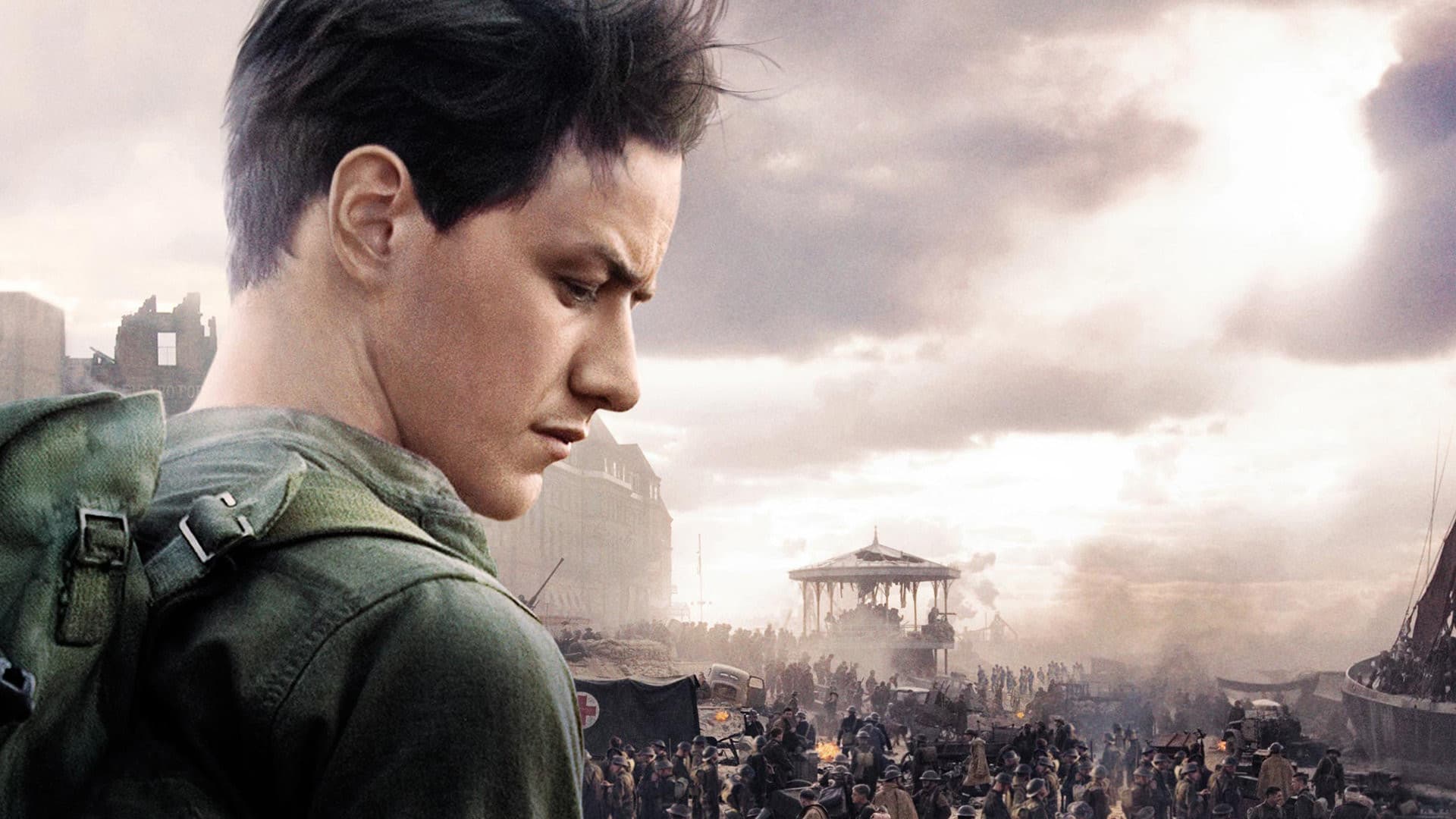
- Dunkirk Beach Sequence: The film's signature five-and-a-half-minute Steadicam shot of the Dunkirk evacuation was filmed on Redcar seafront in North Yorkshire with roughly 1,000 extras, period military vehicles, a Ferris wheel, working bandstand, and a beached vessel. Wright and cinematographer Seamus McGarvey rehearsed for a full week and shot the sequence in only two days, capturing five takes total, with the third take used in the final film. The compressed schedule, the scale of the crowd work, and the technical demands of a continuous Steadicam move across roughly a quarter mile of beach concentrated significant cost into a single production block.
- London and Hospital Locations: The St Thomas' Hospital nurse training sequences were shot on practical hospital wards and dressed period interiors, and the Balham tube station bombing was staged at the disused Aldwych Underground station, a frequent stand-in for wartime London. Grimsby Docks doubled for the embarkation port. Each location required period dressing, removal of modern signage, and union-rate London crew.
- Original Score: Italian composer Dario Marianelli reunited with Wright after Pride and Prejudice to score the film, incorporating diegetic typewriter rhythms into the orchestral cues, a conceit that anchored the picture's framing device of Briony's typed manuscript. The score was recorded with the English Chamber Orchestra and featured French pianist Jean-Yves Thibaudet, both line items that scaled the music budget well above what a standard mid-budget UK production would carry.
- Editing and Post-Production: Editor Paul Tothill assembled the film's nonlinear structure, intercutting the 1935 country house, 1940 Dunkirk and London hospital, and 1999 BBC interview timelines. Period grading, ADR for the Dunkirk crowd ambience, and final mix at Soho post houses added meaningful post-production cost beyond the principal photography line.
- Visual Effects and Practical Augments: Modest digital work extended the Dunkirk crowd in wide masters, added smoke and aerial elements, and enhanced the wartime London skyline. Most of the effect of the long take was achieved practically with extras, real vehicles, and live action, but matte extensions, sky replacements, and a handful of full CG inserts brought scale to several sequences.
How Does Atonement's Budget Compare to Similar Films?
At $30,000,000, Atonement sat firmly in the middle of the prestige literary-adaptation budget bracket of the mid-2000s. The comparison set illustrates how the film performed against its peers in cost, reach, and awards traction:
- Pride and Prejudice (2005): Budget $28,000,000 | Worldwide $121,147,947. Joe Wright's feature debut for Working Title with Knightley landed almost exactly on Atonement's commercial footprint, suggesting the director-star pairing had a reliable global audience around the $120,000,000 to $130,000,000 mark.
- The English Patient (1996): Budget $27,000,000 | Worldwide $231,976,425. Anthony Minghella's WWII-era literary adaptation cost slightly less than Atonement in nominal terms but earned almost twice as much worldwide, an outcome shaped by a wider 1996 theatrical window and a longer Oscar-driven release runway.
- The Pianist (2002): Budget $35,000,000 | Worldwide $120,072,577. Roman Polanski's WWII memoir adaptation cost slightly more than Atonement, earned within a few million of its worldwide gross, and converted its awards momentum into three Oscars (Best Director, Adapted Screenplay, Actor), one more than Atonement's eventual single win.
- Darkest Hour (2017): Budget $30,000,000 | Worldwide $150,837,030. Joe Wright's later Churchill drama matched Atonement's budget almost dollar-for-dollar and out-earned it by roughly $20,000,000, with Gary Oldman taking the Best Actor Oscar to give Wright his most decorated film by win count.
- The King's Speech (2010): Budget $15,000,000 | Worldwide $427,407,107. Tom Hooper's royal-stutterer drama spent half what Atonement did and earned more than three times its worldwide gross, demonstrating how a smaller British prestige picture can dramatically over-index when Oscar momentum carries it past the holiday release window.
- The Imitation Game (2014): Budget $14,000,000 | Worldwide $233,555,708. The Benedict Cumberbatch Alan Turing biopic ran on less than half Atonement's budget and out-grossed it by more than $100,000,000, another data point in the pattern of Working Title-adjacent British prestige films earning outsized returns on tight budgets.
Atonement Box Office Performance
Atonement opened in the United Kingdom on September 7, 2007 following its world premiere as the opening film of the 64th Venice Film Festival on August 29. The US release rolled out platform-style beginning December 7, 2007 in four theaters, where it grossed $784,145 for a per-screen average of $196,036, one of the strongest limited-release per-screen openings of the year. The picture expanded nationwide on January 11, 2008 once Golden Globe and Oscar nominations were in hand.
Against a reported $30,000,000 production budget, the film needed roughly $75,000,000 to $90,000,000 in worldwide gross to clear marketing, prints, and distribution costs. The full financial breakdown was:
Box Office Breakdown
Atonement

Atonement returned approximately $2.18 in theatrical revenue for every $1 invested when measured against total estimated production and marketing spend, a strongly profitable result for a literary period drama. The domestic share of the worldwide gross was $50,927,067 against an international share of $80,092,812, a 39/61 split heavily weighted toward Europe and the United Kingdom where the source novel and the period subject matter had natural traction.
The picture's commercial outcome cemented Working Title's prestige model: a tight UK budget, a Knightley-anchored cast, awards-window release, and a holiday platform expansion. The studio applied the same template to subsequent productions including Anna Karenina (2012) and would later return to the Joe Wright partnership for both Anna Karenina and Darkest Hour.
Atonement Production History
Working Title acquired the film rights to Ian McEwan's novel shortly after its 2001 publication and Booker Prize shortlisting. Playwright Christopher Hampton, who had previously adapted Dangerous Liaisons, came aboard to write the screenplay, and Richard Eyre was initially attached to direct before scheduling conflicts moved him off the project. Joe Wright was approached in 2005 on the back of Pride and Prejudice, and he agreed to the assignment on the condition that Hampton revise the script to preserve the novel's metafictional final twist intact, the revelation that the older Briony has written a redemptive version of events.
Casting Keira Knightley as Cecilia Tallis reunited her with Wright two years after Pride and Prejudice. James McAvoy was cast as Robbie Turner ahead of his star-making turn in The Last King of Scotland reaching wide release. The most consequential casting decision was the search for the young Briony: Wright met with several established child actresses before agreeing to test Saoirse Ronan on the recommendation of casting director Jina Jay. Then twelve years old, Ronan booked the role after a single audition and would receive her first Academy Award nomination for the performance.
Principal photography ran across the summer of 2006 entirely in the United Kingdom. The 1935 Tallis estate sequences were filmed at Stokesay Court in Shropshire over six weeks, with the production dressing the country house extensively to match the novel's pre-war Surrey setting. Costume designer Jacqueline Durran built hundreds of period looks for the ensemble, including the emerald-green silk dress Knightley wears in the library scene, a single piece that has since become one of the most-referenced costume choices of 21st-century cinema.
The Dunkirk evacuation sequence was filmed on Redcar seafront in North Yorkshire over two days in August 2006. Wright and cinematographer Seamus McGarvey designed the now-famous five-and-a-half-minute single-take Steadicam shot to follow McAvoy's Robbie through the chaos of the beach as he searches for his unit, passing roughly 1,000 extras, period vehicles, a working bandstand, a beached cargo ship, abandoned horses being put down, and a Ferris wheel that had been built specifically for the shot. The production rehearsed for a full week before rolling, captured five takes, and used the third in the final film. Wright has cited time pressure and limited extras availability as the reason for adopting the single-take approach, a constraint that ultimately produced the film's defining set piece.
Additional London sequences were filmed at St Thomas' Hospital, the disused Aldwych Underground station (doubling for the Balham bombing), and Grimsby Docks (doubling for the Dunkirk embarkation port). Editor Paul Tothill assembled the picture's nonlinear structure across the 1935, 1940, and 1999 timelines through autumn 2006 and early 2007, while Dario Marianelli composed and recorded the score with the English Chamber Orchestra and French pianist Jean-Yves Thibaudet, incorporating the diegetic clatter of Briony's typewriter as a rhythmic motif that crosses between sound design and music.
Awards and Recognition
Atonement received seven Academy Award nominations at the 80th Oscars in 2008, including Best Picture, Best Supporting Actress for Saoirse Ronan, Best Adapted Screenplay for Christopher Hampton, Best Cinematography for Seamus McGarvey, Best Art Direction, and Best Costume Design. The film converted one nomination into a win: Dario Marianelli took Best Original Score for his typewriter-led composition. Ronan's nomination was her first of four to date and the entry point of one of the most decorated careers of her generation.
At the 65th Golden Globe Awards the film won two of its seven nominations, taking Best Motion Picture (Drama) and Best Original Score. At the 61st BAFTAs the film led the field with fourteen nominations, the most of any picture that year, and won Best Film and Best Production Design. It also took Best Film at the Venice Film Festival's opening selection slot and won the Empire Award for Best British Film. Saoirse Ronan won the Critics' Choice Award for Best Young Performer, and the picture appeared on more than fifty critics' top-ten lists for 2007.
Critical Reception
Atonement received broad critical acclaim. The film holds an 83% approval rating on Rotten Tomatoes based on 217 critic reviews, with a critical consensus that praised it as a faithful, emotionally resonant adaptation. On Metacritic, the film scored 85 out of 100, signalling "universal acclaim." Roger Ebert awarded the film four stars and named it one of the year's best, writing that the picture "achieves what Truffaut once said was impossible: a movie that depicts both the experience of memory and the act of writing." A. O. Scott in The New York Times called the Dunkirk sequence "a virtuoso passage of filmmaking that recalls the great long takes of Welles, Kalatozov, and Cuaron."
Critics praised Seamus McGarvey's cinematography, particularly the Dunkirk single take, alongside Dario Marianelli's typewriter-anchored score and Jacqueline Durran's costume work. Knightley and McAvoy's chemistry drew strong notices, but the breakout performance was the thirteen-year-old Saoirse Ronan, whose closed, watchful Briony anchored the film's moral architecture and announced a career that would later include Brooklyn, Lady Bird, and Little Women. Audience response held similarly strong: the picture played for sixteen weeks in US theatres and outperformed industry projections by a wide margin during its January 2008 wide expansion, sustained by positive word of mouth from holiday-season prestige audiences.
Frequently Asked Questions
How much did it cost to make Atonement (2007)?
The reported production budget was $30,000,000. The film was financed by Working Title Films and StudioCanal, with Universal Pictures handling international distribution and Focus Features releasing the picture theatrically in North America. Tim Bevan, Eric Fellner, and Paul Webster produced.
How much did Atonement earn at the box office?
The film grossed $50,927,067 domestically and $80,092,812 internationally, for a worldwide total of $131,019,879. Its US platform release opened to $784,145 in four theaters on December 7, 2007, a per-screen average of $196,036, before expanding nationwide on January 11, 2008 in the wake of its Golden Globe and Oscar nominations.
Was Atonement profitable?
Yes. Against a $30,000,000 production budget and an estimated $25,000,000 to $30,000,000 in prints and advertising, the film returned approximately $2.18 in worldwide gross for every $1 invested. It cleared roughly $71,000,000 in net return on its total estimated investment.
Who directed Atonement?
Joe Wright directed the film, his second feature after Pride and Prejudice (2005). Wright agreed to the assignment on the condition that screenwriter Christopher Hampton preserve the novel's metafictional final twist intact. He would later reunite with Working Title on Anna Karenina (2012) and Darkest Hour (2017).
Where was Atonement filmed?
Principal photography took place entirely in the United Kingdom during the summer of 2006. The 1935 Tallis estate sequences were shot at Stokesay Court in Shropshire over six weeks. The Dunkirk evacuation was filmed on Redcar seafront in North Yorkshire across two days in August 2006. London hospital scenes were shot at St Thomas' Hospital, the Balham bombing at the disused Aldwych Underground station, and the embarkation port at Grimsby Docks.
How was the Dunkirk one-shot scene filmed?
The five-and-a-half-minute Steadicam shot follows James McAvoy across roughly a quarter mile of Redcar beach, passing roughly 1,000 extras, period military vehicles, a working bandstand, a beached cargo ship, and a purpose-built Ferris wheel. Director Joe Wright and cinematographer Seamus McGarvey rehearsed for a full week and shot the sequence in only two days, capturing five takes total. The third take was used in the final film.
How many Oscars did Atonement win?
Atonement received seven Academy Award nominations at the 80th Oscars in 2008, including Best Picture, Best Supporting Actress for Saoirse Ronan, and Best Adapted Screenplay for Christopher Hampton. It won one Oscar: Dario Marianelli took Best Original Score for his typewriter-led composition recorded with the English Chamber Orchestra.
How old was Saoirse Ronan in Atonement?
Saoirse Ronan was thirteen years old when Atonement was filmed in 2006 and the picture was released in 2007. The role of the young Briony Tallis earned her first Academy Award nomination for Best Supporting Actress and launched a career that has since included Brooklyn, Lady Bird, and Little Women.
How does Atonement compare to other Joe Wright films?
Atonement cost roughly the same as Pride and Prejudice (2005) ($28,000,000 budget, $121,147,947 worldwide) and matched the $30,000,000 budget of Darkest Hour (2017), which earned $150,837,030 worldwide. Atonement's $131,019,879 worldwide gross sits between the two, making it the highest-earning Wright collaboration with Keira Knightley.
What did critics think of Atonement?
Atonement received broad critical acclaim, holding an 83% approval rating on Rotten Tomatoes (based on 217 critics) and a 85 out of 100 Metacritic score signalling "universal acclaim." Roger Ebert gave the film four stars and named it one of the year's best, and A. O. Scott in The New York Times called the Dunkirk sequence a "virtuoso passage of filmmaking that recalls the great long takes of Welles, Kalatozov, and Cuaron."
Filmmakers
Atonement

Official Trailer
Build budgets like this one in Saturation
Start from an industry-standard feature film template, import the schedule and rates you already have, and let the cost report keep itself current as you spend. Real-time collaboration, no spreadsheets.