
Compare Production Banking Services for Independent Film Projects
Independent films raise capital and spend it differently from studio productions. A $2M indie feature mixes pre-sales, equity, tax credit loans, and maybe a gap loan. The production needs an operating bank account for day-to-day spend, separate accounts for escrowed funds, and a banking relationship that understands how indie projects actually work. This guide compares production banking services for independent film projects, what to look for when evaluating options, and how banking choices change by budget size.
Why indie banking is different from studio banking
Studio productions have treasury infrastructure: corporate banking relationships going back decades, internal finance teams, and policies dictating which bank handles which account. An indie producer usually does not. Each project operates as a Single Purpose Entity (SPE), often formed specifically for the film. Banking for that SPE needs to stand up fast and wind down at wrap without the paperwork drill of a traditional business account.
Three additional indie-specific factors:
- Tax credit financing. Many indies borrow against future state tax credit receipts to fund production. The banking partner needs to understand and underwrite this.
- Pre-sales and gap loans. Indie finance stacks include bank debt against pre-sale contracts, sometimes bridged by gap loans.
- Split rails. Equity funds land in one account; loan proceeds in another; studio pickups might be in a third. Segregating funds by source matters for investor reporting.
What to look for in indie production banking
Speed of SPE account setup
Principal photography does not wait for a bank to onboard the LLC. Look for production-native banking that can open an account for a new SPE in 1 to 3 business days. Traditional banks often take 2 to 3 weeks for indie SPEs because they do not fit the standard business banking template.
Tax credit financing capability
If you are borrowing against state tax credits (Georgia, Louisiana, New York, New Mexico, Illinois), the bank needs an entertainment lending division that underwrites credit paper. Traditional banks that serve entertainment (City National, Comerica, First Citizens) have this. Production-native banking platforms typically do not lend directly but partner with entertainment banks for the credit piece.
Card issuance integrated with banking
Indie productions rarely have capital to sit idle. Cards should be issued from the production banking platform directly, not through a separate card program requiring extra capital or personal guarantees. See our virtual cards guide.
Investor-friendly reporting
Indie investors want transparency. Banking platforms that expose account balances, transaction feeds, and spend-to-date reports to authorized investors (read-only) reduce the monthly email cycle. Some platforms offer investor portals.
Per-show architecture
Indie production companies often run 2 to 5 projects per year, each as a separate SPE. Banking should support a parent-child structure where the production company oversees all active SPEs without re-onboarding every account.
Production banking options for indie films
Saturation
Saturation Banking opens SPE accounts in 1 to 3 business days with per-show cards, bill pay, and integrated production finance workflows. Strong fit for indie productions that want modern banking without sacrificing production-specific features. For tax credit financing, Saturation partners with entertainment banks for the credit layer.
City National Bank
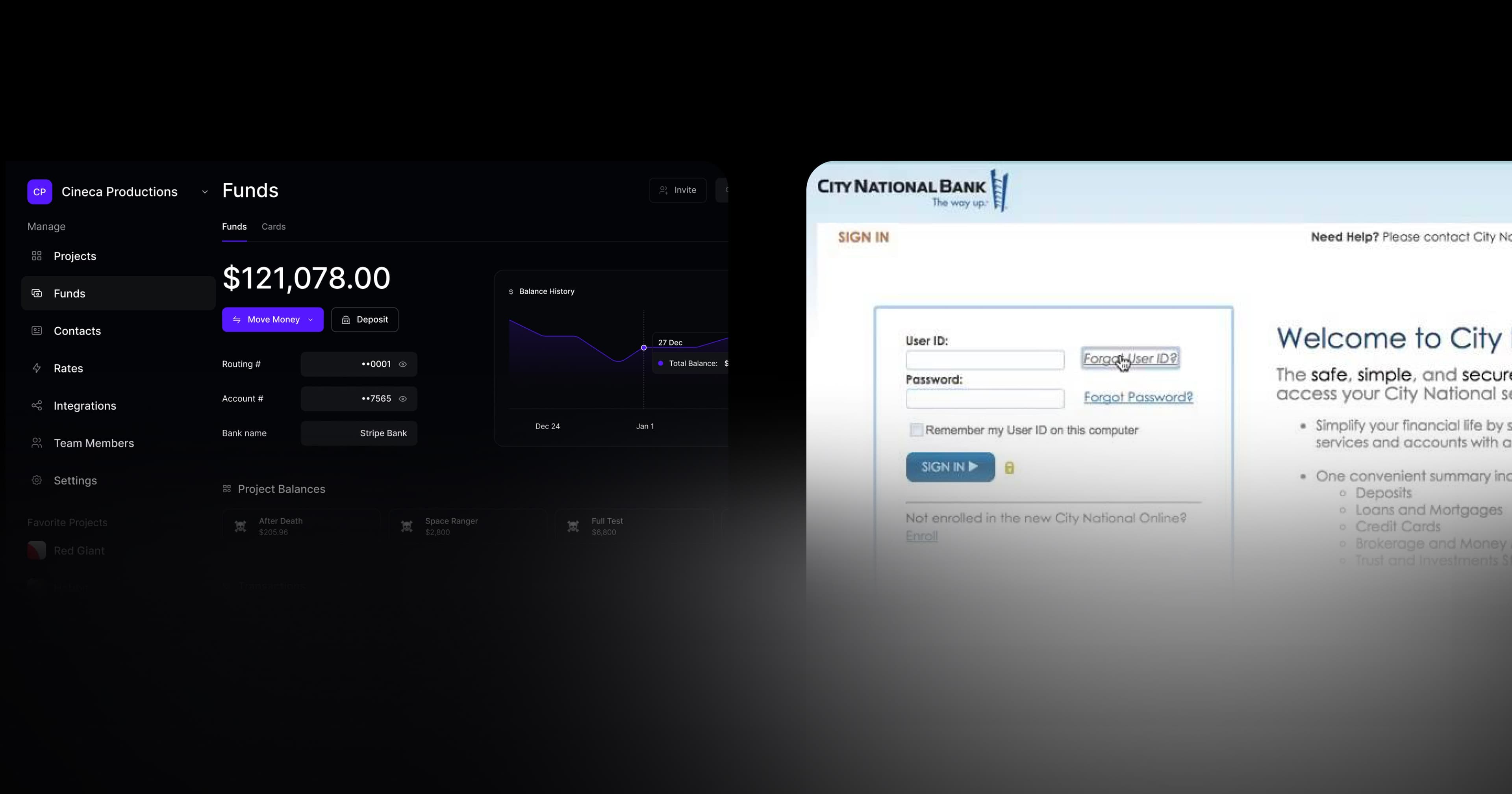
City National's entertainment division has served indie and studio productions for 70+ years. Offers tax credit loans, gap financing, and project financing. Slower to open SPE operating accounts (typical 1 to 3 weeks) but strong on the lending side. See our Saturation vs City National comparison.
Comerica Entertainment
Comerica is one of the most active traditional bank lenders in US film and TV finance. Strong on production loans and tax credit financing. Similar pros and cons as City National for indie operations: slower account setup, strong lending.
First Citizens Bank
First Citizens serves entertainment companies with lending and traditional banking. Smaller presence than City National or Comerica but growing as they acquire entertainment banking portfolios.
CineFi
CineFi is a digital credit union targeted at creators and production crews. Targets individuals and very small productions. Less suited to $1M+ indie features but useful for shorts, commercials, and crew-level banking.
General fintechs (Mercury, Rho, Brex, Ramp)
General business banking platforms offer fast onboarding and modern workflows. They do not understand production-specific structures (SPE escrow, tax credit loans, union compliance). Useful for the production company's corporate operating account, not ideal for per-project production accounts.
Banking fit by budget size
Rough framework for indie film banking by budget:
- Under $500K (shorts, commercials, small features): Saturation or a modern fintech for the operating account. No separate tax credit financing typically needed.
- $500K to $5M (indie features): Saturation or a production-native platform for operations, plus City National or Comerica for tax credit financing if claiming state credits.
- $5M to $25M (mid-range indie): Entertainment bank (City National, Comerica) for the primary banking and financing relationship, with a production finance platform layered on for workflow speed.
- $25M+ (high-end indie and studio-adjacent): Full entertainment bank relationship for all banking and lending, with production finance platforms integrated for operational workflows.
Common banking pitfalls for indie producers
- Using a personal account "just to get started." Co-mingling personal and production funds creates tax and legal problems fast. Always run through the SPE.
- Not segregating funding sources. Equity, loan proceeds, and pickup revenue should flow into separate accounts with clear documentation. Reduces investor disputes at wrap.
- Opening an account too late. A 2-week bank onboarding starting 1 week before principal means no card for prep. Start the account in development, not prep.
- Choosing the bank on financing first. A bank great at tax credit loans might be slow on day-to-day operations. Separate the lending relationship from the operating account if needed.
- Ignoring investor reporting. Equity investors want visibility. A platform that exposes transaction feeds and balances reduces the monthly email chain.
Escrow and fund segregation
Most indie financing requires some funds held in escrow. Tax credit loans often require the credit proceeds escrowed until the state issues the credit. Equity investors sometimes require escrowed reserves until key deliveries. Gap loans may have reserve requirements.
Production banking for indies should handle segregated accounts cleanly. Typical structure:
- Operating account: day-to-day spend, cards, invoices
- Tax credit escrow: holds loan proceeds earmarked for qualified spend
- Equity reserve: holds investor funds not yet committed to production
- Completion bond escrow: if the production has a bond, required reserves
Platforms that force everything into one account require manual workarounds (spreadsheet tracking of "virtual" balances). Platforms that handle multiple accounts under one SPE make this native.
Investor relations and reporting
For indie films, investor communication is ongoing throughout production. Good banking platforms support:
- Read-only investor access to balance and transaction feed
- Automated monthly investor reports with spend against budget
- Tax credit capture progress (if credit is monetized)
- Wrap reconciliation and final cost report
Platforms that require manual investor updates every month add production accountant labor. Platforms with investor portals reduce this to zero touch.
Industry context
For more on how indie financing actually works, see the SAGindie producer resources. For lender perspectives on the indie banking market, American Banker publishes regular entertainment lending coverage.
Frequently asked questions about indie production banking
Do I need a separate bank account per film project?
Yes, for SPE structures. Co-mingling funds across projects creates tax and legal complications. Each SPE should have its own operating account, tied to its LLC and EIN.
Can I use a personal bank for a small indie film?
No. Even for shorts and commercials, run through a separate business or SPE account. Personal accounts create tax filing complications, limit liability protection, and look unprofessional to vendors and crew.
How much capital do I need to open a production bank account?
Most production banking platforms require no minimum deposit. Traditional entertainment banks sometimes require minimum balances for premium relationship pricing but not for account opening.
What is tax credit financing and how does it work?
States offer tax incentives that refund or credit a percentage of qualified production spend. Banks lend against the expected credit proceeds (typically at 80 to 95 percent of face value) so productions can use the funds during production rather than waiting 6 to 18 months for the state to issue the credit.
Can indie production banking platforms fund tax credit loans?
Typically no. Production banking platforms (Saturation, CineFi) handle the operating account layer. Tax credit lending requires credit underwriting capacity that traditional entertainment banks (City National, Comerica, First Citizens) provide. Many indies use both: production banking for operations, entertainment bank for the tax credit loan.
What is a gap loan in indie film finance?
A gap loan covers the gap between the project's committed financing (pre-sales, tax credit, equity) and its total budget. Entertainment banks underwrite gap loans based on unsold distribution rights. This is a specialized product offered by a handful of entertainment lenders.
How do I choose between Saturation and a traditional entertainment bank?
Saturation is better for day-to-day operations: account setup speed, card issuance, integrated budget and bill pay, cost reporting. Traditional entertainment banks are better for financing (tax credit loans, gap loans, equipment financing). Many indies use both: Saturation for operations, an entertainment bank for lending.
Are indie production banking deposits FDIC insured?
Yes, provided the partner bank is FDIC-insured. Saturation partners with FDIC-insured banks. Confirm the partner bank name in the platform's disclosures.
Related posts
Ready to modernize your production finance?
Join thousands of production teams using Saturation to budget, track expenses, and manage payments.