Budget Template: Unscripted
Unscripted Production Budget Template: Purpose-built for reality TV, docuseries, and unscripted content. Covers hosts, field production, casting, and post-production.
What Is an Unscripted Production Budget Template?
An unscripted production budget template organizes all costs associated with producing reality television, competition series, documentary series, talk shows, game shows, and other non-fiction content formats. Unscripted production has a distinct cost structure from scripted television: no writers room, reduced above-the-line costs, larger casting and field production budgets, and significantly higher post-production costs driven by footage ratio and editorial complexity.
Unscripted budgets are notoriously difficult to estimate accurately because the production depends on what actually happens rather than a predetermined script. A competition series that delivers dramatic moments requires less heavy post; one that delivers nothing usable forces editors to construct drama from thin coverage. Building contingency into every phase of an unscripted budget reflects this fundamental unpredictability.
Unscripted Budget Categories
Development and format costs include concept development, sizzle reel production, network pitch preparation, and any format licensing fees if you are producing a version of an existing international format. Format licensing can be a significant upfront cost on competition series adapted from successful international shows.
Casting is typically a larger percentage of an unscripted budget than in scripted productions. Extensive casting processes for competition series, talent searches for reality formats, and casting producer fees all belong in the budget. Travel, accommodation, and casting facility rental for multi-city casting calls add to this line item.
Field production is the largest variable in most unscripted budgets. Multi-camera setups, extended shoot ratios, location fees, travel, accommodation, and per diems for crew and cast drive field production costs. Competition and elimination formats often shoot continuously over weeks or months, with total field production days far exceeding what a scripted drama of equivalent length would require.
Story and post production is where unscripted budgets commonly run over. Story producers who shape the narrative, editors who build episodes from thousands of hours of footage, and the systems needed to manage that footage (logging, transcription, offline editing) represent a substantial ongoing cost. Budget post production based on actual footage ratios (total hours shot versus total deliverable hours), not on a per-episode approximation.
Music licensing for unscripted is a significant ongoing cost, since non-scripted shows use music extensively in montage sequences, competition moments, and emotional beats. Budget for both per-episode music licensing and any series-wide theme music.
Unscripted Budget Ranges
Low-budget reality formats for digital platforms can run $50,000 to $200,000 per episode. Mid-tier cable unscripted series typically range from $200,000 to $600,000 per episode. Premium network and streaming competition series run $1 million to $5 million per episode. Live competition events and major network reality productions can significantly exceed these ranges.
Managing Unscripted Actuals
Unscripted productions have high variance in field production costs and post-production time, making real-time cost tracking especially valuable. Tracking actuals against your episode budget as field production progresses gives you the data to reforecast remaining episodes before variances compound. Use Saturation to monitor unscripted production costs across all departments throughout the production period.
Ready to get started? Explore Saturation's film budgeting software to manage actuals alongside this template, or read our guide to creating a film budget for a step-by-step walkthrough. Saturation cardholders also unlock exclusive production perks on software and services used every day on set.
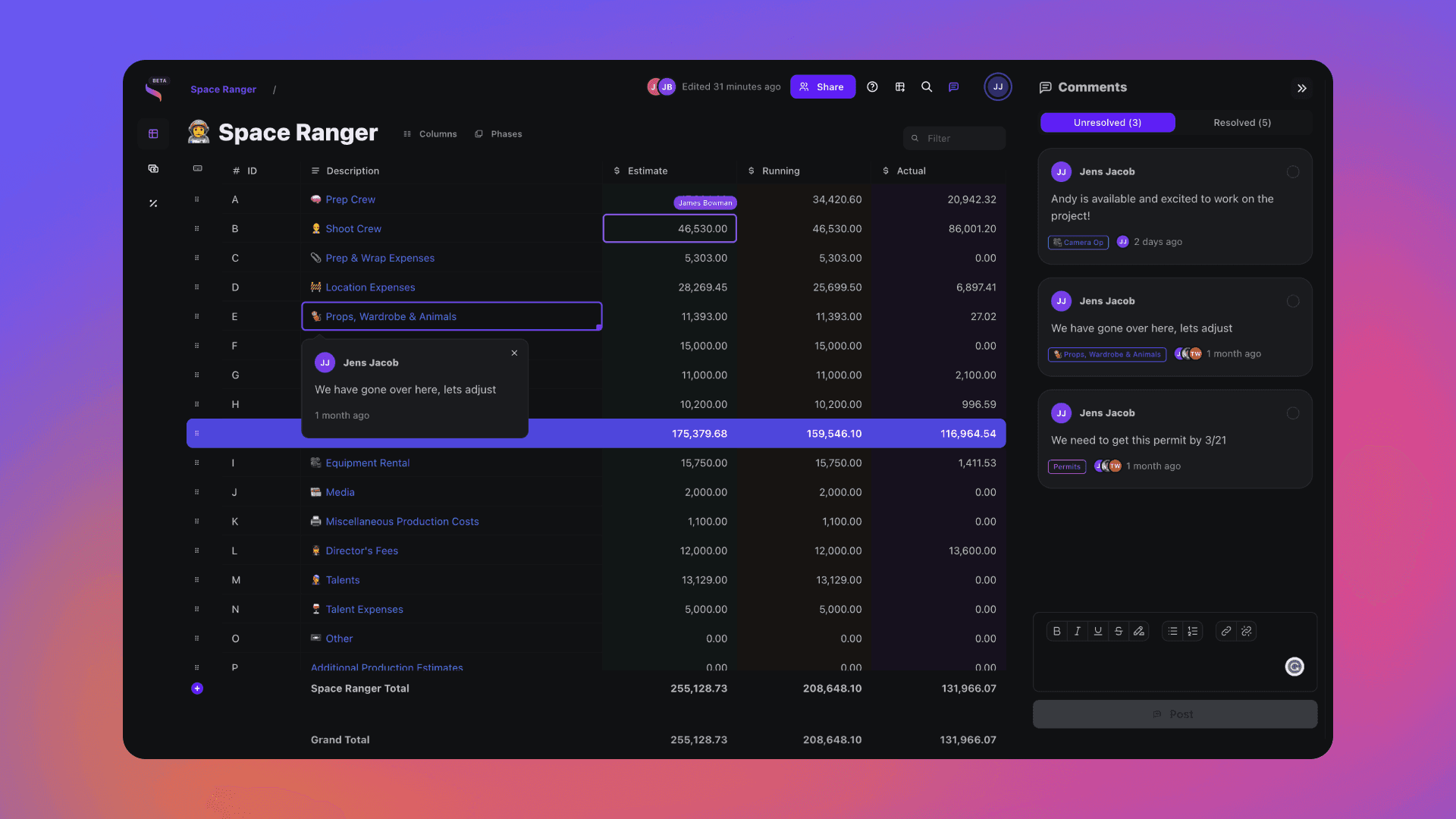
Open this template in Saturation
Every template lands in a live budget: auto-fill the line items, set your phases and rate packs, and let fringes and reports follow the numbers.
Budget Engine 2.0
Your budget, your cost report and every export run on one engine.
Auto-fill
Rates fill in as you type, from the source you turned on.
PhasesRebuilt
Every column knows its type.
Reports
Drag blocks onto the page and split a row in two.
Rate packs
Verified union rates, versioned.


Fringes and markupsRebuilt
Stack them, cap them, and see the split on every line.