Budget Template: TV Series Budget Template (2026)
TV series budget template with pilot, pattern, and series-level budgeting. Covers recurring crew, union scale, per-episode cost modeling, and deliverables.
TV Series Budget Template: Episode-Level Budgeting for Scripted Television
Budgeting a TV series is structurally different from budgeting a film. You are not building one budget; you are building three: a pilot budget that captures the additional costs of the first episode, a pattern budget that sets the average cost per episode for the series, and a series budget that aggregates both across your full order. Most general film budget templates cannot do this. The Saturation TV series template is built around the episodic structure from the start.
What the TV Series Budget Template Covers
Pilot Budget
The pilot carries costs the rest of the series does not: set construction and dressing that recurs throughout the run, casting fees above scale for principal series cast, and additional development and pre-production time. The pilot template section separates these one-time costs from the recurring per-episode costs so your network or streamer can clearly see both.
Pattern Budget (Per-Episode)
- Above-the-line: showrunner, executive producers, episode writers, episode directors, series regular cast
- Production staff and department heads (recurring throughout the series)
- Camera, lighting, grip, sound: equipment and crew at contract rates
- Art department: standing sets vs. built sets vs. practical locations per episode
- Visual effects: episode-level VFX budget with series contingency
- Post-production: editorial, color, sound, music per episode
- Insurance, legal, and completion guaranty costs prorated across the series
Series-Level Costs
- Network and streamer deliverables: technical specifications vary by platform
- Cast and crew travel for location episodes
- Publicity and unit photography
- Series contingency: typically 10% of the total series budget
Union Scale and Fringe
Scripted TV runs under guild agreements: WGA for writers, DGA for directors, SAG-AFTRA for performers, IATSE for below-the-line crew. The TV series template includes fringe fields for all applicable guild contributions, including health and pension rates that differ from feature film rates under most collective bargaining agreements. Getting the fringe wrong on a 10-episode series at network scale is a budget error in the hundreds of thousands of dollars.
How It Works in Saturation
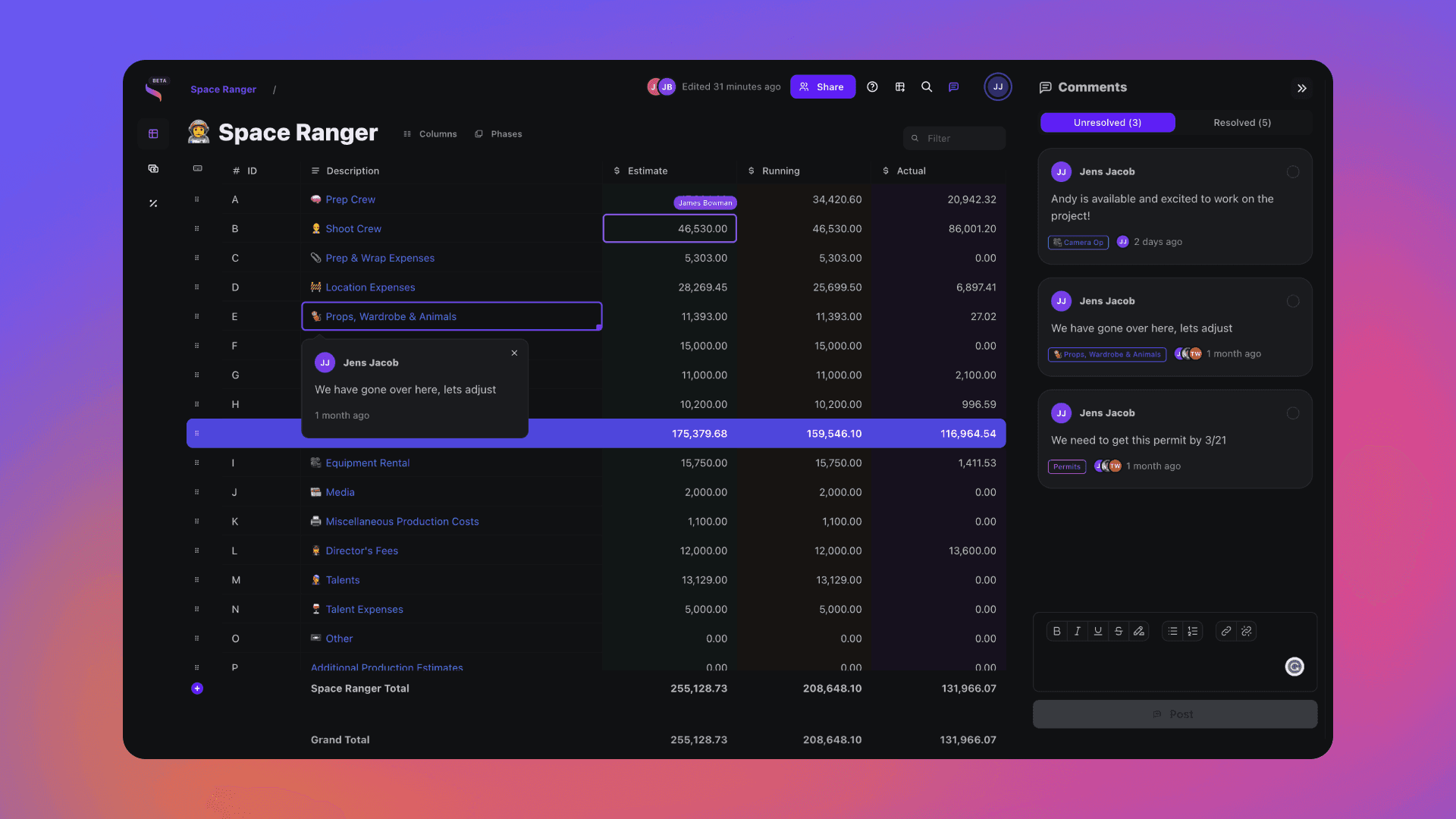
Set your episode count and the template builds your series-level view automatically. Fill in the pattern budget once and Saturation multiplies the per-episode costs across your full order, flagging any episodes with scheduled overages from the pattern average. Your top sheet shows per-episode cost, series total, and variance from original budget in real time.
When production starts, each episode gets its own actual cost tracking. Your cost report shows where episode 3 is running over pattern and exactly which line items are driving the variance, before the episode wraps.
For context on how production cost reporting works in a multi-episode environment, see our guide to production cost reports. For line-item budget structure guidance, see how to create a film budget.
Start with a free Saturation account and open the TV series template to see the episodic structure in action.
Frequently Asked Questions
Does the template work for streaming series as well as network TV?
Yes. The structure works for any scripted episodic production regardless of platform. Streaming deliverable specs differ from broadcast (often requiring UHD masters, HDR, multiple audio formats), but those are line items in the post-production section that you configure per your platform deal. The core above-the-line and below-the-line structure is the same.
How does the pattern budget handle episodes with unusual costs?
The pattern budget sets the average per-episode cost. For bottle episodes, location-heavy episodes, or episodes with significant VFX or stunt work, you create an episode-specific override budget that shows the variance from pattern. The series-level view rolls up both the pattern and the overrides so your total series estimate stays current.
Can I use this for a limited series or miniseries?
Yes. A limited series is structurally a short TV run: you may not have a true pattern budget if every episode has distinct requirements, but the template adapts to episode-by-episode budgeting with a series summary top sheet. A two-hour limited series or a four-part docuseries both work within the same template framework.
Does the template include SAG-AFTRA television rates?
The template includes fields for performer scale rates and fringe that you configure based on your applicable SAG-AFTRA agreement: prime-time, basic cable, streaming, or modified. SAG-AFTRA rate schedules are updated periodically; we recommend verifying current rates at SAG-AFTRA.org before finalizing your budget.
Open this template in Saturation
Every template lands in a live budget: auto-fill the line items, set your phases and rate packs, and let fringes and reports follow the numbers.
Budget Engine 2.0
Your budget, your cost report and every export run on one engine.
Auto-fill
Rates fill in as you type, from the source you turned on.
PhasesRebuilt
Every column knows its type.
Reports
Drag blocks onto the page and split a row in two.
Rate packs
Verified union rates, versioned.


Fringes and markupsRebuilt
Stack them, cap them, and see the split on every line.