Budget Template: California Tax Credit

California Tax Credit Budget Template: Your go-to template for productions aiming to qualify for the California Film Commission's tax incentives.
What Is a California Film Tax Credit Budget Template?
A California film tax credit budget template is a production budget structured to maximize and document eligibility for the California Film and Television Tax Credit Program. The California program, administered by the California Film Commission, provides a 20 to 25 percent transferable tax credit on qualified expenditures for feature films, television series, miniseries, and pilots that shoot and spend a minimum qualifying amount in California.
Applying for California's film tax credit requires a budget that demonstrates your production will meet the minimum qualified California spend thresholds, clearly separates qualified expenditures from non-qualified costs, and tracks actual spend against the application budget throughout production. The credit application and allocation process is competitive, so understanding how to structure your budget for maximum eligibility improves your program allocation odds.
California Tax Credit Budget Categories
Qualified expenditures under the California program include payments to California-based vendors and crew, California location fees and permits, California equipment rentals, and other production costs incurred in California. The budget must clearly distinguish qualified California spend from non-California costs, since only qualified expenditures generate the tax credit.
Qualified wages are the primary driver of California tax credit value. Wages paid to cast and crew working in California are qualified expenditures, subject to a per-employee cap ($1 million per employee for independent films, higher for television). The budget should show eligible wages separately from non-qualified salaries that exceed the per-employee cap.
Minimum spend thresholds vary by production type. Feature films require a minimum of $1 million in qualified expenditures. Television series require a minimum of $1 million per episode (or $10 million total). Independent films have lower minimums but also lower credit percentages. Your budget must demonstrate you will meet these thresholds to qualify for program consideration.
Non-California costs must be clearly identified in the budget because they do not generate credit. Visual effects work done outside California, foreign location shoots, and services from non-California vendors are typical non-qualified costs. The budget structure should make this breakdown clear from day one of production planning.
Credit calculation should appear in the budget as a financing source. A production spending $5 million in qualified California expenditures at a 20 percent credit rate generates a $1 million tax credit that can be transferred or applied against California tax liability. This credit value needs to be shown in the production financing plan.
California Tax Credit Program Budget Ranges
Independent features targeting the California program typically budget $1 million to $10 million. Television series range from $1 million to $5 million per episode. The California program caps annual allocations, so productions with higher qualified California spend have a competitive advantage in the allocation process.
Tracking California Qualified Expenditures
The California Film Commission conducts audits of tax credit recipients and requires documentation of all claimed qualified expenditures. Tracking actual California versus non-California spend throughout production ensures your final credit claim matches your actual production spend. Use Saturation to track actuals by vendor and location, making your final credit documentation accurate and audit-ready.
Ready to get started? Explore Saturation's film budgeting software to manage actuals alongside this template, or read our guide to creating a film budget for a step-by-step walkthrough. Saturation cardholders also unlock exclusive production perks on software and services used every day on set.
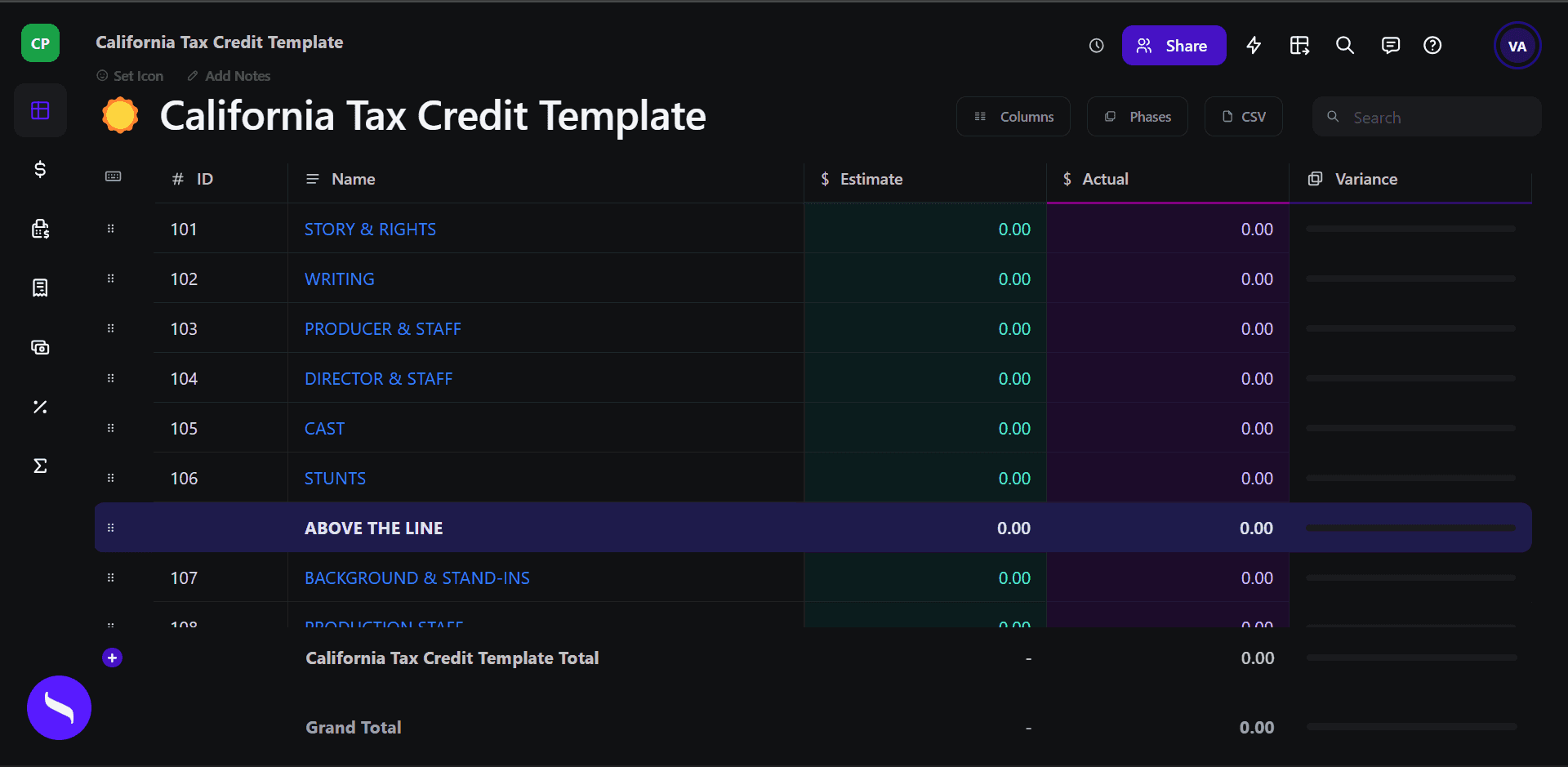
Open this template in Saturation
Every template lands in a live budget: auto-fill the line items, set your phases and rate packs, and let fringes and reports follow the numbers.
Budget Engine 2.0
Your budget, your cost report and every export run on one engine.
Auto-fill
Rates fill in as you type, from the source you turned on.
PhasesRebuilt
Every column knows its type.
Reports
Drag blocks onto the page and split a row in two.
Rate packs
Verified union rates, versioned.


Fringes and markupsRebuilt
Stack them, cap them, and see the split on every line.