Coraline Budget
 AnimationFamilyFantasy1h 40m
Aktualisiert
Synopsis
Eleven-year-old Coraline Jones moves with her distracted parents into an old house in Ashland, Oregon, and finds a small door that leads to an Other World, where a button-eyed Other Mother lavishes her with food and attention. When the Other Mother offers to let her stay forever if she lets buttons be sewn over her eyes, Coraline refuses, and must win back her kidnapped parents and the souls of three ghost children in a game against the creature.
What Is the Budget of Coraline?
Coraline (2009), Henry Selick's stop-motion adaptation of Neil Gaiman's 2002 novella, had a production budget of $60,000,000. That is the figure Box Office Mojo and The Numbers both list. Reports from before release described a range around it: in June 2008, Animation World Network and ICv2, the latter relaying Variety, reported that Laika had put up the entire budget of $50,000,000 to $70,000,000, and in February 2009 Portland Monthly wrote that the film had cost Laika's owner, Nike co-founder Phil Knight, close to $70,000,000. Laika has never published a final cost, and Saturation uses $60,000,000.
The money was Knight's. He first invested in Will Vinton Studios, the Portland stop-motion house, in 1998, later took control of it, and in July 2005 renamed it Laika. Coraline was the studio's first feature, financed by Laika and released by Focus Features in the United States and by Universal Pictures internationally. Before release, Selick told Portland Monthly that "Coraline is a huge risk," adding, "But these days in animation, the safest bet is to take a risk." Knight, comparing film to the shoe business, put it more bluntly: "But the movie business? That's gambling."
Key Budget Allocation Categories
Laika has never released a line-item budget, but the production record shows where the money went in a film where every frame was built, lit and photographed by hand.
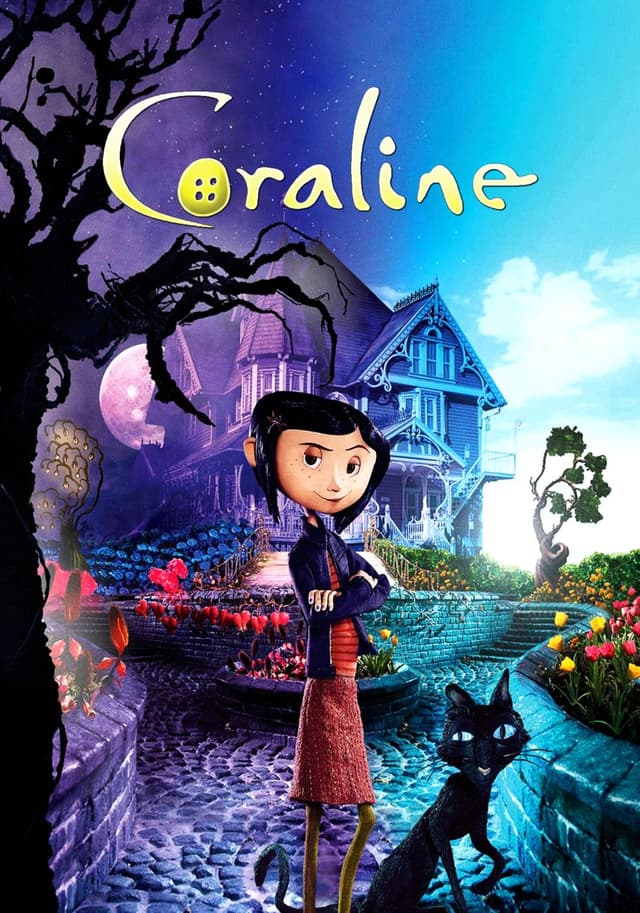
- Stage and Sets: Coraline was shot in a 140,000-square-foot warehouse in Hillsboro, Oregon, divided into about 50 stages holding nearly 150 sets, among them three miniature Victorian mansions, a 42-foot apple orchard and a model of Ashland, Oregon. The garden sequence, with hundreds of handmade flowers built to grow and move as Coraline walks in, was the most complicated set in the film.
- Puppets and Replacement Faces: The crew built 28 identical Coraline puppets, each taking three to four months and about 10 people to make. Faces were split into upper and lower halves that were swapped for each expression, thousands of face parts were produced on Objet 3D printers, and a Laika exhibit at Seattle's Museum of Pop Culture counted 207,336 possible face combinations for Coraline alone.
- Animation Crew and Schedule: At its peak the production employed about 450 people, including 35 animators and more than 250 technicians and designers. Principal photography took 18 months after two years of pre-production, with more than 28 animators working at a time and producing 90 to 100 seconds of finished animation a week.
- Stereoscopic 3D: Coraline was conceived and photographed in 3D, which its production notes describe as a first for a stop-motion feature. Every frame was shot twice, from two slightly offset camera positions, to build the stereo image.
- Costumes and Props: Every object on screen was made for the film. Knitter Althea Crome was hired to make the puppets' miniature sweaters, sometimes with needles as thin as a human hair, and a single garment could take six weeks to six months.
- Digital Work and Music: Laika's Digital Design Group composited separately shot elements in a style meant to look handmade, with fire drawn by hand and fog made from dry ice, and removed the seams between face halves at Phil Knight's request. Bruno Coulais's score was recorded with the Budapest Symphony Orchestra and the Children's Choir of Nice.
How Does Coraline's Budget Compare to Similar Films?
At $60,000,000, Coraline set the budget level for Laika's next three films, and none of the studio's later releases has matched its gross. Figures below are Box Office Mojo's worldwide grosses across all releases, leaving out re-release entries that only repeat an earlier run's total.
- The Nightmare Before Christmas (1993): Budget $18,000,000 | Worldwide $108,777,663. Selick's first stop-motion feature cost less than a third as much, and its re-releases, including 3D versions from 2006 onward, have added more than $50,000,000 to its gross, a path Coraline has since followed.
- Corpse Bride (2005): Budget $40,000,000 | Worldwide $118,435,804. Tim Burton's stop-motion feature from four years earlier cost two-thirds as much; Coraline has grossed $69,374,810 more.
- Fantastic Mr. Fox (2009): Budget $40,000,000 | Worldwide $46,478,193. Released the same year and nominated alongside Coraline for the Academy Award, it cost two-thirds as much and grossed about a quarter as much.
- ParaNorman (2012): Budget $60,000,000 | Worldwide $107,307,220. Laika's second feature had the same reported budget and grossed 57% of Coraline's total.
- Kubo and the Two Strings (2016): Budget $60,000,000 | Worldwide $76,253,437. Directed by Travis Knight, one of Coraline's lead animators, it matched the budget and grossed about 40% as much.
- Missing Link (2019): Budget $100,000,000 | Worldwide $26,599,084. It cost two-thirds more than Coraline and grossed about 14% as much, which shows how unusual Coraline's run has been even within Laika.
Coraline Box Office Performance
Focus Features opened Coraline in the United States and Canada on February 6, 2009, in 2,299 theaters, in both 2D and 3D. It took $16,849,640 in its first weekend, third behind He's Just Not That Into You and Taken. Before release, box office analyst Paul Dergarabedian had told Willamette Week that Laika "should be pleased" with a $10,000,000 opening. After two weekends the film had taken about $35,600,000 domestically, $25,500,000 of it from 3D screens, and it widened to 2,320 theaters. The original run finished with $75,286,229 domestically and $51,677,844 internationally, where Universal released it, for $126,964,073 worldwide, according to Box Office Mojo.
The rest came years later. Fathom Events brought Coraline back for short engagements from 2021; the 2022 run took $834,556, and a 4K presentation in August 2023 grossed about $4,910,000 on its first two days, third behind Barbie (2023) and Oppenheimer (2023) with a higher average per screen than both. Fathom's chief executive, Ray Nutt, called it "Fathom's biggest classic movie of all time," and that run finished at $7,149,366. The 15th anniversary 3D release from Fathom and Trafalgar Releasing opened on August 15, 2024, took $9,832,281 from 1,535 theaters over its first Friday to Sunday and $12,746,103 over four days including Thursday, finishing fifth. It went on to gross $33,626,425 domestically and $18,745,462 internationally, $52,371,887 in all, the most successful re-release in Fathom's history. In Mexico it sold 1,000,000 tickets by its first Tuesday, against 1,600,000 for the entire 2009 release, and in the United Kingdom it became the second-highest grossing re-release of all time.
Across all releases, Coraline has grossed $116,896,576 in the United States and Canada and $187,810,614 worldwide, with 37.8% from international markets, according to Box Office Mojo. That total leaves out $1,014,584 that Box Office Mojo lists under a 2025 South Korean re-release, because the entry repeats the market's cumulative gross from 2009 rather than recording new ticket sales; Box Office Mojo's unadjusted figure is $188,825,198. Re-releases account for $60,846,541 of the total, 32.4%. On Box Office Mojo's figures Coraline is the third-highest grossing stop-motion feature, behind Chicken Run (2000) at $225,164,364 and Wallace & Gromit: The Curse of the Were-Rabbit at $192,799,463.
Box Office Breakdown
Coraline

The original 2009 run grossed 2.1 times the production budget, and the all-releases total is 3.1 times it, but those are statements about the negative cost, not about profit. Home video added to the return: Universal released the film on DVD and Blu-ray on July 21, 2009, and The Numbers estimates domestic disc sales at $70,964,918, $51,458,464 on DVD and $19,506,454 on Blu-ray. A new Shout! Factory edition followed in August 2021 and a 4K Ultra HD Blu-ray in December 2022.
Neither Focus Features nor Laika has published what was spent on prints and advertising for the 2009 release, and no trade estimate exists, so there is no return per dollar figure for Coraline: the total estimated investment is unknown.
Coraline Production History
Neil Gaiman gave Henry Selick the manuscript of Coraline before the novella was published, as a fan of Selick's work on The Nightmare Before Christmas. Producer Bill Mechanic's Pandemonium secured the film rights in 2002, Will Vinton Studios acquired them in 2004, and Selick, who had joined the studio as a supervising director, wrote and directed. He felt a direct adaptation would make "maybe a 47-minute movie," so he expanded the story, moving it from England to Ashland, Oregon, and creating Wybie, a boy only mentioned in the book, so that Coraline would not spend the film talking to herself.
Looking for a design unlike most animation, Selick hired the Japanese illustrator Tadahiro Uesugi as concept artist. Uesugi expected a few weeks of character work and stayed more than a year, designing sets and backgrounds, and he gave the film its muted palette for the real world and saturated color for the Other World, as in The Wizard of Oz (1939).
Coraline was announced in 2005 as one of Laika's first two features, alongside a computer-animated film, Jack & Ben's Animated Adventure. When that project was cancelled in 2008, Laika laid off a significant part of its staff, leaving Coraline as its only announced feature. Dakota Fanning voiced Coraline, with Teri Hatcher as both her mother and the Other Mother, John Hodgman as her father, Keith David as the Cat, Ian McShane as Mr. Bobinsky and Robert Bailey Jr. as Wybie; Dawn French and Jennifer Saunders were cast as the retired actresses Miss Forcible and Miss Spink at Gaiman's suggestion. They Might Be Giants were hired to write songs, but the producers wanted the music to be creepier and only the "Other Father Song," sung by the band's John Linnell, made the film.
The shoot in Hillsboro ran for 18 months. Selick wanted the seams across the puppets' faces left visible to show that they were handmade; Phil Knight asked for them to be removed digitally. Knight's son Travis was one of the film's lead animators. Coraline premiered at the Portland International Film Festival on February 5, 2009, and opened the next day. Selick left Laika later that year after failing to renegotiate his contract and returned to features with Wendell & Wild (2022) for Netflix. Laika, with Travis Knight later becoming its president and chief executive, went on to make ParaNorman, The Boxtrolls (2014), Kubo and the Two Strings, Missing Link and Wildwood (2026), and Coraline remains its highest-grossing film.
Awards and Recognition
Coraline was nominated for the Academy Award, the Golden Globe and the BAFTA for best animated feature, and won three Annie Awards.
- Academy Awards: Nominated for Best Animated Feature at the 82nd Academy Awards, losing to Up (2009).
- Golden Globe Awards: Nominated for Best Animated Feature Film.
- British Academy Film Awards: Nominated for Best Animated Film.
- Annie Awards: Won three of eight nominations, for Best Music (Bruno Coulais), Best Character Design (Shane Prigmore and Shannon Tindle) and Best Production Design (Christopher Appelhans and Tadahiro Uesugi). Its other nominations included Best Animated Feature, Best Directing for Selick and Best Character Animation for Travis Knight.
- Annecy: Shared the Cristal for best feature at the Annecy International Animation Film Festival with Mary and Max (2009).
- Other Wins and Nominations: Won Best Feature Film at the British Academy Children's Awards and Best Animated Feature from the San Francisco Film Critics Circle. It was also nominated by the Producers Guild of America, the Motion Picture Sound Editors and the Visual Effects Society, including for Outstanding Models and Miniatures in a Feature Motion Picture.
The American Film Institute named Coraline one of the ten best films of 2009, and the film's interactive website won a 2009 Webby Award for Best Use of Animation or Motion Graphics.
Critical Reception
Reviews were strongly positive. Coraline holds 91% on Rotten Tomatoes from 276 critics, with an average rating of 8.0/10, and a Metacritic score of 80 out of 100 from 40 critics, indicating generally favorable reviews. The Rotten Tomatoes consensus reads: "With its vivid stop-motion animation combined with Neil Gaiman's imaginative story, Coraline is a film that's both visually stunning and wondrously entertaining."
A. O. Scott of The New York Times called the film "exquisitely realized" and wrote that rather than race toward a hectic climax, it "lingers in an atmosphere that is creepy, wonderfully strange, and full of feeling." Roger Ebert gave it three stars out of four, calling it "a beautiful film about several nasty people" and warning that it was "nightmare fodder for children, however brave, under a certain age." David Edelstein of New York magazine called it "a bona fide fairy-tale" but wanted less entrancement and more story.
Its reputation has grown since. Coraline has built a cult following and appears regularly on lists of the best animated films, including those of Time Out and Forbes. Kymberli Frueh, Trafalgar Releasing's senior vice president of programming and acquisitions, described the 2024 audiences as fans "rushing to come back because they were moved by the story."
Häufig gestellte Fragen
How much did it cost to make Coraline (2009)?
Coraline had a production budget of $60,000,000, the figure Box Office Mojo and The Numbers list. Reports before release gave a range of $50,000,000 to $70,000,000, and Portland Monthly wrote in February 2009 that it had cost Laika owner Phil Knight close to $70,000,000.
How much did Coraline (2009) make at the box office?
Coraline has grossed $187,810,614 worldwide across all releases, including $116,896,576 in the United States and Canada, according to Box Office Mojo. The original 2009 run took $126,964,073, and later re-releases added $60,846,541, led by the 2024 15th anniversary release at $52,371,887. Saturation leaves out a $1,014,584 South Korean entry that repeats the 2009 run, so Box Office Mojo's own all-releases figure reads $188,825,198.
Was Coraline (2009) profitable?
A full return on investment cannot be calculated, because Focus Features and Laika never disclosed the marketing spend. What is known: the original run grossed $126,964,073, 2.1 times the $60,000,000 budget, The Numbers estimates $70,964,918 in domestic DVD and Blu-ray sales, and re-releases have since added $60,846,541. Laika has made five more features since.
How much did the Coraline re-releases make?
Re-releases have added $60,846,541, about a third of the film's lifetime gross. Fathom Events' 4K run in August 2023 took $7,149,366 domestically, and the 15th anniversary 3D release in 2024 grossed $52,371,887 worldwide, the most successful re-release in Fathom's history.
Who paid for Coraline?
Laika, the Oregon studio owned by Nike co-founder Phil Knight, financed the whole budget. Coraline was its first feature. Focus Features distributed the film in the United States and Universal Pictures handled international markets.
Where was Coraline (2009) made?
Coraline was made in a 140,000-square-foot warehouse in Hillsboro, Oregon, divided into about 50 stages holding nearly 150 sets. They included three miniature Victorian mansions and a model of Ashland, Oregon, where the story is set.
How long did it take to make Coraline?
After two years of pre-production, principal photography took 18 months. More than 28 animators worked at a time, producing 90 to 100 seconds of finished animation a week, and up to 450 people worked on the film at its peak.
Was Coraline nominated for an Oscar?
Yes. Coraline was nominated for Best Animated Feature at the 82nd Academy Awards and lost to Up. It was also nominated for a Golden Globe and a BAFTA, won three Annie Awards and shared the Cristal for best feature at the Annecy festival with Mary and Max.
What did critics think of Coraline?
Critics were strongly positive. Coraline holds 91% on Rotten Tomatoes from 276 reviews, with an average of 8.0/10, and 80 out of 100 on Metacritic from 40 critics. Roger Ebert gave it three stars out of four and called it "a beautiful film about several nasty people."
How does Coraline's budget compare to Laika's other films?
ParaNorman (2012) and Kubo and the Two Strings (2016) had the same $60,000,000 budget and grossed $107,307,220 and $76,253,437 worldwide. Missing Link (2019) cost $100,000,000 and grossed $26,599,084. At $187,810,614, Coraline is Laika's highest-grossing film.
Filmmakers
Coraline

Official Trailer
Erstellen Sie Budgets wie dieses in Saturation
Starten Sie mit einer branchenüblichen Spielfilmvorlage, importieren Sie Drehplan und Gagen, die Sie schon haben, und lassen Sie den Kostenbericht sich beim Ausgeben von selbst aktualisieren. Zusammenarbeit in Echtzeit, ohne Tabellen.