Year One Budget
 Comedy
Updated
Synopsis
Zed, a lazy and incompetent biblical-era hunter, and his timid friend Oh, a gatherer banished from their primitive village, set out on a meandering journey across the ancient world. They cross paths with Cain and Abel, witness Abraham's near-sacrifice of Isaac, and ultimately attempt to free their kidnapped tribeswomen from the wicked city of Sodom in a satirical tour of Old Testament history.
What Is the Budget of Year One (2009)?
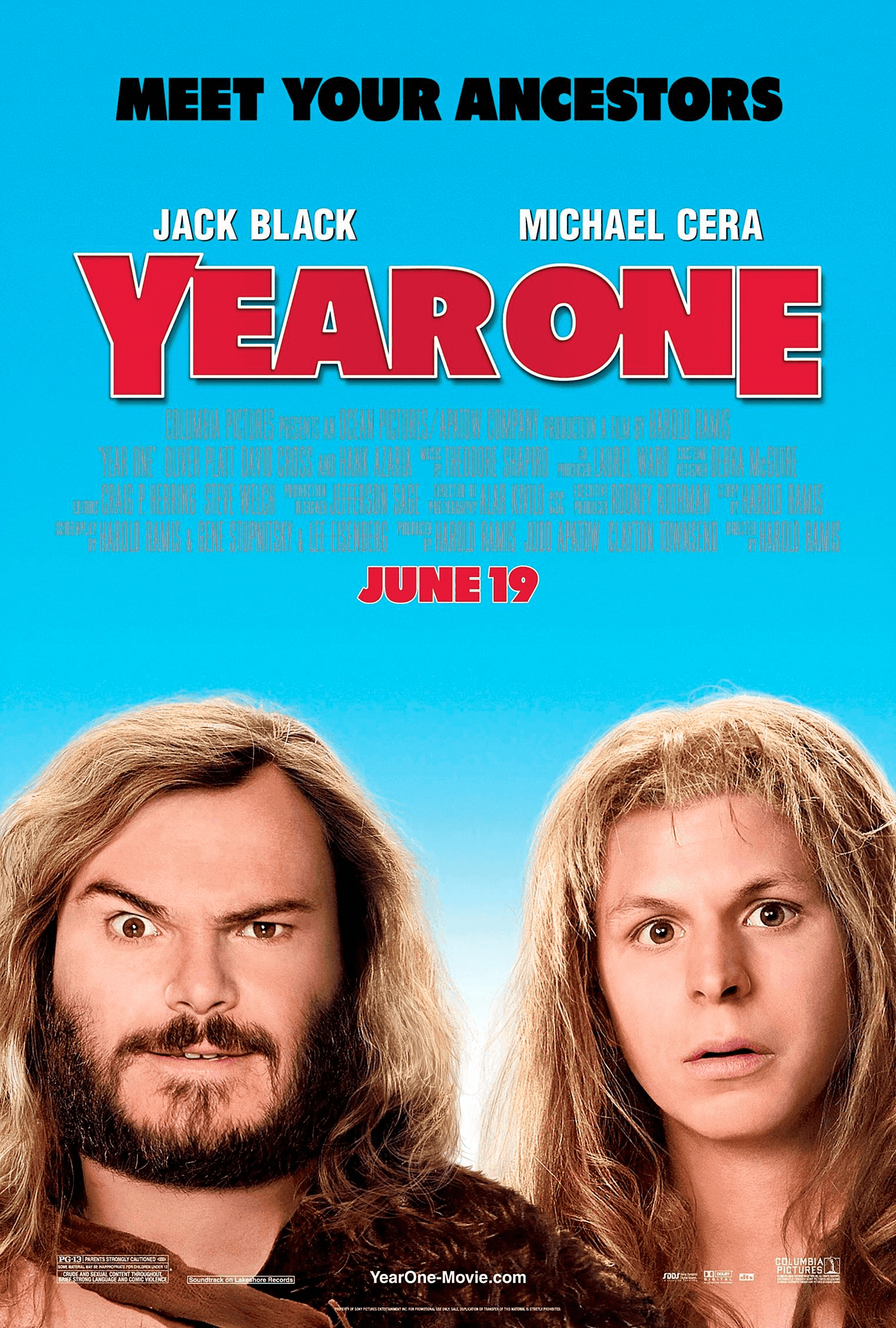
Year One (2009), directed by Harold Ramis and distributed by Columbia Pictures, was produced on a reported budget of $60,000,000. The biblical-era comedy was financed by Columbia Pictures and Apatow Productions, with producers Judd Apatow, Harold Ramis, and Clayton Townsend structuring the project as a star-driven historical comedy built around Jack Black and Michael Cera. The film was the first feature directed by Harold Ramis since The Ice Harvest (2005), and it represented the latest in Apatow's post-Knocked Up run of R-rated star vehicles.
The investment positioned Year One as a mid-budget summer comedy tentpole. Sony wanted a property that could anchor the summer 2009 comedy corridor and demonstrate that Apatow's producing brand could carry an R-rated historical premise. The math required roughly $135,000,000 in worldwide gross to break even after marketing, a target the film missed despite a credible domestic opening.
Key Budget Allocation Categories
Year One's $60,000,000 budget was distributed across several core production areas:
- Above-the-Line Talent: Jack Black commanded a substantial fee for the Zed role at the peak of his post-Tropic Thunder and Kung Fu Panda commercial standing. Michael Cera signed at his post-Juno and Superbad rate. The supporting cast was unusually deep: David Cross as Cain, Oliver Platt as the High Priest, Hank Azaria as Abraham, Olivia Wilde as Princess Inanna, Christopher Mintz-Plasse as Isaac, Vinnie Jones as Sargon, and Paul Rudd as Abel. The combined cast cost was substantial.
- Harold Ramis Directing Fee: Director Harold Ramis commanded a senior feature-director rate from the project, reflecting his Caddyshack, Groundhog Day, and Analyze This résumé. The Ramis name was central to the project's marketing identity.
- Louisiana Location Shoot: Principal photography took place primarily in New Orleans, Louisiana and surrounding parishes in 2008, anchored by the state's 30% film production tax credit, which was among the most aggressive in the country at the time. The Louisiana shoot was central to the production financing math.
- Set Construction: The production built elaborate biblical-era sets including the Sodom city walls, marketplace, and palace interiors, the wilderness encampment, and various supporting environments. Set construction was a substantial line item given the period scale and the multiple geographic settings.
- Costume and Visual Effects: Costume designer Shay Cunliffe dressed a large supporting cast in biblical-era wardrobe. Visual effects were limited to environmental enhancements, set extensions of the Sodom city walls, and various smaller composite shots.
- Marketing and Reshoots: Sony invested in an aggressive domestic marketing campaign positioning the film as the summer 2009 Apatow R-rated comedy event. Limited reshoots in spring 2009 added incremental cost. Domestic marketing spend was estimated in the $40,000,000 to $50,000,000 range.
How Does Year One's Budget Compare to Similar Films?
At $60,000,000, Year One sat in the upper range of late-2000s star-driven R-rated comedies:
- Knocked Up (2007): Budget $30,000,000 | Worldwide $219,061,053. Judd Apatow's directorial benchmark cost half what Year One did and earned more than 2.7x its worldwide gross, the Apatow-brand peak that Year One failed to approach.
- Pineapple Express (2008): Budget $25,000,000 | Worldwide $101,624,843. The contemporary Apatow-produced action comedy cost less than half of Year One and earned roughly 1.3x its worldwide gross, the close Apatow comparable that outperformed.
- Funny People (2009): Budget $75,000,000 | Worldwide $71,584,837. Judd Apatow's contemporary directorial release cost 25% more than Year One and earned roughly 90% of its worldwide gross, the parallel summer-2009 Apatow misfire.
- Tropic Thunder (2008): Budget $92,000,000 | Worldwide $195,704,832. The Jack Black ensemble action-comedy cost 53% more than Year One and earned roughly 2.6x its worldwide gross.
- Land of the Lost (2009): Budget $100,000,000 | Worldwide $68,777,554. Universal's contemporary Will Ferrell summer release cost 67% more than Year One and earned somewhat less worldwide, the close contemporary summer-2009 comedy bomb comparable.
Year One Box Office Performance
Year One opened on June 19, 2009 to $19,608,847 across 3,022 theaters, finishing third on a weekend dominated by The Proposal and the continuing The Hangover run. The opening was modestly below Sony's internal projections and the film dropped sharply in subsequent weeks as Transformers: Revenge of the Fallen and Public Enemies absorbed the broader summer audience.
Against a $60,000,000 production budget the film needed approximately $135,000,000 worldwide to clear breakeven after marketing. Here is the financial breakdown:
Box Office Breakdown
Year One

Year One returned approximately $0.58 in theatrical revenue for every $1 invested when measured against total estimated production and marketing spend, a substantial commercial loss that ranked among the more decisive Apatow Productions disappointments of the decade. The domestic share of the gross was $43,337,279 against an international share of $18,791,369, a 70/30 domestic skew typical for American-comedy-anchored period satire that did not travel internationally.
Home video provided modest recovery. DVD sales in late 2009 and 2010 returned a portion of the production investment, and the film became a steady cable rerun across the early 2010s. The combined commercial outcome remained a meaningful loss against the production investment. Year One was Harold Ramis's final completed feature as a director before his death in 2014.
Year One Production History
Development on Year One began in 2007 with a screenplay by Harold Ramis, Gene Stupnitsky, and Lee Eisenberg (Stupnitsky and Eisenberg were then writing on The Office). Judd Apatow came on as a producer through Apatow Productions, partnering with Clayton Townsend and Ramis on the project. Columbia Pictures financed the production, with the property positioned as a Ramis return-to-feature-directing after a hiatus from his Groundhog Day and Analyze This commercial peak.
Casting was completed by early 2008. Jack Black signed as Zed and Michael Cera as Oh in May 2008, with the supporting cast assembled through summer 2008: David Cross as Cain, Oliver Platt as the High Priest, Hank Azaria as Abraham, Olivia Wilde as Princess Inanna, Christopher Mintz-Plasse as Isaac, Vinnie Jones as Sargon, Juno Temple as Eema, and Paul Rudd in an extended cameo as Abel. The cast was unusually deep for a mid-budget comedy.
Principal photography ran from July to October 2008 primarily in New Orleans, Louisiana, anchored by the state's 30% film production tax credit. The production built elaborate biblical-era sets including the Sodom city walls, marketplace, and palace interiors, with additional unit work in surrounding Louisiana parishes for the wilderness sequences. Post-production wrapped in spring 2009 at Sony's Los Angeles facilities, with composer Theodore Shapiro recording the score ahead of the June 19, 2009 theatrical release.
Awards and Recognition
Year One received virtually no significant industry awards recognition. The film failed to register at the major industry ceremonies and earned no nominations at the Golden Globes, the Saturn Awards, or the major guild awards.
The film received Razzie attention, with multiple nominations across the 2010 ceremony including Worst Picture, Worst Director (Harold Ramis), and Worst Screenplay. The combined commercial and critical reception positioned Year One as one of the more decisive misfires in the late-2000s Apatow producing run, and the film has remained a footnote in retrospective coverage of that decade's R-rated comedy boom.
Critical Reception
Year One received largely negative reviews. The film holds a 15% approval rating on Rotten Tomatoes based on 178 critic reviews, with a critical consensus calling it a misfire that wastes its talented ensemble on a meandering and pointlessly raunchy historical premise. On Metacritic, the film scored 34 out of 100, indicating generally unfavorable reviews. Audiences surveyed by CinemaScore gave the film a C, weak for an Apatow-produced summer comedy.
Critics broadly objected to the meandering structure, the absence of comedic momentum, and what A.O. Scott of The New York Times called "a movie that confuses anachronism with comedy and earns very few laughs in either direction." Manohla Dargis wrote that the film "is the rare Apatow production that feels like nobody knew what to do with it once the cameras were rolling." Variety's Brian Lowry called it "an aggressively unfunny historical comedy whose primary virtue is its length." Roger Ebert defended portions of the film but acknowledged its broader failure.
Harold Ramis's directing was the most divisive element. Some critics defended his loose, character-driven approach as appropriate for the meandering road-trip premise; many viewed the film as evidence that his Groundhog Day-era comedic command had not survived the intervening decade. Year One has remained a footnote in his filmography, and its commercial failure was widely cited as a factor in his decision to step back from theatrical features in the final years of his life before his 2014 death.
Frequently Asked Questions
How much did it cost to make Year One (2009)?
The reported production budget was $60,000,000. Columbia Pictures financed the production with Apatow Productions, with Judd Apatow producing through his banner alongside director Harold Ramis and Clayton Townsend.
How much did Year One earn at the box office?
The film grossed $43,337,279 domestically and $18,791,369 internationally, for a worldwide total of $62,128,648. It opened to $19,608,847 in the United States on June 19, 2009, finishing third on a weekend dominated by The Proposal and the continuing The Hangover run.
Was Year One a box office bomb?
Yes. Against a $60,000,000 production budget and an estimated $40,000,000 to $50,000,000 in marketing spend, the film returned approximately $0.58 in worldwide gross for every $1 invested. The film ranked among the more decisive Apatow Productions disappointments of the decade.
Who directed Year One?
Harold Ramis directed the film, working from a screenplay he co-wrote with Gene Stupnitsky and Lee Eisenberg. It was Ramis's first feature as director since The Ice Harvest (2005) and his final completed feature before his death in 2014.
Where was Year One filmed?
Principal photography ran from July to October 2008 primarily in New Orleans, Louisiana and surrounding parishes, anchored by the state's 30% film production tax credit. The production built elaborate biblical-era sets including the Sodom city walls, marketplace, and palace interiors.
Who stars in Year One?
Jack Black stars as Zed, with Michael Cera as Oh. The supporting cast includes David Cross as Cain, Oliver Platt as the High Priest, Hank Azaria as Abraham, Olivia Wilde as Princess Inanna, Christopher Mintz-Plasse as Isaac, Vinnie Jones as Sargon, and Paul Rudd in an extended cameo as Abel.
How does Year One compare to other Apatow productions?
Year One ($62,128,648 worldwide against $60,000,000) significantly underperformed Knocked Up (2007, $219,061,053 worldwide against $30,000,000) and Pineapple Express (2008, $101,624,843 against $25,000,000). It was a close summer-2009 Apatow comparable to Funny People (2009, $71,584,837 against $75,000,000), which also underperformed.
What did critics think of Year One?
The film received largely negative reviews, with a 15% approval rating on Rotten Tomatoes (based on 178 critics) and a 34 out of 100 score on Metacritic. Audiences gave it a C CinemaScore. Critics objected to the meandering structure and absence of comedic momentum.
Was Year One Harold Ramis's last film?
Yes. Year One was Harold Ramis's final completed feature as a director before his death in 2014. The film's commercial failure was widely cited as a factor in his decision to step back from theatrical features in his final years.
Did Year One win any awards?
No. Year One received virtually no industry awards recognition. The film received Razzie attention, with multiple nominations across the 2010 ceremony including Worst Picture, Worst Director (Harold Ramis), and Worst Screenplay.
Filmmakers
Year One

Build budgets like this one in Saturation
Start from an industry-standard feature film template, import the schedule and rates you already have, and let the cost report keep itself current as you spend. Real-time collaboration, no spreadsheets.