Wild Hogs Budget
 Comedy
Updated
Synopsis
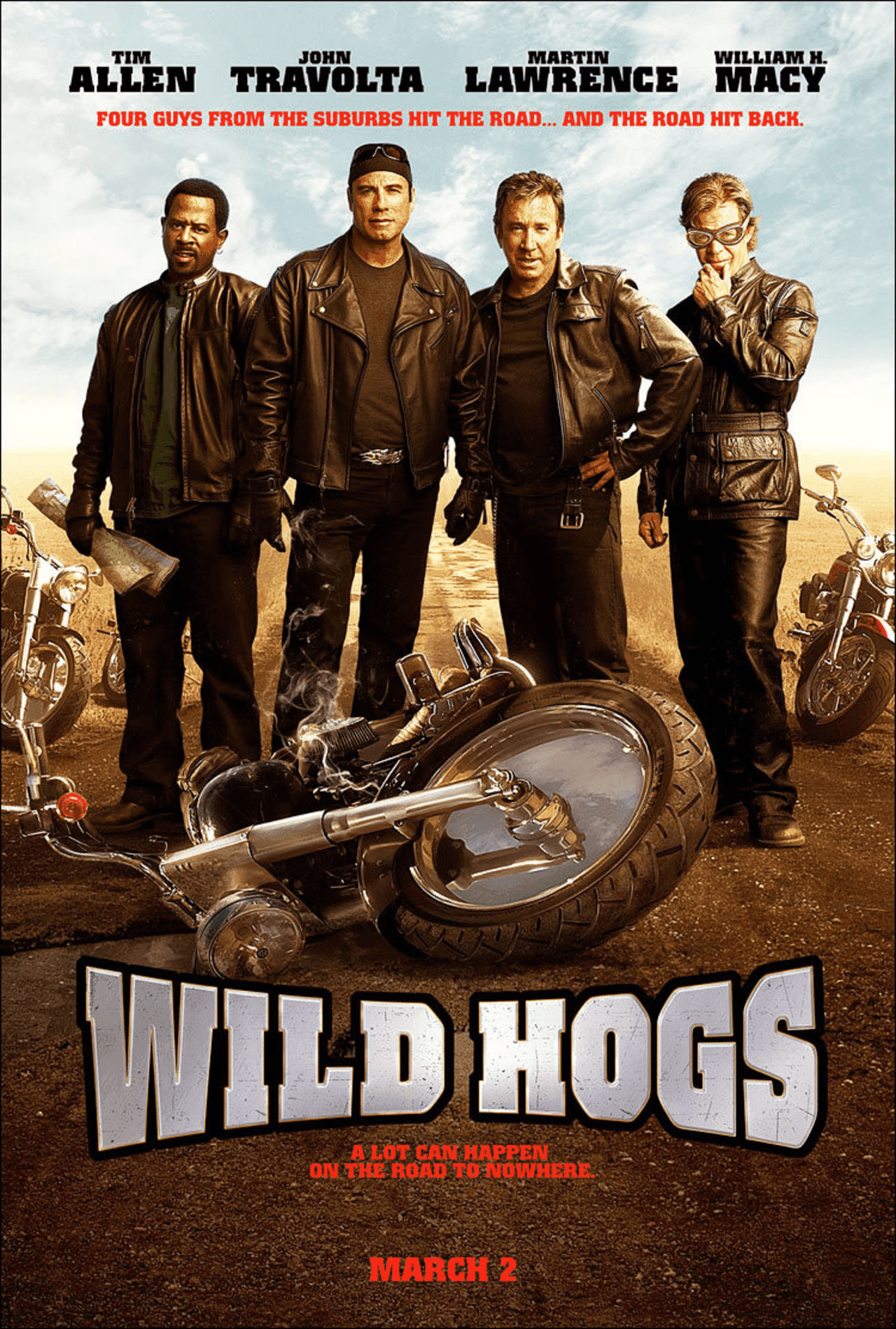
Four middle-aged suburban friends saddle up their Harleys for a long-overdue motorcycle road trip from Cincinnati to the Pacific coast. When they tangle with a violent New Mexico biker gang at a desert bar, the weekend warriors must defend a small town and rediscover their manhood.
What Is the Budget of Wild Hogs (2007)?
Wild Hogs (2007), directed by Walt Becker and distributed by Walt Disney Pictures through its Touchstone Pictures label, was produced on a budget of $60,000,000. Brad Krevoy and Todd Lieberman produced through Krevoy's Motion Picture Corporation of America, with Disney providing studio finance and full marketing support. The film was developed as a four-quadrant adult comedy built around an ensemble of A-list and B-list comedy leads in the middle of their careers.
The budget reflected the cost of assembling a marketable ensemble headed by Tim Allen, John Travolta, Martin Lawrence, and William H. Macy. Each principal cast member commanded significant compensation relative to the project's mid-tier comedy positioning, with above-the-line talent absorbing the largest share of production cost. Disney positioned the film for a soft early-March release with no major studio competition, betting that the cast and a broad PG-13 comedy hook could carry the film to the $100M domestic mark.
Key Budget Allocation Categories
Wild Hogs's $60,000,000 budget was distributed across several core production areas:
- Above-the-Line Talent: Tim Allen, John Travolta, Martin Lawrence, and William H. Macy each commanded multi-million-dollar paydays, with Travolta in particular taking a significant fee following his Be Cool work for MGM. Ray Liotta as the villainous Del Fuegos leader added an additional marquee compensation tier. Above-the-line spend dominated the budget structure.
- New Mexico Location Shoot: The desert road sequences and the climactic Madrid, New Mexico bar showdown were shot on practical locations in and around Santa Fe and Madrid. New Mexico's aggressive 25% film production tax credit, then one of the most competitive in the United States, offset a substantial share of in-state spend.
- Motorcycles and Stunt Riding: The production required dozens of Harley-Davidson motorcycles for the principal "Wild Hogs" and the rival Del Fuegos gang, plus a full stunt-riding unit that included experienced rider doubles for each principal. Custom paint jobs, picture-vehicle duplicates, and on-set mechanical support added a significant line.
- Practical Stunt and Pyrotechnic Sequences: The third-act gas-station fireball, multiple staged crashes, and the Del Fuegos bar destruction required a dedicated pyro and stunt team, on-set fire safety, and breakaway set construction. The sequence ran across multiple shooting days.
- Music Licensing: The soundtrack featured Steppenwolf's "Born to Be Wild," The Allman Brothers' "Ramblin' Man," and other classic-rock needle drops that carried significant licensing fees. Teddy Castellucci composed the original score.
- Special Cameos and Cinematic Set Pieces: Peter Fonda's cameo as Damien Blade, a callback to Easy Rider, required a separate negotiation and a dedicated shooting day. The closing-credits dance sequence with the principal cast and Extreme Makeover: Home Edition crew was a marketing-driven addition that incurred additional production cost.
How Does Wild Hogs's Budget Compare to Similar Films?
At $60,000,000, Wild Hogs sits in the mid-range of mid-2000s ensemble adult comedies. The comparison set illustrates how the cycle's commercial outcomes varied dramatically by cast and concept:
- The Bucket List (2007): Budget $45,000,000 | Worldwide $175,373,567. Rob Reiner's Jack Nicholson-Morgan Freeman pairing cost less than Wild Hogs and earned $80M less worldwide, demonstrating that the comedy ensemble formula scaled well at the Wild Hogs price point.
- Yes Man (2008): Budget $50,000,000 | Worldwide $223,241,606. The Jim Carrey vehicle came in $10M below Wild Hogs and posted a similar worldwide total, suggesting an established comedy star carried roughly the same commercial weight as the Wild Hogs ensemble.
- RV (2006): Budget $50,000,000 | Worldwide $98,720,403. Robin Williams's family road comedy from the previous year cost less than Wild Hogs and earned less than half its worldwide gross, illustrating the Wild Hogs ensemble's upside.
- Old Dogs (2009): Budget $35,000,000 | Worldwide $96,752,376. Walt Becker's follow-up Travolta-Robin Williams pairing for Disney cost roughly half what Wild Hogs cost and earned less than 40% of its worldwide gross, confirming that the original's commercial scale was not easily replicable.
- Bad Teacher (2011): Budget $20,000,000 | Worldwide $216,206,142. Sony's Cameron Diaz comedy came in at one third the Wild Hogs budget and earned 86% of its worldwide gross, illustrating the high ROI ceiling for tightly budgeted R-rated comedies.
Wild Hogs Box Office Performance
Wild Hogs opened on March 2, 2007, debuting to $39,381,165 in its opening weekend across 3,265 theaters, finishing first on the chart and significantly exceeding Disney's pre-release tracking, which had projected a $25M to $28M opening. The film benefited from a soft adult-comedy marketplace, no significant competition for older moviegoers, and a marketing campaign that emphasized the four leads.
Against a $60,000,000 production budget, Wild Hogs needed roughly $130,000,000 in worldwide gross to reach profitability when accounting for marketing and distribution costs. Here is the financial breakdown:
Box Office Breakdown
Wild Hogs

Wild Hogs returned approximately $2.15 in theatrical revenue for every $1 invested when measured against total estimated production and marketing spend, placing it among the most profitable Disney live-action comedies of the late 2000s. The domestic share of the gross was $168,213,584 against an international share of $85,411,843, a 66/34 split heavily weighted toward North America, reflecting the property's middle-American suburban-dad appeal.
The strong commercial performance prompted Disney to develop a follow-up adult-comedy slate at the Touchstone label, including Old Dogs (2009), also directed by Walt Becker and again co-starring John Travolta. Wild Hogs' multi-quadrant success briefly revived the studio's appetite for star-driven adult comedies before the cycle's diminishing returns shifted production back toward family and tentpole.
Wild Hogs Production History
The screenplay was written by Brad Copeland (Yes, Dear, Arrested Development), originally as a Universal project in the early 2000s before moving into turnaround. Walt Becker, who had directed Van Wilder for Lions Gate, was attached as director in 2005 after the project relocated to Disney under producer Brad Krevoy. Krevoy and Todd Lieberman shepherded the package through Disney's development process during 2005 and into 2006.
Casting was completed in early 2006, with Tim Allen, John Travolta, Martin Lawrence, and William H. Macy signing in succession over a multi-month period. Marisa Tomei, Ray Liotta, and Peter Fonda joined the supporting cast. Allen and Travolta both took percentage points on the back end in addition to their upfront fees, a deal structure that proved highly lucrative once the film overperformed.
Principal photography began in May 2006 in New Mexico, with the unit basing in Santa Fe and shooting extensively in and around Madrid, New Mexico, a small mining town that doubled for the fictional Madrid bar showdown. New Mexico's 25% film production tax credit, one of the most aggressive in the country at the time, offset a meaningful share of below-the-line spend. Additional sequences were shot in Cincinnati, Ohio (the film's opening) and on Universal Studios stages in Los Angeles.
Post-production wrapped in late 2006, with the film positioned for a soft March 2007 release window. Disney's marketing campaign emphasized the four leads, the road-trip concept, and the Steppenwolf-driven needle drops in trailers, deliberately targeting both younger moviegoers responding to the cast and older audiences who recognized Peter Fonda's cameo as an Easy Rider callback.
Awards and Recognition
Wild Hogs received no major industry awards recognition. It was not nominated at the Academy Awards, Golden Globes, BAFTAs, SAG Awards, or Critics' Choice Awards.
The film did appear at the Razzies, earning two Golden Raspberry Award nominations including Worst Excuse for Family Entertainment and Worst Screenplay (Brad Copeland), though it won neither. At the People's Choice Awards, the film received nominations including Favorite Movie Comedy. The Madrid, New Mexico filming location became a Wild Hogs tourist draw following the film's release, with the practical bar set preserved and operated as a roadside attraction for several years.
Critical Reception
Wild Hogs received broadly negative reviews. The film holds a 14% approval rating on Rotten Tomatoes based on 132 critic reviews, with a critical consensus that dismissed it as a formulaic, joke-light ensemble comedy. On Metacritic, the film scored 27 out of 100, indicating generally unfavorable reviews. Audiences surveyed by CinemaScore gave the film an A-, a striking 60+ point gap between critic and audience reception that mirrored the disconnect on contemporaneous Adam Sandler vehicles.
Critics broadly objected to the screenplay's reliance on broad masculinity gags, predictable beats, and what The New York Times' Stephen Holden called "a relentless string of pratfalls that mistake humiliation for character development." Roger Ebert awarded the film two stars, writing that "you keep wishing it had been funnier, but you also keep liking the actors." Variety's Robert Koehler noted the disconnect between critical pans and audience embrace, calling the film "critic-proof in the Adam Sandler tradition."
Among audiences, the film became an unexpected sleeper of the spring 2007 season, generating strong word-of-mouth and repeat viewing among older moviegoers. The A- CinemaScore translated to multi-week box office holds, and the film remained in the top ten for six consecutive weekends, an unusual run for a Razzie-nominated production. The critical-audience gap has since made Wild Hogs a regular reference point in discussions of mid-budget studio-comedy economics and the limits of professional criticism as a commercial predictor.
Frequently Asked Questions
How much did it cost to make Wild Hogs (2007)?
The production budget was $60,000,000. The film was produced by Touchstone Pictures with Brad Krevoy's Motion Picture Corporation of America and Tollin/Robbins Productions, and distributed worldwide by Walt Disney Pictures.
How much did Wild Hogs earn at the box office?
The film grossed $168,213,584 domestically and $85,411,843 internationally, for a worldwide total of $253,625,427. It opened to $39,381,165 across 3,265 theaters on March 2, 2007, finishing first on the chart.
Was Wild Hogs profitable?
Yes. Against a $60M production budget and an estimated $50M to $60M in marketing spend, the film returned approximately $2.15 in worldwide gross for every $1 invested, generating roughly $133M to $143M in theatrical profit before home entertainment and television revenue.
Who directed Wild Hogs?
Walt Becker directed the film. Becker had previously directed Van Wilder (2002) for Lions Gate, and he would reunite with John Travolta for Disney's Old Dogs (2009).
Where was Wild Hogs filmed?
Most of the film was shot in and around Santa Fe, New Mexico, with the climactic bar sequences shot in Madrid, New Mexico. New Mexico's 25% film production tax credit offset a significant share of below-the-line spend. Additional sequences were shot in Cincinnati, Ohio and on Los Angeles soundstages.
Who stars in Wild Hogs?
Tim Allen, John Travolta, Martin Lawrence, and William H. Macy star as the four "Wild Hogs" suburban motorcyclists. Ray Liotta plays the Del Fuegos gang leader, Marisa Tomei the love interest, and Peter Fonda makes a cameo as Damien Blade, a callback to his Easy Rider role.
How does Wild Hogs compare to other 2007 comedies?
Wild Hogs earned $253.6M worldwide on a $60M budget, far exceeding the cycle's typical performance. The Bucket List (2007) earned $175.4M on $45M. RV (2006) earned $98.7M on $50M. Wild Hogs' commercial scale was rarely matched in the mid-2000s adult comedy cycle.
Why was Wild Hogs a critical failure but audience hit?
The film holds a 14% Rotten Tomatoes rating against an A- CinemaScore, a 60+ point gap. Critics objected to the screenplay's reliance on broad masculinity gags and predictable beats, while audiences embraced the four leads and the road-trip concept. The disconnect mirrored contemporaneous Adam Sandler vehicles.
Did Wild Hogs get a sequel?
No direct sequel was produced, though Disney developed Old Dogs (2009) as a spiritual follow-up, again directed by Walt Becker and starring John Travolta opposite Robin Williams. Old Dogs earned $96.7M worldwide on a $35M budget, a significant step down from Wild Hogs' commercial scale.
What did critics think of Wild Hogs?
The film holds a 14% approval rating on Rotten Tomatoes (132 reviews) and scored 27 out of 100 on Metacritic. Roger Ebert gave it two stars, calling it not funny enough but admitting the actors were likable. Audiences gave it an A- CinemaScore.
Filmmakers
Wild Hogs

Build budgets like this one in Saturation
Start from an industry-standard feature film template, import the schedule and rates you already have, and let the cost report keep itself current as you spend. Real-time collaboration, no spreadsheets.