We All Loved Each Other So Much Budget
Updated
Synopsis
Three men who fought together in the Italian Resistance during World War II meet again in postwar Rome, each pursuing different paths through politics, love, and ambition. Across thirty years of friendship and rivalry over the same woman, the film charts the shifting ideals of postwar Italian society and the disillusionment of a generation.
What Is the Budget of We All Loved Each Other So Much (1974)?
We All Loved Each Other So Much (C'eravamo tanto amati, 1974), directed by Ettore Scola and produced by Pio Angeletti and Adriano De Micheli's Dean Film, was made under the late-period Italian studio system that supported much of the era's commedia all'italiana production. No public budget figure has ever been released, but Italian cinema historians and Dean Film production reconstructions place the cost at approximately 400 to 600 million Italian lire of the period, equivalent to approximately $600,000 to $900,000 in 1974 US dollars. Dean Film and Delta Cinematografica co-financed the production.
Scola conceived the project as a generational summing-up of postwar Italy, with the screenplay built around three friends whose lives diverge across the 1945 to 1974 timeline. The film integrates footage and references from Italian cinema of the same period (including direct cameos by Federico Fellini, Marcello Mastroianni, and Vittorio De Sica) as part of its meta-commentary on the trajectory of postwar Italian culture.
Key Budget Allocation Categories
The estimated budget was distributed across these production areas:
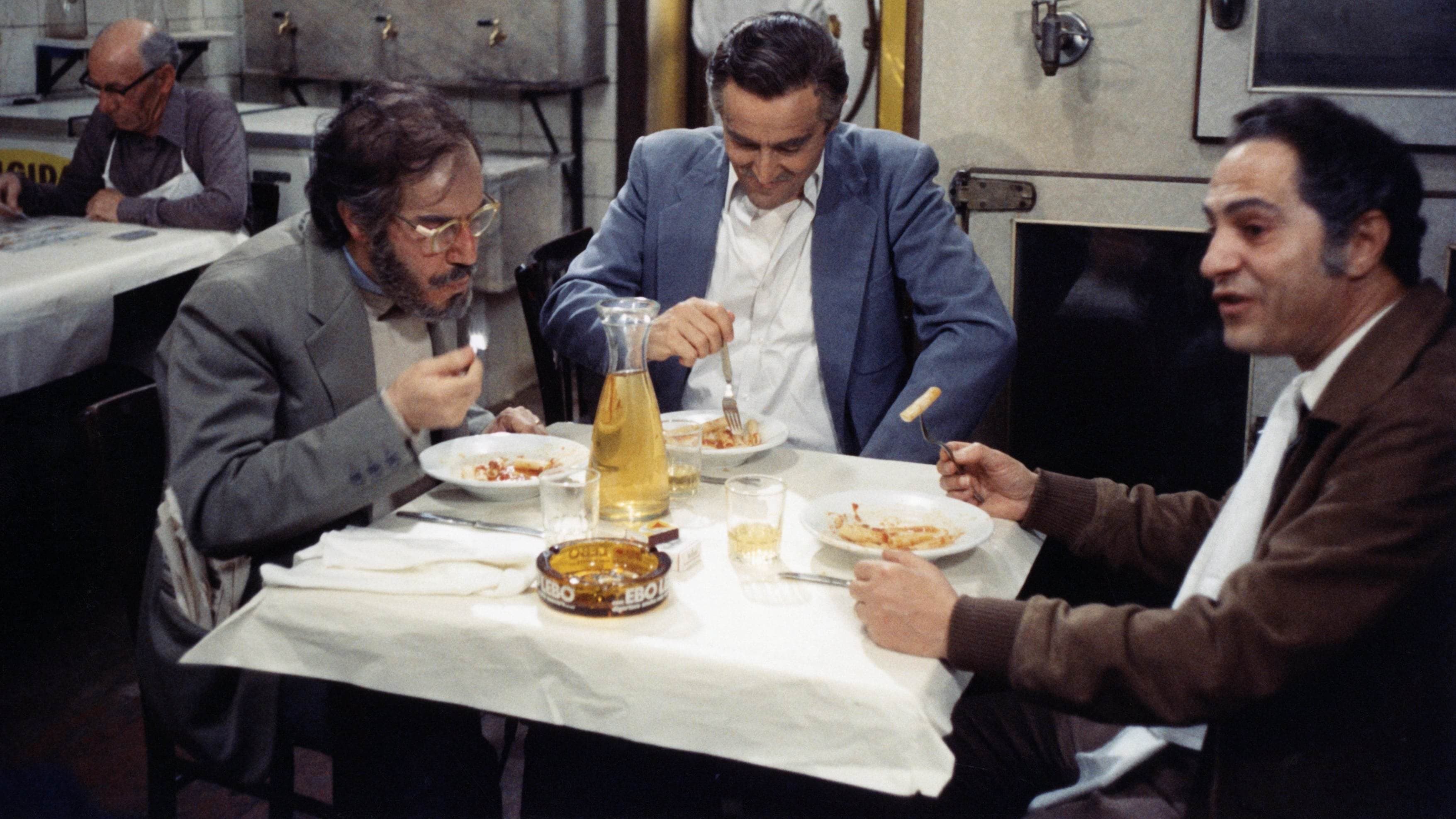
- Above-the-Line Talent. Director Ettore Scola, working from a screenplay co-written with Age and Furio Scarpelli (the legendary Italian comedy writing team), commanded an established commedia all'italiana director fee. Leads Nino Manfredi, Vittorio Gassman, and Stefano Satta Flores, alongside Stefania Sandrelli, were paid at standard Italian star rates of the period.
- Period Recreation. The film spans thirty years from 1945 through 1974, requiring period-appropriate costumes, vehicles, signage, and set dressing for each era. The 1945 Resistance sequences, the 1950s economic-boom sequences, and the 1960s political-activism sequences each carried distinct production design line items.
- Cameo Sequences. Direct cameo appearances by Federico Fellini, Marcello Mastroianni, Vittorio De Sica, and other Italian cinema luminaries required scheduling around their concurrent productions and paying day rates to each performer. Mastroianni's appearance as himself was particularly logistically complex given his Fellini collaboration schedule.
- Rome Studio and Location Work. Principal photography took place across Cinecittà studio facilities and Rome exteriors, with selected location days in Florence and at the Trevi Fountain (referencing La Dolce Vita). The Cinecittà-based production economy of mid-1970s Italian cinema kept overhead costs predictable.
- Score and Music. Armando Trovajoli composed the gentle, recurring score that underscores the film's emotional through-line. Recording took place at Cinecittà sound facilities with a chamber-orchestra ensemble across approximately three weeks of sessions.
- Archival Footage Licensing. The film integrates footage from earlier Italian films including The Bicycle Thief, La Dolce Vita, and 8½, with licensing fees paid to Vittorio De Sica's estate and to Federico Fellini's production banner. The licensing line item was modest but symbolically significant given the film's meta-commentary intent.
How Does We All Loved Each Other So Much's Budget Compare to Similar Films?
At an estimated $600,000 to $900,000 (1974 dollars), We All Loved Each Other So Much sits among the major commedia all'italiana productions of the mid-1970s and contemporary international art-house releases:
- Amarcord (1973): Budget approximately $1,500,000 | Worldwide $5,000,000. Federico Fellini's contemporaneous Italian autobiographical comedy cost roughly twice We All Loved Each Other So Much and earned a major US art-house return alongside the Best Foreign Language Film Oscar, demonstrating the upper tier of Italian arthouse commerce in the mid-1970s.
- The Conformist (1970): Budget approximately $750,000 | Worldwide $1,500,000. Bernardo Bertolucci's preceding Italian political drama cost essentially the same as We All Loved Each Other So Much and earned a strong international return, illustrating the comparable budget profiles of Italian art-house productions in the period.
- Scenes from a Marriage (1973): Budget approximately $200,000 | Worldwide $13,000,000. Ingmar Bergman's contemporaneous Swedish television-to-film release cost a fraction of We All Loved Each Other So Much and earned vastly higher international returns, illustrating the international art-house ceiling for serious dramatic material.
- A Special Day (1977): Budget approximately $1,000,000 | Worldwide $2,500,000. Scola's next major international success cost more than We All Loved Each Other So Much and earned Best Foreign Language Film and Best Actor Oscar nominations, demonstrating the upward trajectory of his international profile after the 1974 film.
We All Loved Each Other So Much Box Office Performance
We All Loved Each Other So Much released in Italy on December 21, 1974 through CIDIF distribution, achieving major domestic commercial success. The film grossed approximately 7 billion Italian lire domestically across its initial 1974 and 1975 release, equivalent to roughly $11,000,000 in 1974 US dollars. International release through Cinema 5 (United States) and major European art-house distributors followed throughout 1975 and 1976.
Against an estimated $600,000 to $900,000 production cost, the financial outcome was a substantial commercial success:
Box Office Breakdown
We All Loved Each Other So Much

The film returned between nine and fifteen dollars in worldwide gross for every dollar of production budget, an exceptional commercial outcome for an Italian art-house drama. The film was the highest-grossing Italian film of 1975 in domestic theatrical release and confirmed Ettore Scola's position as a major commercial-critical figure in Italian cinema.
Subsequent revenue from international art-house theatrical re-issue, Italian home-video releases, the Criterion Channel streaming licensing, and the 2014 Restored Classics theatrical re-release through Cinecittà Luce has continued to generate compounding returns for the rights library across five decades. The film's ongoing presence in international film festival retrospectives and academic film programming maintains its commercial visibility.
We All Loved Each Other So Much Production History
Ettore Scola, Age, and Furio Scarpelli developed the screenplay across the early months of 1974, building the structure around three friends whose lives diverge after their shared experience in the Italian Resistance. The script's integration of meta-commentary on Italian cinema history (including direct quotations from and cameos by Fellini, Mastroianni, and De Sica) reflected Scola's career-long engagement with the trajectory of postwar Italian filmmaking.
Principal photography took place at Cinecittà and across Rome locations in Italy from spring through summer 1974. The thirty-year time span across the script required dedicated period-recreation shoot blocks for each era, with the 1945 Resistance sequences shot at locations in the Italian countryside outside Rome and the 1960s sequences shot at recognizable Roman landmarks including the Trevi Fountain.
The cameo appearances by Federico Fellini, Marcello Mastroianni, and Vittorio De Sica were scheduled around the actors' concurrent productions, with Mastroianni's appearance particularly logistically complex given his Fellini collaboration schedule. The Mastroianni Trevi Fountain sequence, which directly references La Dolce Vita, was shot in a single day in May 1974 with Cinecittà crew dressing the location for period accuracy.
Post-production wrapped in time for the December 21, 1974 Italian release. The Armando Trovajoli score was recorded at Cinecittà sound stages over approximately three weeks in September and October 1974. The film's opening at the December holiday-season position placed it directly against Hollywood imports including The Towering Inferno and Murder on the Orient Express in the Italian market.
Awards and Recognition
We All Loved Each Other So Much won the David di Donatello award for Best Film at the 1975 ceremony, with Ettore Scola taking Best Director and Vittorio Gassman, Nino Manfredi, and Stefano Satta Flores splitting Best Actor recognition across the year's critic and industry polls. The film also won the Nastro d'Argento (Italian National Syndicate of Film Journalists) for Best Story (Age and Scarpelli), Best Screenplay, and Best Score (Armando Trovajoli).
International recognition followed in 1975 and 1976. The film won the Grand Prize at the Moscow International Film Festival in 1975 and the FIPRESCI Prize at the same festival. It was nominated for the BAFTA Best Foreign Language Film, the National Society of Film Critics Best Foreign Language Film Award, and earned a place on Cahiers du Cinéma's ten best films of 1975 list. The Criterion Collection issued the film on DVD and Blu-ray in 2017 with restored 4K transfers.
Critical Reception
We All Loved Each Other So Much received highly positive reviews at the time of its 1974 release and through subsequent international distribution. The film holds a 100% approval rating on Rotten Tomatoes based on 19 critic reviews, with the critical consensus calling it "a deeply felt portrait of postwar Italian disillusionment, with Scola threading three lives into a generational reckoning." On Metacritic, the Criterion restoration scored 81 out of 100, indicating universal acclaim. The film does not have a CinemaScore because of its specialty release pattern.
Critics responded to the film's structural ambition, the ensemble performances by Manfredi, Gassman, and Satta Flores, the meta-commentary on Italian cinema history, and the Armando Trovajoli score. The New York Times' Vincent Canby called it "a film of unusual sweep and intelligence, with Scola moving effortlessly between comedy and quiet devastation." The Village Voice's Andrew Sarris wrote that "Scola has produced the definitive postwar Italian disillusionment narrative, and the film's position as the dominant work of the commedia all'italiana tradition is now confirmed."
Detractors are essentially absent from the published critical record. A minority view, articulated by some later Italian film scholars, holds that the film's reliance on meta-cinematic cameos can feel self-congratulatory in retrospect. The film's reputation has remained steady at the top tier of Italian cinema, with regular appearances on critics' lists of the greatest Italian films and the greatest 1970s films.
Frequently Asked Questions
How much did We All Loved Each Other So Much (1974) cost to make?
Dean Film and Delta Cinematografica did not disclose a budget. Italian cinema historians and production reconstructions estimate the cost at approximately 400 to 600 million Italian lire of the period, equivalent to approximately $600,000 to $900,000 in 1974 US dollars, or roughly $4,000,000 to $6,000,000 in 2024 dollars.
How much did We All Loved Each Other So Much earn at the box office?
The film grossed approximately 7 billion Italian lire domestically across its 1974 and 1975 release, equivalent to roughly $11,000,000 in 1974 US dollars, making it the highest-grossing Italian film of 1975. International release through Cinema 5 in the United States added additional theatrical revenue, with combined worldwide gross estimated at $11,000,000 to $13,000,000 in 1974 dollars.
Who directed We All Loved Each Other So Much?
Ettore Scola, the Italian director and screenwriter who worked across the commedia all'italiana tradition from the late 1950s through the early 2000s. We All Loved Each Other So Much was the international breakthrough that established him as a major commercial-critical figure, with subsequent works including A Special Day (1977) and Le Bal (1983).
Who are the three main characters in We All Loved Each Other So Much?
The film follows three men who fought together in the Italian Resistance during World War II: Antonio (Nino Manfredi), a hospital porter; Gianni (Vittorio Gassman), a lawyer; and Nicola (Stefano Satta Flores), a film-obsessed schoolteacher. The three friends meet again in postwar Rome and pursue different paths through politics, love, and ambition across thirty years.
Why does Marcello Mastroianni appear in We All Loved Each Other So Much?
Mastroianni appears as himself in a direct reference to La Dolce Vita (1960), filmed at the Trevi Fountain. The cameo is part of the film's meta-commentary on the trajectory of postwar Italian cinema, alongside cameos by Federico Fellini and Vittorio De Sica.
Where was We All Loved Each Other So Much filmed?
Principal photography took place at Cinecittà studio facilities and across Rome locations from spring through summer 1974, with selected location days in the Italian countryside outside Rome for the 1945 Resistance sequences. The Trevi Fountain sequence with Marcello Mastroianni was shot in a single day in May 1974.
Did We All Loved Each Other So Much win any awards?
Yes. The film won the David di Donatello award for Best Film at the 1975 ceremony, with Ettore Scola taking Best Director. It also won the Nastro d'Argento for Best Story, Best Screenplay, and Best Score, plus the Grand Prize and FIPRESCI Prize at the 1975 Moscow International Film Festival.
What is the commedia all'italiana tradition?
Commedia all'italiana is the Italian comedy genre that flourished from the late 1950s through the 1970s, combining social satire with dramatic emotional weight. Major directors in the tradition include Pietro Germi, Mario Monicelli, Dino Risi, and Ettore Scola. We All Loved Each Other So Much is widely considered the genre's definitive late-period summing-up.
What did critics think of We All Loved Each Other So Much?
The film holds a 100% approval rating on Rotten Tomatoes (19 critics) and a 81 out of 100 score on Metacritic for the Criterion restoration release. Critics praised the structural ambition, the ensemble performances by Manfredi, Gassman, and Satta Flores, the meta-commentary on Italian cinema history, and the Armando Trovajoli score.
Who composed the music for We All Loved Each Other So Much?
Armando Trovajoli, the Italian composer who scored multiple Ettore Scola films across the 1970s and 1980s including A Special Day (1977) and Le Bal (1983). The We All Loved Each Other So Much score was recorded at Cinecittà sound stages over approximately three weeks in September and October 1974 with a chamber-orchestra ensemble.
Filmmakers
We All Loved Each Other So Much

Official Trailer
Build budgets like this one in Saturation
Start from an industry-standard feature film template, import the schedule and rates you already have, and let the cost report keep itself current as you spend. Real-time collaboration, no spreadsheets.