Undercover Brother Budget
 Comedy
Updated
Synopsis
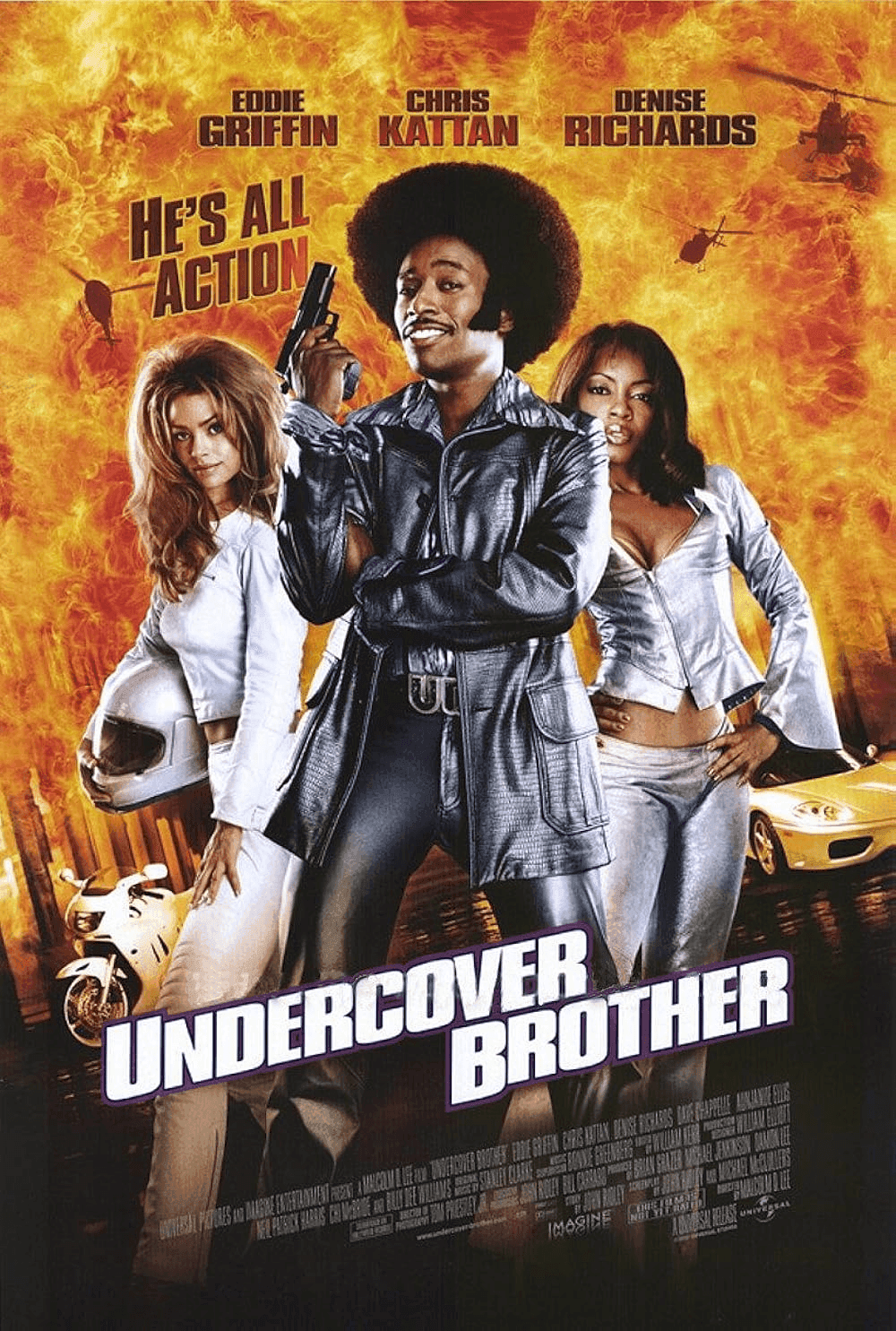
Anton Jackson, a streetwise hipster with an afro and a passion for 1970s pop culture, is recruited by the secret B.R.O.T.H.E.R.H.O.O.D. organization as agent Undercover Brother to infiltrate the corporation of The Man, an all-powerful figure determined to undermine Black culture in America. Going undercover as a strait-laced corporate executive while being seduced by the femme fatale White She-Devil, Undercover Brother and his team must save General Boutwell from mind-control and uncover The Man's plot.
What Is the Budget of Undercover Brother (2002)?
Undercover Brother (2002), directed by Malcolm D. Lee and distributed by Universal Pictures, was produced on a reported budget of $25,000,000. The film expanded the popular UrbanEntertainment.com web cartoon of the same name into a feature comedy, with Eddie Griffin headlining as the titular blaxploitation-style superspy. Denise Richards co-starred as the femme fatale White She-Devil, with Aunjanue Ellis, Dave Chappelle, Chris Kattan, Neil Patrick Harris, and Billy Dee Williams filling out the ensemble.
The investment reflected a calculated mid-budget Black-comedy bet that aligned with Universal's aggressive 2000s push into Eddie Griffin and Spike Lee-adjacent material. Malcolm D. Lee, the cousin of Spike Lee, was attached to direct following his breakout debut The Best Man (1999), with Spike Lee's 40 Acres and a Mule Filmworks co-producing alongside Imagine Entertainment's Brian Grazer and Imagine Films's Michael Jenkinson. The budget accommodated Atlanta production, extensive 1970s-style needle-drop music licensing, and a multi-week reshoot block to refine the parody.
Key Budget Allocation Categories
Undercover Brother's reported $25,000,000 budget was distributed across several core production areas:
- Above-the-Line Talent: Director Malcolm D. Lee commanded a feature-director rate appropriate to his post-Best Man market value. Eddie Griffin (Deuce Bigalow: Male Gigolo, Date Movie) commanded a top-tier Black-comedy quote, with Denise Richards (Wild Things, The World Is Not Enough), Aunjanue Ellis (Men of Honor), Dave Chappelle (Half Baked, Chappelle's Show was a year away), Chris Kattan (SNL), Neil Patrick Harris (Doogie Howser, M.D.), and Billy Dee Williams (Brian's Song, Star Wars) anchoring an internationally recognizable ensemble.
- Production Design and Set Construction: Production designer William Elliott and his department reconstructed B.R.O.T.H.E.R.H.O.O.D. headquarters (a soundstage build), The Man's corporate Multinational Inc. headquarters, the 1970s-style funk-soul nightclub interiors, and the karate-dojo training sequence sets. The retro-futurist set design represented one of the production's single largest line items.
- Music and Licensing: Composer Stanley Clarke scored the film, and the production licensed an extensive catalog of 1970s soul, funk, and disco tracks for parody sequences including James Brown, Curtis Mayfield, Isaac Hayes, Sly and the Family Stone, and the Ohio Players. Music licensing represented one of the most-substantial line items, given the parody depended on instantly recognizable musical cues from the 1970s blaxploitation era.
- Costume Design: Costume designer Danielle Hollowell designed the 1970s-pastiche wardrobes for the principal cast and supporting ensemble, including Eddie Griffin's leather-jacket-and-afro signature look, the karate-dojo white gi sequences, and Denise Richards's White She-Devil seduction costumes. The costume budget reflected the multi-period spread (contemporary office and corporate, period 1970s parody) and the parody's emphasis on visual gags.
- Visual Effects: Although Undercover Brother was lighter on digital effects than its straight-genre targets, the film required CGI for the Brotherhood headquarters wall-screens, the spy-gadget gags, and the climactic conference-room destruction. Vendor work was concentrated at smaller Atlanta and Los Angeles VFX houses, with shot counts intentionally restrained.
- Atlanta Location Production: Principal photography took place primarily in Atlanta, Georgia, with the production using practical Atlanta and surrounding-county locations doubling for the unnamed metropolitan setting. Atlanta's nascent 2002 production environment, before the state's aggressive tax credit was enacted in 2008, was nonetheless cost-competitive with comparable Los Angeles soundstage shoots.
How Does Undercover Brother's Budget Compare to Similar Films?
At a reported $25,000,000, Undercover Brother sat in the mid-range of early-2000s Black comedies. The comparison set frames its commercial outcome:
- The Best Man (1999): Budget $9,000,000 | Worldwide $34,154,029. Malcolm D. Lee's breakout debut cost roughly one third and earned 86% of Undercover Brother's worldwide total, providing the template the director's subsequent material aspired to.
- Barbershop (2002): Budget $12,000,000 | Worldwide $77,158,389. The Tim Story-directed contemporaneous Black comedy released four months later cost half and earned 92% more worldwide, illustrating how a more grounded Black-comedy ensemble outperformed Undercover Brother's parody-style premise.
- Friday After Next (2002): Budget $10,500,000 | Worldwide $33,584,047. The third Friday film released six months later cost less than half and earned 84% of Undercover Brother's worldwide total, again confirming the broader strength of the Black-comedy category.
- Austin Powers in Goldmember (2002): Budget $63,000,000 | Worldwide $296,655,431. The Mike Myers comedy spy parody released two months later cost 2.5 times as much and earned 7.4 times the worldwide total, the genre-peer comparison Universal could not avoid when projecting an Undercover Brother ceiling.
- Snow Day (2000): Budget $30,000,000 | Worldwide $61,148,067. Nickelodeon's family comedy released two years earlier cost 20% more and earned 53% more worldwide, a useful peer comparison for the $25,000,000-bracket family-and-young-adult comedy.
Undercover Brother Box Office Performance
Undercover Brother opened on May 31, 2002, finishing third at the domestic box office with $11,749,400 over its opening weekend. That figure trailed Spider-Man (in its fifth weekend) and Star Wars: Episode II - Attack of the Clones (in its third weekend), and the picture's legs through June were respectable for a parody comedy, holding into the top ten for three weeks.
Against a reported production budget of $25,000,000, the film needed approximately $60,000,000 in worldwide gross to reach profitability when accounting for marketing and distribution costs. Here is the financial breakdown:
Box Office Breakdown
Undercover Brother

Undercover Brother returned approximately $0.80 in worldwide theatrical revenue for every $1 invested when measured against total estimated production and marketing spend, a marginal commercial outcome that fell below Universal's break-even threshold. The domestic share of the gross was $38,237,800 against an international share of just $1,835,000, a 95/5 split heavily weighted toward North America and a clear signal that the property's blaxploitation-era cultural references did not translate to international markets unfamiliar with the source material.
The commercial result did not damage Malcolm D. Lee's subsequent career, with the director going on to Welcome Home Roscoe Jenkins (2008), Soul Plane (which he ultimately didn't direct), The Best Man Holiday (2013), Girls Trip (2017), and Space Jam: A New Legacy (2021). Eddie Griffin's post-Undercover Brother trajectory included Date Movie (2006) and continued voice and supporting work, though he did not return to leading-man theatrical comedy at this scale.
A 2019 streaming-only sequel, Undercover Brother 2, was released directly to DVD and Netflix, with Vince Swann replacing Eddie Griffin as the title character's younger brother.
Undercover Brother Production History
Development on a Undercover Brother feature began in 2000 when Universal acquired feature-film rights to the popular UrbanEntertainment.com web cartoon created by John Ridley (who would later win the Best Adapted Screenplay Oscar for 12 Years a Slave in 2014). John Ridley wrote the screenplay with Michael McCullers (Austin Powers: The Spy Who Shagged Me, Mr. Peabody and Sherman) co-writing, with Malcolm D. Lee attaching as director in early 2001.
Casting Eddie Griffin as Undercover Brother was the production's defining creative anchor. Griffin attached in late 2001 on the strength of his Deuce Bigalow: Male Gigolo and Double Take credits, with Denise Richards joining as White She-Devil in November 2001 and Aunjanue Ellis as Sister Girl in early 2002.
Principal photography began in February 2002 in Atlanta, Georgia, with the production using practical Atlanta and surrounding-county locations doubling for the unnamed metropolitan setting. The unit shot at standing Atlanta soundstages and at practical office, nightclub, and street locations across the metropolitan area. Shooting wrapped in April 2002 after a roughly ten-week schedule.
Post-production ran through spring 2002 with a compressed turnaround targeting the May 31 release. The film was rated PG-13 by the MPAA for language, sexual humor, and drug references. Universal positioned the picture as Black-comedy counter-programming against the Spider-Man and Attack of the Clones tentpoles dominating the corridor, a strategic choice that produced a respectable third-place opening but limited subsequent expansion.
Awards and Recognition
Undercover Brother received minimal awards recognition. The film was not nominated at the Academy Awards, the Golden Globes, the Saturn Awards, or any of the principal critics' organizations.
The film received Black Reel Award nominations for Best Comedy and Best Actor (Eddie Griffin), with Eddie Griffin winning the Best Actor award at the 2003 ceremony. The film also received NAACP Image Award nominations for Outstanding Motion Picture and Outstanding Actor in a Motion Picture (Eddie Griffin). The broader awards-season absence reflected the parody-comedy positioning and the marginal commercial performance.
Critical Reception
Undercover Brother received generally positive reviews. The film holds a 76% approval rating on Rotten Tomatoes based on 121 critic reviews, with the consensus calling it a sharper-than-expected parody powered by Eddie Griffin's commitment. On Metacritic, the film scored 65 out of 100, indicating generally favorable reviews. Audiences surveyed by CinemaScore gave the film a B.
Roger Ebert wrote in the Chicago Sun-Times that the film "deploys the blaxploitation reference set with affection rather than condescension, and that makes all the difference," and A. O. Scott in The New York Times called it "the rare studio parody that knows what it loves." Variety's Joe Leydon noted that Eddie Griffin "holds the film together with a deceptively casual performance that few of his peers could replicate."
Genre and Black-press reaction was overwhelmingly positive. Ebony, Jet, and the Amsterdam News all praised the film as a smart engagement with blaxploitation history, with Denise Richards's self-aware White She-Devil performance and the Brian Knapp-Aunjanue Ellis chemistry receiving particular notice. The reception has cemented Undercover Brother's reputation as a critical sleeper hit that nonetheless failed to convert its critical traction into box office momentum.
Frequently Asked Questions
How much did it cost to make Undercover Brother (2002)?
The reported production budget was $25,000,000. Universal Pictures distributed the film, with Imagine Entertainment (Brian Grazer) and 40 Acres and a Mule Filmworks (Spike Lee) co-producing.
How much did Undercover Brother earn at the box office?
The film grossed $38,237,800 domestically and $1,835,000 internationally, for a worldwide total of $40,072,800. It opened to $11,749,400 in the United States, finishing third on its May 31, 2002 opening weekend behind Spider-Man (in its fifth weekend) and Star Wars: Episode II - Attack of the Clones (in its third weekend).
Was Undercover Brother a box office success?
Marginally not. Against a $25,000,000 production budget and an estimated $20,000,000 to $25,000,000 in marketing spend, the film returned approximately $0.80 in worldwide gross for every $1 invested, falling below Universal's break-even threshold. The domestic-skewing 95/5 international split reflected the property's blaxploitation-era cultural references not translating to international markets.
Who directed Undercover Brother?
Malcolm D. Lee directed the film, working from a screenplay by John Ridley (who would later win the Best Adapted Screenplay Oscar for 12 Years a Slave in 2014) and Michael McCullers. Lee had previously directed The Best Man (1999) and went on to direct The Best Man Holiday (2013), Girls Trip (2017), and Space Jam: A New Legacy (2021).
Where was Undercover Brother filmed?
Principal photography began in February 2002 in Atlanta, Georgia, with the production using practical Atlanta and surrounding-county locations doubling for the unnamed metropolitan setting. The unit shot at standing Atlanta soundstages and at practical office, nightclub, and street locations across the metropolitan area. Shooting wrapped in April 2002.
Who stars in Undercover Brother?
Eddie Griffin plays the title character Undercover Brother (real name Anton Jackson). Supporting cast includes Denise Richards as White She-Devil, Aunjanue Ellis as Sister Girl, Dave Chappelle as Conspiracy Brother, Chris Kattan as Mr. Feather, Neil Patrick Harris as Lance, Chi McBride as the Chief, and Billy Dee Williams as General Warren Boutwell.
Is Undercover Brother based on a web cartoon?
Yes. The film expanded the popular UrbanEntertainment.com web cartoon Undercover Brother, created by John Ridley in 1999. The original web series had built a substantial online following during the late-1990s and early-2000s, and Universal acquired feature-film rights in 2000.
What did critics think of Undercover Brother?
The film received generally positive reviews, with a 76% approval rating on Rotten Tomatoes (based on 121 critics) and a 65 out of 100 score on Metacritic. Audiences gave it a B CinemaScore. Roger Ebert praised the film's affectionate engagement with the blaxploitation reference set, and A. O. Scott in The New York Times called it the rare studio parody that knows what it loves.
Did Undercover Brother have a sequel?
A 2019 streaming-only sequel, Undercover Brother 2, was released directly to DVD and Netflix. The sequel features Vince Swann replacing Eddie Griffin as the title character's younger brother (with Griffin returning briefly in a flashback role). The straight-to-streaming production was a low-budget release that received minimal critical attention.
Did Undercover Brother win any awards?
The film received Black Reel Award nominations for Best Comedy and Best Actor (Eddie Griffin), with Eddie Griffin winning the Best Actor award at the 2003 ceremony. The film also received NAACP Image Award nominations for Outstanding Motion Picture and Outstanding Actor in a Motion Picture (Eddie Griffin). It received no Academy Award, Golden Globe, or major critics' awards.
Filmmakers
Undercover Brother

Build budgets like this one in Saturation
Start from an industry-standard feature film template, import the schedule and rates you already have, and let the cost report keep itself current as you spend. Real-time collaboration, no spreadsheets.