Trading Places Budget
 Comedy116 minutes
Updated
Synopsis
A snobbish investor and a wily street con-artist find their positions reversed as part of a bet by two callous millionaires.
What Is the Budget of Trading Places?
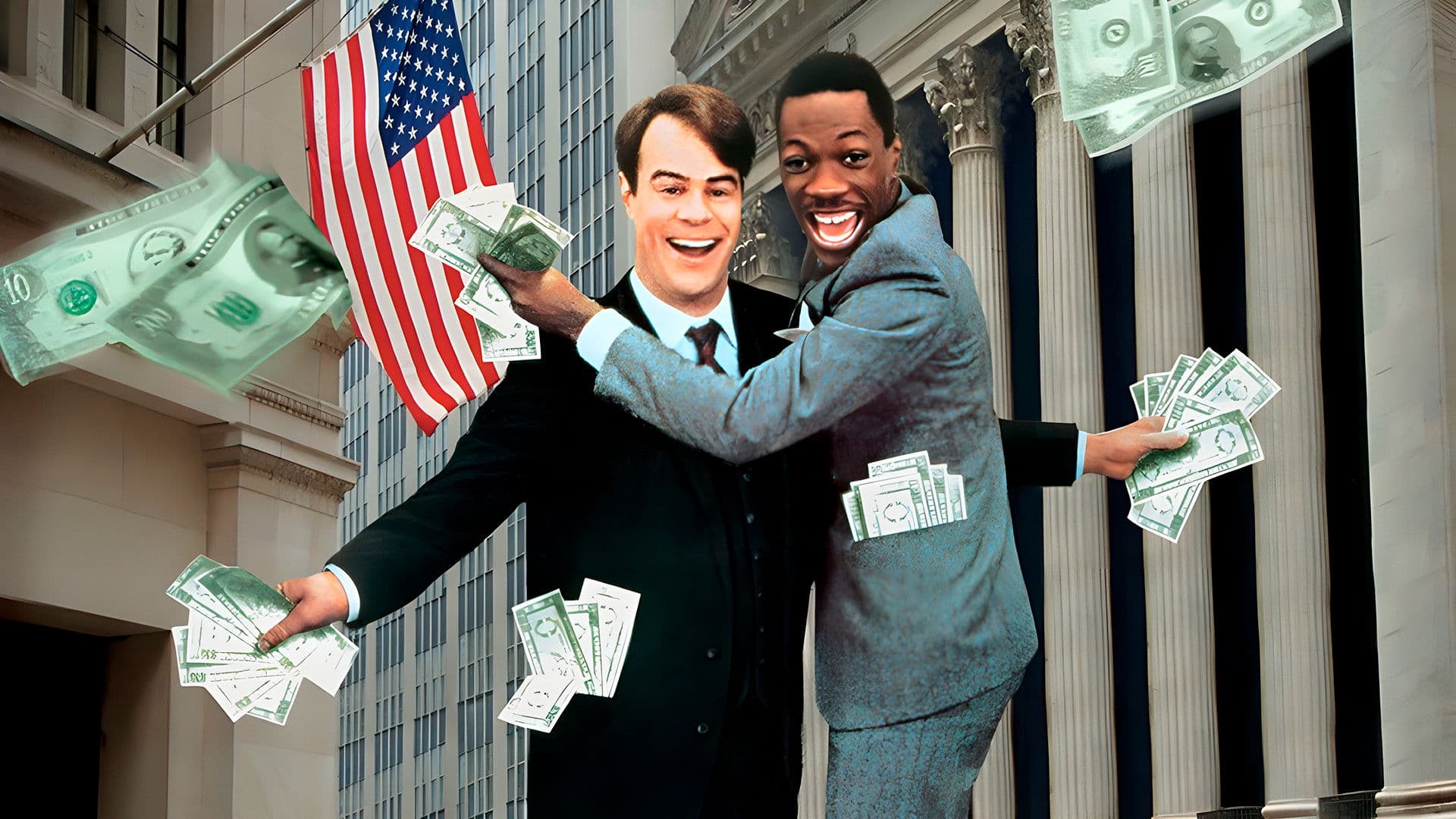
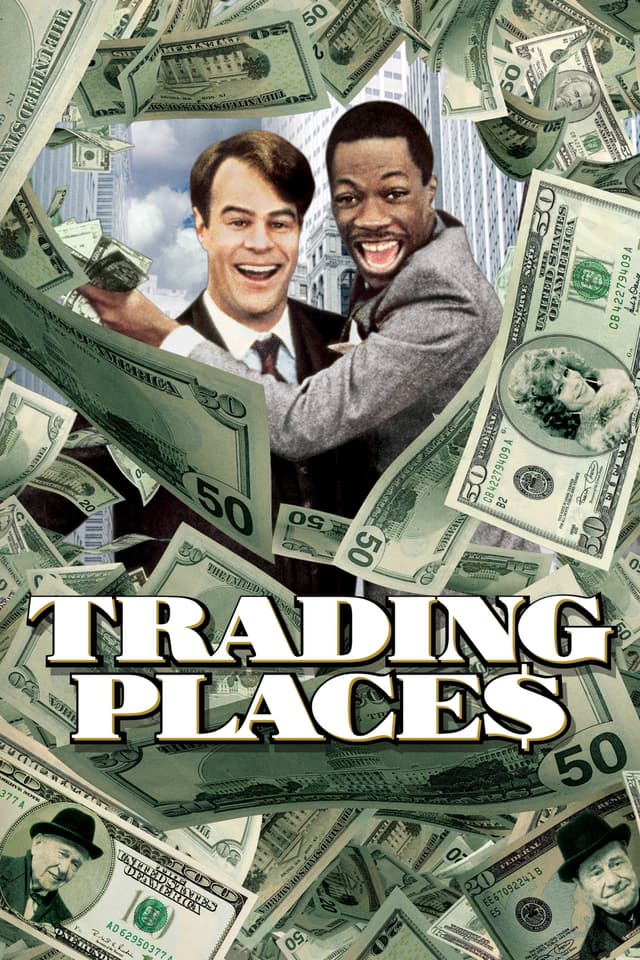
Trading Places was produced by Aaron Russo for Paramount Pictures on a budget of $15,000,000 in 1983 dollars. Directed by John Landis from a screenplay by Timothy Harris and Herschel Weingrod, the film starred Dan Aykroyd and Eddie Murphy in their first pairing, supported by Ralph Bellamy, Don Ameche, Jamie Lee Curtis, and Denholm Elliott.
$15 million was a solid mid-tier studio comedy budget for 1983, reflecting the caliber of talent assembled and the demands of a New York City and Philadelphia location shoot. The investment proved remarkably efficient: Trading Places became the fourth-highest-grossing film of 1983 in the United States and earned $120,600,000 worldwide, cementing it as one of the most commercially successful comedies of the decade.
Key Budget Allocation Categories
The $15,000,000 production budget for Trading Places was concentrated in these primary areas:
- Talent Salaries: Eddie Murphy received approximately $1,000,000, a major step up from 48 Hrs. (1982). Dan Aykroyd, whose recent solo work had underperformed, agreed to a reduced fee to secure the role. Ralph Bellamy and Don Ameche, both Hollywood veterans, commanded fees befitting their status.
- Location Photography: Principal photography ran 78 days from December 13, 1982 through March 1, 1983 across Philadelphia and New York City, including the New York Mercantile Exchange trading floor. Winter location shoots in major cities carry premium costs for permits, logistics, and crew accommodation.
- Production Design and Costumes: The script required detailed period-accurate Wall Street sets, upscale interiors for the Duke and Duke brokerage house, and the visual contrast between Aykroyd's patrician wardrobe and Murphy's street clothes, all requiring significant wardrobe and art department investment.
- Elmer Bernstein Score: The Academy Award-nominated score, incorporating Handel's Messiah and original orchestral compositions, required a full ensemble recording.
- Saint Croix Beach Sequence: The finale was filmed on location in St. Croix, U.S. Virgin Islands, adding travel, crew, and equipment logistics to the budget for those sequences.
How Does Trading Places Compare to Similar Films?
Trading Places sits among the most cost-efficient studio comedies of the 1980s. Its $15 million budget and $120.6 million worldwide return place it in an elite category of comedies that converted modest production investment into major commercial results.
- 48 Hrs. (1982): Budget approximately $12,000,000 | Domestic $78,868,508. Eddie Murphy's film debut the year before Trading Places, which launched his career and made the pairing with Aykroyd commercially irresistible to Paramount.
- Tootsie (1982): Budget approximately $21,000,000 | Domestic $177,200,000. The Dustin Hoffman comedy from the same era showed that smart social satire could generate outsized returns, a model Trading Places followed closely.
- National Lampoon's Vacation (1983): Budget approximately $15,000,000 | Domestic $61,399,552. Released the same summer on a comparable budget, but Trading Places outperformed it by nearly $30 million domestically.
- Beverly Hills Cop (1984): Budget approximately $14,000,000 | Domestic $234,760,478. Murphy's follow-up to Trading Places, built on the same formula of fish-out-of-water comedy with an edge, demonstrated how far his star had risen in just one year.
- Ghostbusters (1984): Budget approximately $30,000,000 | Domestic $229,242,989. The following year's blockbuster comedy featured Aykroyd alongside Bill Murray and benefited from significantly higher VFX costs, illustrating how economically Trading Places was produced for its commercial ambitions.
Trading Places Box Office Performance
Trading Places opened on June 8, 1983, earning $7,348,200 in its opening weekend. The film built steadily through word of mouth, ultimately becoming the fourth-highest-grossing film of 1983 in the United States behind Return of the Jedi, Terms of Endearment, and Flashdance. It was the top-grossing comedy of 1983 domestically.
Box Office Breakdown
Trading Places (1983)

Trading Places returned approximately $8 for every $1 invested in production costs. Against total estimated investment of $25 million, the worldwide gross still represented a return of more than 4 to 1, placing it among the most profitable studio comedies of the early 1980s.
The film's domestic performance was driven almost entirely by North American audiences, with international revenues of approximately $30 million reflecting more limited overseas marketing for American comedy at the time. The domestic total of $90.4 million made it the clear comedy champion of 1983, a year that included strong competition from other studio releases.
Trading Places Production History
The script for Trading Places originated with writers Timothy Harris and Herschel Weingrod, who conceived it as a vehicle for Richard Pryor and Gene Wilder following the success of films like Silver Streak (1976) and Stir Crazy (1980). When Pryor was seriously injured in a freebasing accident in 1980, the project required a complete recasting.
Director John Landis, fresh from An American Werewolf in London (1981) and building on the massive success of The Blues Brothers (1980), brought Dan Aykroyd into the project. Aykroyd, whose solo work had not replicated his success with John Belushi, agreed to a pay reduction to secure the part. Paramount Pictures was initially skeptical, viewing Aykroyd as an ensemble player rather than a lead.
Eddie Murphy, 21 years old during production, had just completed 48 Hrs. (1982), his film debut, which had demonstrated his ability to command a screen. Paramount championed Murphy for the role of Billy Ray Valentine, the street hustler swept up in the Duke brothers' social experiment. The studio was less certain about Jamie Lee Curtis, then typecast as a horror actress following Halloween (1978) and its sequels. Landis cast her anyway, and her comedic performance as Ophelia earned her a BAFTA Award.
Principal photography ran 78 days from December 13, 1982, through March 1, 1983, shot entirely on location in Philadelphia and New York City. The New York Mercantile Exchange provided the setting for the film's climactic commodity trading sequence, with the frozen concentrated orange juice futures pit at the center of the plot. Final scenes were filmed in Saint Croix, U.S. Virgin Islands.
The film's plot drew on the tradition of class-swap comedies stretching from Mark Twain's The Prince and the Pauper through the screwball comedies of the 1930s, updating the premise with pointed commentary on Reagan-era economic inequality. The Duke brothers' casual bet over whether nature or nurture determines success functions as a satire of inherited wealth and social mobility that gave the comedy a bite beyond its surface entertainment.
The commodity trading plot that drives the finale had an unexpected real-world afterlife. In 2010, Congress passed the Dodd-Frank Wall Street Reform and Consumer Protection Act. Section 746 of that legislation, which prohibits federal employees from leaking government information to commodity traders and bars traders from profiting on such leaked information, became known colloquially as the Eddie Murphy Rule. A CFTC commissioner cited the film directly in congressional testimony when explaining the provision, noting that the scheme executed by Murphy and Aykroyd in the film had not, in fact, been illegal before the law passed.
Awards and Recognition
Trading Places received nominations and wins across the major awards circuits for the 1983 awards season:
- BAFTA Award, Best Supporting Actor: Won. Denholm Elliott as Coleman, the Duke family's butler, delivered what many critics considered the finest performance in the film. Elliott won the BAFTA over a competitive field.
- BAFTA Award, Best Supporting Actress: Won. Jamie Lee Curtis as Ophelia. The win was a signal moment for Curtis, repositioning her beyond the horror genre in which she had built her early career.
- BAFTA Award, Best Original Screenplay: Nominated. Timothy Harris and Herschel Weingrod lost to Paul D. Zimmerman for The King of Comedy (1982).
- Academy Award, Best Original Score: Nominated. Elmer Bernstein's score, which incorporated Handel's Messiah alongside original compositions, was nominated at the 56th Academy Awards. Bernstein lost to Michel Legrand, Alan Bergman, and Marilyn Bergman for Yentl.
- Golden Globe, Best Motion Picture (Musical or Comedy): Nominated at the 41st Golden Globe Awards. The film lost to Yentl.
- Golden Globe, Best Actor in a Musical or Comedy: Nominated for Eddie Murphy. Murphy lost to Michael Caine for Educating Rita (1983), though the nomination was widely seen as recognition of his breakthrough year.
Critical Reception
Trading Places holds an 87% approval rating on Rotten Tomatoes based on 53 reviews, with an 85% audience score from over 50,000 ratings. The critics consensus reads: "Featuring deft interplay between Eddie Murphy and Dan Aykroyd, Trading Places is an immensely appealing social satire." The film carries a Metacritic score of 69, reflecting favorable reviews from most major critics at the time of release.
Contemporary reviews highlighted the chemistry between Murphy and Aykroyd as the film's defining strength. The Associated Press noted that "the sparkling performances are the real draw, not only by Murphy and Aykroyd but also by Don Ameche and Ralph Bellamy." The Guardian called the film "a joy to behold, clever without being smart, affectionate without being sentimental." Roger Ebert awarded the film four out of four stars, writing that Murphy and Aykroyd were "one of the most entertaining comedy teams" he had seen.
Denholm Elliott's performance as Coleman was singled out repeatedly, earning him the BAFTA Supporting Actor award and establishing him as one of the most dependable character actors in English-language cinema. Don Ameche and Ralph Bellamy, both in their 70s during production, received widespread praise for their work as the Duke brothers; Ameche would win an Academy Award the following year for Cocoon (1985).
The film is consistently cited among the greatest comedies of the 1980s and as a pivotal film in Eddie Murphy's career. Murphy had appeared in only one previous feature (48 Hrs.) before Trading Places; by the time Beverly Hills Cop opened in 1984, he was the biggest box office draw in Hollywood. Trading Places is credited as the film that confirmed the transition.
Frequently Asked Questions
What was the production budget for Trading Places?
Trading Places was produced on a budget of approximately $15,000,000. The film was made for Paramount Pictures, with Aaron Russo as producer. That figure covered 78 days of location photography in Philadelphia and New York City, the principal cast salaries for Dan Aykroyd and Eddie Murphy, and Elmer Bernstein's orchestral score.
How much did Trading Places make at the box office?
Trading Places earned $90,404,800 domestically and approximately $30,200,000 internationally, for a worldwide gross of $120,600,000. It was the fourth-highest-grossing film of 1983 in the United States and the top-grossing comedy of that year domestically, finishing ahead of National Lampoon's Vacation and Risky Business.
What is the Eddie Murphy Rule from Trading Places?
Section 746 of the Dodd-Frank Wall Street Reform and Consumer Protection Act (2010) is informally known as the Eddie Murphy Rule. It prohibits federal employees from leaking nonpublic government information to commodity traders and bars anyone from profiting on such leaked data. The provision was named after the film because the scheme Murphy and Aykroyd execute in the finale, feeding false USDA crop reports to the Duke brothers to corner the orange juice futures market, had not actually been illegal before the law passed. A CFTC commissioner cited the film by name in congressional testimony during the legislative debate.
Was Trading Places a breakthrough film for Eddie Murphy?
Yes. Trading Places was only Eddie Murphy's second feature film, following 48 Hrs. (1982). He was 21 years old during production. The film confirmed that Murphy could carry a major studio comedy as a co-lead and cemented his bankability with Paramount. Beverly Hills Cop followed in 1984, by which point Murphy had become the highest-grossing box office star in Hollywood. Trading Places is widely credited as the film that made the transition possible.
How does Trading Places relate to The Prince and the Pauper?
The film's central premise, in which a wealthy man and a poor man have their lives forcibly exchanged as the result of a bet by two powerful figures, draws directly from the class-swap tradition of Mark Twain's The Prince and the Pauper. Writers Timothy Harris and Herschel Weingrod updated that framework with a Wall Street setting and pointed commentary on Reagan-era inequality. The Duke brothers' casual wager over nature versus nurture functions as a satire of how inherited privilege shapes opportunity, grounding the comedy in genuine social critique.
Did Trading Places win any awards?
Yes. The film won two BAFTA Awards at the 37th British Academy Film Awards: Best Supporting Actor for Denholm Elliott and Best Supporting Actress for Jamie Lee Curtis. It received additional nominations for BAFTA Best Original Screenplay (Timothy Harris and Herschel Weingrod), Academy Award Best Original Score (Elmer Bernstein), Golden Globe Best Musical or Comedy, and Golden Globe Best Actor in a Musical or Comedy for Eddie Murphy.
Filmmakers
Trading Places (1983)

Official Trailer
Build budgets like this one in Saturation
Start from an industry-standard feature film template, import the schedule and rates you already have, and let the cost report keep itself current as you spend. Real-time collaboration, no spreadsheets.