
Popeye Budget
 ActionAdventureComedyFamily1h 54m
Updated
Synopsis
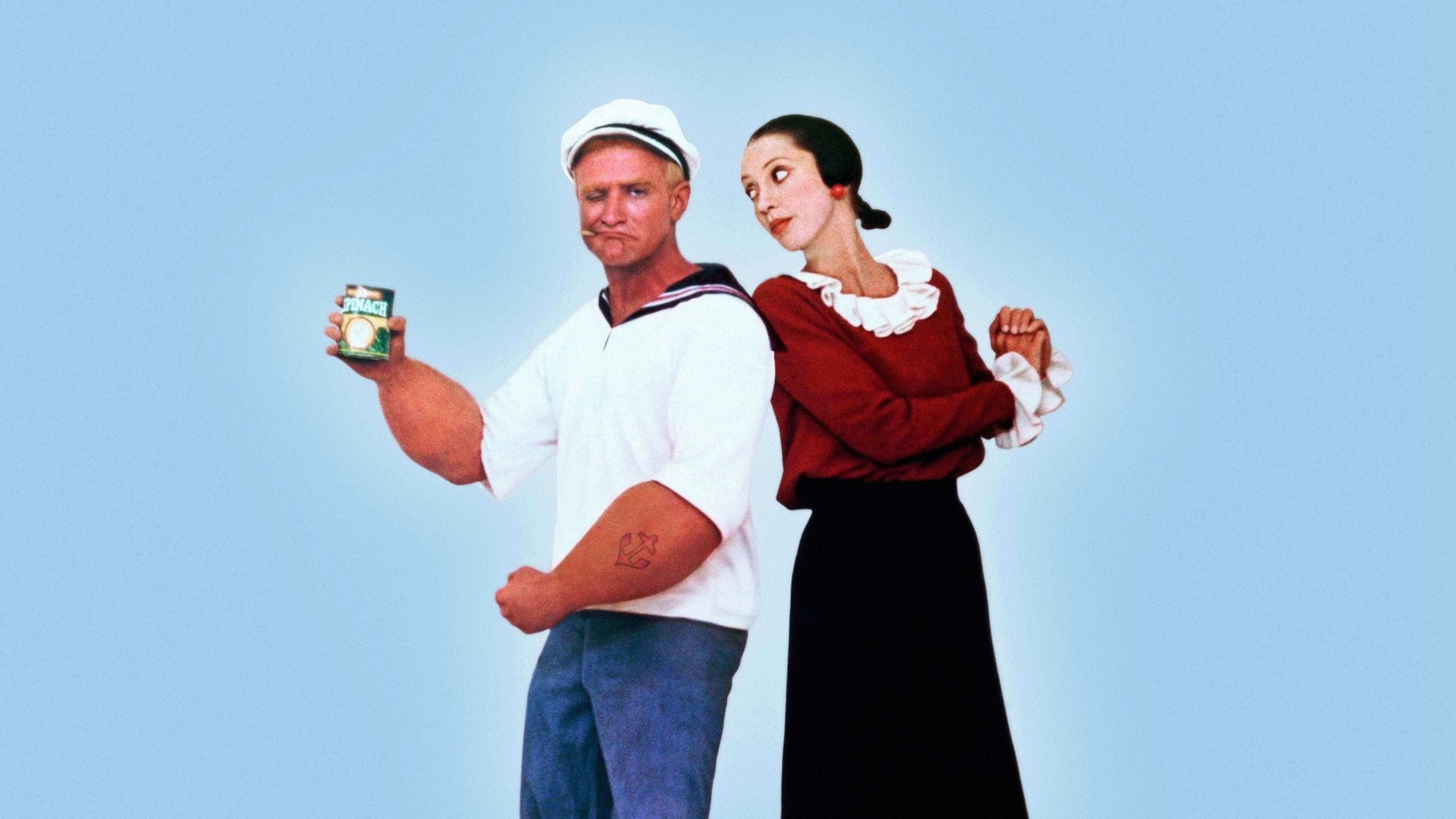
"Popeye" (1980) is a musical comedy directed by Robert Altman, bringing the beloved comic strip character to life in a whimsical and vibrant seaside town. The story follows the iconic sailor, played by Robin Williams, as he arrives in the quirky town of Sweethaven in search of his long-lost father. Upon his arrival, Popeye encounters a colorful cast of characters, including the sweet and spirited Olive Oyl, portrayed by Shelley Duvall, who quickly captures his heart.
As Popeye navigates the challenges of his new surroundings, he faces off against the brutish Bluto, a rival who seeks to win Olive's affections and create chaos in the town. The film is filled with catchy musical numbers and charming visuals, showcasing Popeye's unique abilities and his love for spinach, which gives him superhuman strength. Ultimately, the story unfolds with themes of love, friendship, and the importance of staying true to oneself, all wrapped in a delightful and humorous package that appeals to audiences of all ages.
What is the budget of Popeye?
"Popeye," an action released in 1980, was directed by Robert Altman and stars Robin Williams, Shelley Duvall. The production budget was $20,000,000, placing it in the mid-budget range for action productions of the 1980s.
Key Budget Allocation Categories
While specific budget breakdowns are not publicly available, typical cost drivers for an action production like this include:
- Stunts, Action Sequences & Visual Effects: Action films allocate a substantial portion of their budget to choreographing and executing practical stunts, pyrotechnics, and CGI-heavy sequences.
- Above-the-Line Talent (Cast & Director): A-list talent commands significant upfront fees plus backend participation.
- Production Design, Sets & Locations: Action films frequently require multiple international shooting locations, large-scale set construction, vehicle acquisitions and modifications, and specialized equipment , all of which drive production costs well above those of dialogue-driven genres.
- Production: In his book, Fiasco: A History of Hollywood's Iconic Flops, James Robert Parish says that the Popeye musical had its basis in the bidding war for the film adaptation of the Broadway musical, Annie, between the two major studios vying for the rights, Columbia and Paramount.
What were the major cost factors in Popeye?
Several factors contributed to the overall production costs of "Popeye."
- Stunts: Stunts, Action Sequences & Visual Effects is one of the primary cost drivers in action productions of this scale.
- Above-the-Line Talent (Cast: Above-the-Line Talent (Cast & Director) is one of the primary cost drivers in action productions of this scale.
- Production Design: Production Design, Sets & Locations is one of the primary cost drivers in action productions of this scale.
How Does Popeye's Budget Compare to Similar Films?
At $20,000,000, Popeye sits in the mid-budget range. Here is how it compares to productions with a similar budget:
- 12 Years a Slave (2013): Budget $20,000,000, Worldwide Gross $187,000,000
- 21 Grams (2003): Budget $20,000,000, Worldwide Gross $60,427,839
- 3 Ninjas Kick Back (1994): Budget $20,000,000, Worldwide Gross $11,798,854
- A Guy Thing (2003): Budget $20,000,000, Worldwide Gross $17,400,000
- A Most Violent Year (2014): Budget $20,000,000, Worldwide Gross $12,007,070
The median budget for wide-release action films in the era ranges from $30 to 80M for mid-budget to $150M+ for tentpoles.
Popeye Box Office Performance
"Popeye" earned $49,823,037 worldwide at the box office. Against a production budget of $20,000,000, the film showed modest profitability in theatrical release.
A film typically needs to earn approximately twice its production budget to cover marketing and distribution costs. For "Popeye," that break-even threshold was roughly $40,000,000. With worldwide earnings of $49,823,037, the film cleared that threshold comfortably.
Box Office Breakdown
Popeye

At 149.1%, "Popeye" earned roughly $2.49 for every $1 invested in production.
Awards and Recognition
3 wins & 4 nominations total
Critical Reception
Reviews at the time were generally negative, but the film has been more positively reappraised over time.
Frequently Asked Questions
How much did it cost to make Popeye (1980)?
The production budget was $20,000,000, covering principal photography, visual effects, cast and crew salaries, locations, sets, post-production, and music. Marketing and distribution (P&A) costs are estimated at an additional $10,000,000 - $16,000,000, bringing the total studio investment to approximately $30,000,000 - $36,000,000.
How much did Popeye (1980) earn at the box office?
Popeye grossed $49,823,037 domestic, totaling $49,823,037 worldwide.
Was Popeye (1980) profitable?
The film did not break even theatrically, earning $49,823,037 against an estimated $50,000,000 needed. Ancillary revenue may have improved the picture.
What were the biggest costs in producing Popeye?
The primary cost drivers were above-the-line talent (Robin Williams, Shelley Duvall, Ray Walston); visual effects, practical stunts, and A-list talent compensation.
How does Popeye's budget compare to similar action films?
At $20,000,000, Popeye is classified as a low-budget production. The median budget for wide-release action films in the era ranges from $30 - 80M for mid-budget to $150M+ for tentpoles. Comparable budgets: 12 Years a Slave (2013, $20,000,000); 21 Grams (2003, $20,000,000); 3 Ninjas Kick Back (1994, $20,000,000).
Did Popeye (1980) go over budget?
There are no widely reported accounts of significant budget overruns for this production. However, studios rarely disclose precise budget overrun figures publicly. The reported production budget reflects the final estimated cost.
What was the return on investment (ROI) for Popeye?
The theatrical ROI was 149.1%, calculated as ($49,823,037 − $20,000,000) ÷ $20,000,000 × 100. This measures gross revenue against production budget only - it does not account for P&A or exhibitor shares.
What awards did Popeye (1980) win?
3 wins & 4 nominations total.
Who directed Popeye and who were the key crew members?
Directed by Robert Altman, written by Jules Feiffer, shot by Giuseppe Rotunno, with music by Harry Nilsson, edited by David A. Simmons, John W. Holmes.
Where was Popeye filmed?
Popeye was filmed in United States of America.
Filmmakers
Popeye

Official Trailer
Build budgets like this one in Saturation
Start from an industry-standard feature film template, import the schedule and rates you already have, and let the cost report keep itself current as you spend. Real-time collaboration, no spreadsheets.