Toy Story Budget
 FamilyComedyAnimationAdventure1h 21m
Updated
Synopsis
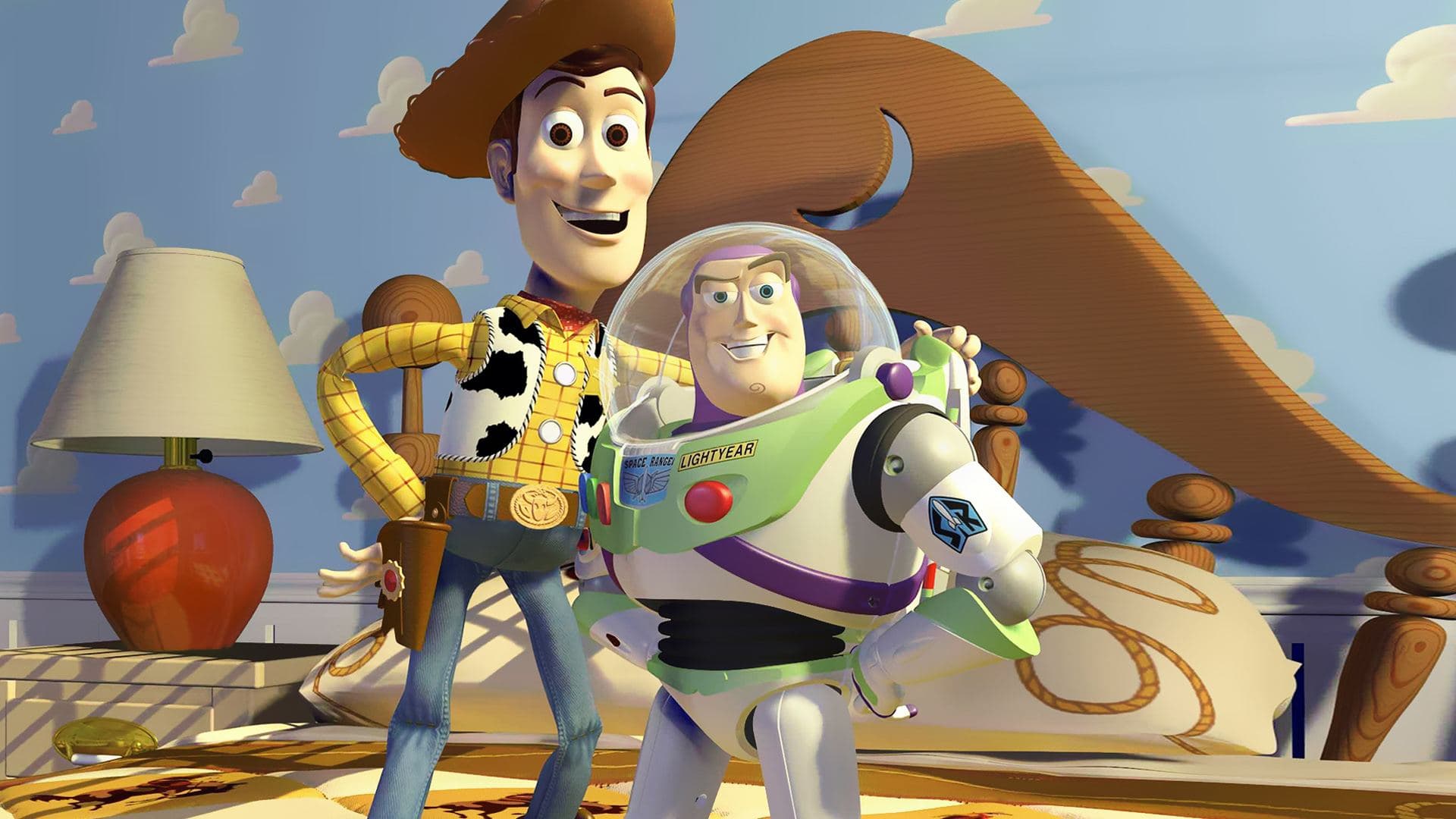
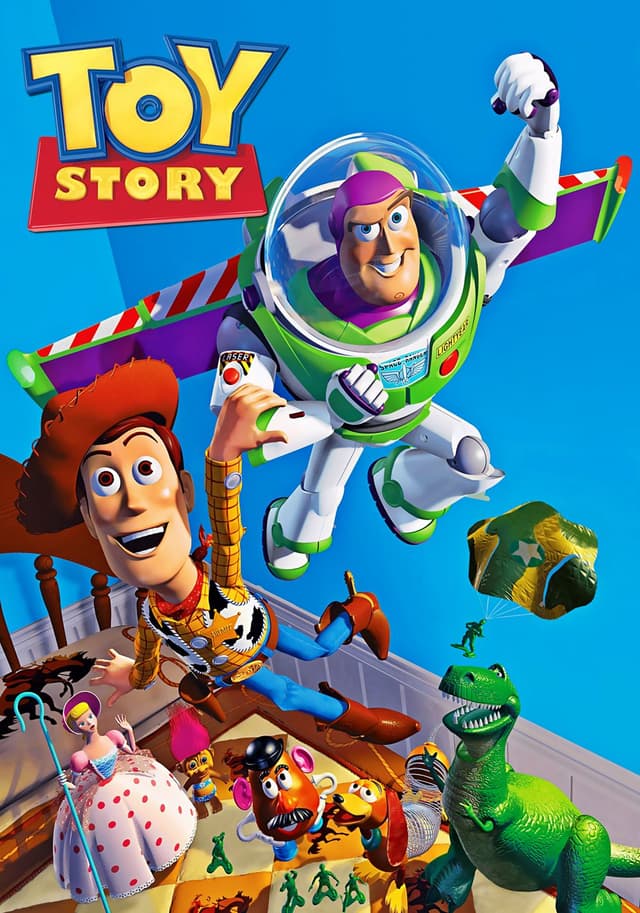
"Toy Story" is a groundbreaking animated film that follows the secret life of toys when their owner, a young boy named Andy, is not around. The story centers on Woody, a pull-string cowboy doll who has long been the favorite toy of Andy. However, his world is turned upside down when Buzz Lightyear, a flashy space ranger action figure, arrives and quickly becomes Andy's new favorite. As Woody grapples with feelings of jealousy and insecurity, a series of misadventures ensue, leading to an unexpected friendship between the two toys. Together, they must navigate the challenges of being toys in a world where they must remain hidden from humans, ultimately learning valuable lessons about loyalty, friendship, and acceptance. This heartwarming tale, filled with humor and emotion, showcases the importance of camaraderie and the bittersweet nature of growing up.
What Is the Budget of Toy Story?
Toy Story (1995) was produced on a budget of $30 million by Pixar Animation Studios, with Walt Disney Pictures distributing the film through its Buena Vista Pictures label. That $30 million figure is remarkable not because it was large for 1995 -- Disney's The Lion King the previous year had cost $45 million -- but because of what it funded: the first entirely computer-generated feature film in the history of cinema. No studio had ever attempted to produce a full-length narrative film using only digital animation, which meant a significant portion of the budget was spent developing the tools and infrastructure to make the production possible at all.
In 1995 dollars, $30 million was a modest budget for a major studio release but a considerable investment for an untested medium. Pixar's team of 110 people spent approximately four years on the production, two of which followed the 1991 development deal with Disney. The computer hardware required to render 1,561 shots at 24 frames per second -- each frame taking between 45 minutes and 30 hours depending on scene complexity -- represented a capital infrastructure investment unlike anything in traditional animation. The $30 million bought not just a film but the proof of concept for an entirely new industry.
Key Budget Allocation Categories
- RenderMan Software Development: Pixar's proprietary RenderMan rendering system was not merely a production tool but a valuable IP asset. The cost of its ongoing development was amortized across the Toy Story production budget, and Pixar had already begun licensing RenderMan to other studios and effects houses. The software had been used for effects shots in films including Terminator 2 and Jurassic Park, providing Pixar a revenue stream even before Toy Story shipped.
- Tom Hanks and Tim Allen Voice Fees: Tom Hanks was one of Hollywood's highest-paid actors following back-to-back Best Actor wins for Philadelphia (1993) and Forrest Gump (1994). Tim Allen was at the peak of his Home Improvement television career with one of the most-watched shows in the country. Voice fees at star level for both leads, plus a supporting cast including Don Rickles, Jim Varney, Wallace Shawn, John Ratzenberger, and Annie Potts, represented a meaningful above-the-line cost for a $30 million production.
- Animation Team Salaries: Pixar employed 110 people across approximately four years of production. In 1993-1995, computer animators with the skill set required for feature-length CGI were genuinely scarce -- the field barely existed. Pixar recruited and retained a team whose expertise had no established market comparable. The multi-year salary cost for a specialized workforce with no precedent in the industry was one of the largest line items in the budget.
- Computing Infrastructure: The server farm required to render 1,561 shots at 24 frames per second was a capital expense with no equivalent in traditional animation. Individual frames of complex scenes required up to 30 hours of rendering time. Pixar operated roughly 117 Sun Microsystems workstations for production and a dedicated render farm for final output. The cost of purchasing, maintaining, and running this infrastructure across four years of active production was a recurring budget line unique to CGI filmmaking.
- Score and Post-Production: Randy Newman composed and recorded the film's score, including the original song 'You've Got a Friend in Me,' which received an Academy Award nomination. Newman had a prior relationship with Pixar from scoring their early short films. Post-production encompassed final rendering, sound mix, foley work, and the Dolby SR-D theatrical soundtrack. The film's post-production timeline was compressed relative to the long animation phase, with Pixar delivering the final print in time for the November 22, 1995 release.
How Does Toy Story's Budget Compare to Similar Films?
Toy Story's $30 million budget placed it below Disney's own traditionally animated blockbusters of the period but well above the typical independent film. Its commercial performance -- $373.6 million worldwide on $30 million in production costs -- set a benchmark for animated feature returns that reshaped how studios evaluated computer animation as a commercial proposition.
- The Lion King (1994): Budget $45M | Worldwide $987M. Disney's hand-drawn blockbuster the year before Toy Story demonstrated the commercial ceiling for animated features. The Lion King's production cost was 50% higher than Toy Story's, largely due to the scale of its traditional animation workforce and the production of period-accurate African settings. Toy Story entered a market The Lion King had just proven was worth over $900 million.
- A Bug's Life (1998): Budget $120M | Worldwide $363M. Lasseter's second Pixar feature cost four times as much as Toy Story and earned slightly less worldwide, illustrating how quickly CGI production costs inflated once Pixar's technical approach was established and expanded. A Bug's Life also competed directly with DreamWorks' Antz (1998), released weeks earlier, in the first major animated film rivalry of the CGI era.
- The Nightmare Before Christmas (1993): Budget $18M | Worldwide $91M. Tim Burton's stop-motion feature from Disney's Touchstone Pictures was produced two years before Toy Story at roughly 60% of its budget. Nightmare's $91 million worldwide return on $18 million was a success, but Toy Story's 12x return on investment made the case for CGI in a way stop-motion's smaller footprint could not match commercially.
- Shrek (2001): Budget $60M | Worldwide $484M. DreamWorks' first major CGI animated feature arrived six years after Toy Story at double the production cost, reflecting both inflation in CGI production budgets and the competitive market Toy Story had created. Shrek's $484 million worldwide performance demonstrated that Pixar had not captured the entire animated audience, and the two studios would compete for the top animated film slot for the next decade.
Toy Story Box Office Performance
Toy Story earned $191.8 million domestically and $181.8 million internationally for a worldwide total of $373.6 million, distributed by Walt Disney Pictures through Buena Vista Pictures. The film opened on November 22, 1995, with $29.1 million in its opening weekend -- nearly equal to its entire production budget -- and became the highest-grossing film of 1995 both domestically and worldwide. Its Thanksgiving opening was a deliberate strategy by Disney, targeting family audiences during the holiday corridor.
On a production budget of $30 million and an estimated $20 million in prints and advertising, Pixar and Disney's total investment in Toy Story was approximately $50 million. Theatrical exhibition retains roughly 50% of gross receipts, meaning Disney's studio share from the worldwide theatrical run was approximately $186.8 million. The film cleared its total investment by nearly four times over, making it one of the most profitable animated features in history relative to production cost.
Box Office Breakdown
Toy Story

Toy Story earned roughly $12.45 for every $1 invested in production. Even accounting for the $20 million in estimated P&A and the 50% theatrical split that reduces the studio's actual take, the film returned its total investment more than three times over from theatrical alone. Home video, television licensing, and merchandise revenue in the years following release extended that return considerably further.
Toy Story Production History
The origins of Toy Story trace to a 1991 co-production deal between Pixar and Walt Disney Feature Animation, negotiated by Pixar CEO Steve Jobs and Disney's Jeffrey Katzenberg. The deal called for Pixar to produce three computer-animated feature films for Disney, which would own the resulting properties and sequels. John Lasseter, Pete Docter, Andrew Stanton, and Joe Ranft developed the original story concept: a pull-string cowboy toy whose position as a child's favorite is threatened by the arrival of a newer, flashier space ranger action figure. The premise was built around the idea that toys come to life when humans aren't watching -- a concept Lasseter had explored in his 1988 Oscar-winning short Tin Toy.
Development nearly derailed the production entirely in November 1993. Disney executives reviewed an early story reel and found the characters -- particularly Woody -- to be mean-spirited, sarcastic, and unlikable. Disney shut down the production that month, later referred to internally as 'Black Friday,' and sent Pixar's story team back to fundamentally rethink the characters. Lasseter, Stanton, Docter, and Ranft rewrote the film over the following months, softening Woody and deepening the emotional relationship between him and Buzz Lightyear. Disney reviewed the revised material in early 1994 and gave the production a green light to resume full scale.
Casting proceeded with deliberate choices about star power. Tom Hanks, fresh from his back-to-back Oscar wins and one of the most bankable actors in Hollywood, was cast as Woody. Tim Allen, whose Home Improvement sitcom was one of the top-rated shows in America, was cast as Buzz Lightyear. The pairing of two entertainers who embodied American-ness -- Hanks the everyman, Allen the tool-time bravado -- suited the film's all-American toy sensibility. Hanks and Allen recorded their dialogue in separate sessions and never appeared in the studio together during production, a standard practice for animated features that nonetheless required Pixar's animators to build chemistry from separately recorded tracks.
Principal animation was completed in 1995, with Pixar's team delivering the final film for a November 22, 1995 Thanksgiving release. The film opened to unanimous critical praise and immediately commercial dominance, becoming the number one film in America for its opening weekend and holding strong through the holiday season. Disney screened the film for press in September 1995, generating exceptional pre-release buzz. The worldwide theatrical run concluded with $373.6 million, establishing Pixar as a major Hollywood studio in its own right and validating Steve Jobs' 1986 acquisition of the Pixar division from Lucasfilm for $5 million as one of the most lucrative investments in entertainment history.
Awards and Recognition
Toy Story received three Academy Award nominations at the 68th Academy Awards ceremony in March 1996: Best Original Screenplay (John Lasseter, Pete Docter, Andrew Stanton, Joe Ranft, Joss Whedon, Joel Cohen, and Alec Sokolow), Best Original Score (Randy Newman), and Best Original Song for 'You've Got a Friend in Me' (Randy Newman). Director John Lasseter received a Special Achievement Award from the Academy of Motion Picture Arts and Sciences for his inspired leadership of the Pixar Toy Story team, recognizing the film's unprecedented technical and creative contribution to cinema. The film's omission from the Best Picture nominees -- despite being the highest-grossing film of 1995 and one of the most acclaimed -- was widely considered an oversight and contributed to the Academy's eventual decision to expand the Best Picture category.
In 2005, Toy Story was selected for preservation in the United States National Film Registry by the Library of Congress as being 'culturally, historically, or aesthetically significant.' The film holds a 100% approval rating on Rotten Tomatoes based on 79 reviews, a distinction it has maintained for three decades. Its cultural significance extends well beyond its immediate commercial performance: Toy Story effectively created the modern computer animation industry, established Pixar as a premier creative studio, and demonstrated that computer-generated imagery could carry the full emotional weight of a feature-length narrative film.
Critical Reception
Toy Story received unanimous critical acclaim on release. Roger Ebert awarded the film four stars, writing that Pixar had 'made a film that creates a new world and tells a story that takes place in it with wit and invention.' The New York Times called it 'a work of visual delight,' and Time named it one of the ten best films of 1995. Critics praised the film on multiple registers simultaneously: as a technical achievement, as an emotionally sophisticated story about friendship and obsolescence, and as a genuinely funny comedy that worked for both children and adults.
The film's 100% rating on Rotten Tomatoes, sustained across 79 reviews spanning the original 1995 release through subsequent retrospective assessments, reflects a critical consensus that has only deepened over time. What struck 1995 reviewers as a remarkable technical novelty is now understood as the founding document of an entire medium. Toy Story is regularly cited in lists of the greatest films ever made regardless of medium or era, appearing on Sight and Sound, AFI, and Empire magazine rankings alongside films by Kubrick, Hitchcock, and Fellini. Its lasting reputation rests not on its CGI novelty -- which is now simply the norm -- but on the originality of its premise, the precision of its screenplay, and the emotional authenticity of its central friendship.
Frequently Asked Questions
How much did it cost to make Toy Story (1995)?
The production budget was $30,000,000, covering principal photography, cast and crew salaries, locations, sets, post-production, and music. Marketing and distribution (P&A) costs are estimated at an additional $15,000,000 - $24,000,000, bringing the total studio investment to approximately $45,000,000 - $54,000,000.
How much did Toy Story (1995) earn at the box office?
Toy Story grossed $223,225,679 domestic, $177,932,290 international, totaling $401,157,969 worldwide.
Was Toy Story (1995) profitable?
Yes. Against a production budget of $30,000,000 and estimated total costs of ~$75,000,000, the film earned $401,157,969 theatrically - a 1237% ROI on production costs alone.
What were the biggest costs in producing Toy Story?
The primary cost drivers were above-the-line talent (Tom Hanks, Tim Allen, Don Rickles); star comedian salaries, location filming, and aggressive marketing campaigns.
How does Toy Story's budget compare to similar family films?
At $30,000,000, Toy Story is classified as a low-budget production. The median budget for wide-release family films in the era ranges from $30 - 80M for mid-budget to $150M+ for tentpoles. Comparable budgets: A Hologram for the King (2016, $30,000,000); A Lot Like Love (2005, $30,000,000); Big Momma's House (2000, $30,000,000).
Did Toy Story (1995) go over budget?
There are no widely reported accounts of significant budget overruns for this production. However, studios rarely disclose precise budget overrun figures publicly. The reported production budget reflects the final estimated cost.
What was the return on investment (ROI) for Toy Story?
The theatrical ROI was 1237.2%, calculated as ($401,157,969 − $30,000,000) ÷ $30,000,000 × 100. This measures gross revenue against production budget only - it does not account for P&A or exhibitor shares.
What awards did Toy Story (1995) win?
Nominated for 3 Oscars. 29 wins & 24 nominations total.
Who directed Toy Story and who were the key crew members?
Directed by John Lasseter, written by Alec Sokolow, Joel Cohen, Joss Whedon, Andrew Stanton, with music by Randy Newman, edited by Lee Unkrich, Robert Gordon.
Where was Toy Story filmed?
Toy Story was filmed in United States of America.
Filmmakers
Toy Story

Official Trailer
Build budgets like this one in Saturation
Start from an industry-standard feature film template, import the schedule and rates you already have, and let the cost report keep itself current as you spend. Real-time collaboration, no spreadsheets.