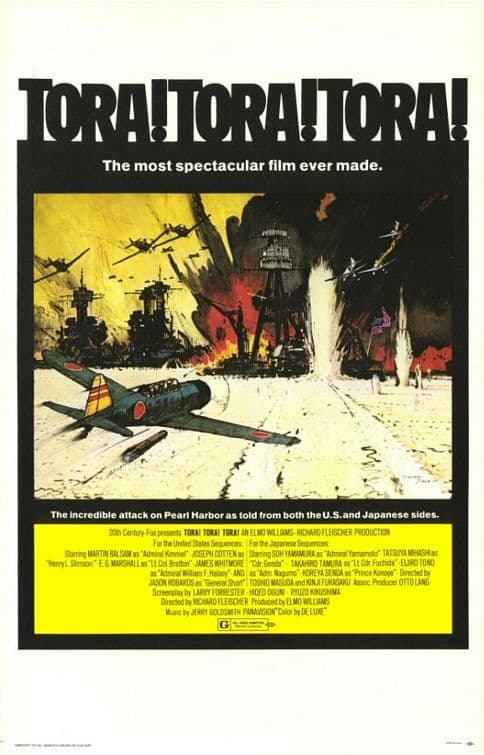
Tora! Tora! Tora! Budget
 Drama
DramaUpdated
Synopsis
Across late 1941, Imperial Japanese naval planners under Admirals Yamamoto and Nagumo prepare an audacious carrier-based strike on the U.S. Pacific Fleet anchorage at Pearl Harbor, while American military intelligence officers in Washington and Hawaii struggle to interpret fragmentary signals warnings. The film alternates between Japanese and American command perspectives across the months leading to the December 7, 1941 attack.
What Is the Budget of Tora! Tora! Tora! (1970)?
Tora! Tora! Tora! (1970), directed by Richard Fleischer (American sequences) and Toshio Masuda and Kinji Fukasaku (Japanese sequences) and distributed by 20th Century Fox, was produced on a reported budget of $25,000,000 (approximately $200,000,000 in 2025 dollars adjusted for inflation). The film served as 20th Century Fox's ambitious attempt to deliver a definitive, historically accurate account of the December 7, 1941 attack on Pearl Harbor from both American and Japanese perspectives.
Producer Elmo Williams structured the budget around an unprecedented dual-nation production that included extensive Japanese-language sequences shot in Japan by Japanese directors with a Japanese cast and crew (originally intended to be Akira Kurosawa, who exited the production after two months of work in 1968). The production was meant to leverage Fox's experience with the similarly multinational The Longest Day (1962), which had been Fox's most ambitious previous war epic. The $25,000,000 figure represented one of the largest war-film budgets of its era and reflected the considerable scale of the U.S. Navy and Japanese Self-Defense Forces' cooperation, the construction of full-scale ship and aircraft replicas, and the practical pyrotechnic destruction of replica vessels for the climactic attack sequence.
Key Budget Allocation Categories
Tora! Tora! Tora!'s $25,000,000 budget broke down across these major production areas:
- Dual American/Japanese Production: The film employed parallel production teams in the United States and Japan, with Richard Fleischer directing American sequences (initially based at Pearl Harbor and later Mexico, Hawaii, and Hollywood) and Toshio Masuda and Kinji Fukasaku directing Japanese sequences in Japan after the original director Akira Kurosawa exited the production. The dual-production structure added significant administrative, transportation, and coordination costs.
- Full-Scale Ship and Aircraft Replicas: Production used a combination of actual U.S. Navy vessels at Pearl Harbor (including the still-operational USS Yorktown carrier as a stand-in for the Japanese fleet), Japanese Self-Defense Force ships, and elaborate full-scale replicas. Aircraft included AT-6 Texan trainers modified to resemble Japanese Mitsubishi A6M Zero fighters, B-17 bombers, and various American patrol aircraft. The aircraft modifications, construction, and weatherization added substantial cost.
- Practical Pyrotechnic Effects: The climactic Pearl Harbor attack sequence was filmed using practical pyrotechnic destruction of replica vessels, with special effects coordinator A.D. Flowers (later an Oscar winner for The Poseidon Adventure and Tora! Tora! Tora! itself) overseeing controlled explosions, fire effects, and ship-sinking sequences. The practical-effects scale was unprecedented for the era and required extensive U.S. Navy safety coordination.
- U.S. Navy and Japanese Self-Defense Force Cooperation: Both navies provided substantial cooperation, with the U.S. Navy allowing the production to film at Pearl Harbor and various stateside facilities and the Japanese Self-Defense Force providing modern Akizuki-class destroyers as stand-ins for the World War II Imperial Japanese Navy carriers Akagi, Kaga, Soryu, and Hiryu. The military cooperation reduced certain costs while adding others including coordination, security, and operational fees.
- Multinational Cast and Crew: American sequences featured Jason Robards (as General Walter C. Short), Martin Balsam (as Admiral Husband E. Kimmel), Joseph Cotten (as Henry L. Stimson), James Whitmore (as Vice Admiral William F. Halsey Jr.), E.G. Marshall, Wesley Addy, and others. Japanese sequences featured Sō Yamamura (as Admiral Isoroku Yamamoto), Tatsuya Mihashi (as Commander Minoru Genda), Eijirō Tōno (as Admiral Chuichi Nagumo), Takahiro Tamura (as Lt. Commander Mitsuo Fuchida), and others. The international cast required dual scale-rate compensation structures.
- Akira Kurosawa Production Phase: Kurosawa was originally hired to direct the Japanese sequences and worked on the production for approximately two months in late 1968 before being replaced. Kurosawa's pre-production work, including extensive storyboarding and casting, was largely abandoned when he left the project, but had already absorbed substantial production resources.
- Five-Year Pre-Production: Producer Elmo Williams began developing the project in 1965, with screenplay development across 1966-1969 involving multiple drafts by Larry Forrester, Hideo Oguni, Akira Kurosawa, and Ryūzō Kikushima. The extended pre-production cycle added carrying costs across the development phase.
How Does Tora! Tora! Tora!'s Budget Compare to Similar Films?
At $25,000,000, Tora! Tora! Tora! sits in the upper tier of late-1960s and early-1970s war epics. Comparable productions:
- The Longest Day (1962): Budget $10,000,000 | Worldwide approximately $50,100,000. Fox's previous multinational World War II epic cost less than half what Tora! Tora! Tora! did and grossed more, illustrating how the earlier all-star approach delivered better commercial returns.
- Battle of the Bulge (1965): Budget $6,800,000 | Worldwide approximately $14,000,000. The Ken Annakin Warner Bros. epic cost approximately one third and grossed less than half worldwide.
- Battle of Britain (1969): Budget $14,000,000 | Worldwide approximately $20,000,000. The Guy Hamilton United Artists war epic cost approximately 56% of Tora! Tora! Tora! and grossed about 37% worldwide.
- Patton (1970): Budget $12,000,000 | Worldwide $61,749,765. Franklin J. Schaffner's contemporaneous Fox-produced biographical war film cost approximately half of Tora! Tora! Tora! and grossed roughly the same worldwide, illustrating how character-focused war films could outperform multinational ensemble epics.
- Pearl Harbor (2001): Budget $140,000,000 | Worldwide $449,220,945. Michael Bay's subsequent Pearl Harbor-set epic, released 31 years after Tora! Tora! Tora!, cost more than five times as much (in nominal dollars, comparable in inflation-adjusted terms) and grossed approximately eight times worldwide.
Tora! Tora! Tora! Box Office Performance
Tora! Tora! Tora! opened in U.S. theatrical release on September 23, 1970, including roadshow exclusive engagements in major markets before going wide. The film's domestic gross was approximately $29,500,000 and worldwide gross totaled approximately $54,400,000.
Against a reported production budget of $25,000,000, the film needed approximately $60,000,000 worldwide to reach profitability when accounting for marketing and distribution costs. The financial breakdown:
Box Office Breakdown
Tora! Tora! Tora!

Tora! Tora! Tora! returned approximately $1.36 to $1.55 in worldwide theatrical revenue for every $1 invested when measured against total estimated production and marketing spend, making it a modest theatrical performer that fell well short of 20th Century Fox's $60-70 million break-even target due to higher production costs and marketing spend than anticipated. The domestic gross of approximately $29,500,000 against an international gross of approximately $24,900,000 reflected a roughly 54/46 split that demonstrated decent international travel for the dual-perspective war epic.
Home video, television syndication, and the film's enduring use as a reference for subsequent Pearl Harbor depictions allowed 20th Century Fox to eventually recoup costs and generate modest sustained profit. The film's release on the eve of Fox's broader financial difficulties (which included the failure of Doctor Dolittle and Star! in the late 1960s) contributed to the studio's late-1960s/early-1970s crisis. The studio was eventually reorganized under new management led by Alan Ladd Jr. that would launch Star Wars in 1977.
Tora! Tora! Tora! Production History
Development of Tora! Tora! Tora! began in 1965, when 20th Century Fox producer Elmo Williams optioned source material from Gordon W. Prange's then-unpublished manuscript that would later be released as At Dawn We Slept (1981), and Walter Lord's Day of Infamy (1957). Larry Forrester developed the initial screenplay across 1966 and 1967, with parallel Japanese script development by Hideo Oguni, Akira Kurosawa, and Ryūzō Kikushima.
Akira Kurosawa was hired in 1967 to direct the Japanese sequences and arrived on the production in summer 1968. Kurosawa worked on extensive storyboarding, casting, and pre-production across two months before being replaced in December 1968 due to creative and scheduling differences with Fox's American production team. Toshio Masuda and Kinji Fukasaku were brought in as replacement directors for the Japanese sequences. Kurosawa's involvement and subsequent dismissal became a major news story in Japan and contributed significantly to his subsequent decade of struggle to secure financing for his own projects.
American principal photography ran from December 1968 through July 1969, with shooting at Pearl Harbor, Hawaii, various U.S. Navy facilities on the East Coast, and 20th Century Fox studios in Hollywood. Japanese principal photography ran in parallel from December 1968 through May 1969 across Japanese Self-Defense Force facilities at Sasebo and Kure, Toei Kyoto Studios, and various Pacific locations.
Special effects coordinator A.D. Flowers and his team designed and executed the unprecedented practical pyrotechnic destruction of the climactic Pearl Harbor attack, including controlled detonations of replica vessels and fire effects across multiple shooting days at Pearl Harbor and elsewhere. The aircraft fleet included AT-6 Texan trainers modified to resemble Japanese Mitsubishi A6M Zero fighters, B-17 bombers, and various American patrol aircraft. Post-production extended through summer 1970, with composer Jerry Goldsmith delivering the orchestral score and editor Pembroke J. Herring cutting the dual-perspective material. The film premiered in roadshow engagements in September 1970.
Awards and Recognition
Tora! Tora! Tora! won the Academy Award for Best Visual Effects (A.D. Flowers and L.B. Abbott) at the 43rd Academy Awards in 1971. The film was nominated for four additional Academy Awards: Best Cinematography (Charles F. Wheeler, Osami Furuya, Sinsaku Himeda, Masamichi Satoh), Best Film Editing (James E. Newcom, Pembroke J. Herring, Inoue Chikaya), Best Art Direction-Set Decoration, and Best Sound. The film lost in those four additional categories to Patton, M*A*S*H, Patton, and Patton respectively.
The film also received a Golden Globe nomination for Best Original Score in a Motion Picture for Jerry Goldsmith. In Japan, the film received various nominations at the Kinema Junpo and other Japanese industry ceremonies, though it received no major awards there given the perception in Japan that the production had treated Kurosawa's dismissal poorly. The film's enduring historical reputation has been recognized in subsequent decades through Library of Congress preservation considerations and inclusion in various "best war films" critical lists.
Critical Reception
Tora! Tora! Tora! received generally positive reviews. The film holds a 64% approval rating on Rotten Tomatoes based on 31 critic reviews, with the critical consensus calling it a methodical and historically authentic procedural that struggles dramatically against its commitment to procedural accuracy. The film did not receive a Metacritic score due to limited critical coverage at the time of release.
The New York Times' Vincent Canby gave the film a mixed review, writing that it "presents the events at Pearl Harbor with a sort of pedantic accuracy that occasionally borders on dullness" while praising the visual scale and the practical-effects sequences. The Los Angeles Times' Charles Champlin was more enthusiastic, calling the film "a serious, important, careful work" that "achieves a measure of historical truth that few war films attempt." Variety praised the dual-perspective structure and the production-design scale.
Critics broadly praised the practical-effects sequences, the historical accuracy of the production design (including the recreation of Imperial Japanese Navy uniforms, equipment, and command-center layouts), and the willingness to present the Japanese command perspective with restraint and historical seriousness, but objected to the procedural structure that emphasized fact-driven accuracy over dramatic momentum. The film's reputation has continued to strengthen in subsequent decades, with retrospective assessments positioning it as one of the most historically careful World War II films ever produced and an enduring reference for subsequent Pearl Harbor depictions including Michael Bay's 2001 film, which featured several visual quotations from Tora! Tora! Tora!'s key sequences.
Frequently Asked Questions
How much did Tora! Tora! Tora! (1970) cost to make?
The production budget was $25,000,000 (approximately $200,000,000 in 2025 dollars adjusted for inflation), financed by 20th Century Fox with Japanese co-production support from Toei Company. The figure represented one of the largest war-film budgets of its era and covered the dual American/Japanese production, U.S. Navy cooperation, full-scale ship and aircraft replicas, and unprecedented practical pyrotechnic effects.
How much did Tora! Tora! Tora! earn at the box office?
The film grossed approximately $29,500,000 domestically and approximately $24,900,000 internationally, for a worldwide total of approximately $54,400,000. It opened in U.S. roadshow exclusive engagements on September 23, 1970, before going wide.
Was Tora! Tora! Tora! a box office success?
The film was a modest theatrical performer. Against a $25,000,000 production budget and an estimated $10,000,000 to $15,000,000 in marketing spend, the film returned approximately $1.36 to $1.55 in worldwide gross for every $1 invested. However, it fell well short of 20th Century Fox's $60-70 million break-even target, contributing to the studio's late-1960s/early-1970s financial crisis.
Who directed Tora! Tora! Tora!?
Richard Fleischer directed the American sequences, while Toshio Masuda and Kinji Fukasaku directed the Japanese sequences. Akira Kurosawa was originally hired in 1967 to direct the Japanese sequences but was replaced in December 1968 due to creative and scheduling differences with Fox's American production team after two months of work.
Why did Akira Kurosawa leave Tora! Tora! Tora!?
Kurosawa was hired in 1967 to direct the Japanese sequences and arrived on the production in summer 1968. He worked on extensive storyboarding, casting, and pre-production across two months before being replaced in December 1968. Fox cited creative and scheduling differences with the American production team. Kurosawa's involvement and subsequent dismissal became a major news story in Japan and contributed significantly to his subsequent decade of struggle to secure financing for his own projects.
How does Tora! Tora! Tora! compare to Pearl Harbor (2001)?
Tora! Tora! Tora! (1970) cost $25,000,000 and grossed $54,400,000 worldwide. Michael Bay's Pearl Harbor (2001), released 31 years later, cost $140,000,000 and grossed $449,220,945 worldwide. Tora! Tora! Tora! is widely regarded as more historically accurate and is the documentary-style reference, while Pearl Harbor adopts a more melodramatic three-protagonist structure. Pearl Harbor featured several visual quotations from Tora! Tora! Tora!'s key sequences.
Where was Tora! Tora! Tora! filmed?
American principal photography ran from December 1968 through July 1969 at Pearl Harbor, Hawaii, various U.S. Navy facilities on the East Coast, and 20th Century Fox studios in Hollywood. Japanese principal photography ran in parallel from December 1968 through May 1969 across Japanese Self-Defense Force facilities at Sasebo and Kure, Toei Kyoto Studios, and various Pacific locations.
Did Tora! Tora! Tora! win any Academy Awards?
Yes. Tora! Tora! Tora! won the Academy Award for Best Visual Effects (A.D. Flowers and L.B. Abbott) at the 43rd Academy Awards in 1971. The film was nominated for four additional Academy Awards: Best Cinematography, Best Film Editing, Best Art Direction-Set Decoration, and Best Sound, losing in three of those categories to Patton and one to M*A*S*H.
What did critics think of Tora! Tora! Tora!?
The film received generally positive reviews, with a 64% Rotten Tomatoes approval rating from 31 critics. Critics praised the practical-effects sequences, the historical accuracy of the production design, and the willingness to present the Japanese command perspective with restraint and historical seriousness, but objected to the procedural structure that emphasized fact-driven accuracy over dramatic momentum.
How accurate is Tora! Tora! Tora! historically?
Tora! Tora! Tora! is widely regarded by historians as one of the most historically accurate Pearl Harbor films ever produced. Producer Elmo Williams and his research team consulted Gordon W. Prange's then-unpublished manuscript (later released as At Dawn We Slept), Walter Lord's Day of Infamy, and substantial military archival material. The film's depiction of Imperial Japanese Navy uniforms, equipment, command-center layouts, and the chain of command leading to the attack has served as an enduring reference for subsequent depictions.
Filmmakers
Tora! Tora! Tora!

Build budgets like this one in Saturation
Start from an industry-standard feature film template, import the schedule and rates you already have, and let the cost report keep itself current as you spend. Real-time collaboration, no spreadsheets.