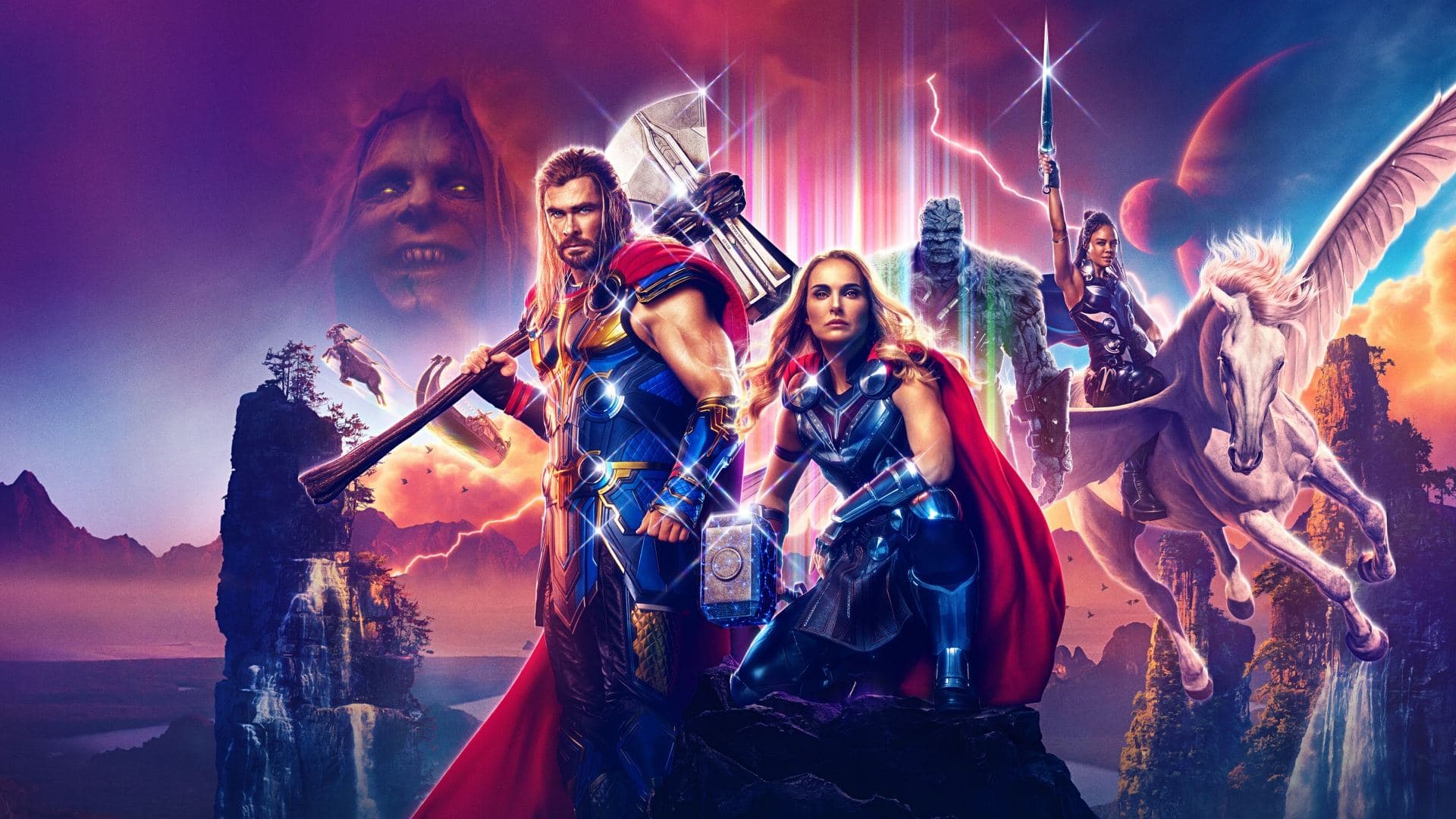
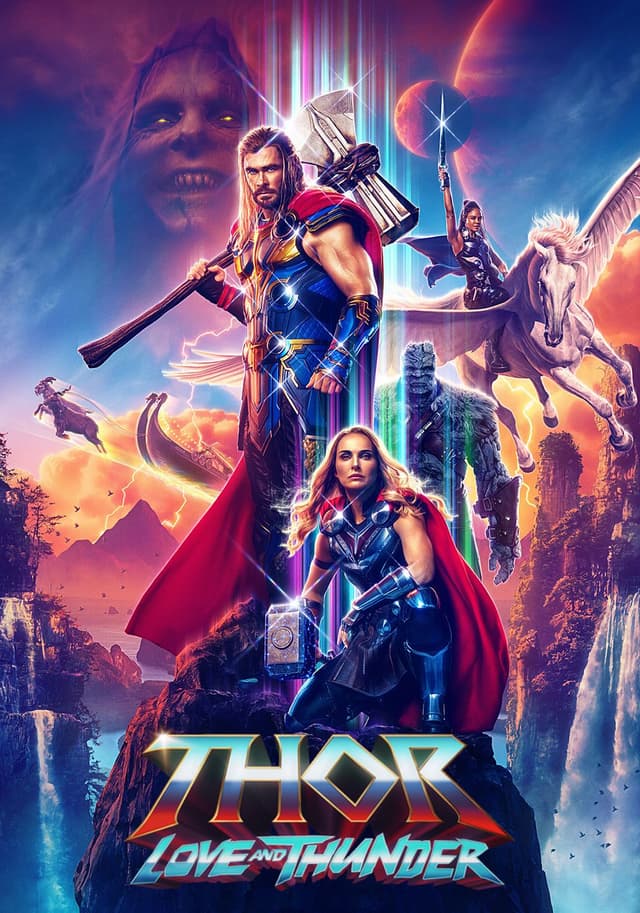
Thor: Love and Thunder Budget
 FantasyActionComedy1h 59m
Updated
Synopsis
Thor embarks on a journey of self-discovery after retiring from active heroism, but his meditation is interrupted when Gorr the God Butcher, a grief-stricken warrior wielding the god-killing Necrosword, begins systematically murdering gods across the universe. Thor reunites with his ex-girlfriend Jane Foster, who has been diagnosed with terminal cancer but has mysteriously been chosen by the reassembled Mjolnir, gaining the powers of the Mighty Thor each time she wields the hammer. Together with Valkyrie and Korg, Thor and Jane must stop Gorr before he reaches Eternity, a cosmic entity capable of granting any wish, even the extinction of all gods.
What Is the Budget of Thor: Love and Thunder?
Thor: Love and Thunder (2022), directed by Taika Waititi and distributed by Walt Disney Studios Motion Pictures, was produced on a budget of $250,000,000. The 29th film in the Marvel Cinematic Universe served as a direct sequel to Thor: Ragnarok (2017), reuniting Waititi with Chris Hemsworth for a cosmic adventure that introduced Gorr the God Butcher (Christian Bale) as the villain while bringing back Natalie Portman as Jane Foster, who takes up Mjolnir and becomes the Mighty Thor.
The $250 million budget represented a significant increase from Ragnarok's $180 million, driven by the addition of major cast members, the production's base at Fox Studios Australia in Sydney, and the extensive visual effects work required to render Gorr's shadow realm, the city of Omnipotence, and the cosmic landscapes central to the narrative. The film also carried costs from Waititi's improvisational shooting style, which generated large amounts of footage and required extended post-production editing.
Key Budget Allocation Categories
Thor: Love and Thunder allocated its $250 million budget across the following production areas:
- Cast and Above-the-Line Talent: Chris Hemsworth returned as Thor with a salary reportedly exceeding $20 million. Christian Bale joined as Gorr the God Butcher, and Natalie Portman returned as Jane Foster after sitting out Thor: The Dark World and Ragnarok's plots. Tessa Thompson reprised Valkyrie, and Russell Crowe joined as Zeus. The Guardians of the Galaxy, including Chris Pratt, Dave Bautista, Pom Klementieff, Karen Gillan, Vin Diesel, and Bradley Cooper, appeared in the opening act. Taika Waititi's directing fee, his performance as Korg, and Kevin Feige's producing costs completed the above-the-line allocation.
- Visual Effects and Cosmic Environments: The film required extensive VFX to create the Shadow Realm, a monochrome dimension rendered in stark black and white with occasional color splashes. The city of Omnipotence, where Zeus holds court among gods from multiple pantheons, demanded detailed architectural and crowd simulation work. Gorr's Necrosword tendrils, the reconstruction of Mjolnir, Jane Foster's transformation sequences, and the climactic battle at the Gates of Eternity each required dedicated VFX pipelines. Industrial Light & Magic led the effects work alongside Framestore and other vendors.
- Production Design and Australian Studio Base: Production designer Nigel Phelps built extensive sets at Fox Studios Australia in Sydney. The production leveraged Australia's studio infrastructure and location diversity, filming in Centennial Park and various Sydney-area locations. Key practical builds included portions of New Asgard (a Norwegian-style fishing village), Zeus's golden throne room, and the interior of the Viking tour boat. Australia's Location Offset and PDV Offset tax incentives provided rebates that partially offset the production's costs.
- Improvisational Shooting and Extended Coverage: Waititi's directorial approach encourages extensive improvisation from actors, resulting in significantly more footage than a traditionally scripted production would generate. Hemsworth, Bale, Thompson, and Crowe all engaged in lengthy improvisational takes, particularly in comedic scenes. This approach, while yielding some of the film's most memorable moments, required additional shooting days, more storage and data management, and a longer editorial process to shape the improvisations into a coherent narrative.
- Score and Musical Elements: Michael Giacchino composed the score, bringing a bombastic, operatic sensibility to the cosmic adventure. The film's use of Guns N' Roses' "Sweet Child O' Mine" as a recurring motif required music licensing fees. Additional needle drops, including other classic rock tracks, contributed to the soundtrack costs. Sound design for the Necrosword, the thunderbolts, and the Shadow Realm's eerie silence-to-violence contrasts required detailed audio engineering.
How Does Thor: Love and Thunder's Budget Compare to Similar Films?
At $250,000,000, Love and Thunder sits above most MCU solo films. Comparing it with other Thor entries and cosmic superhero films:
- Thor: Ragnarok (2017): Budget $180,000,000 | Worldwide $853,900,000. Waititi's first Thor film cost 28% less and earned 12% more worldwide, delivering a stronger ROI and wider critical acclaim. Ragnarok's tighter budget may have imposed creative discipline that benefited the final product.
- Doctor Strange in the Multiverse of Madness (2022): Budget $200,000,000 | Worldwide $955,800,000. Released two months before Love and Thunder in the same summer, this MCU entry cost 20% less and earned 26% more, suggesting that Love and Thunder suffered from audience fatigue with the MCU's rapid 2022 release pace.
- Guardians of the Galaxy Vol. 3 (2023): Budget $250,000,000 | Worldwide $845,600,000. James Gunn's cosmic trilogy closer matched Love and Thunder's budget but earned 11% more worldwide with significantly stronger reviews, illustrating the premium audiences placed on emotional storytelling over comedic spectacle in the cosmic MCU lane.
- Eternals (2021): Budget $200,000,000 | Worldwide $402,100,000. Chloe Zhao's MCU entry cost 20% less and earned 47% less, making Love and Thunder's commercial performance look stronger by comparison despite its own underwhelming reception.
- The Flash (2023): Budget $200,000,000 | Worldwide $271,300,000. Warner Bros.' DC multiverse film cost 20% less but earned 64% less, placing both films in the category of expensive superhero disappointments, though Love and Thunder's $760.9 million was at least commercially viable.
Thor: Love and Thunder Box Office Performance
Thor: Love and Thunder opened in the United States on July 8, 2022, debuting to $144.2 million domestically in its opening weekend. The film had a strong opening fueled by goodwill from Ragnarok and the MCU brand, but experienced steep week-over-week declines that indicated divisive audience reception.
Box Office Breakdown
Thor: Love and Thunder

At approximately +204%, Thor: Love and Thunder returned roughly $3.04 for every $1 of production budget invested during its theatrical run.
While profitable, Love and Thunder's $760.9 million worldwide fell below its predecessor Thor: Ragnarok ($854 million), reflecting post-pandemic audience fatigue with Marvel's accelerated release pace. The domestic gross of $343.3 million (45% of worldwide) outperformed the international share, an unusual split for a Marvel film and a signal of softening overseas demand for the franchise.
Thor: Love and Thunder Production History
Taika Waititi confirmed development on a fourth Thor film in July 2019 at San Diego Comic-Con, announcing that Natalie Portman would return as Jane Foster and wield Mjolnir, adapting Jason Aaron's "Mighty Thor" comic run. The announcement generated significant excitement, as Portman had been absent from the MCU since Thor: The Dark World (2013). Waititi and Jennifer Kaytin Robinson wrote the screenplay, balancing the Gorr the God Butcher storyline with Jane's cancer diagnosis and transformation narrative.
Principal photography began in January 2021 at Fox Studios Australia in Sydney, continuing through June 2021. The production operated under strict COVID-19 protocols in Australia, which had implemented some of the world's most stringent border controls. The Australian production base reflected both Waititi's preference for the region (he is from New Zealand) and the availability of Fox Studios' large soundstages for the film's numerous interior and VFX-heavy sequences.
Christian Bale's portrayal of Gorr required extensive prosthetic makeup application and physical transformation. Bale shaved his head for the role and wore prosthetics designed by makeup effects supervisor Bart Mixon. Natalie Portman's physical transformation into the Mighty Thor required months of training to build the muscular physique visible in the film, supported by a dedicated fitness and nutrition program.
Post-production proved lengthy due to the volume of improvised footage. Waititi and editors Tim Roth, Matthew Schmidt, and Peter Sciberras shaped what was reportedly a significantly longer initial cut into the final 119-minute runtime. Several scenes and subplots were trimmed, including extended Guardians of the Galaxy sequences and additional Zeus material with Russell Crowe. The truncated runtime was later cited by some critics as contributing to pacing issues, with emotional beats feeling rushed alongside the comedy.
Awards and Recognition
Thor: Love and Thunder received limited awards recognition, reflecting its mixed critical reception. The film was nominated for Best Comic-to-Film Motion Picture at the Saturn Awards. Christian Bale's performance as Gorr the God Butcher was singled out by genre critics as one of the strongest villain portrayals in Phase Four of the MCU, though it did not translate into mainstream awards nominations.
The film's visual effects work, particularly the monochrome Shadow Realm sequences, received positive attention from VFX industry professionals. The color-desaturated battle environment represented an unusual creative risk for a tentpole blockbuster and was praised for its visual boldness, even among critics who found the surrounding film uneven.
Critical Reception
Thor: Love and Thunder earned a 63% approval rating on Rotten Tomatoes based on 358 reviews, making it the lowest-rated Thor film since The Dark World. On Metacritic, the film scored 57 out of 100, indicating "mixed or average reviews." Audiences gave it a B+ on CinemaScore.
Positive reviews praised Christian Bale's menacing performance as Gorr, the Shadow Realm's striking visual design, and individual comedic moments that recaptured Ragnarok's irreverent spirit. Hemsworth and Portman's romantic dynamic and the film's willingness to address mortality and cancer were noted as ambitious thematic choices for a blockbuster comedy.
Detractors argued that Waititi's comedic approach overwhelmed the dramatic material, undercutting Gorr's menace, Jane's illness, and the film's emotional stakes with relentless joke density. The tonal whiplash between cancer-diagnosis scenes and screaming-goat sight gags became a focal point of negative criticism. Many reviewers concluded that the qualities that made Ragnarok a revelation, the irreverence, the improvisational energy, the subversion of Thor's self-seriousness, had calcified into formula in Love and Thunder, producing diminishing returns for both audiences and critics.
Frequently Asked Questions
How much did it cost to make Thor: Love and Thunder?
The production budget was $250,000,000, a 39% increase over Thor: Ragnarok's $180 million. Costs were driven by the large cast including Christian Bale and the return of Natalie Portman, extensive VFX work for the Shadow Realm and cosmic environments, and the production's base at Fox Studios Australia in Sydney.
How much did Thor: Love and Thunder earn at the box office?
The film grossed $343,300,000 domestically and $417,600,000 internationally, totaling $760,900,000 worldwide. It opened with $144.2 million domestically but experienced steep week-over-week declines, falling 68% in its second weekend.
Was Thor: Love and Thunder profitable?
Yes, but modestly by MCU standards. With a $250 million production budget and estimated $150 million in marketing, the film's $760.9 million gross exceeded the break-even threshold. However, the result was disappointing compared to Ragnarok's $853.9 million on a $180 million budget.
Where was Thor: Love and Thunder filmed?
Principal photography took place from January to June 2021 at Fox Studios Australia in Sydney. Additional filming occurred at Centennial Park and various Sydney-area locations. The production utilized Australia's Location Offset and PDV Offset tax incentives.
Why did Natalie Portman return for Love and Thunder?
Taika Waititi adapted Jason Aaron's "Mighty Thor" comic run, which features Jane Foster wielding Mjolnir while battling cancer. Portman, who had been absent from the MCU since Thor: The Dark World (2013), was drawn back by the dramatic depth of Jane's storyline and her partnership with Waititi.
What is the Shadow Realm in Thor: Love and Thunder?
The Shadow Realm is Gorr the God Butcher's domain, rendered in stark monochrome black and white with occasional splashes of color during combat. The visual effect was achieved through VFX post-processing and was praised for its boldness, creating a distinctive environment unlike anything previously seen in the MCU.
Who plays Gorr the God Butcher?
Christian Bale plays Gorr, undergoing extensive physical transformation including shaving his head and wearing prosthetics designed by makeup effects supervisor Bart Mixon. Bale's menacing, grief-driven performance was widely praised by critics as one of the strongest villain portrayals in MCU Phase Four.
How does Love and Thunder compare to Thor: Ragnarok?
Ragnarok cost $180 million and earned $853.9 million worldwide with a 93% Rotten Tomatoes score. Love and Thunder cost $250 million (39% more) but earned only $760.9 million (11% less) with a 63% RT score. Critics felt the comedic approach that revitalized Ragnarok had become formulaic in the sequel.
Why did Thor: Love and Thunder receive mixed reviews?
Critics cited relentless joke density that undercut dramatic material, tonal whiplash between cancer-diagnosis scenes and comedic sight gags, and a rushed 119-minute runtime that shortchanged both Gorr's storyline and Jane's emotional arc. The 63% Rotten Tomatoes score made it the lowest-rated Thor film since The Dark World.
Did Thor: Love and Thunder release in China?
No. Thor: Love and Thunder was not released theatrically in China, which significantly impacted its international gross. China had been a major market for MCU films, with several earning over $100 million there. The absence of a Chinese release contributed to the film's international underperformance relative to Ragnarok.
Filmmakers
Thor: Love and Thunder

Official Trailer
Build budgets like this one in Saturation
Start from an industry-standard feature film template, import the schedule and rates you already have, and let the cost report keep itself current as you spend. Real-time collaboration, no spreadsheets.