The Way Back Budget
 Drama
DramaUpdated
Synopsis
A former high-school basketball phenom whose life has been consumed by addiction and grief is offered the chance to coach his alma mater's struggling team. The job forces him to confront the loss that derailed his life and decide whether redemption is still within reach.
What Is the Budget of The Way Back (2020)?
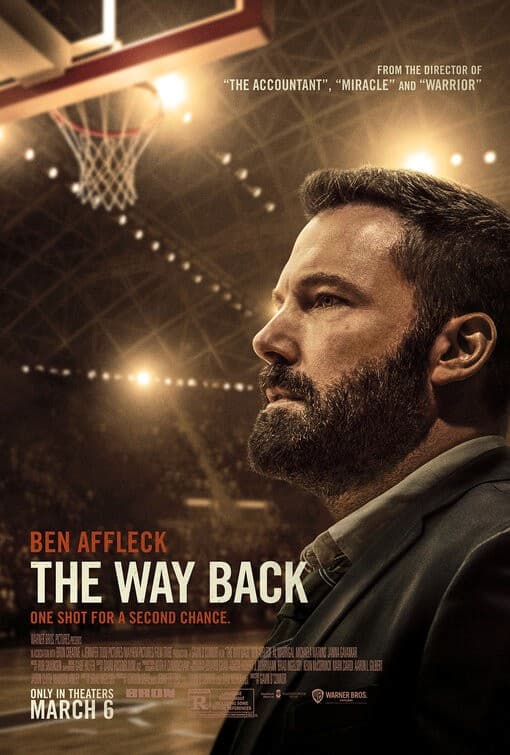
The Way Back (2020), directed by Gavin O'Connor and distributed by Warner Bros. Pictures, was produced on a budget of $25,000,000. Ravi Mehta produced through Filmtribe alongside Gavin O'Connor, with Madison Ainley, Jennifer Todd, and Gordon Gray serving as executive producers. Warner Bros. provided studio finance and a wide theatrical rollout positioned as both an adult drama and a Ben Affleck comeback vehicle, building on his prior collaboration with O'Connor on The Accountant (2016).
The budget reflected an adult-drama tier well below Warner Bros.' tentpole slate. Affleck took a reduced fee relative to his typical leading-man scale, reportedly accepting the role as part of a personal commitment to material that mirrored his own publicly documented struggles with alcohol. The math required the film to clear roughly $60,000,000 worldwide to break even after marketing, a target that became unreachable when COVID-19 closed theaters one week into the release.
Key Budget Allocation Categories
The Way Back's $25,000,000 budget was distributed across several core production areas:
- Above-the-Line Talent: Ben Affleck took a reduced lead-actor fee that gave the production access to a top-tier star within the $25M envelope. Gavin O'Connor commanded a feature-director fee appropriate to a Warner Bros. drama, and supporting actors Janina Gavankar, Al Madrigal, Michaela Watkins, Glynn Turman, and Brandon Wilson rounded out the cast at standard supporting-tier rates.
- Los Angeles Location Shoot: Principal photography took place across the greater Los Angeles area, with the fictional Bishop Hayes High School represented by multiple practical locations across San Pedro and South Bay. California's film tax credit program offset a portion of in-state spend, though the rebate program's capacity constraints limit its impact on individual productions at this budget tier.
- Basketball Sequence Choreography: The film required extensive basketball gameplay sequences featuring the cast of high-school actors. Basketball coordinator and former Loyola Marymount player Tony McCoy choreographed the game sequences, with multi-week pre-production training for the principal teen ensemble to bring their on-court work to a credible level for camera coverage.
- Costume and Production Design: Costume designer Lyn Paolo (Scandal, Shameless) outfitted the period-grounded contemporary cast with an emphasis on Affleck's deteriorating wardrobe as a visual register of his character's spiral. Production designer Keith Cunningham built the Bishop Hayes locker room, family home interiors, and bar sequences as practical sets supplementing the location work.
- Score: Composer Rob Simonsen wrote the original score, blending orchestral and electronic textures to underscore the film's blend of basketball-procedural and addiction-drama tones. The score was recorded in Los Angeles with a moderate orchestra contingent.
- Casting and Teen Ensemble: The film featured a substantial teen-actor ensemble as the Bishop Hayes basketball team. Casting director Avy Kaufman ran extensive open calls across Southern California to identify performers who could both act and credibly play game-level high school basketball, a combination that required a long pre-production scouting period.
How Does The Way Back's Budget Compare to Similar Films?
At $25,000,000, The Way Back sits in the typical range for star-driven adult dramas of the late 2010s and early 2020s. The comparison set illustrates how the pandemic disrupted what would otherwise have been a viable financial path:
- Manchester by the Sea (2016): Budget $9,000,000 | Worldwide $79,178,564. Kenneth Lonergan's grief drama cost roughly one third of The Way Back and earned more than five times its worldwide gross, demonstrating the ceiling that pandemic disruption denied The Way Back.
- Wind River (2017): Budget $11,000,000 | Worldwide $45,488,761. Taylor Sheridan's thriller cost less than half The Way Back and earned three times its worldwide gross under normal release conditions.
- Hell or High Water (2016): Budget $12,000,000 | Worldwide $38,710,402. Another Sheridan-written drama at the same tier outearned The Way Back by nearly three times despite costing less than half.
- Beautiful Boy (2018): Budget $25,000,000 | Worldwide $14,895,029. Felix Van Groeningen's Steve Carell-Timothée Chalamet addiction drama cost identically to The Way Back and earned roughly the same worldwide total under normal release conditions, illustrating the commercial ceiling for this genre.
- Coach Carter (2005): Budget $30,000,000 | Worldwide $76,659,353. The earlier Samuel L. Jackson basketball-coaching drama cost $5M more than The Way Back and earned five times its worldwide gross, the genre's commercial high-water mark.
The Way Back Box Office Performance
The Way Back opened on March 6, 2020, debuting to $8,200,000 in its opening weekend across 2,718 theaters, finishing third on the chart behind Onward and The Invisible Man. The opening was slightly below Warner Bros.' projections, which had targeted a $9M to $11M debut. One week later, on March 17, all major United States theater chains closed nationwide in response to COVID-19, cutting the film's theatrical run short before any meaningful second-week erosion.
Against a $25,000,000 production budget, The Way Back needed roughly $60,000,000 in worldwide gross to reach profitability when accounting for marketing and distribution costs. Here is the financial breakdown:
Box Office Breakdown
The Way Back (2020)

The Way Back returned approximately $0.30 in theatrical revenue for every $1 invested when measured against total estimated production and marketing spend. The domestic share of the gross was $13,422,471 against an international share of just $1,294,319, a near-total imbalance driven primarily by the global theatrical shutdown that prevented any meaningful international release.
Warner Bros. accelerated the film to premium video-on-demand on March 24, 2020, just three weeks after theatrical release, making it one of the first major-studio releases to break the traditional theatrical window in response to the pandemic. The PVOD performance was strong by 2020 standards (Warner Bros. did not disclose specific figures), and the home-entertainment release helped recoup a meaningful share of the theatrical shortfall.
The Way Back Production History
Development began at Warner Bros. in 2018, with screenwriter Brad Ingelsby (Out of the Furnace, the future Mare of Easttown) writing the script under a working title that was later changed from "Torrance" to "Finding the Way Back" and finally "The Way Back." Gavin O'Connor, who had directed Affleck in The Accountant (2016) and had also directed sports dramas Warrior (2011) and Miracle (2004), came aboard in 2018 with a vision for a recovery drama embedded within a basketball coaching narrative.
Ben Affleck attached as the lead in early 2019, with the actor publicly framing the project as one that mirrored his own documented relationship with alcohol. The film was conceived from the outset as a recovery story rather than an addiction story, with O'Connor and Ingelsby focused on the long, slow process of climbing back from a low point rather than the visceral spectacle of the descent.
Principal photography ran from August to October 2019 in and around Los Angeles, with the bulk of basketball sequences shot at practical high-school gym locations in the South Bay and San Pedro. The teen ensemble worked under continuous training with basketball coordinator Tony McCoy throughout pre-production, with several actors continuing to refine their on-court work between game-sequence shoot days.
Post-production wrapped in early 2020, with Warner Bros. positioning the film for an early-March release window in the pre-summer adult-drama corridor. Marketing emphasized Affleck's personal connection to the material in interviews and the trailer's framing of recovery rather than addiction. The COVID-19 theatrical shutdown one week into the release rendered the marketing campaign's commercial impact moot.
Awards and Recognition
The Way Back received limited industry awards recognition, in part because of the pandemic-shortened theatrical window and the early 2020 release date that fell outside most awards-cycle eligibility windows. The film was not nominated at the Academy Awards, Golden Globes, BAFTAs, or SAG Awards.
Ben Affleck received a Critics Choice Super Award nomination for Best Actor in an Action Movie (a category mismatch reflecting the film's genre ambiguity) and won the Hollywood Critics Association award for Best Lead Performance for the role. The performance also generated meaningful awards conversation in trade press during the spring of 2020 before the pandemic effectively suspended the awards-eligibility calendar. Multiple retrospective critical assessments since 2020 have flagged the performance as one of Affleck's strongest dramatic showings.
Critical Reception
The Way Back received broadly positive reviews. The film holds an 84% approval rating on Rotten Tomatoes based on 240 critic reviews, with a critical consensus that praised Affleck's performance and O'Connor's restrained direction. On Metacritic, the film scored 67 out of 100, indicating generally favorable reviews. Audiences surveyed by CinemaScore gave the film an A-.
Critics broadly praised Ben Affleck's grounded, often wordless central performance, calling it among the strongest dramatic work of his career. The Los Angeles Times' Justin Chang wrote that "Affleck has rarely been better, and the film around him knows exactly what it has." Variety's Owen Gleiberman called the performance "a humbled tour de force." A common critical thread emphasized the gap between the film's subject matter and Affleck's real-life recovery, with reviewers noting that the personal undercurrent gave the performance a documentary edge.
Among basketball-film criticism specifically, several reviewers placed the film alongside Hoosiers and Coach Carter as a credibly mounted entry in the high-school-coaching genre, with particular praise for the on-court sequences' realistic pacing and the teen ensemble's authentic gameplay. The mixed-positive critical response, combined with the strong premium VOD afterlife, has cemented The Way Back's reputation as a film whose theatrical commercial result is misleading relative to its actual quality and cultural footprint.
Frequently Asked Questions
How much did it cost to make The Way Back (2020)?
The production budget was $25,000,000. The film was financed by Warner Bros. Pictures with co-financing from Bron Studios, and produced by Filmtribe, Mayhem Pictures, and Jennifer Todd Pictures.
How much did The Way Back earn at the box office?
The film grossed $13,422,471 domestically and $1,294,319 internationally, for a worldwide total of $14,716,790. It opened to $8,200,000 across 2,718 theaters on March 6, 2020, finishing third behind Onward and The Invisible Man.
Why did The Way Back have such a short theatrical run?
The film opened on March 6, 2020 and reached its widest release in week one. On March 17, all major United States theater chains closed nationwide in response to COVID-19, cutting the theatrical run short. Warner Bros. accelerated the film to premium video-on-demand on March 24, 2020, three weeks after theatrical release.
Was The Way Back profitable?
The theatrical run posted a $30M to $35M loss against $45M to $50M total investment, but the film recouped a meaningful share through premium video-on-demand, home entertainment, and television licensing. Warner Bros. has not disclosed specific PVOD figures.
Who directed The Way Back?
Gavin O'Connor directed the film, working from a screenplay by Brad Ingelsby. O'Connor had previously directed Ben Affleck in The Accountant (2016) and had also directed the sports dramas Warrior (2011) and Miracle (2004).
Where was The Way Back filmed?
Principal photography ran from August to October 2019 in and around Los Angeles, with the bulk of basketball sequences shot at practical high-school gym locations in the South Bay and San Pedro. California's film tax credit program offset a portion of in-state spend.
Is The Way Back based on a true story?
No. The screenplay by Brad Ingelsby is an original fictional story. However, Ben Affleck has publicly framed his connection to the material as mirroring his own documented relationship with alcohol, giving the central performance an autobiographical undercurrent.
How does The Way Back compare to other basketball films?
The Way Back earned $14.7M worldwide on a $25M budget. Coach Carter (2005) earned $76.7M on $30M. Hoosiers (1986), the genre's critical high-water mark, has remained in pop-cultural circulation for nearly four decades. The Way Back's commercial result is misleading relative to its critical reputation because of the pandemic theatrical shutdown.
Did Ben Affleck win any awards for The Way Back?
Affleck won the Hollywood Critics Association award for Best Lead Performance and received a Critics Choice Super Award nomination. The pandemic disrupted the conventional 2020-2021 awards-season eligibility calendar, limiting the recognition the performance might otherwise have received.
What did critics think of The Way Back?
The film holds an 84% approval rating on Rotten Tomatoes (240 reviews) and scored 67 out of 100 on Metacritic. Audiences gave it an A- CinemaScore. The Los Angeles Times' Justin Chang wrote that "Affleck has rarely been better," and Variety called the performance "a humbled tour de force."
Filmmakers
The Way Back (2020)

Build budgets like this one in Saturation
Start from an industry-standard feature film template, import the schedule and rates you already have, and let the cost report keep itself current as you spend. Real-time collaboration, no spreadsheets.