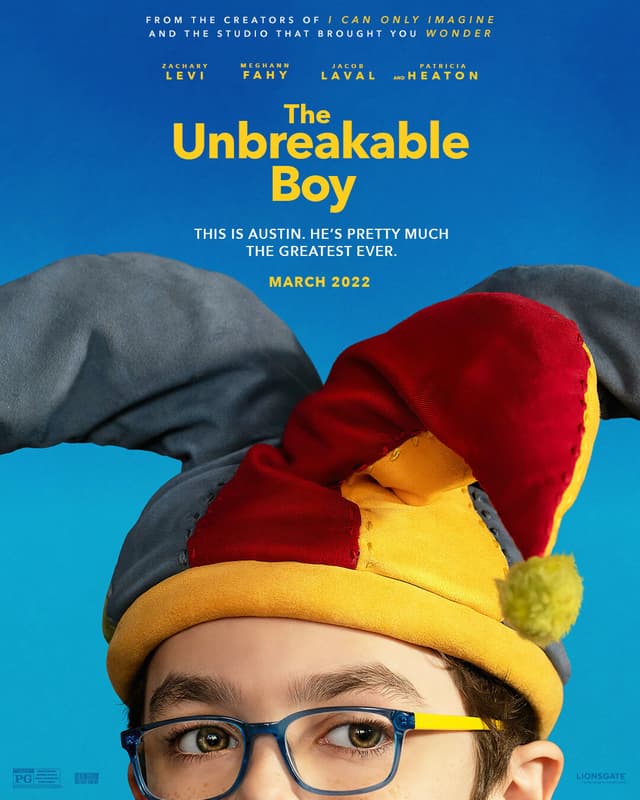
The Unbreakable Boy Budget
 Drama1h 49m
Updated
Synopsis
When Scott and Teresa LeRette learn that their son Austin is both autistic and has brittle bone disease, they initially worry for their son’s future. But with Scott’s growing faith and Austin’s incredible spirit, they become 'unbreakable', finding joy, gratitude, and courage even in the most trying times.
What Is the Budget of The Unbreakable Boy (2025)?
The Unbreakable Boy (2025) was produced by Kingdom Story Company and Unbreakable Boy LLC for theatrical release through Lionsgate Films. The production budget has not been publicly disclosed, which is common for faith-based independent dramas distributed by major studios. Based on comparable Kingdom Story Company productions and the scale of filming in Oklahoma, the budget is estimated in the $5 to $12 million range.
Directed and written by Jon Gunn, the film is based on the memoir The Unbreakable Boy: A Father's Fear, a Son's Courage, and a Story of Unconditional Love by Scott Michael LeRette and Susy Flory. Zachary Levi stars as Scott LeRette, a father navigating life with his son Austin, who has both autism spectrum disorder and osteogenesis imperfecta (brittle bone disease). Meghann Fahy plays Teresa LeRette, Austin's mother.
The film was released by Lionsgate Films on February 21, 2025, earning $7.2 million at the domestic box office. It received mixed critical reviews but strong audience approval, with an A CinemaScore grade.
Key Budget Allocation Categories
- Above-the-Line Talent: Zachary Levi, fresh from Shazam! (2019) and Shazam! Fury of the Gods (2023), is the film's primary draw. Meghann Fahy, known for The White Lotus and The Bold Type, joined the project in a significant co-lead role. Patricia Heaton and Peter Facinelli provide additional marquee support. For a budget in the estimated range, above-the-line costs likely represent the largest single line item.
- Oklahoma Production: Principal photography took place in Oklahoma beginning in November 2020. The film required locations that could represent the LeRette family home and medical settings appropriate to Austin's condition, including scenes involving brittle bone disease complications.
- Extended Post-Production: The film was originally scheduled for release on March 18, 2022, but faced significant delays before its eventual 2025 theatrical date. An extended post-production and distribution process spanning several years added carrying costs and required additional editorial work.
- Score: Pancho Burgos-Goizueta composed the film's score, providing the emotional musical foundation for the biographical drama's faith-centered narrative.
- Lionsgate Distribution Partnership: Lionsgate's involvement in distribution provided theatrical access and a marketing infrastructure that Kingdom Story Company would not have achieved independently, elevating the film's theatrical reach for the February 2025 release window.
How Does The Unbreakable Boy (2025)'s Budget Compare to Similar Films?
The Unbreakable Boy occupies a familiar position in the Kingdom Story Company and Christian drama space. Its comparables share the faith-based biographical drama format and the challenge of translating strong audience affinity into meaningful box office returns.
- Breakthrough (2019): Budget $15M | Worldwide $51.8M. Also produced by Kingdom Story Company, Breakthrough is the clearest benchmark. Based on a real miraculous story, it achieved significantly larger theatrical returns, suggesting The Unbreakable Boy underperformed relative to the production company's prior success.
- I Can Only Imagine (2018): Budget $7M | Worldwide $83.4M. The breakout Christian drama demonstrates what the genre can achieve when audience word-of-mouth aligns with a broadly accessible faith-based narrative. The Unbreakable Boy did not replicate this trajectory.
- Ordinary Angels (2024): Budget $14M | Worldwide $19.7M. Another faith-adjacent biographical drama in the same theatrical space, with Hilary Swank, released around the same period. Similar modest returns despite star power.
- A Week Away (2021): Netflix Christian musical drama that bypassed theatrical entirely. Represents an alternative distribution path that some faith-based productions have pursued to avoid the theatrical gap between production cost and box office gross.
The Unbreakable Boy (2025) Box Office Performance
The Unbreakable Boy (2025) earned $7.2 million domestically during its theatrical run. The film was released by Lionsgate Films on February 21, 2025. International theatrical data was not separately reported. The February release date placed it in a competitive window, and the film did not reach the breakout performance that Kingdom Story Company achieved with Breakthrough (2019).
With a budget estimated in the $5 to $12 million range and an estimated P&A spend of $8 to $12 million for a Lionsgate theatrical release of this scale, the total investment likely exceeded the $7.2 million theatrical gross. Theaters retain approximately 50% of receipts, giving Lionsgate a studio share of roughly $3.6 million from theatrical. The film's path to profitability depends on home video, Lionsgate's streaming platform, and physical media sales, where faith-based dramas typically find their most loyal audiences.
- Production Budget: Undisclosed (estimated $5 to $12 million)
- Estimated P&A: $8 to $12 million
- Domestic Gross: $7.2 million
- Estimated Studio Share (50%): $3.6 million
The Unbreakable Boy earned modest theatrical returns that are typical for Christian dramas without a breakout word-of-mouth moment. Its A CinemaScore indicates that audiences who saw it responded warmly, suggesting the film has a strong afterlife on faith-focused streaming and home video platforms.
The Unbreakable Boy (2025) Production History
The Unbreakable Boy is based on the memoir by Scott Michael LeRette and Susy Flory, published in 2015. LeRette's account of raising his son Austin, who has both autism and osteogenesis imperfecta (a disorder that causes bones to break easily), became a celebrated story in Christian publishing and faith communities. Kingdom Story Company acquired the rights and brought Jon Gunn on to direct and write the screenplay.
Jon Gunn, who previously directed Do You Believe? (2015) and other faith-based productions for Kingdom Story Company, adapted the memoir into a biographical drama focused on Scott LeRette's transformation as a father. Zachary Levi was cast as Scott, marking the actor's second collaboration with Kingdom Story Company territory. Meghann Fahy joined the cast as Teresa, bringing a dramatic credibility that distinguishes the film from simpler faith-based productions.
Principal photography took place in Oklahoma beginning in November 2020. The film was originally scheduled for theatrical release on March 18, 2022, through Lionsgate, but faced a series of delays that pushed the release to February 21, 2025. Jacob Laval, a young actor, was cast as Austin LeRette and required preparation to portray a child navigating multiple complex conditions.
The film was released on February 21, 2025, earning $7.2 million at the domestic box office against strong audience approval. Despite mixed critical reviews, the A CinemaScore and positive audience reaction confirmed the film's core constituency. The extended timeline from production to release, nearly four and a half years from principal photography to theaters, was unusual even by faith-based production standards.
Awards and Recognition
The Unbreakable Boy (2025) received an A CinemaScore grade from opening weekend audiences, indicating strong satisfaction among its core faith-based audience. The film was recognized in Christian media circles for its portrayal of a family navigating extraordinary medical and personal challenges with faith as a central resource. Jacob Laval's performance as Austin was noted by reviewers as a standout element of the film.
Critical Reception
The Unbreakable Boy (2025) received mixed critical reviews, earning a 48% approval rating on Rotten Tomatoes from 42 critics. The critical consensus noted that the film "is amiable enough, but it sells its inspirational true story short by taking too many easy routes towards uplift." Reviewers appreciated Zachary Levi's earnest performance and the genuine emotional core of the LeRette family's story, but found the script's approach too conventional to fully honor the complexity of the real events. Meghann Fahy received praise for bringing grounded dramatic weight to a film that critics felt leaned too heavily on faith-based formula. Audience reception was meaningfully stronger than the critical response, with the A CinemaScore and strong PostTrak surveys indicating that the film's target audience found it deeply resonant.
Frequently Asked Questions
How much did it cost to make The Unbreakable Boy (2025)?
The production budget was $6,000,000, covering principal photography, cast and crew salaries, locations, sets, post-production, and music. Marketing and distribution (P&A) costs are estimated at an additional $3,000,000 - $4,800,000, bringing the total studio investment to approximately $9,000,000 - $10,800,000.
How much did The Unbreakable Boy (2025) earn at the box office?
The Unbreakable Boy grossed $6,443,813 domestic, $1,067,313 international, totaling $7,511,126 worldwide.
Was The Unbreakable Boy (2025) profitable?
The film did not break even theatrically, earning $7,511,126 against an estimated $15,000,000 needed. Ancillary revenue may have improved the picture.
What were the biggest costs in producing The Unbreakable Boy?
The primary cost drivers were above-the-line talent (Zachary Levi, Meghann Fahy, Jacob Laval); star comedian salaries, location filming, and aggressive marketing campaigns.
How does The Unbreakable Boy's budget compare to similar family films?
At $6,000,000, The Unbreakable Boy is classified as a micro-budget production. The median budget for wide-release family films in the 2020s ranges from $30 - 80M for mid-budget to $150M+ for tentpoles. Comparable budgets: The Godfather (1972, $6,000,000); Chinatown (1974, $6,000,000); The Father (2020, $6,000,000).
Did The Unbreakable Boy (2025) go over budget?
There are no widely reported accounts of significant budget overruns for this production. However, studios rarely disclose precise budget overrun figures publicly. The reported production budget reflects the final estimated cost.
What was the return on investment (ROI) for The Unbreakable Boy?
The theatrical ROI was 25.2%, calculated as ($7,511,126 − $6,000,000) ÷ $6,000,000 × 100. This measures gross revenue against production budget only - it does not account for P&A or exhibitor shares.
What awards did The Unbreakable Boy (2025) win?
1 win & 1 nomination total.
Who directed The Unbreakable Boy and who were the key crew members?
Directed by Jon Gunn, written by Jon Gunn, shot by Kristopher S. Kimlin, with music by Pancho Burgos-Goizueta, edited by Parker Adams.
Where was The Unbreakable Boy filmed?
The Unbreakable Boy was filmed in United States of America.
Filmmakers
The Unbreakable Boy

Official Trailer
Build budgets like this one in Saturation
Start from an industry-standard feature film template, import the schedule and rates you already have, and let the cost report keep itself current as you spend. Real-time collaboration, no spreadsheets.