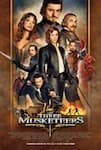
The Three Musketeers Budget
 Adventure
Updated
Synopsis
The hot-headed young D'Artagnan along with three former legendary but now down-on-their-luck Musketeers must unite and defeat a beautiful double agent and her villainous employer from seizing the French throne and engulfing Europe in war. Paul W.S. Anderson's 3D adaptation reimagines Alexandre Dumas' 1844 novel with steampunk airships and stylized swordplay.
What Is the Budget of The Three Musketeers (2011)?
The Three Musketeers (2011), directed by Paul W.S. Anderson and distributed by Summit Entertainment, was produced on a reported budget of $75,000,000. The 3D action adaptation of Alexandre Dumas' 1844 novel was financed by Constantin Film, NEF Productions, and Impact Pictures, with Summit handling North American distribution and a network of international partners covering overseas territories. The film represented a calculated bet that a steampunk-inflected reimagining of the property, complete with airships and elaborate gadgetry, could play to the post-Pirates of the Caribbean and post-Sherlock Holmes appetite for stylized period action.
The investment reflected an international co-production model that minimized domestic studio exposure. Most of the budget flowed through European tax incentives in Germany and a Bavarian studio shoot, with the cast structured around an internationally bankable mix of Milla Jovovich (a draw in Eastern Europe and Asia thanks to the Resident Evil franchise), Orlando Bloom (still trading on Lord of the Rings and Pirates equity), and Christoph Waltz (fresh off his Inglourious Basterds Oscar). The math assumed the film needed roughly $200,000,000 in worldwide gross to break even, a target it cleared narrowly thanks to strong international play.
Key Budget Allocation Categories
The Three Musketeers' $75,000,000 budget was distributed across several core production areas:
- Above-the-Line Talent: Director Paul W.S. Anderson commanded a feature director rate consistent with his Resident Evil franchise track record. Christoph Waltz, fresh off his Oscar win for Inglourious Basterds, took the antagonist role of Cardinal Richelieu, while Orlando Bloom played the Duke of Buckingham. Milla Jovovich was cast as Milady de Winter in part because of her marriage to Anderson and her established international box office profile. Logan Lerman, Matthew Macfadyen, Ray Stevenson, and Luke Evans rounded out the principal cast at pre-breakout rates.
- Bavaria Studios and German Locations: Principal photography was anchored at Bavaria Film Studios in Munich, with location work at the Würzburg Residenz, Herrenchiemsee Palace, and other Bavarian and Franconian historic estates standing in for 17th-century France and England. The German Federal Film Fund (DFFF) covered a meaningful share of below-the-line spend.
- 3D Cinematography and Airship Effects: The film was shot natively in 3D using Paradise FX and SI3D rigs, requiring slower setups and dual-camera configurations throughout principal photography. The signature airship sequences combined practical full-scale ship sets on gimbals with extensive digital sky environments delivered by Pixomondo and Trixter, who handled the bulk of the 800-plus visual effects shots.
- Costumes and Production Design: Costume designer Pierre-Yves Gayraud and production designer Paul D. Austerberry crafted a stylized 17th-century palette with steampunk inflections, including custom armor, intricate court dress, and full-scale airship interiors. The wardrobe and prop budget ran significantly above a conventional period drama because of the dual-character requirements and stylized design language.
- Sword Choreography and Stunts: Fight choreographer Vincent Lyn designed the swordplay sequences, requiring extensive rehearsal time for cast members who needed to look credible across multi-character melee shots. Stunt rigging for the airship boarding scenes added significant cost compared with a ground-level period film.
- Score and Music: Composer Paul Haslinger scored the film with a hybrid orchestral and electronic palette that leaned into the steampunk aesthetic. Take That recorded the original song "When We Were Young" for the closing credits, an attempt to broaden the film's marketing reach in the UK and Europe.
How Does The Three Musketeers' Budget Compare to Similar Films?
At $75,000,000, The Three Musketeers fit comfortably into the early-2010s 3D period action category but was significantly out-grossed by tonal peers:
- Pirates of the Caribbean: On Stranger Tides (2011): Budget $250,000,000 | Worldwide $1,045,713,802. Disney's contemporaneous 3D swashbuckler cost more than three times the Musketeers and earned roughly 14x its worldwide gross, illustrating the gulf between brand-driven and concept-driven 3D action.
- Sherlock Holmes: A Game of Shadows (2011): Budget $125,000,000 | Worldwide $545,448,418. Warner Bros' Robert Downey Jr. sequel cost 67% more and earned 3.7x The Three Musketeers worldwide, demonstrating the franchise advantage in stylized period adaptation.
- The Man with the Iron Fists (2012): Budget $15,000,000 | Worldwide $20,135,477. RZA's contemporaneous stylized period action earned only 14% of The Three Musketeers worldwide gross against 20% of the budget, a contrast that frames the Anderson film as a relatively successful mid-range play.
- Hansel & Gretel: Witch Hunters (2013): Budget $50,000,000 | Worldwide $226,338,808. Paramount's stylized period genre film cost two-thirds of The Three Musketeers and earned 1.5x its worldwide haul.
- Resident Evil: Afterlife (2010): Budget $60,000,000 | Worldwide $300,228,084. Anderson's own preceding 3D action film cost 80% of The Three Musketeers and earned more than twice the worldwide gross, suggesting the property rather than the filmmaking choices limited the film's commercial ceiling.
The Three Musketeers Box Office Performance
The Three Musketeers opened on October 21, 2011 in North America to $8,705,761 across 3,017 theaters, a sixth-place finish that fell well below Summit's domestic projections. The film never gained domestic traction, ultimately closing with $20,328,247 in North America after a six-week theatrical run.
Against a $75,000,000 production budget the film needed roughly $200,000,000 worldwide to clear breakeven after marketing. Here is the financial breakdown:
Box Office Breakdown
The Three Musketeers

The Three Musketeers returned approximately $0.91 in theatrical revenue for every $1 invested. The domestic share was just $20,328,247 against an international share of $111,946,237, an 85/15 split heavily weighted toward overseas markets, which is exactly the inverse of the typical North American studio breakdown.
The international skew vindicated Constantin Film's co-production strategy. Germany, France, Russia, China, and the United Kingdom delivered the bulk of the gross, with Russia alone contributing more than $14,000,000. Anderson and Jovovich's subsequent collaborations on Resident Evil and Pompeii leveraged the same international-first financing model.
The Three Musketeers Production History
Development on a Paul W.S. Anderson-directed Three Musketeers began at Constantin Film in 2008 after the director and his producing partner Jeremy Bolt acquired rights to a steampunk-inflected reimagining of the Dumas novel from screenwriters Alex Litvak and Andrew Davies. Constantin chairman Martin Moszkowicz committed to financing the film as a flagship international co-production, with Summit Entertainment boarding for North American distribution and a network of pre-sale partners covering the rest of the world.
Casting solidified through late 2009 and early 2010. Logan Lerman, fresh off Percy Jackson, was cast as the young d'Artagnan. Matthew Macfadyen, Ray Stevenson, and Luke Evans took the three established Musketeer roles. Milla Jovovich joined as Milady de Winter, with Christoph Waltz and Mads Mikkelsen as the principal antagonists. Orlando Bloom was cast against type as the Duke of Buckingham, a role he played with a more theatrical register than his earlier costume work.
Principal photography ran from August to November 2010 in Germany, anchored at Bavaria Film Studios in Munich with location work at the Würzburg Residenz, Herrenchiemsee Palace, and other Bavarian historic estates standing in for 17th-century France and England. The German Federal Film Fund (DFFF) covered a substantial share of below-the-line spend, making the film one of the larger German-anchored productions of the year.
Post-production extended into spring and summer 2011 to accommodate the 800-plus visual effects shots, the majority handled by Pixomondo and Trixter. The film opened in Germany on September 1, 2011 ahead of the international rollout, and Summit released the film in North America on October 21, 2011.
Awards and Recognition
The Three Musketeers received the Golden Trailer Award for Best Foreign Action Trailer in 2011, recognizing the international marketing campaign that drove the film's overseas performance. The film also picked up a German Film Award nomination for Outstanding Visual Effects.
Beyond those technical recognitions, the film failed to register at major industry ceremonies and was not nominated at the Saturn Awards or the Visual Effects Society Awards. It avoided Razzie nominations despite its mixed reception, in part because its commercial profile was too low in North America to attract the worst-of-year attention that the Razzies use as a longlist.
Critical Reception
The Three Musketeers received largely negative reviews. The film holds a 25% approval rating on Rotten Tomatoes based on 154 critic reviews, with a critical consensus that called it "loud, ludicrous, and unmoored from any of the Dumas novel's pleasures." On Metacritic, the film scored 35 out of 100, indicating generally unfavorable reviews. Audiences surveyed by CinemaScore gave the film a B, a noticeably warmer audience response than the critical reception suggested.
Critics objected to the film's tonal disconnect between Anderson's signature stylization and the source novel's romantic-adventure tradition, the awkward inserts of airship battles into a 17th-century setting, and what The Hollywood Reporter's Frank Scheck called "a brand of joyless excess." Roger Ebert wrote that the film "may have been an oversized action movie, but at least it could have been a fun one," awarding two stars.
Genre-press reaction was more divided. Empire Magazine praised Christoph Waltz and Mads Mikkelsen's villain work, and several action-press outlets noted that the action choreography improved on Anderson's prior Resident Evil work. The combination of poor mainstream reviews and strong international audience interest produced an unusual gap between professional and ticket-buyer assessments, with the international gross effectively rescuing the production from outright disaster.
Frequently Asked Questions
How much did it cost to make The Three Musketeers (2011)?
The reported production budget was $75,000,000. The film was financed by Constantin Film, NEF Productions, and Impact Pictures as an international co-production, with Summit Entertainment handling North American distribution and a network of pre-sale partners covering overseas territories.
How much did The Three Musketeers earn at the box office?
The film grossed $20,328,247 domestically and $111,946,237 internationally, for a worldwide total of $132,274,484. It opened to $8,705,761 in the United States, finishing sixth on its October 21, 2011 opening weekend, with the strongest play in Germany, Russia, France, and China.
Was The Three Musketeers (2011) a box office bomb?
It underperformed but did not crater. Against a $75,000,000 production budget and an estimated $60,000,000 to $80,000,000 in marketing spend, the film returned approximately $0.91 in worldwide gross for every $1 invested. Home video and television revenue eventually closed the theatrical gap, but the planned sequel teased in the final scene was never produced.
Who directed The Three Musketeers (2011)?
Paul W.S. Anderson directed the film, working from a screenplay by Alex Litvak and Andrew Davies based on Alexandre Dumas' 1844 novel. Anderson previously directed the Resident Evil franchise and Death Race, and approached the material with a steampunk-inflected reimagining featuring airships and elaborate gadgetry.
Where was The Three Musketeers (2011) filmed?
Principal photography took place from August to November 2010 in Germany, anchored at Bavaria Film Studios in Munich with location work at the Würzburg Residenz, Herrenchiemsee Palace, and other Bavarian historic estates. The German Federal Film Fund (DFFF) covered a substantial share of the below-the-line spend.
Is The Three Musketeers (2011) in 3D?
Yes. The film was shot natively in 3D using Paradise FX and SI3D rigs, with elaborate airship boarding sequences designed specifically for stereoscopic exhibition. The 3D presentation was a centerpiece of the marketing campaign and contributed meaningfully to international gross in 3D-friendly territories like Russia and China.
Who plays Milady de Winter in the 2011 Three Musketeers?
Milla Jovovich plays Milady de Winter. Jovovich is married to director Paul W.S. Anderson, and her established international box office profile from the Resident Evil franchise made her a meaningful draw in the territories that drove the film's overseas success.
How does the 2011 Three Musketeers compare to other adaptations?
The 1993 Stephen Herek-directed Disney version cost $30M and earned $53M domestically alone. The 1973 Richard Lester version became a critical favorite and won the Saturn Award. The 2011 Anderson version is the most expensive theatrical adaptation but is widely regarded as the least faithful to Dumas, with its steampunk airships and stylized action diverging sharply from the romantic-adventure tradition.
What did critics think of The Three Musketeers (2011)?
The film received largely negative reviews, with a 25% approval rating on Rotten Tomatoes (based on 154 critics) and a 35 out of 100 score on Metacritic. Audiences gave it a B CinemaScore, suggesting a warmer ticket-buyer response than the critical reception implied. Reviewers objected to the tonal disconnect between Anderson's signature stylization and the source novel's adventure tradition.
Was there a sequel to The Three Musketeers (2011)?
No. Despite the final scene teasing a continuation of the story, the planned sequel was never produced after the soft North American performance and mixed reviews. Constantin Film and Paul W.S. Anderson moved on to subsequent projects including the Resident Evil franchise and Pompeii.
Filmmakers
The Three Musketeers

Build budgets like this one in Saturation
Start from an industry-standard feature film template, import the schedule and rates you already have, and let the cost report keep itself current as you spend. Real-time collaboration, no spreadsheets.