The Soloist Budget
 Drama
DramaUpdated
Synopsis
Los Angeles Times columnist Steve Lopez discovers Nathaniel Ayers, a homeless Juilliard-trained musician living on Skid Row, and writes a series of columns that grow into an unlikely friendship. As Lopez tries to help Ayers reclaim his musical career and find shelter, both men confront the limits of recovery from mental illness and the redemptive power of music.
What Is the Budget of The Soloist (2009)?
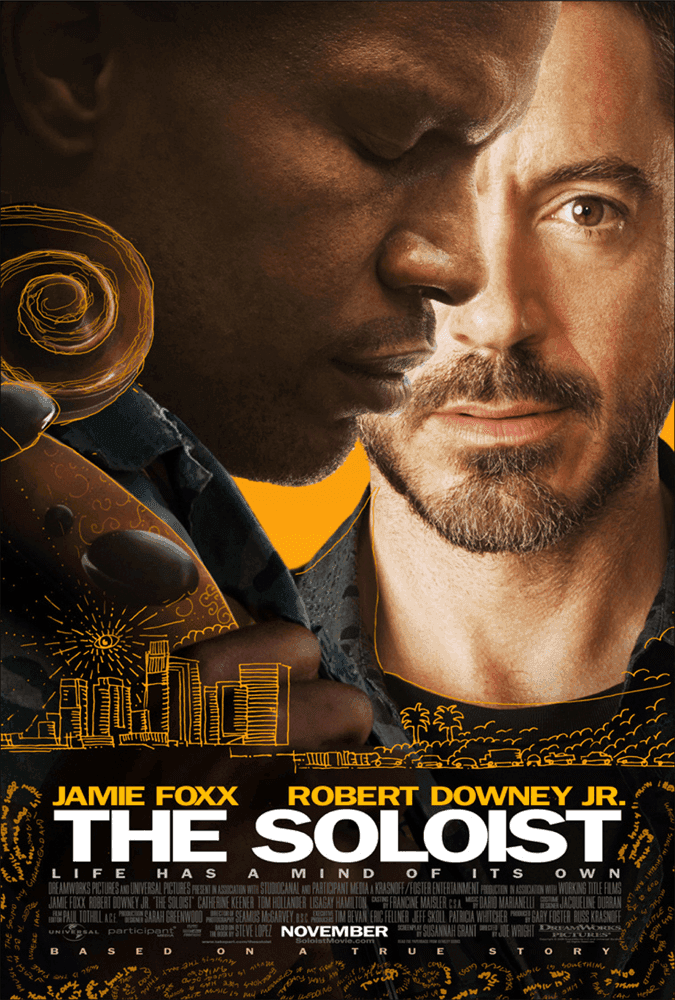
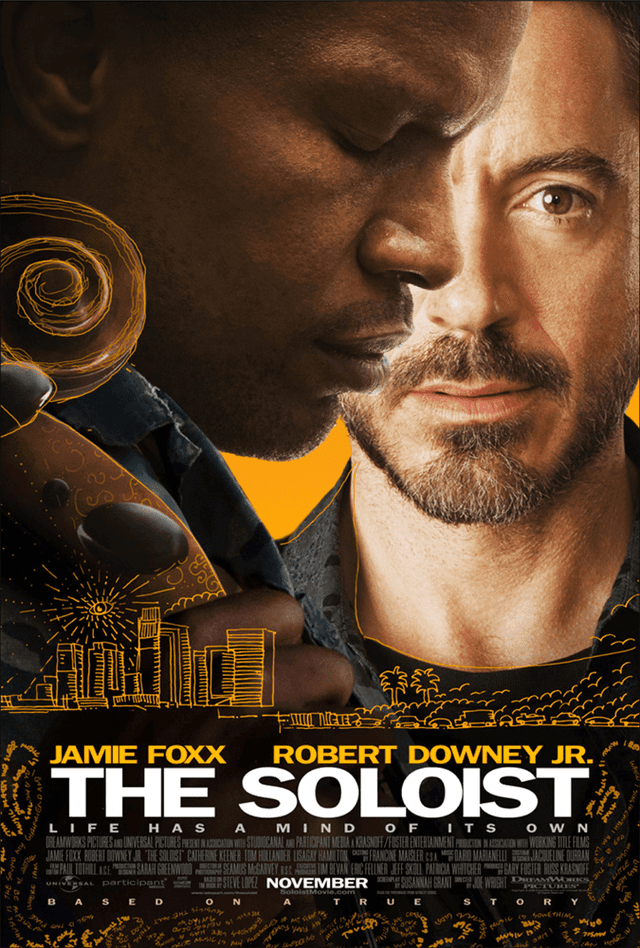
The Soloist (2009), directed by Joe Wright and distributed by Paramount Pictures (DreamWorks), was produced on a reported budget of $60,000,000. The drama, adapted from Los Angeles Times columnist Steve Lopez's 2008 memoir about his friendship with homeless musician Nathaniel Ayers, was financed by DreamWorks Pictures, Universal Pictures, StudioCanal, and Working Title Films. The film represented Wright's first American-set feature after Pride & Prejudice and Atonement, and was structured around the awards-season prospects of leads Robert Downey Jr. and Jamie Foxx.
The investment reflected an awards-track strategy that ultimately misfired. The film was originally scheduled for a November 21, 2008 release that would have positioned it for Oscar consideration, but Paramount pushed it to April 24, 2009 after disappointing test screenings, effectively removing it from awards contention. The math required the film to earn roughly $130,000,000 worldwide to clear breakeven after marketing, a target it missed by a wide margin as the spring release squandered the commercial advantages that the original holiday-corridor slot would have provided.
Key Budget Allocation Categories
The Soloist's $60,000,000 budget was distributed across several core production areas:
- Above-the-Line Talent: Robert Downey Jr., coming off Iron Man and Tropic Thunder, commanded a star salary appropriate to his 2008 ascendance. Jamie Foxx was three years removed from his Best Actor Oscar for Ray and brought his post-Oscar rate to the Nathaniel Ayers role. Director Joe Wright took compensation reflecting his Atonement-driven prestige, and producer Gary Foster oversaw the project for DreamWorks. Catherine Keener and Tom Hollander joined in supporting roles at character-actor rates.
- Los Angeles Location Shoot: Principal photography ran almost entirely on Los Angeles locations from March through June 2008, with extensive Skid Row sequences shot on actual downtown streets using real homeless residents as background performers. The production worked closely with the Los Angeles Homeless Services Authority and the Lamp Community to ensure the depiction respected the community, which added meaningful coordination costs beyond a standard urban location shoot.
- Music Performance and Cello Training: Jamie Foxx spent more than a year learning cello technique with instructor Ben Hong, principal cellist of the Los Angeles Philharmonic, in order to perform credibly on screen. The film's integration of live music performance with narrative scenes required extensive pre-recording, on-set playback, and post-production music editing.
- Original Score and Source Music Rights: Composer Dario Marianelli scored the film, blending original composition with extensive use of Beethoven excerpts. The Beethoven repertoire required no licensing but the performance recordings did, with the Los Angeles Philharmonic contributing tracks used throughout the film. Soundtrack rights clearance was a meaningful budget item.
- Production Design: Production designer Sarah Greenwood, Wright's frequent collaborator, oversaw set dressing for Skid Row sequences, the LA Times newsroom, Walt Disney Concert Hall sequences, and Nathaniel's transient living spaces. The mix of real and dressed locations required substantial set construction work and continuity dressing across a six-month shooting window.
- Reshoots and Editorial: After disappointing November 2008 test screenings, additional reshoots and re-editing extended into early 2009. The four-month release delay from November 2008 to April 2009 also extended finance carrying costs and forced a second-wave marketing campaign at higher cumulative spend than originally budgeted.
How Does The Soloist's Budget Compare to Similar Films?
At $60,000,000, The Soloist sat above the typical budget for true-story prestige dramas of the period:
- The Blind Side (2009): Budget $29,000,000 | Worldwide $309,208,309. Warner Bros' contemporaneous true-story drama cost less than half The Soloist and earned more than 13x worldwide, illustrating how dramatically different commercial outcomes could be in the same genre and release year.
- The Pursuit of Happyness (2006): Budget $55,000,000 | Worldwide $307,127,029. Will Smith's true-story homelessness drama cost roughly the same as The Soloist and earned 11x its worldwide gross, a closer comparable that frames how badly the Wright film underperformed.
- Atonement (2007): Budget $30,000,000 | Worldwide $129,266,061. Wright's prior collaboration with Working Title cost half of The Soloist and earned 4.5x its worldwide gross while collecting seven Oscar nominations.
- Ray (2004): Budget $40,000,000 | Worldwide $124,731,534. Jamie Foxx's Best Actor Oscar vehicle cost two-thirds of The Soloist and earned 4.5x worldwide, demonstrating the awards-driven commercial path the later film failed to replicate.
- Walk the Line (2005): Budget $28,000,000 | Worldwide $186,438,883. Fox's Johnny Cash biopic cost less than half of The Soloist and earned roughly 7x its worldwide gross, another music-anchored true-story comparable that achieved the awards-and-commerce double The Soloist had been positioned to chase.
The Soloist Box Office Performance
The Soloist opened on April 24, 2009 to $9,675,810 across 2,128 theaters, finishing third for the weekend behind Obsessed and 17 Again. The spring release positioned the film against family entertainment and adult crowd-pleasers, neither of which created favorable audience overlap. Subsequent weeks saw steep drops as word-of-mouth failed to materialize and the film closed with a domestic total of $31,720,158.
Against a $60,000,000 production budget the film needed approximately $130,000,000 worldwide to clear breakeven after marketing. Here is the financial breakdown:
Box Office Breakdown
The Soloist

The Soloist returned approximately $0.38 in theatrical revenue for every $1 invested when measured against total estimated production and marketing spend. The domestic share was $31,720,158 against an international share of just $6,612,836, an 83/17 split heavily weighted toward North America, which is unusual for a film carrying two A-list American stars and indicated minimal overseas demand.
The commercial disappointment effectively ended DreamWorks' strategy of pairing prestige directors with star-led true-story material in this budget range. The film's failure also contributed to a broader retreat from socially-conscious mid-budget dramas during the 2009 to 2011 period, with Paramount and DreamWorks subsequently shifting their dramatic slate toward genre-hybrid material with clearer audience hooks.
The Soloist Production History
Susannah Grant adapted Steve Lopez's 2008 memoir The Soloist: A Lost Dream, an Unlikely Friendship, and the Redemptive Power of Music for the screen. Grant's screenplay went into development at DreamWorks in 2007 with Joe Wright attached to direct on the strength of his Atonement work. Producer Gary Foster shepherded the project, and Working Title Films and Universal Pictures joined as financing partners. Robert Downey Jr. and Jamie Foxx attached in late 2007 in a casting move that reflected both actors' commercial peak.
Jamie Foxx began cello training in early 2008 with Ben Hong, principal cellist of the Los Angeles Philharmonic, working roughly four hours daily over a four-month pre-production window. Foxx had no prior string-instrument experience and approached the role as a complete technical reset. Robert Downey Jr. spent extended time with Steve Lopez at the LA Times newsroom and in the field on his Skid Row reporting beat to capture the specific cadences of the columnist's voice.
Principal photography ran from March 17 to June 25, 2008 across Los Angeles, with the production basing in downtown LA to shoot Skid Row sequences on real streets. The film worked closely with the Lamp Community, which provides services to homeless adults with severe mental illness, and cast roughly 500 LA residents experiencing homelessness as background performers in the major Skid Row sequences. Some of these performers were later credited and paid additional residuals as the film qualified for SAG-AFTRA principal coverage.
DreamWorks originally scheduled the film for November 21, 2008, positioning it for Oscar consideration. After disappointing test screenings in October 2008, the studio pushed the release first to March 13, 2009 and then to April 24, 2009. The four-month delay required additional reshoots and re-editing, extended finance carrying costs, and effectively removed the film from awards contention. The decision was widely reported at the time as a signal of DreamWorks' lost confidence in the cut.
Awards and Recognition
The Soloist received scattered nominations but no major awards wins. The Critics' Choice Movie Awards nominated Jamie Foxx for Best Supporting Actor, and the NAACP Image Awards recognized the film with nominations for Outstanding Motion Picture, Outstanding Actor (Foxx), and Outstanding Director (Wright). The film also picked up a Capri Hollywood Film Festival award for Joe Wright as Director of the Year.
Despite the awards-track positioning of the production and the talents involved, the film registered essentially no presence at the Academy Awards, Golden Globes, BAFTAs, or major guild ceremonies. The April 2009 release date, four months after the standard awards-corridor window, was a significant factor, but the mixed reviews and commercial disappointment compounded the absence. Industry observers cited The Soloist as a cautionary example of how prestige positioning can collapse when the cut does not test well.
Critical Reception
The Soloist received mixed reviews. The film holds a 56% approval rating on Rotten Tomatoes based on 213 critic reviews, with a critical consensus that called it "sincere but uneven." On Metacritic, the film scored 61 out of 100, indicating generally favorable reviews. Audiences surveyed by CinemaScore gave the film a B-, a soft response for a drama anchored by two Oscar-recognized leads.
Critics praised Jamie Foxx's committed performance as Nathaniel Ayers, particularly the cello sequences that drew on his year of pre-production training. Robert Downey Jr. received positive notices for a restrained turn against type. Roger Ebert awarded the film 3.5 stars and called Foxx's work "a performance of touching authenticity." A.O. Scott of the New York Times wrote that Wright "directs with an empathy that the script can't quite earn," capturing a common thread of critical ambivalence about the screenplay's structure.
The mental-illness advocacy community offered mixed responses, with some praising the film's respectful depiction of schizophrenia and others objecting to dramatic compressions that simplified Ayers' actual recovery arc. Steve Lopez himself defended the adaptation publicly while acknowledging changes from his memoir. The Skid Row community engagement, however, drew uniformly positive attention, with the Lamp Community and several homeless advocacy groups citing the production as a model for respectful collaboration on urban location work.
Frequently Asked Questions
How much did it cost to make The Soloist (2009)?
The reported production budget was $60,000,000. The film was financed by DreamWorks Pictures, Universal Pictures, StudioCanal, and Working Title Films, with producer Gary Foster overseeing the project. Paramount Pictures handled distribution under its DreamWorks releasing agreement.
How much did The Soloist earn at the box office?
The film grossed $31,720,158 domestically and $6,612,836 internationally, for a worldwide total of $38,332,994. It opened to $9,675,810 in the United States, finishing third on its April 24, 2009 opening weekend behind Obsessed and 17 Again.
Was The Soloist a box office bomb?
Yes. Against a $60,000,000 production budget and an estimated $35,000,000 to $45,000,000 in marketing spend, the film returned approximately $0.38 in worldwide gross for every $1 invested. The four-month release delay from November 2008 to April 2009 effectively removed the film from awards contention and squandered the commercial advantages of a holiday-corridor slot.
Who directed The Soloist?
Joe Wright directed the film, his first American-set feature after Pride & Prejudice (2005) and Atonement (2007). Susannah Grant wrote the screenplay adapted from Steve Lopez's 2008 memoir The Soloist: A Lost Dream, an Unlikely Friendship, and the Redemptive Power of Music.
Is The Soloist based on a true story?
Yes. The film is based on Los Angeles Times columnist Steve Lopez's columns and 2008 memoir about his real friendship with Nathaniel Anthony Ayers, a Juilliard-trained musician who developed schizophrenia in his second year at the school and later lived homeless on Skid Row in Los Angeles. Lopez wrote dozens of columns about Ayers between 2005 and 2008.
Where was The Soloist filmed?
Principal photography ran from March 17 to June 25, 2008 across Los Angeles, with extensive Skid Row sequences shot on actual downtown streets. The production worked with the Lamp Community, which provides services to homeless adults with severe mental illness, and cast roughly 500 LA residents experiencing homelessness as background performers in the major Skid Row sequences.
Did Jamie Foxx actually play the cello?
Yes. Jamie Foxx spent more than a year learning cello technique with Ben Hong, principal cellist of the Los Angeles Philharmonic, working roughly four hours daily over a four-month pre-production window. Foxx had no prior string-instrument experience and approached the role as a complete technical reset. The performance scenes integrate his actual playing with selective dubbing.
How does The Soloist compare to The Blind Side and The Pursuit of Happyness?
All three are true-story dramas released within three years of each other. The Soloist cost $60M and earned $38M worldwide. The Blind Side (2009) cost $29M and earned $309M. The Pursuit of Happyness (2006) cost $55M and earned $307M. The Soloist's commercial outcome was the worst of the three by a wide margin despite a similar budget and equivalent star wattage.
What did critics think of The Soloist?
The film received mixed reviews, with a 56% approval rating on Rotten Tomatoes (based on 213 critics) and a 61 out of 100 score on Metacritic. Audiences gave it a B- CinemaScore. Critics praised Jamie Foxx's committed performance as Nathaniel Ayers and Robert Downey Jr.'s restrained turn as Steve Lopez but objected to the screenplay's structural unevenness.
Did The Soloist win any awards?
No major awards wins. The Critics' Choice Movie Awards nominated Jamie Foxx for Best Supporting Actor, and the NAACP Image Awards recognized the film with multiple nominations. Despite the awards-track positioning of the production, the film registered essentially no presence at the Academy Awards, Golden Globes, BAFTAs, or major guild ceremonies after the April 2009 release date placed it outside the awards corridor.
Filmmakers
The Soloist

Build budgets like this one in Saturation
Start from an industry-standard feature film template, import the schedule and rates you already have, and let the cost report keep itself current as you spend. Real-time collaboration, no spreadsheets.