The Saint Budget
 Action
Updated
Synopsis
Simon Templar, a brilliant high-tech thief and master of disguise known as "The Saint," is hired by a Russian oligarch to steal a revolutionary cold fusion formula from a beautiful American scientist. As his disguises peel away, Templar finds himself falling for his target and caught between competing forces in post-Soviet Moscow.
What Is the Budget of The Saint (1997)?
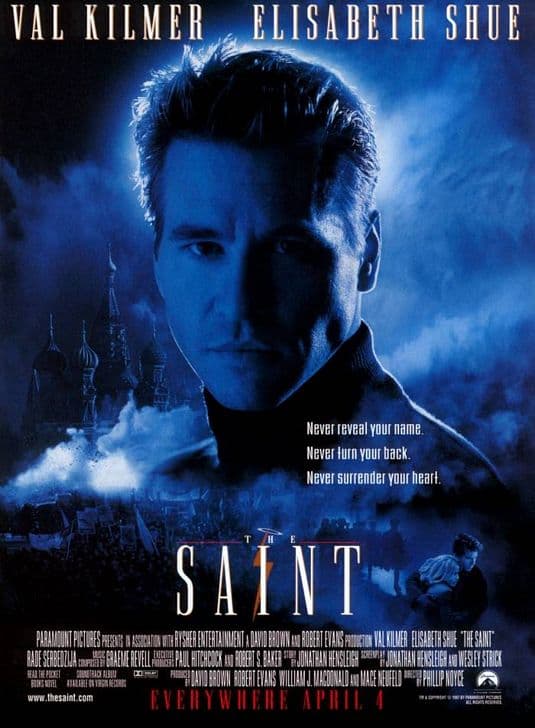
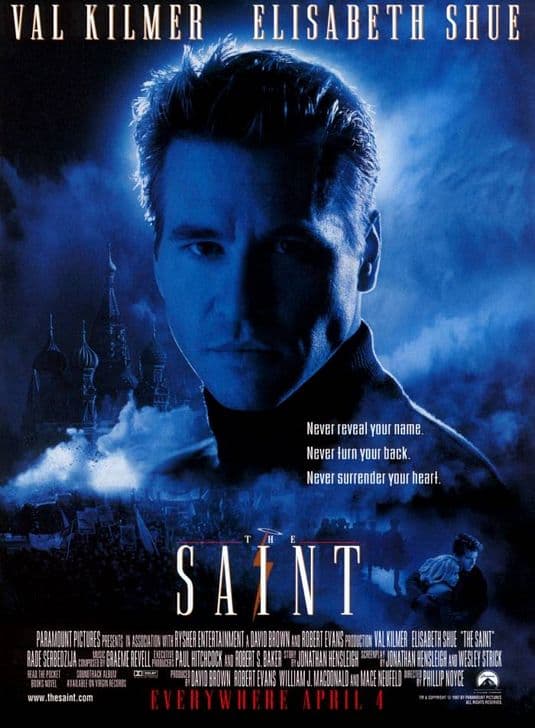
The Saint (1997), directed by Phillip Noyce and distributed by Paramount Pictures, was produced on a reported budget of $68,000,000. The film was a contemporary reinvention of Leslie Charteris' famed gentleman-thief character Simon Templar (The Saint), who had previously been portrayed in dozens of novels and short stories starting in 1928, several film adaptations including a 1938-1954 RKO Pictures series, a 1962-1969 ITC Entertainment British television series starring Roger Moore, and the 1978-1979 Return of the Saint with Ian Ogilvy. Paramount positioned the film as a potential franchise launch with Val Kilmer in the lead role, following Kilmer's post-Batman Forever (1995) box office momentum.
The investment reflected Paramount's mid-1990s commitment to star-driven, internationally-set thrillers in the wake of the studio's recent Sliver and Indecent Proposal commercial successes. The budget covered an extensive international location shoot across Russia, the United Kingdom, and Switzerland, an ensemble international cast headed by Kilmer and Elisabeth Shue, the practical and digital effects for the film's elaborate set pieces including the Kremlin chase and the Moscow penthouse infiltration, and a significant marketing-and-distribution commitment from Paramount's spring 1997 release window.
Key Budget Allocation Categories
The Saint's reported $68,000,000 budget was distributed across several core production areas:
- Above-the-Line Talent: Val Kilmer, then commanding A-list compensation following Batman Forever (1995) and Heat (1995), headlined as Simon Templar. Kilmer's deal reportedly included a base salary of $7,000,000 plus first-dollar gross participation. Elisabeth Shue, an Oscar nominee for Leaving Las Vegas (1995), played cold fusion scientist Dr. Emma Russell. Supporting roles for Rade Šerbedžija as Russian oligarch Ivan Tretiak and Valery Nikolaev as his son Ilya filled out the ensemble. Director Phillip Noyce commanded a feature-director rate appropriate to his post-Clear and Present Danger standing.
- International Location Shoot: Principal photography ranged across Moscow and surrounding regions of Russia for extensive on-the-ground exteriors at the Kremlin, Red Square, and various Soviet-era residential districts, Oxford and London in the United Kingdom for the prologue and key chase sequences, and brief Switzerland photography in Zurich. The Russia block, conducted in late 1995 and early 1996 during the post-Soviet political transition, required complex logistics, security infrastructure, and Russian government coordination.
- Val Kilmer Multiple-Identity Performance: The script required Kilmer to perform multiple distinct character identities throughout the film, each with its own physical appearance, accent, and behavioral specifics. The performance required extensive prosthetic application, multiple costume designs, dialect coaching, and additional shooting time relative to a conventional single-identity lead performance.
- Practical Set Pieces: The Saint required extensive practical action including the Kremlin chase, the Moscow penthouse infiltration, the Oxford rooftop sequence, the prologue boys-school break-in, and the Russian dacha climax. Practical effects, fire stunts, vehicle work, and dedicated stunt teams across the multiple locations added meaningful cost.
- Visual Effects: The cold fusion device and various technical sequences required modest computer-generated effects work, handled by Cinesite and various smaller vendor houses. Composite work supporting the multiple-disguise sequences also contributed to the VFX line item.
- Score and Music: Composer Graeme Revell scored the film with a contemporary electronic and orchestral approach. The soundtrack featured original tracks from Sneaker Pimps, Orbital, Daft Punk, and Moby, with the Sneaker Pimps' "6 Underground" serving as the lead single. Music licensing for the high-profile electronic and trip-hop tracks added significant cost.
How Does The Saint's Budget Compare to Similar Films?
At a reported $68,000,000, The Saint sits in the upper-mid range of mid-1990s action thrillers. The comparison set illustrates the genre context:
- Mission: Impossible (1996): Budget $80,000,000 | Worldwide $457,696,359. Brian De Palma's contemporaneous spy reboot launch cost slightly more and earned nearly three times The Saint's worldwide gross, illustrating the gap between a successful franchise launch and a missed one.
- GoldenEye (1995): Budget $60,000,000 | Worldwide $352,194,034. Pierce Brosnan's James Bond debut cost less and earned more than twice The Saint's worldwide gross, providing the closest spy-thriller benchmark.
- Sneakers (1992): Budget $35,000,000 | Worldwide $51,432,691. Phil Alden Robinson's contemporaneous high-tech heist film cost half as much and earned less, illustrating how The Saint outperformed the broader high-tech heist subgenre while underperforming the spy-franchise launches.
- Mercury Rising (1998): Budget $60,000,000 | Worldwide $93,103,506. Bruce Willis's subsequent next-year cryptographic thriller cost slightly less and earned roughly 55 percent of The Saint's worldwide gross, providing a direct genre comparison.
The Saint Box Office Performance
The Saint opened on April 4, 1997 to $16,400,000 over its three-day weekend, finishing first at the domestic box office and edging out Liar Liar in its second weekend. The strong opening exceeded Paramount's expectations and provided early validation of the project's franchise potential. International rollouts over the following months proved consistent, with the film performing particularly well in European markets where Leslie Charteris' Saint character had established generational recognition.
Against a reported production budget of $68,000,000, the film needed approximately $170,000,000 in worldwide gross to reach profitability when accounting for marketing and distribution costs. Here is the financial breakdown:
Box Office Breakdown
The Saint

The Saint returned approximately $1.32 in theatrical revenue for every $1 invested in production and marketing, a modest figure that cleared the profitability bar but fell short of the levels Paramount had projected based on the strong opening weekend and the underlying franchise potential. The domestic share of the gross was $61,376,234 against an international share of $108,000,000, a 36/64 split that reflected the property's European origin and stronger overseas recognition.
Despite clearing modest profitability, the commercial result was insufficient to greenlight an immediate sequel. Paramount held the Leslie Charteris film rights and discussed sequel possibilities in 1997-1998, but Val Kilmer's subsequent off-screen disputes with the studio and his pivot toward more diverse genre projects (At First Sight, At Sundance) effectively ended the planned franchise. A 2017 television film, The Saint, with Adam Rayner attempted to revive the property unsuccessfully. The Charteris estate continues to pursue feature adaptations as of the mid-2020s.
The Saint Production History
Development on The Saint began at Paramount Pictures in 1989, when the studio acquired the film rights from the Leslie Charteris estate following the 1985 commercial success of the The Saint television film starring Andrew Clarke. Multiple iterations of the project circulated through the early 1990s with attached directors including Sydney Pollack, Steven Spielberg, and John Boorman. Phillip Noyce was attached in late 1994 on the strength of his Clear and Present Danger commercial success, with Jonathan Hensleigh delivering the principal screenplay and Wesley Strick handling subsequent rewrites.
Casting was finalized in mid-1995. Val Kilmer was confirmed in August 1995 following his Batman Forever success, with Elisabeth Shue announced in late 1995 after her Leaving Las Vegas reception established her as a viable A-list lead. Supporting cast was finalized in early 1996. The choice to cast Kilmer over previously discussed candidates including Mel Gibson, Brad Pitt, and Hugh Grant reflected Paramount's belief that Kilmer's post-Batman commercial momentum would carry the film domestically while his arthouse credentials (The Doors, Heat) would support international and critical reception.
Principal photography ran from November 1995 through July 1996, an unusually extended shooting schedule reflecting both the multiple international locations and the complexity of Val Kilmer's multiple-identity performances. Production began at Pinewood Studios in the United Kingdom for the Oxford and London sequences, then relocated to Moscow and surrounding Russia regions in early 1996. The Russia block was particularly logistically complex, requiring extensive government coordination during the politically uncertain post-Soviet transition period. The original ending, in which Templar's love interest Emma Russell died, was reshot in late 1996 after test audiences rejected the tragic resolution. The replacement ending, in which Emma survives, prompted significant production reshuffling and additional reshoots in early 1997.
Awards and Recognition
The Saint received minimal awards recognition. The film was not nominated at the Academy Awards, the Golden Globes, the BAFTAs, the Critics' Choice Movie Awards, or the major guild ceremonies. The film also avoided Razzie nominations at the 18th Golden Raspberry Awards, with that year's Razzies focused on The Postman, Speed 2: Cruise Control, and Anaconda.
The film did receive some genre and music industry recognition. The soundtrack received Grammy Award consideration for the Sneaker Pimps' "6 Underground," and the Saint score by Graeme Revell received BMI Film Music Award consideration. Within the spy-thriller and action-genre press, The Saint was largely absent from year-end recognition lists, reflecting the film's mixed critical reception and the commercial-rather-than-prestige positioning of the project. Val Kilmer's multiple-identity performance drew positive notices in some quarters but did not translate to awards recognition.
Critical Reception
The Saint received mixed reviews. The film holds a 30% approval rating on Rotten Tomatoes based on 67 critic reviews, with a critical consensus calling it "a remake that doesn't live up to its 1960s namesake and which features a confusingly muddled plot anchored by Val Kilmer's arch performance." On Metacritic, the film scored 36 out of 100, indicating generally unfavorable reviews. Audiences surveyed by CinemaScore gave the film a B-, a soft grade for a star-driven action film where B+ or higher is the typical baseline for the genre.
Critics broadly praised the international location work, Phillip Noyce's assured action staging, and the Graeme Revell score, while objecting to the convoluted plot, the inconsistency of Val Kilmer's multiple-identity performance, and the muddled tonal balance between camp and seriousness. Roger Ebert gave the film two and a half stars and noted that "The Saint is a movie that wants to be both clever and exciting, but spends so much time on character disguises that it forgets to give us a story." The New York Times' Janet Maslin called it "an entertaining but disposable thriller anchored by a star who looks like he's having fun but never quite connects with the audience." Variety's Todd McCarthy wrote that "Kilmer's multiple-identity stunt work is impressive but ultimately undercuts rather than supports the dramatic momentum."
Some critics defended the film as a satisfying old-school adventure that revived the gentleman-thief subgenre. Empire's Ian Nathan praised the "lavish production design and Kilmer's charismatic central performance," giving it three stars. The Saint's critical legacy has been mixed: retrospective reappraisal in outlets including the AV Club and Den of Geek has been somewhat more generous than initial 1997 reviews, with the film increasingly framed as a stylish high-concept programmer rather than a major creative achievement. The mixed reception, combined with the modest theatrical return, has limited The Saint's cultural footprint compared with peer spy-thriller launches of the era.
Frequently Asked Questions
How much did it cost to make The Saint (1997)?
The reported production budget was $68,000,000. Paramount Pictures financed the production, which covered an extensive international location shoot across Russia, the United Kingdom, and Switzerland, an ensemble international cast headed by Val Kilmer and Elisabeth Shue, the practical and digital effects for the film's elaborate set pieces, and the multiple-identity performance requirements that extended shooting time relative to a conventional single-identity lead.
How much did The Saint (1997) earn at the box office?
The film grossed $61,376,234 domestically and $108,000,000 internationally, for a worldwide total of $169,376,234. It opened to $16,400,000 over its three-day weekend in the United States on April 4, 1997, finishing first at the domestic box office and edging out Liar Liar in its second weekend.
Was The Saint (1997) profitable?
Modestly. Against a $68,000,000 production budget and approximately $50,000,000 to $60,000,000 in marketing spend, the film returned approximately $1.32 in worldwide gross for every $1 invested. Paramount cleared an estimated break-even to $10,000,000 in net profit after theatrical splits, a result insufficient to greenlight an immediate sequel.
Who directed The Saint (1997)?
Phillip Noyce directed the film, working from a screenplay by Jonathan Hensleigh with rewrites by Wesley Strick. Noyce had previously directed Clear and Present Danger (1994) and Patriot Games (1992), both Tom Clancy adaptations. He was attached to The Saint in late 1994 on the strength of his Clear and Present Danger commercial success. Noyce subsequently directed Rabbit-Proof Fence (2002), The Quiet American (2002), and Salt (2010).
Where was The Saint (1997) filmed?
Principal photography ran from November 1995 through July 1996. Production began at Pinewood Studios in the United Kingdom for the Oxford and London sequences, then relocated to Moscow and surrounding regions of Russia in early 1996 for extensive on-the-ground exteriors at the Kremlin, Red Square, and various Soviet-era residential districts. Brief Switzerland photography was conducted in Zurich.
Who plays Simon Templar in The Saint (1997)?
Val Kilmer plays Simon Templar, the gentleman-thief known as The Saint. The role required Kilmer to perform multiple distinct character identities throughout the film, each with its own physical appearance, accent, and behavioral specifics. Kilmer was confirmed in August 1995 following his Batman Forever success. The Saint role had been played by dozens of previous actors including George Sanders, Hugh Sinclair, Roger Moore, Ian Ogilvy, Simon Dutton, and Andrew Clarke.
What is The Saint (1997) based on?
The film is based on the character of Simon Templar, created by Leslie Charteris in 1928 and featured in dozens of novels and short stories through the 1980s. Previous adaptations include a 1938-1954 RKO Pictures film series, a 1962-1969 ITC Entertainment British television series starring Roger Moore, the 1978-1979 Return of the Saint with Ian Ogilvy, and a 1985 television film with Andrew Clarke. The 1997 Phillip Noyce film was the first feature-film adaptation of the character in over three decades.
Why was The Saint (1997)'s ending reshot?
The original ending, in which Templar's love interest Emma Russell died, was reshot in late 1996 after test audiences rejected the tragic resolution. The replacement ending, in which Emma survives, prompted significant production reshuffling and additional reshoots in early 1997. The change extended the film's post-production timeline and added incremental cost to the budget.
What did critics think of The Saint (1997)?
The film received mixed reviews, with a 30% approval rating on Rotten Tomatoes (based on 67 critics) and a 36 out of 100 score on Metacritic. Audiences gave it a B- CinemaScore. Critics praised the international location work, Phillip Noyce's action staging, and the Graeme Revell score, while objecting to the convoluted plot, the inconsistency of Val Kilmer's multiple-identity performance, and the muddled tonal balance.
Did The Saint (1997) get a sequel?
No. Despite clearing modest profitability, the commercial result was insufficient to greenlight an immediate sequel. Paramount held the Leslie Charteris film rights and discussed sequel possibilities in 1997-1998, but Val Kilmer's subsequent disputes with the studio and his pivot toward more diverse genre projects effectively ended the planned franchise. A 2017 television film, The Saint, with Adam Rayner attempted to revive the property unsuccessfully.
Filmmakers
The Saint

Build budgets like this one in Saturation
Start from an industry-standard feature film template, import the schedule and rates you already have, and let the cost report keep itself current as you spend. Real-time collaboration, no spreadsheets.