The Phantom Budget
 Action
Updated
Synopsis
In 1938, the masked jungle adventurer Kit Walker, descendant of a line of crime-fighting Phantoms, leaves his African home to thwart a megalomaniacal industrialist plotting to harness the power of three ancient skulls. A pulp adventure in the Saturday-matinee tradition, set across jungles, New York City, and a hidden island fortress.
What Is the Budget of The Phantom (1996)?
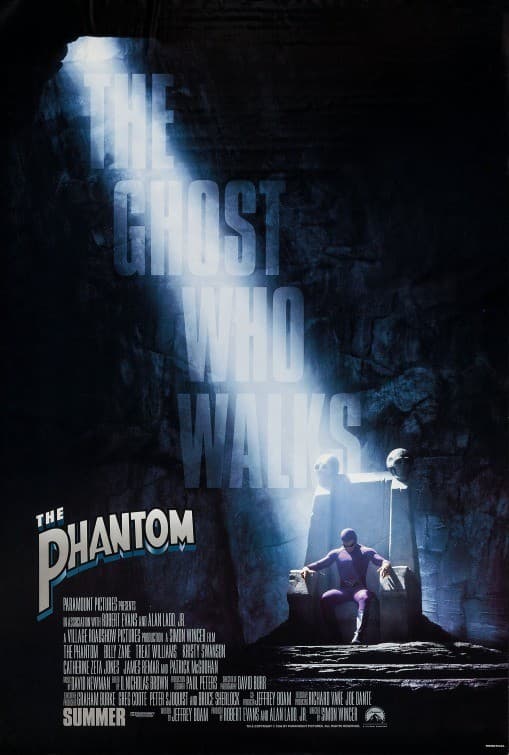
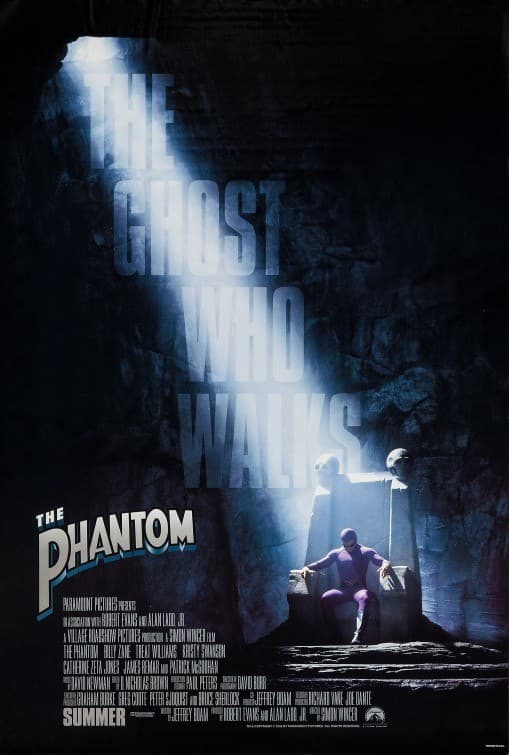
The Phantom (1996), directed by Australian filmmaker Simon Wincer and distributed by Paramount Pictures, was produced on a reported budget of approximately $45,000,000. The film adapted Lee Falk's long-running newspaper-comic-strip character, in continuous publication since 1936, for a wide-release theatrical feature with Billy Zane in the title role. Robert Evans Productions and The Ladd Company co-produced, with Robert Evans, Alan Ladd Jr., and Joe Dante serving as the principal producers.
The budget reflected a mid-1990s adventure-genre scale. The bulk of the spend went to the cast (Billy Zane, Treat Williams, Kristy Swanson, Catherine Zeta-Jones in one of her early-career roles), the Thai and Australian location shoot for the jungle exteriors, the 1938-era period production design across New York and Bangkok settings, and the visual effects required for the three magic-skull sequences and various pulp-action set pieces. Paramount positioned the film as a counter-programming summer release targeting the all-ages adventure audience.
Key Budget Allocation Categories
The Phantom's reported $45,000,000 budget was distributed across the following core production areas:
- Above-the-Line Talent: Billy Zane, coming off Titanic's casting and his Demon Knight horror lead, commanded a star fee in the low seven figures plus extensive physical-training and stunt-prep compensation. Treat Williams played the antagonist Xander Drax, with Kristy Swanson and Catherine Zeta-Jones in principal supporting roles. Director Simon Wincer, an Australian veteran of Free Willy and Lonesome Dove, was paid at a feature-director rate appropriate to a wide-release adventure project.
- Thailand and Australia Location Shoot: Principal photography took place across Thailand (for the jungle exteriors of the fictional country of Bangalla) and Australia (Sydney and surrounding regions for the 1938 New York and Bangkok cityscape sequences). The location work required substantial logistics, cast and crew travel across hemispheres, and local-crew arrangements in both territories.
- Period Production Design: Production designer Paul Peters recreated 1938 New York exteriors and interiors with period vehicles, art-deco architecture, and the streetscape vocabulary of the late-1930s pulp adventure. Bangalla jungle interiors and the Phantom's Skull Cave headquarters were built on Australian soundstages with detailed historical research and source-material verification.
- Visual Effects: The film required extensive VFX for the three magic-skull sequences, the climactic skull-power confrontation, and various pulp-action set pieces including a horseback-versus-truck chase and a riverboat sequence. Cinesite, Dream Quest Images, and other vendors handled the practical and digital effects work, with both miniature and CG composition layered across the major sequences.
- Costume and Practical Effects: Costume designer Marlene Stewart created multiple iterations of the Phantom's purple bodysuit, including hero costumes, stunt-double versions, and damage-progression copies for the action sequences. Practical effects included horseback work, gun-and-whip choreography, and the riverboat and biplane sequences that punctuate the act-three pulp action.
- Score and Music: Composer David Newman delivered an orchestral score in the tradition of John Williams' Indiana Jones work, with brass-driven hero themes, exotic Asian percussion for the Bangalla sequences, and a Wagnerian skull-power motif for the climactic confrontation. Music licensing was minimal, with the soundtrack carried almost entirely by original composition.
How Does The Phantom's Budget Compare to Similar Films?
At a reported $45,000,000, The Phantom sits in the mid-range of mid-1990s pulp adventure features. The comparison set illustrates how its commercial outcome compared with budgetary peers:
- The Rocketeer (1991): Budget $40,000,000 | Worldwide $46,704,056. The earlier Disney pulp adventure cost effectively the same as The Phantom and earned more than twice the worldwide gross, illustrating the upper ceiling of the format that The Phantom could not approach.
- The Shadow (1994): Budget $40,000,000 | Worldwide $48,063,435. The previous Universal pulp adventure with Alec Baldwin cost less than The Phantom and earned nearly three times the worldwide gross, illustrating the broader commercial difficulty of the format throughout the 1990s.
- Dick Tracy (1990): Budget $47,000,000 | Worldwide $162,738,726. Warren Beatty's previous-decade pulp adventure cost almost exactly the same as The Phantom and earned nearly ten times the worldwide gross, illustrating how the format had peaked commercially in the late 1980s before declining sharply through the 1990s.
- The Mask of Zorro (1998): Budget $95,000,000 | Worldwide $250,288,523. The Antonio Banderas and Catherine Zeta-Jones adventure released two years after The Phantom cost more than twice as much and earned more than 14 times the worldwide gross, illustrating how Zeta-Jones (a Phantom co-star) found commercial success in the pulp-adventure form after the Paramount film's underperformance.
- The Quick and the Dead (1995): Budget $35,000,000 | Worldwide $47,326,964. Sam Raimi's western from one year before The Phantom cost less and earned three times the worldwide, illustrating the broader genre challenge of nostalgia-adventure forms in mid-1990s theatrical.
The Phantom Box Office Performance
The Phantom opened on June 7, 1996, finishing third at the U.S. box office with $5,118,719 over its three-day opening weekend, well below pre-release tracking that had pegged the film for an opening in the $10,000,000 to $15,000,000 range. The film closed its domestic run at $17,316,468 and added negligible international gross of approximately $92,000, for a worldwide total of $17,408,468.
Against a reported production budget of $45,000,000, the film fell catastrophically short of theatrical break-even. Here is the financial breakdown:
Box Office Breakdown
The Phantom

The Phantom returned approximately $0.22 to $0.25 in worldwide theatrical gross for every $1 invested in production and marketing, placing it among the clearer commercial bombs of the 1996 summer slate. Home video sales, television revenue, and the film's cult-classic afterlife on Saturday-afternoon cable have closed only a modest share of the theatrical loss over decades, but the initial theatrical recoupment was essentially nonexistent.
The negligible international gross is unusual and reflects the Paramount international distribution's decision to forgo wide theatrical release outside North America, opting instead for direct-to-home-video release in most international territories. The commercial failure killed plans for a Phantom sequel and effectively ended the wave of mid-1990s pulp-adventure adaptations.
The Phantom Production History
Development began at Robert Evans Productions in the late 1980s, with Evans personally championing The Phantom property as the next great pulp-adventure feature in the tradition of his successful productions of the 1970s and 1980s. Joe Dante was briefly attached to direct in the early 1990s before falling off the project, and several screenwriters cycled through the script before Jeffrey Boam (Indiana Jones and the Last Crusade, The Lost Boys) delivered the shooting draft.
Australian director Simon Wincer attached in 1995 on the strength of his work on Lonesome Dove, Free Willy, and Quigley Down Under. Casting Billy Zane as the Phantom took place in late 1995, with Treat Williams attached as the antagonist Xander Drax. Catherine Zeta-Jones, then twenty-six and largely unknown to U.S. audiences (her breakout role would come in The Mask of Zorro two years later), was cast in the supporting role of Sala.
Principal photography ran from December 1995 to April 1996 across Thailand (for the Bangalla jungle exteriors) and Australia (Sydney and surrounding regions for the 1938 New York and Bangkok cityscape sequences). The production took advantage of the favorable Thai baht and Australian dollar exchange rates against the U.S. dollar in the mid-1990s, with substantial local-crew utilization on both continents.
Post-production ran across the spring of 1996, with editor O. Nicholas Brown cutting the film for a 100-minute runtime. The visual effects work was supervised by Dream Quest Images and Cinesite, with both practical and CG composition layered across the major sequences. The film premiered with a wide release on June 7, 1996, in approximately 2,073 theaters, but the weak opening weekend prompted Paramount to scale back its planned wide international rollout.
Awards and Recognition
The Phantom received limited awards recognition. The film earned a nomination at the Saturn Awards for Best Costume Design, the only major industry-association nod the production received. It also picked up minor genre-press recognition for David Newman's score, although it did not win at the IFMCA or other film-music ceremonies.
The film did not register at the broader industry ceremonies, including the Academy Awards, the Golden Globes, the BAFTAs, or the Razzies. Its legacy within awards conversation has been essentially absent, reflecting both its commercial failure and the broader late-1990s decline of mid-budget pulp-adventure features as an awards category.
Critical Reception
The Phantom received mixed reviews. The film holds a 47 percent approval rating on Rotten Tomatoes based on 36 critic reviews, with a critical consensus that called it "harmless enough, but unable to find the formula for adventure that worked for Indiana Jones and The Rocketeer." CinemaScore polled opening-weekend audiences and reported a B grade, well below the typical A-or-better expectation for a four-quadrant summer adventure.
Roger Ebert gave the film three out of four stars and praised it as "an enjoyable adventure in the spirit of the comics, played with deadpan style by Billy Zane and a strong cast." Janet Maslin of The New York Times called it "a colorful, lightly amusing entry in the pulp-revival genre that nonetheless feels just a beat slow." Variety's Brian Lowry wrote that the film "lacks the kinetic energy that contemporary adventure audiences expect."
The film has settled into a curious cult-classic afterlife. Frequent Saturday-afternoon cable airings through the late 1990s and 2000s established the film as a guilty-pleasure favorite for a generation of nostalgia-prone viewers, and Billy Zane's performance has been periodically reassessed as one of the more committed pulp-hero performances of the era. The film remains a touchstone reference in retrospectives of the mid-1990s pulp-adventure cycle.
Frequently Asked Questions
How much did it cost to make The Phantom (1996)?
The reported production budget was approximately $45,000,000. Paramount Pictures distributed the film and co-produced with The Ladd Company, Robert Evans Productions, and Village Roadshow Pictures. The Thai and Australian location shoot benefited from favorable exchange rates against the U.S. dollar in the mid-1990s.
How much did The Phantom (1996) earn at the box office?
The film grossed $17,316,468 domestically and approximately $92,000 internationally, for a worldwide total of $17,408,468. It opened to $5,118,719 in the United States, finishing third on its June 7, 1996 opening weekend, well below pre-release tracking that projected a $10,000,000 to $15,000,000 opening.
Was The Phantom (1996) profitable?
No. Against a $45,000,000 production budget and an estimated $25,000,000 to $35,000,000 in marketing spend, the film returned approximately $0.22 to $0.25 in worldwide gross for every $1 invested. The theatrical run produced an estimated $52,591,532 to $62,591,532 loss, killing plans for a sequel.
Who directed The Phantom (1996)?
Australian director Simon Wincer directed the film. Wincer is best known for Free Willy (1993), Lonesome Dove (1989 miniseries), and Quigley Down Under (1990). He brought a workmanlike, classical-adventure approach to the material in the tradition of his earlier television and feature work.
Is The Phantom (1996) based on a comic strip?
Yes. The film is based on Lee Falk's newspaper comic strip "The Phantom," which has been in continuous publication since 1936 and is one of the longest-running adventure comic strips in publishing history. Screenwriter Jeffrey Boam (Indiana Jones and the Last Crusade) delivered the shooting draft.
Where was The Phantom (1996) filmed?
Principal photography ran from December 1995 to April 1996 across Thailand (for the Bangalla jungle exteriors) and Australia (Sydney and surrounding regions for the 1938 New York and Bangkok cityscape sequences). The production took advantage of the favorable Thai baht and Australian dollar exchange rates against the U.S. dollar.
Who stars in The Phantom (1996)?
Billy Zane stars as Kit Walker / The Phantom. Treat Williams plays the antagonist Xander Drax, Kristy Swanson plays Diana Palmer, and Catherine Zeta-Jones (then twenty-six and largely unknown to U.S. audiences) plays the supporting role of Sala. James Remar, Cary-Hiroyuki Tagawa, and Patrick McGoohan round out the supporting cast.
How does it compare to other 1990s pulp adventures?
The Phantom cost $45,000,000 and earned $17,408,468 worldwide. The Shadow (1994) cost $40,000,000 and earned $48,063,435 worldwide. The Rocketeer (1991) cost $40,000,000 and earned $46,704,056 worldwide. Dick Tracy (1990) cost $47,000,000 and earned $162,738,726 worldwide. The Phantom's worldwide gross was the weakest of the major 1990s pulp-adventure cycle.
What did critics think of The Phantom (1996)?
The film received mixed reviews, with a 47 percent approval rating on Rotten Tomatoes (36 critics). Audiences gave it a B CinemaScore. Roger Ebert gave the film three out of four stars and called it "an enjoyable adventure in the spirit of the comics." Janet Maslin of The New York Times wrote that the film "feels just a beat slow."
Did The Phantom (1996) win any awards?
The film received limited awards recognition. It earned a nomination at the Saturn Awards for Best Costume Design, the only major industry-association nod the production received. It did not register at the Academy Awards, the Golden Globes, the BAFTAs, or the Razzies.
Filmmakers
The Phantom

Build budgets like this one in Saturation
Start from an industry-standard feature film template, import the schedule and rates you already have, and let the cost report keep itself current as you spend. Real-time collaboration, no spreadsheets.