The Number 23 Budget
 Thriller/Suspense
Updated
Synopsis
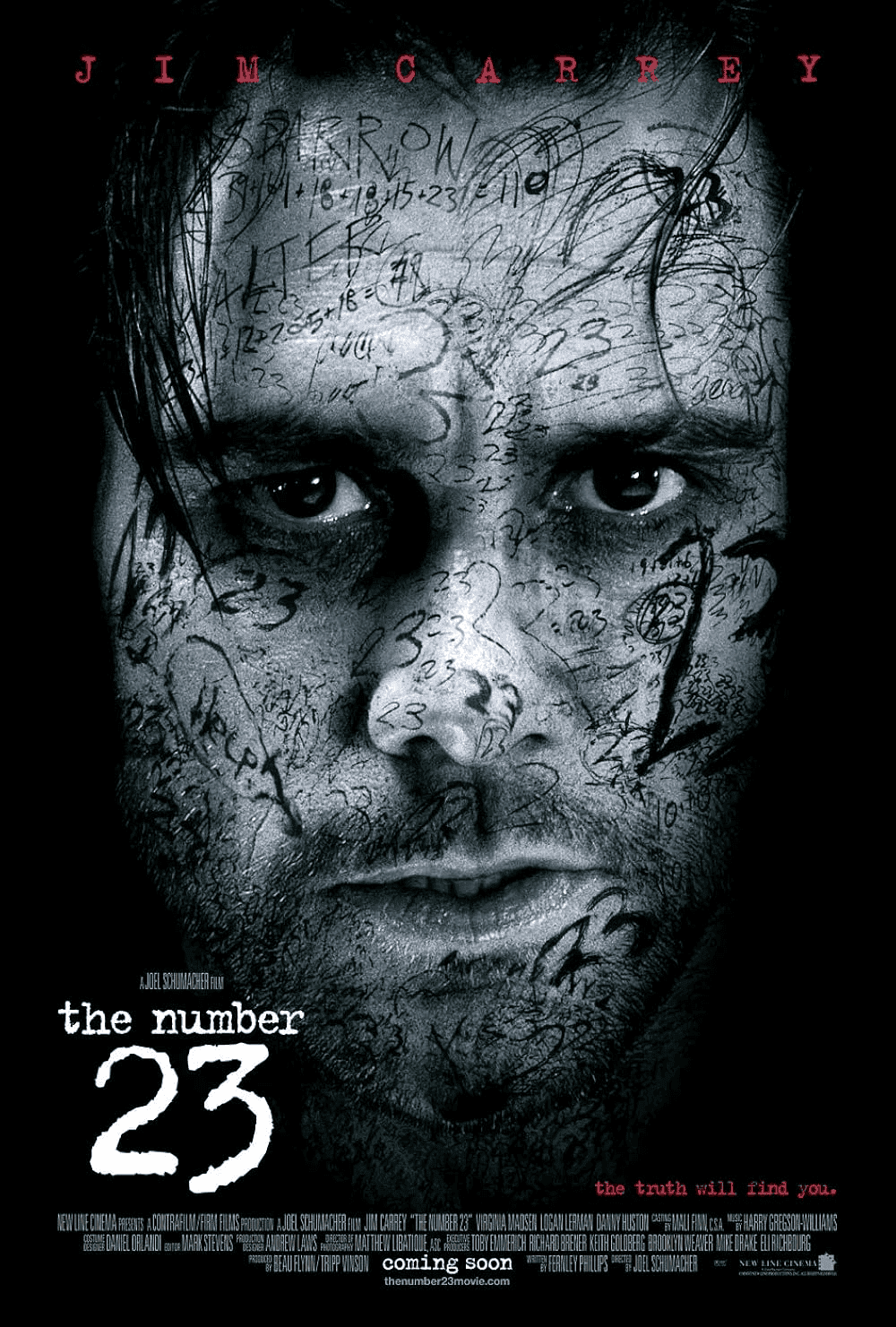
Walter Sparrow (Jim Carrey), an even-tempered dog catcher in suburban Los Angeles, receives a mysterious self-published novel called "The Number 23" from his wife Agatha (Virginia Madsen) as a birthday present. As he reads the book, Walter becomes increasingly convinced that its noir-thriller protagonist Fingerling mirrors his own life, and that the numerological obsession with the integer 23 that drives the novel's plot is also operating on his own past. His escalating paranoia threatens to consume his family, his sanity, and a buried memory he has spent his entire adult life trying to suppress.
What Is the Budget of The Number 23 (2007)?
The Number 23 (2007), directed by Joel Schumacher and distributed by New Line Cinema, was produced on a reported budget of $30,000,000. The psychological thriller marked Jim Carrey's most overt attempt to anchor a dark dramatic property in the mold of his earlier serious turns in The Truman Show (1998), Man on the Moon (1999), and Eternal Sunshine of the Spotless Mind (2004). Carrey personally championed the project after responding to Fernley Phillips' spec screenplay, which built its plot around the numerological paranoia surrounding the integer 23.
The $30,000,000 budget reflected New Line's confidence in Carrey's mid-2000s drawing power across both comedy and dramatic registers, but it was a measured commitment relative to his late-1990s peak studio fees. Joel Schumacher, working in his commercial-thriller register after Phone Booth (2002) and The Phantom of the Opera (2004), brought a director-of-record name without commanding tentpole compensation. The production assumed a worldwide gross of approximately $80,000,000 to $100,000,000 would clear profitability.
Key Budget Allocation Categories
The Number 23's reported $30,000,000 budget was distributed across these production areas:
- Above-the-Line Talent: Jim Carrey commanded the largest line item with a salary reportedly in the $5,000,000 to $8,000,000 range plus first-dollar gross participation, significantly below his peak Liar Liar and Bruce Almighty rates. Virginia Madsen, fresh off her Oscar nomination for Sideways (2004), played his wife at a supporting-lead rate. Logan Lerman, Danny Huston, Lynn Collins, and Rhona Mitra filled out the ensemble.
- Los Angeles Production: The film shot primarily in Los Angeles between March and June 2006, using practical locations including Universal Studios soundstages, suburban exteriors in Pasadena and Calabasas, and the Fingerling-novel interior sequences built on dressed studio stages.
- Dual-Visual-Style Cinematography: Cinematographer Matthew Libatique designed two distinct visual registers: a desaturated suburban present-day look and a stylized noir-pulp register for the Fingerling fictional-within-the-film scenes. The dual approach required separate lighting packages, lensing schemes, and post-production color pipelines.
- Visual Effects: A modest VFX line covered the dream-sequence inserts, the Fingerling chapter title cards, the numerological montage sequences, and the climactic graveyard reveal. Multiple smaller vendors split the work.
- Score and Music: Harry Gregson-Williams composed the score, working in his psychological-thriller register. The music budget covered original score, orchestra recording, and licensing of needle drops including a key Joy Division cue.
- Reshoots: After test screenings flagged the third-act reveal as confusing, New Line funded a brief reshoot in late 2006 to tighten the ending. The reshoot added marginal incremental cost.
How Does The Number 23's Budget Compare to Similar Films?
At $30,000,000, The Number 23 sits in the middle range of mid-2000s psychological thrillers:
- The Machinist (2004): Budget $5,000,000 | Worldwide $8,200,000. Brad Anderson's Christian Bale paranoia thriller cost a sixth of The Number 23 but earned only a tenth of its worldwide gross.
- Identity (2003): Budget $28,000,000 | Worldwide $90,300,000. James Mangold's John Cusack-Ray Liotta psychological thriller matched The Number 23's budget and out-grossed it worldwide.
- Hide and Seek (2005): Budget $30,000,000 | Worldwide $127,200,000. The contemporaneous Robert De Niro-Dakota Fanning psychological thriller matched the budget exactly and significantly outperformed worldwide.
- Stay (2005): Budget $50,000,000 | Worldwide $8,300,000. Marc Forster's Ewan McGregor-Naomi Watts psychological thriller cost significantly more and posted a catastrophic theatrical run.
- Mr. Brooks (2007): Budget $20,000,000 | Worldwide $48,600,000. The contemporaneous Kevin Costner serial-killer thriller offers a tight comparison point in genre and release year.
The Number 23 Box Office Performance
The Number 23 opened on February 23, 2007 (a deliberate date selection tied to the film's numerological premise), earning $14,602,438 over its three-day opening weekend and finishing first at the domestic box office for the frame. The opening exceeded analyst expectations for a dark mid-budget thriller carrying a comedic-star lead.
Against a reported production budget of $30,000,000, the film needed approximately $70,000,000 in worldwide gross to reach profitability. Here is the financial breakdown:
Box Office Breakdown
The Number 23

The Number 23 returned approximately $1.15 in worldwide theatrical revenue for every $1 invested. The domestic share of the gross was $35,193,167 against an international share of $42,438,998, a 45/55 split slightly favoring international markets that proved more receptive to the dark numerological premise than analysts had projected. The film cleared profitability on theatrical and recouped further on its DVD and Blu-ray runs.
Despite the modest commercial success, The Number 23 became a turning point in Carrey's leading-man trajectory. His subsequent dramatic projects either underperformed (I Love You Phillip Morris) or pivoted back to comedy (Yes Man, Mr. Popper's Penguins). The film also ranks as Joel Schumacher's last commercially viable mainstream theatrical release before his decline through Trespass (2011) and his death in 2020.
The Number 23 Production History
Fernley Phillips wrote the spec screenplay in 2005, drawing on the long-running pop-culture fascination with the 23 enigma, the numerological belief that the integer 23 appears with statistically significant frequency in important historical events. The script attracted Jim Carrey's attention through his manager, and Carrey attached as star and producer in late 2005. New Line Cinema acquired the project on the strength of Carrey's commitment.
Joel Schumacher attached to direct in early 2006, with Beau Flynn and Tripp Vinson producing through their Contrafilm banner. Casting Virginia Madsen as Carrey's wife Agatha grounded the project in adult-drama register following her Oscar-nominated Sideways turn. Logan Lerman (in an early role) played the couple's teenage son Robin. Danny Huston joined as Carrey's psychiatrist friend, with Lynn Collins playing the femme fatale Fabrizia in the Fingerling-novel sequences.
Principal photography ran from March to June 2006 in Los Angeles, primarily on Universal Studios soundstages with practical exteriors in Pasadena and Calabasas. After test screenings flagged the third-act revelation as confusing, New Line funded a brief reshoot in late 2006 to tighten the ending. The film opened on February 23, 2007, a release date chosen deliberately to align with the numerological premise.
Awards and Recognition
The Number 23 received no major awards recognition. The film registered no Oscar, Golden Globe, BAFTA, or Saturn Award nominations. It received two Razzie nominations: Worst Actor (Jim Carrey) and Worst Director (Joel Schumacher), but did not win in either category.
The Razzie nominations reflected the polarized critical reception more than any consensus on the film's quality. The film has been largely absent from awards conversation since its release, fitting within the broader pattern of Carrey's dramatic-thriller turns that registered commercially without translating to industry-awards visibility.
Critical Reception
The Number 23 received largely negative reviews. The film holds an 8% approval rating on Rotten Tomatoes based on 161 critic reviews, with a critical consensus that called the premise intriguing but the execution muddled. On Metacritic, the film scored 29 out of 100, indicating generally unfavorable reviews. Audiences surveyed by CinemaScore gave the film a B-, a typical mid-tier thriller floor.
Critics broadly praised Carrey's commitment to the dramatic register and the dual-visual approach of cinematographer Matthew Libatique, but objected to the script's reliance on a third-act revelation that several reviewers characterized as a cheat. Variety's Justin Chang wrote that the film "boasts a genuinely committed Carrey performance trapped in a screenplay that ultimately fails to honor its own premise." Roger Ebert wrote in the Chicago Sun-Times that "the film is intriguing for about 30 minutes, then becomes a problem."
The polarized reception, combined with the modest commercial success, has cemented The Number 23's reputation as a curiosity within Carrey's filmography. The film is more frequently discussed today through retrospective coverage of his dramatic ambitions than through any critical reassessment of its merits.
Frequently Asked Questions
How much did it cost to make The Number 23 (2007)?
The reported production budget was $30,000,000. The film was produced by Beau Flynn and Tripp Vinson through their Contrafilm banner together with Jim Carrey's Firm Films, and distributed by New Line Cinema.
How much did The Number 23 earn at the box office?
The film grossed $35,193,167 domestically and $42,438,998 internationally for a worldwide total of $77,632,165. It opened to $14,602,438 over its February 23, 2007 weekend (a release date chosen deliberately to align with the numerological premise), finishing first at the domestic box office for the frame.
Was The Number 23 profitable?
Yes, marginally. Against a $30,000,000 production budget and approximately $30,000,000 to $40,000,000 in marketing costs, the film returned approximately $1.15 in worldwide theatrical revenue for every $1 invested. It cleared profitability on theatrical and recouped further on its DVD and Blu-ray runs.
Who directed The Number 23?
Joel Schumacher directed the film, working in his commercial-thriller register after Phone Booth (2002) and The Phantom of the Opera (2004). The screenplay was written by Fernley Phillips as an original spec. It was Schumacher's last commercially viable mainstream theatrical release.
Where was The Number 23 filmed?
Principal photography ran from March to June 2006 in Los Angeles, primarily on Universal Studios soundstages with practical exteriors in Pasadena and Calabasas. New Line funded a brief reshoot in late 2006 to tighten the third act after test screenings flagged the ending as confusing.
Who stars in The Number 23?
Jim Carrey stars as Walter Sparrow with Virginia Madsen as his wife Agatha. Logan Lerman plays their teenage son Robin in an early role. Danny Huston, Lynn Collins, Rhona Mitra, Mark Pellegrino, and Ed Lauter fill out the ensemble. Cinematographer Matthew Libatique designed the dual visual register.
What is the 23 enigma in The Number 23?
The 23 enigma is the numerological belief that the integer 23 appears with statistically significant frequency in important historical events and personal lives. The premise traces back to William S. Burroughs in the 1960s and was popularized through Robert Anton Wilson's Illuminatus! trilogy. The film builds its plot around the obsession.
What did critics think of The Number 23?
The film received largely negative reviews, with an 8% Rotten Tomatoes score based on 161 critics and a 29 Metacritic score. Critics praised Carrey's committed performance but objected to the screenplay's reliance on a third-act revelation many reviewers characterized as a cheat. Audiences gave the film a B- CinemaScore.
Did The Number 23 win any awards?
No. The film received no major industry-awards nominations and was nominated for two Razzies (Worst Actor for Jim Carrey and Worst Director for Joel Schumacher), but did not win in either category.
How does The Number 23 fit in Jim Carrey's career?
The Number 23 was a turning point in Carrey's leading-man trajectory. His subsequent dramatic projects either underperformed (I Love You Phillip Morris) or pivoted back to comedy (Yes Man, Mr. Popper's Penguins). The film stands as his last successful mid-budget dramatic-thriller lead.
Filmmakers
The Number 23

Build budgets like this one in Saturation
Start from an industry-standard feature film template, import the schedule and rates you already have, and let the cost report keep itself current as you spend. Real-time collaboration, no spreadsheets.