The Motel Budget
Updated
Synopsis
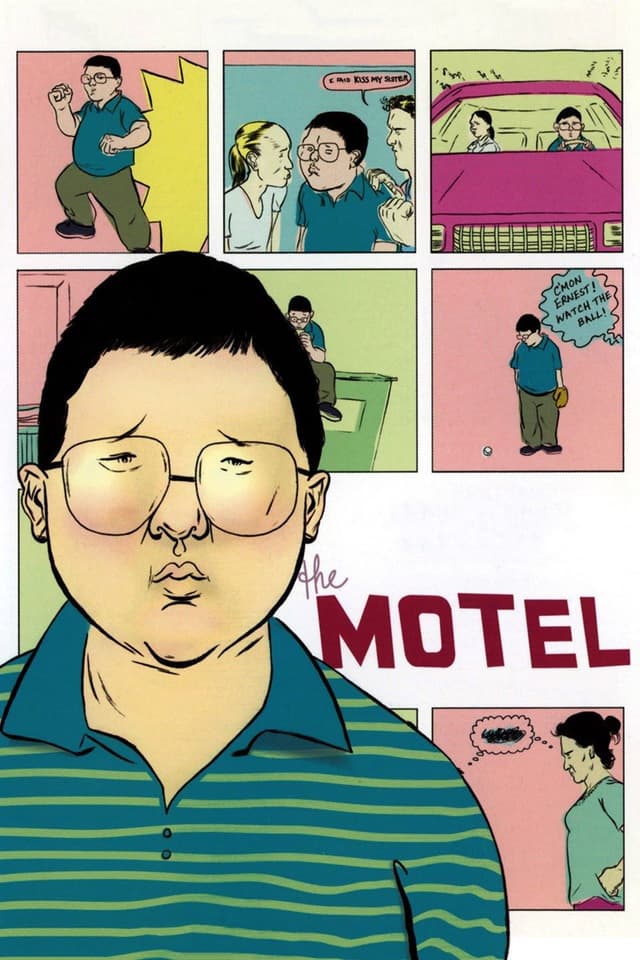
Thirteen-year-old Ernest Chin lives with his mother, grandfather and younger sister at the hourly-rate motel his family runs on a desolate stretch of suburban highway, where he does the cleaning, mans the front desk and works through adolescence in the least private building in town. When Sam Kim, a charismatic and self-destructive Korean-American guest, checks in and stays, he takes the fatherless boy under his wing and starts teaching him a version of manhood that Ernest is in no position to question. Michael Kang's feature debut, adapted from Ed Lin's novel Waylaid, premiered at the 2005 Sundance Film Festival.
What Is the Budget of The Motel?
The Motel (2005), written and directed by Michael Kang in his feature debut, was made for a production budget of $250,000. At a quarter of a million dollars, The Motel sits in the bracket where a first feature is financed by grants, deferrals and favors rather than by a studio, and the film was produced independently through Flan de Coco Films with no studio money behind it.
The script came out of the 2002 Sundance Writing and Directing Labs, where Kang developed his adaptation of Ed Lin's novel Waylaid under the mentorship of Miguel Arteta. Arteta then produced the finished film alongside Karin Chien, Matthew Greenfield and Gina Kwon. That path matters to the budget in a way a line item never shows: the development work that would normally be paid for was done inside a non-profit lab, and the producer attached to it arrived through the same room. The film premiered at the Sundance Film Festival on January 24, 2005, and did not reach American cinemas until June 28, 2006, seventeen months later.
Key Budget Allocation Categories
A $250,000 negative cost leaves no room for a second unit, a name cast or a long schedule. The Motel spends what it has on the few things a 76 minute character piece cannot fake:
- One Practical Location, Playing Itself: The film was shot in Poughkeepsie, New York, with the town deliberately left unidentified on screen, as Variety's Joe Leydon noted in his Sundance review. The hourly-rate motel is the entire world of the picture: Ernest lives, works, eats and grows up inside it. A single standing location that doubles as the set, the production office and the story's only geography is the structural decision that makes the rest of the budget possible.
- A Six Month Casting Search Instead of a Casting Fee: Kang and casting director Susan Shopmaker spent half a year looking for the boy who plays Ernest, and found Jeffrey Chyau through an after school program. Kang told the International Examiner in September 2006: "It took about six months to find him. We were actively searching for him on the streets of Chinatown and in every after school program." Search time is cheap in cash and expensive in calendar, which is exactly the trade a $250,000 film has to make.
- One Recognizable Name in the Supporting Role: Sung Kang plays Sam Kim, the charismatic and self-destructive guest who becomes Ernest's accidental mentor. Kang came to the film off Better Luck Tomorrow (2002), which had been bought out of Sundance by MTV Films two years earlier, and he is the only performer on the call sheet with a prior theatrical credit of any size. At this budget a single known face is not a marketing plan, it is the whole above-the-line strategy.
- Post-Production, Where This Film Actually Went Long: Two editors are credited, David Leonard and Colleen Sharp, and Kang told Greg Pak in a June 2006 interview that on the cut "We spent over a year working on it." More than twelve months of editing on a 76 minute feature is the single largest schedule commitment in the production, and on a film this size it is bought with deferred time rather than with weekly facility rates.
- Camera and Score: Lisa Leone shot the film and Nathan Larson wrote the score. Both are the kind of departments that a micro-budget coming-of-age picture cannot economize on without the result looking like what it cost, and the critical response to the film's texture suggests the money went to the right places.
How Does The Motel's Budget Compare to Similar Films?
The useful comparisons for The Motel are not studio films but the other American independents that came out of Sundance in the same era at the same scale, including the four features it ran against for the Independent Spirit Award for Best First Feature:
- Better Luck Tomorrow (2002): Budget $250,000 | Worldwide $3,809,226. Justin Lin's film was made for the identical figure and, picked up by Paramount out of Sundance and expanded to 387 theaters, returned roughly seventy-four times what The Motel did. The two films share a budget, a festival, and Sung Kang; what separates their box office is distribution scale, not production spend.
- Finishing the Game (2007): Budget $500,000 | Worldwide $53,570. Lin's follow-up cost twice as much and grossed $2,030 more, on a near-identical release pattern of one opening theater expanding to five. It is the closest financial twin The Motel has, and the pair together describe what a small distributor's platform release was worth in this period.
- Wristcutters: A Love Story (2006): Budget $1,000,000 | Worldwide $473,769. A fellow nominee in the same Spirit Award category, made for four times the money and grossing roughly nine times as much across a run that reached 91 theaters. It still recovered under half its negative cost theatrically, which is the ordinary outcome in this bracket rather than the exception.
- Sweet Land (2006): Budget not publicly reported | Domestic $1,706,325. The film that won Best First Feature over The Motel opened in two theaters and expanded to 47, averaging 12.2 weeks per theater. Its patient, long-legged rollout is the outcome a platform release is designed to produce, and the one The Motel never got.
- Man Push Cart (2006): Budget not publicly reported | Domestic $36,608. Ramin Bahrani's debut, nominated in the same category, played a single theater and never expanded. It grossed less than The Motel on a comparable release, which puts The Motel's $51,540 in its real context: unremarkable in isolation, entirely normal for the tier.
- Drifter (2026): Budget not disclosed | Worldwide not yet reported. Two decades on, Sung Kang's own second feature as a director was financed from inside the drifting community rather than by a studio, on the same principle The Motel ran on.
The Motel Box Office Performance
The Motel earned $51,540 in North America, with no international gross reported, so that figure is also the worldwide total. Palm Pictures opened the film on June 28, 2006 in a single theater, where it took $7,100 in its opening weekend, and the release never widened beyond a maximum of four theaters across an average run of five weeks per screen. Kang was clear about what that meant at the time, telling the International Examiner: "When you have a modest distribution company like Palm Pictures that can't afford to open the film in hundreds of screens across the country, you have to rely on the word of mouth."
Box Office Breakdown
The Motel (2005)

No prints and advertising spend has ever been reported for the release. The standard method of estimating P&A from a theater count assumes a wide release where the marketing buy scales with the number of screens; applied to a film that opened in one theater and peaked at four, it produces a number smaller than the cost of the posters. Without a P&A figure there is no total investment to measure against, so net return and return on investment cannot be calculated. The opening weekend represented 13.8 percent of the eventual gross, and the film played out over roughly five weeks per theater, which is a long tail by the standards of a four-screen release and a rounding error by any other.
The two known figures do support a simple ratio: the worldwide box office is 0.2 times the production budget. The Motel recovered about a fifth of its $250,000 negative cost in cinemas, which for a 76 minute coming-of-age drama on four screens was never the measure the film was going to be judged by.
The Motel Production History
The film began as a friendship rather than an option. Kang knew the novelist Ed Lin before Waylaid was a novel at all, telling the International Examiner: "I actually was friends with Ed Lin back when the book was still just a short story. I was really struck by the themes that the setting allowed for." Kang has described the two works as separate treatments of the same material rather than a straight adaptation: "The two are like Rashomon companion pieces. We each deal with the subject of sexuality with unique voices and attitudes."
The setting was the premise. Kang has said he was "inspired by the idea of exploring the worst place to go through puberty. A sleazy motel surrounded by sex seemed about the worst possible setting." He developed the script at the 2002 Sundance Writing and Directing Labs with Miguel Arteta as his mentor, and Arteta stayed with the project through to production, taking a producer credit alongside Karin Chien, Matthew Greenfield and Gina Kwon. Flan de Coco Films produced.
Casting the lead took six months of searching after school programs and the streets of Chinatown before Jeffrey Chyau was found, and the role of Sam Kim went to Sung Kang, then two years past Better Luck Tomorrow. Jade Wu plays Ernest's mother and Samantha Futerman plays Christine, the girl at the neighboring Chinese restaurant. Lisa Leone shot the film in Poughkeepsie, New York, with the town's identity kept off screen. Editing ran more than a year across two cutters.
The gap between the January 2005 Sundance premiere and the June 2006 release is the part of the story the numbers do not tell. Seventeen months passed between a well-received festival debut and four theaters, and in that window the film accumulated the festival prizes and the Spirit Award nomination that now define it. For Sung Kang the film became an early marker in a run of independent work that continued through Snakehead (2021), in which he plays Rambo, before he moved behind the camera himself with Shaky Shivers (2022), and on to Weekend in Taipei (2024), in which he plays the cartel leader Kwang.
Awards and Recognition
The Motel was nominated for Best First Feature at the 22nd Independent Spirit Awards, the ceremony honoring 2006 releases. It lost to Ali Selim's Sweet Land, and was nominated alongside Julia Loktev's Day Night Day Night, Ramin Bahrani's Man Push Cart and Goran Dukic's Wristcutters: A Love Story. For a film that played four theaters, a place on that ballot was the most substantial recognition available to it.
It also won the Humanitas Prize in the Independent Feature Film category and the NHK International Filmmakers Award, and it took the top jury prize for narrative feature at three of the major Asian American festivals: the San Francisco International Asian American Film Festival, the San Diego Asian Film Festival, and the Los Angeles Asian Pacific Film Festival, then known as the VC Film Festival. Three top jury prizes across that circuit in a single year is an unusually clean sweep.
The film's standing has held up. In 2019 the Los Angeles Times placed The Motel at number 18 on its list of the 20 best Asian American films of the preceding two decades, describing it as a "Sundance charmer" that "follows a 13-year-old boy's misadventures growing up in a locale all too familiar to many Asian American immigrants: the family-run motel."
Critical Reception
The Motel holds an 88 percent score on Rotten Tomatoes from 32 reviews, with a critics consensus reading: "A coming-of-age dramedy whose familiar outline is filled in with rewarding empathy and character detail, The Motel marks an impressive feature debut for writer-director Michael Kang." The audience score stands at 64 percent. On Metacritic the film carries a Metascore of 70 from 16 reviews, in the generally favorable band, with no negative reviews recorded: 14 of the 16 were positive and two were mixed.
Stephen Holden of The New York Times, who scored the film 80 on Metacritic, called it "Michael Kang's small, perfectly observed portrait of a Chinese-American boy" that "captures the glum desperation of inhabiting the biological limbo of early adolescence." Joe Leydon wrote in Variety that the film "signals arrival of a singularly promising filmmaker." Ty Burr of the Boston Globe wrote that "Kang breaks no new narrative ground here, and that's OK; his portrayal of ethnic discombobulation is fresh and freshly seen," and elsewhere that the film "gives the lie to all those mainstream teen sex comedies starring happy, horny gwailos."
Elizabeth Weitzman of the New York Daily News wrote that "unlike so many indie films, Michael Kang's gently empathetic debut embraces eccentricity without drowning in its own hip irony," and Jeff Shannon of the Seattle Times called it "a modest triumph of unflattering realism." The most reserved notice among the scored reviews came from Michael Atkinson of the Village Voice at 40. Other Metacritic scores included Ken Fox of TV Guide at 88, G. Allen Johnson of the San Francisco Chronicle and V.A. Musetto of the New York Post at 75 each, and Tim Grierson of L.A. Weekly and Eric Campos of Film Threat at 70. There is no CinemaScore for the film, as the service polls opening-night audiences at wide releases and The Motel never played more than four theaters.
Frequently Asked Questions
How much did The Motel (2005) cost to make?
The production budget was $250,000. The film was produced independently through Flan de Coco Films with no studio financing, from a script Kang developed at the 2002 Sundance Writing and Directing Labs. At that level the money goes to a single standing location, a 76 minute cut and a cast of almost entirely unknown performers.
How much did The Motel make at the box office?
The Motel grossed $51,540 in North America, with no international gross reported, so that is also the worldwide total. Palm Pictures opened it on June 28, 2006 in a single theater for an opening weekend of $7,100, which was 13.8 percent of the eventual gross, and the release peaked at four theaters with an average run of five weeks per screen. No prints and advertising spend was ever reported, so total investment, net return and return on investment cannot be calculated for this title.
Who directed The Motel and who stars in it?
Michael Kang wrote and directed it as his feature debut, adapting Ed Lin's novel Waylaid. Jeffrey Chyau stars as thirteen-year-old Ernest Chin and Sung Kang plays Sam Kim, the motel guest who befriends him, with Jade Wu as Ernest's mother, Samantha Futerman as Christine and Alexis Chang as his sister Katie. Miguel Arteta, Karin Chien, Matthew Greenfield and Gina Kwon produced, Lisa Leone was the cinematographer, Nathan Larson wrote the score, and David Leonard and Colleen Sharp edited.
Where was The Motel filmed?
The film was shot in Poughkeepsie, New York, though the town is deliberately never identified on screen, a choice Variety's Joe Leydon noted in his review out of Sundance. The hourly-rate motel functions as the film's only real geography: Ernest lives there, works there and grows up there, and the single practical location is the structural decision that makes a $250,000 budget workable. Editing then ran more than a year, which Kang described in a 2006 interview as spending over a year working on the cut.
What awards did The Motel win?
It won the Humanitas Prize in the Independent Feature Film category and the NHK International Filmmakers Award, and took the top narrative feature jury prize at the San Francisco International Asian American Film Festival, the San Diego Asian Film Festival and the Los Angeles Asian Pacific Film Festival. It was nominated for Best First Feature at the 22nd Independent Spirit Awards, losing to Sweet Land alongside fellow nominees Day Night Day Night, Man Push Cart and Wristcutters: A Love Story. In 2019 the Los Angeles Times ranked it eighteenth among the 20 best Asian American films of the previous two decades.
What did critics say about The Motel?
Reviews were strongly positive. Rotten Tomatoes reports 88 percent from 32 critics, with a consensus calling it an impressive feature debut whose familiar outline is filled in with rewarding empathy and character detail, and Metacritic carries a Metascore of 70 from 16 reviews with no negative notices. Stephen Holden of The New York Times praised its portrait of a Chinese-American boy in the biological limbo of early adolescence, and Joe Leydon wrote in Variety that it signaled the arrival of a singularly promising filmmaker. Michael Atkinson of the Village Voice was the most reserved at 40.
Filmmakers
The Motel (2005)

Official Trailer
Build budgets like this one in Saturation
Start from an industry-standard feature film template, import the schedule and rates you already have, and let the cost report keep itself current as you spend. Real-time collaboration, no spreadsheets.