Kingpin Budget
 Comedy
Updated
Synopsis
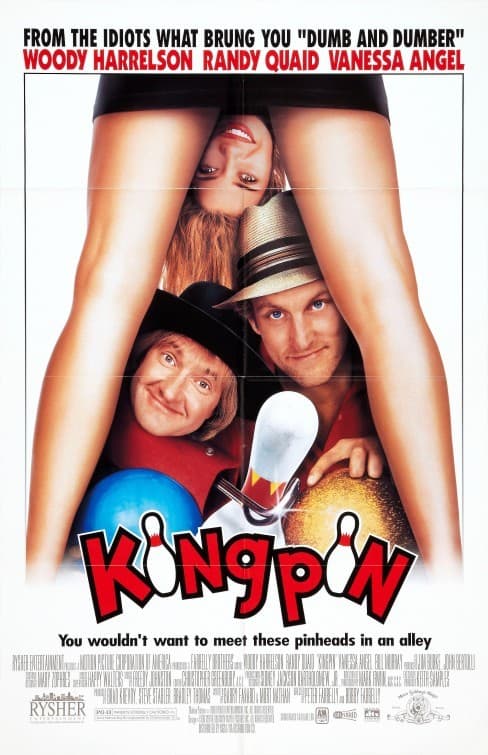
"Kingpin" is a 1996 comedy film directed by the Farrelly brothers, featuring a blend of outrageous humor and heartfelt moments. The story follows Roy Munson, played by Woody Harrelson, a once-promising bowler whose career takes a nosedive after a disastrous match against a ruthless competitor. Years later, he encounters a talented but naive Amish bowler named Ishmael, portrayed by Randy Quaid. Together, they embark on a cross-country journey to compete in a high-stakes bowling tournament, hoping to reclaim Roy's lost glory. Along the way, they face a series of comedic misadventures, including encounters with eccentric characters and the looming threat of Roy's former rival. Ultimately, "Kingpin" explores themes of redemption, friendship, and the pursuit of dreams, all wrapped in a hilariously chaotic package.
What Is the Budget of Kingpin?
Kingpin (1996) was made on a production budget of $25 million, financed by the Motion Picture Corporation of America and distributed by MGM/UA. That figure placed it in the mid-tier range for studio comedies of the mid-1990s, notably higher than the Farrelly Brothers' debut Dumb and Dumber, which cost around $17 million two years earlier. The increased budget reflected the Farrellys' growing leverage after Dumb and Dumber's strong performance, as well as the costs of assembling a cast that included Woody Harrelson, Randy Quaid, Vanessa Angel, and Bill Murray.
The film opened in July 1996 and earned $24.6 million domestically, falling short of its production costs at the theatrical window. However, Kingpin became one of the clearest examples of the home video era transforming a theatrical disappointment into a long-term profitable property, generating substantial revenue through VHS rentals and cable licensing through the late 1990s and into the 2000s.
Key Budget Allocation Categories
- Cast and Above-the-Line Talent: Woody Harrelson carried the lead role of Roy Munson, a physically demanding performance requiring him to wear a prosthetic rubber hand throughout the entire shoot. Randy Quaid and Vanessa Angel rounded out the main cast, but the largest single above-the-line variable was Bill Murray, whose star billing and reported on-set improvisation added premium value. Combined above-the-line talent likely consumed $8 to $11 million of the $25 million budget.
- Locations and Production Logistics: Principal photography took place in Roanoke, Virginia, supplemented by Pennsylvania Dutch Country for the Amish sequences and the Pittsburgh area for bowling tournament exteriors. Filming across three distinct regional settings required significant company moves, location fees, and extended crew accommodations, which would have represented a meaningful portion of the physical production budget.
- Practical Effects and Prosthetics: Rather than relying on CGI, Kingpin's visual comedy depended heavily on practical effects. Harrelson's prosthetic right hand had to function convincingly across dozens of scenes, including bowling sequences. The rubber appliance required custom fabrication and ongoing maintenance throughout the shoot. The film's comedic set pieces, from slapstick gags to the climactic tournament scenes, were executed practically, adding to the production design and art department costs.
- Soundtrack and Music Licensing: Kingpin featured an eclectic soundtrack that leaned into its mid-1990s Midwest setting, with music by singer-songwriter Freedy Johnston and a mix of licensed tracks. Clearing rights for period-appropriate music and original compositions contributed to post-production costs.
How Does Kingpin's Budget Compare to Similar Films?
Kingpin's $25 million budget placed it in a competitive tier for mid-1990s studio comedies. The following films provide useful context for understanding how the Farrellys were positioned against their peers and their own earlier work.
- Dumb and Dumber (1994): Budget $17M | Worldwide $247M. The Farrellys' debut grossed more than 14 times its budget, cementing their reputation and directly enabling the increased budget they received for Kingpin two years later.
- There's Something About Mary (1998): Budget $23M | Worldwide $369M. Made just two years after Kingpin on a comparable budget, Mary became the film that transformed the Farrellys into A-list directors and demonstrated the ceiling for their brand of comedy when the marketing landed perfectly.
- Happy Gilmore (1996): Budget $12M | Worldwide $41M. Released the same year as Kingpin, Adam Sandler's sports comedy was made for less than half the cost and earned a comparable worldwide gross, illustrating how the comedy market of the mid-1990s rewarded lean productions as readily as mid-budget ones.
- BASEketball (1998): Budget $23M | Worldwide $7.4M. A similarly irreverent sports comedy from the same era that struggled far more at the box office, confirming that Kingpin's modest theatrical return was not unusual for the genre, and that audience word-of-mouth through home video could rehabilitate a box office disappointment.
Kingpin Box Office Performance
Kingpin opened on July 26, 1996, distributed by MGM/UA Distribution. It earned $24,603,585 domestically and approximately $35 million worldwide against its $25 million production budget. The domestic opening weekend was underwhelming relative to studio expectations, and the film exited theaters before reaching break-even on the theatrical window alone.
To break even theatrically, Kingpin needed to generate roughly $75 million worldwide after factoring in a $12 million estimated prints and advertising spend and the approximately 50% theatrical revenue split with exhibitors. At $35 million worldwide, the studio's share was approximately $17.5 million, well short of covering the combined $37 million production and marketing investment. The film became profitable through home video and cable, not the box office.
Box Office Breakdown
Kingpin

On production budget alone, the theatrical run returned roughly $0.70 for every $1 invested. Once P&A is factored in, the theatrical-only picture was a loss. The film's long-term profitability came from home video rentals, cable licensing, and eventually digital distribution, where its cult following drove sustained revenue well into the 2000s.
Kingpin Production History
Kingpin originated as an original screenplay by Barry Fanaro and Mort Nathan, two writers known primarily for television work including The Golden Girls. Bobby and Peter Farrelly were attached to direct after the commercial success of Dumb and Dumber gave them leverage to greenlight their next project. The Motion Picture Corporation of America co-financed, with MGM/UA securing distribution rights for domestic theatrical release.
Casting centered on Woody Harrelson, then known primarily for his television work on Cheers and his film roles in White Men Can't Jump and Natural Born Killers. Randy Quaid was brought in for the role of Ishmael, the Amish bowling prodigy. Vanessa Angel played Claudia, Roy's love interest. Bill Murray's casting as the villainous Ernie McCracken was the late addition that elevated the film's comedic ceiling significantly.
Principal photography took place in Roanoke, Virginia, with the production moving to Pennsylvania Dutch Country for the Amish community sequences and to the Pittsburgh area for the bowling tournament exteriors. Cinematographer Mark Irwin shot the film, bringing a naturalistic visual style that contrasted with the film's increasingly absurd comedy. The production is widely reported to have been a congenial set, with Murray's improvisational approach during his scenes energizing the cast.
The film was released on July 26, 1996, entering a crowded summer marketplace. The opening weekend did not meet studio expectations, and Kingpin never gained the box office traction needed to recoup its theatrical costs. MGM/UA moved the film to home video release in early 1997, where it immediately found a receptive audience. Cable airings on HBO and Cinemax through the late 1990s introduced the film to millions of viewers who had missed it theatrically, establishing the cult following it retains today.
Awards and Recognition
Kingpin received no major awards recognition from the Academy Awards, Golden Globes, or Critics' Choice, which was consistent with the mainstream critical dismissal the film received on release. However, it did earn recognition from the MTV Movie Awards, where Bill Murray won Best Villain for his role as Ernie McCracken. The MTV recognition was notable because it acknowledged Murray's performance for exactly what made it memorable: its gleeful, swaggering commitment to villainy.
In the years since its release, Kingpin has earned broader critical reappraisal. It is frequently cited by comedy writers and directors as an underrated gem of 1990s comedy filmmaking, and is consistently included on lists of the best bowling movies ever made. The film's reputation has grown significantly as Murray's performance has been recognized in retrospect as one of his funniest supporting turns of the decade.
Critical Reception
Kingpin holds a 62% approval rating on Rotten Tomatoes, reflecting the divided critical response it received in 1996. The split was fairly clean: critics who appreciated the Farrelly Brothers' anarchic sensibility found the film genuinely funny, while those put off by gross-out comedy dismissed it outright. Roger Ebert gave the film 2.5 out of 4 stars, praising Murray's performance while finding the overall film uneven.
Audience reception was warmer than the critical consensus suggested, and word-of-mouth on home video was strongly positive. The film built a devoted fanbase through cable television in the late 1990s that persists today. Contemporary reassessments have been considerably more generous, with many critics who revisited the film acknowledging that it holds up as one of the more inventive comedies of its era, with Harrelson, Quaid, and Murray all delivering performances that reward repeat viewing.
Frequently Asked Questions
How much did Kingpin (1996) cost to make?
The production budget was $27,000,000. MGM/UA produced the bowling comedy, with the Farrelly Brothers given a substantially larger budget than their breakout Dumb and Dumber (1994, $17,000,000 budget).
How much did Kingpin earn at the box office?
The film grossed $25,022,648 domestically against limited international reporting, for a worldwide total of approximately $25,000,000. It opened to $7,089,000 on July 26, 1996, finishing fourth behind A Time to Kill, Phenomenon, and Independence Day in its fifth week of dominance.
Who directed Kingpin?
Peter and Bobby Farrelly directed the film, their second feature after Dumb and Dumber (1994). The brothers went on to direct There's Something About Mary (1998), which grossed $369,900,000 worldwide against a $23,000,000 budget.
Who stars in Kingpin?
Woody Harrelson stars as Roy Munson, a one-handed bowler. Bill Murray plays the villainous Ernie McCracken, Randy Quaid plays Amish bowling prodigy Ishmael Boorg, and Vanessa Angel plays Claudia. Chris Elliott appears in a memorable cameo as Stanley Osmanski.
Where was Kingpin filmed?
Principal photography took place in Pittsburgh, Pennsylvania, with bowling alley sequences shot at the Galleria Lanes and the Reno-Sparks Convention Center for the climactic tournament. The Amish sequences were filmed in Lancaster County, Pennsylvania.
Was Bill Murray's comb-over real in Kingpin?
Bill Murray's elaborate comb-over hairpiece became one of the most cited prosthetic creations of 1990s comedy. The look took approximately two hours to apply each shooting day and was developed in collaboration with hair designer Yolanda Toussieng.
What did critics think of Kingpin?
Reviews at release were mixed, with a 56% approval rating on Rotten Tomatoes reflecting the period's split between critics objecting to crass humor and those embracing the Farrellys' anti-hero comedy. The film's critical reputation has grown substantially in subsequent years, and it is now widely cited as a cult classic.
Was Kingpin a box office bomb?
Yes, in theatrical terms. Against the $27,000,000 production budget and an estimated $15,000,000 to $20,000,000 in marketing spend, the domestic gross of $25,022,648 represented a clear theatrical loss for MGM/UA. Strong home video, cable, and later streaming revenue brought the film into eventual profit and built its cult following.
How does Kingpin compare to other Farrelly Brothers films?
Kingpin underperformed compared with both Dumb and Dumber (1994, $17,000,000 budget, $247,300,000 worldwide) and the follow-up There's Something About Mary (1998, $23,000,000 budget, $369,900,000 worldwide). Despite the commercial disappointment, the brothers consider it one of their strongest screenplays.
Where can I stream Kingpin?
The film is available for digital rental and purchase on Amazon Prime Video, Apple TV, and Google Play. It has periodically rotated through Paramount+, Hulu, and other subscription services through the MGM library deals.
Official Trailer
Build budgets like this one in Saturation
Start from an industry-standard feature film template, import the schedule and rates you already have, and let the cost report keep itself current as you spend. Real-time collaboration, no spreadsheets.